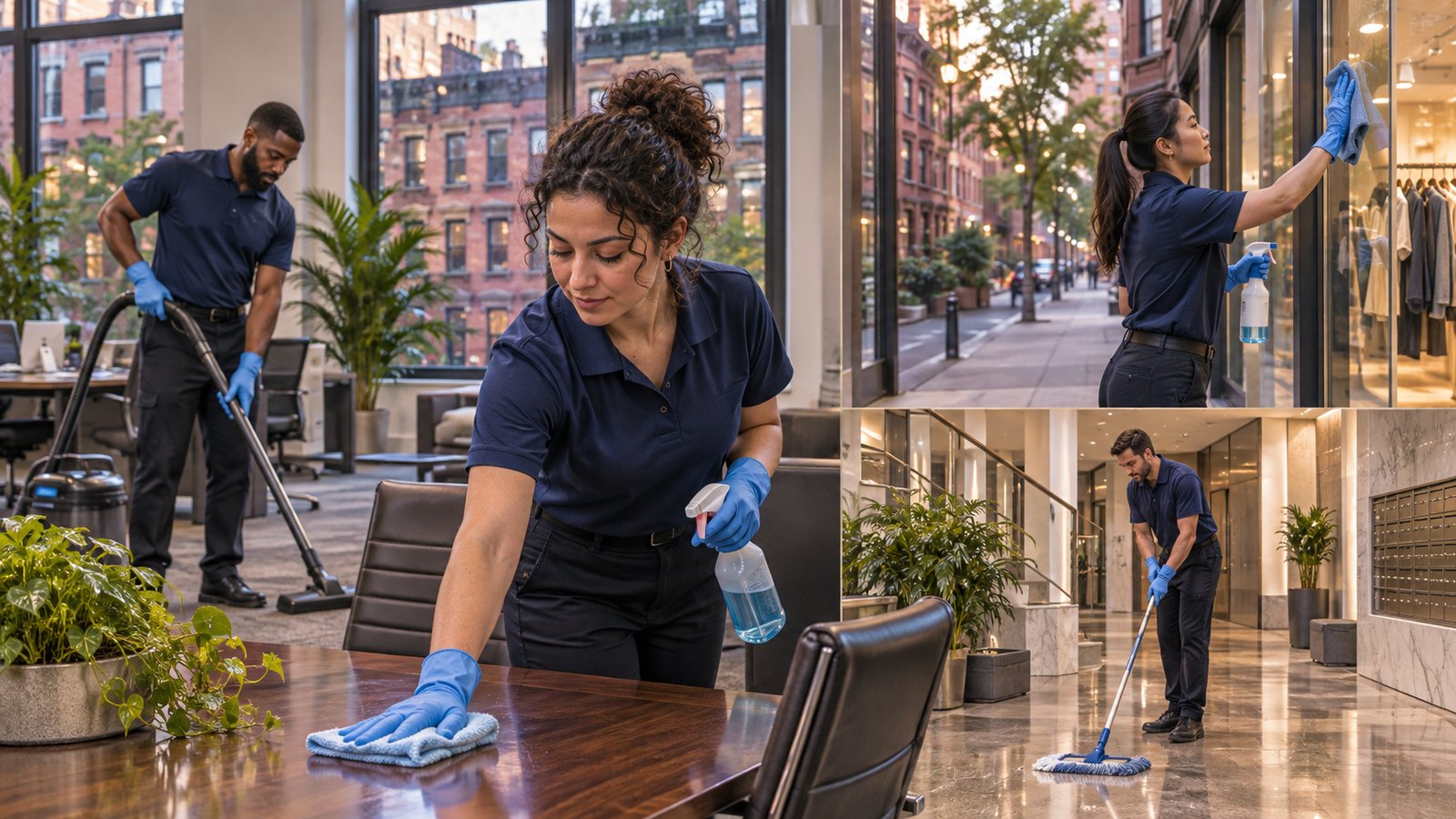
Park Slope's commercial properties range from neighborhood storefronts and restaurants to medical practices, nonprofit offices, schools, and brownstone or apartment common areas. A cleaning vendor must work around residents, customers, deliveries, and transit-driven peaks without leaving a generic checklist behind. The best service plan begins with the exact rooms, finishes, hours, and access conditions at the property. GreenPoint Maintenance Services provides commercial janitorial programs for organizations that want fixed pricing and documented quality. This guide helps Park Slope buyers compare vendors, set a realistic scope, and decide which proof of service belongs in a monthly review.
Identify the property type and its highest-visibility spaces
A small office near Seventh Avenue does not need the same route as a busy clinic, restaurant, or shared lobby near Flatbush Avenue. Inventory entrance glass, waiting areas, conference rooms, workstations, staff kitchens, restrooms, stairs, elevators, and waste points. Note floor materials and sensitive surfaces, plus rooms that require separate authorization. A simple space schedule can distinguish daily tasks from weekly or monthly detail work. GreenPoint Maintenance Services uses a site walkthrough to map those responsibilities before proposing a frequency, helping avoid the familiar gap where everyone assumes another vendor is cleaning the stairwell.
Estimate activity by more than square feet. A 2,000-square-foot suite with two restrooms and frequent visitors may need more attention than a larger office with mostly desk work and fewer shared areas. Count fixtures, entrances, waste points, and occupant turnover; describe peak hours and event schedules. Separate routine janitorial service from periodic floor care, window washing, and post-construction cleaning. To request a Park Slope walkthrough and fixed-price proposal, call GreenPoint at 347-332-9348 and share the building's operating hours and must-have tasks.
Account for Seventh Avenue, Fifth Avenue, and transit-driven traffic
Seventh Avenue and Fifth Avenue support dense retail and service activity, while nearby stations on the F and G trains and Atlantic Avenue-Barclays Center bring people through the surrounding streets. On wet or snowy days, grit and moisture collect at entrances; during evening rush, lobby and restroom use may continue after a business's last appointment. Build the route around these practical patterns. Place entry matting where permitted, include threshold and glass checks, and clarify when a daytime touch-up is needed rather than expecting a single after-hours visit to solve every peak-period issue.
Park Slope buildings can have narrow hallways, shared residential doors, limited freight access, and quiet-hour requirements. Before service starts, identify the authorized entrance, elevator rules, alarm procedure, supply storage, and secure disposal points. For a multi-tenant building, decide whether the property manager or each tenant reports missed work. GreenPoint Maintenance records the agreed entry plan and escalation contact so service coordination does not depend on a cleaner guessing what to do when a door is locked or a room is occupied.
Ask the building manager to identify quiet-hour, elevator, recycling, and waste-room requirements in writing. A crew working in a brownstone conversion or mixed-use property may pass through residential corridors on its way to a commercial suite, so floor protection and door security matter as much as the visible cleaning. If tenants have staggered hours, define which rooms can be entered on each service night and how cleaners handle a meeting or appointment that runs late. GreenPoint Maintenance can include these instructions in a site orientation, reducing interruptions and helping the customer distinguish an access delay from an incomplete visit.
Define what done means in a written cleaning specification
Use observable tasks: remove waste from named bins, wipe accessible horizontal surfaces, spot-clean glass, clean listed restroom fixtures, and vacuum or damp-mop the identified floor areas. State what is excluded, such as personal papers, computer screens, high windows, medical devices, and locked rooms. Specify whether the customer or cleaner supplies soap, paper products, liners, and hand sanitizer. Documenting the exact service frequency and change-order process makes it easier to resolve questions fairly. GreenPoint Maintenance Services offers fixed pricing based on the agreed scope rather than charging by the hour with hidden add-ons.
The questions to ask a commercial cleaning company article offers a vendor interview checklist, and the quality assurance commercial cleaning program guide explains how to turn standards into regular inspections. Use the same scope when requesting bids so each provider prices the same rooms and frequencies. If one proposal excludes restocking or lobby glass and another includes them, adjust the comparison before treating one as cheaper.
For businesses that host evening meetings, weekend appointments, or seasonal events, write down how those dates affect service. Decide whether the standard visit moves, whether a separate event reset is available, and who can approve the change. A clear schedule prevents a cleaner from entering during a reception or leaving before a high-use area is ready for the next morning. GreenPoint Maintenance can include the agreed calendar in the service plan, while the Park Slope manager provides advance notice when tenant activity changes. Keep one current copy of the calendar with the access contact and review it when operating hours shift.
Protect occupants, finishes, and chemical-handling routines
Park Slope sites may be occupied during cleaning or share space with children, patients, residents, and pets. Ask the contractor how staff are trained to read product labels and safety data sheets, use dilution controls, store chemicals securely, and place warning signs around wet floors. OSHA's Hazard Communication Standard provides a baseline reference for chemical hazard communication in workplaces. Facility-specific rules should cover ventilation, product restrictions, after-hours access, and any surfaces that require manufacturer-approved care.
GreenPoint Maintenance uses Green Seal certified products where suitable for the task and surface, while avoiding a one-product-fits-all approach. Microfiber and appropriate equipment can help control soil, but no method should be represented as a substitute for a required disinfectant or a clinic's infection-control plan. The indoor air quality and commercial cleaning guide can help buyers ask about dust control and ventilation-sensitive practices. Confirm in writing how cleaners handle electronics, finished wood, stone, and any equipment the business identifies as delicate.
Set a verification routine that fits the size of the site
A Park Slope office may need a short weekly supervisor review, while a multi-floor property may need a more detailed inspection by zone. Choose a compact scorecard: entrances, restrooms, floors, trash, high-touch points, and completion of planned periodic tasks. The inspection should record a location, date, observation, owner, and correction status. GreenPoint's JaniTrack can support agreed checkpoints with timestamped GPS-tagged photos, ATP testing where appropriate, and a live dashboard. These records help verify activity, but ATP results are indicators and do not establish that a surface is sterile.
Request a sample report and test it against your actual decision needs: can the manager see what was checked, whether a problem was found, and when it was closed? GreenPoint Maintenance Services reports 98% client retention and pairs verification with a service contact for follow-up. Do not rely on a technology demonstration alone; ask how a missed visit or repeated quality issue changes staffing, coaching, or inspection frequency. Call 347-332-9348 to discuss a walkthrough and a Park Slope-specific quality plan.
Share the scorecard with the people who use the space, but ask them to report a location and time instead of a general impression. A dated note such as a restroom restock missed after a Saturday event gives the supervisor a concrete item to review. The manager can compare that observation with the scheduled route and decide whether to correct a task, add a visit, or update the contract. This feedback loop helps GreenPoint Maintenance focus follow-up on repeatable service expectations rather than subjective impressions.
Compare proposals, schedules, and total service value
A fair proposal identifies the service calendar, included consumables, periodic tasks, holiday coverage, and response procedure for extra work. Price should follow the labor and materials required for the actual scope, not a generic square-foot number. A 3,000-square-foot clinic with several exam rooms and heavy visitor turnover has a different cleaning profile from an open-plan office of the same size. The cleaning staffing ratios by square footage guide explains why layout, soil load, equipment, and task standards affect productivity.
Ask each vendor to identify the supervisor, backup coverage, training approach, and process for updating the price when space or frequency changes. GreenPoint Maintenance provides fixed pricing for the scope that the client approves, with no hourly billing or hidden fees. A walkthrough makes it possible to identify difficult access, high dusting, or floor-care needs before launch. To receive a quote for an office, clinic, retail property, or common area in Park Slope, call 347-332-9348 or email info@greenpointms.com.
Use a short transition checklist when changing vendors: return keys and badges, remove abandoned supplies, confirm the incoming team's access, set the first inspection date, and introduce the service contact to the property manager. For clinics and appointment-based businesses, schedule launch detail work outside patient hours and clarify which instruments or electronics must remain untouched. Keep an inventory of customer-owned dispensers and floor mats so they are not confused with contractor supplies. These controls make the handoff measurable and reduce the chance that a service gap is blamed on the incoming team before its first full cycle is complete.
Frequently asked questions
How often should a Park Slope commercial space be cleaned? Frequency depends on occupancy, public access, restrooms, floor type, and customer expectations. Set daily tasks for areas that need them, then assign weekly or periodic detail work based on inspection results and actual use.
Can cleaners service a Park Slope building after business hours? Yes, when the access window, key control, alarm steps, insurance requirements, and end-of-shift lockup are documented. Shared residential or tenant entrances may require advance approval from the property manager.
What should be in a cleaning contract? Include service areas, task frequencies, consumables, exclusions, inspection method, access rules, holiday schedule, price-change conditions, and a point of contact. A site walkthrough should confirm the scope before signature.
Does JaniTrack replace an in-person inspection? No. It can help document agreed visits and selected quality checks, while a manager still needs to review outcomes, talk with occupants, and confirm that corrective actions are complete.
How can I get a commercial cleaning quote in Park Slope? Contact GreenPoint Maintenance Services at 347-332-9348 or info@greenpointms.com. Provide the address, approximate area, business type, hours, and any special access or product restrictions.
Compare Park Slope cleaning providers with a documented scope and clear proof of work. Call GreenPoint Maintenance Services at 347-332-9348 for a walkthrough and fixed-price quote; JaniTrack supports verification, and GreenPoint reports 98% client retention.