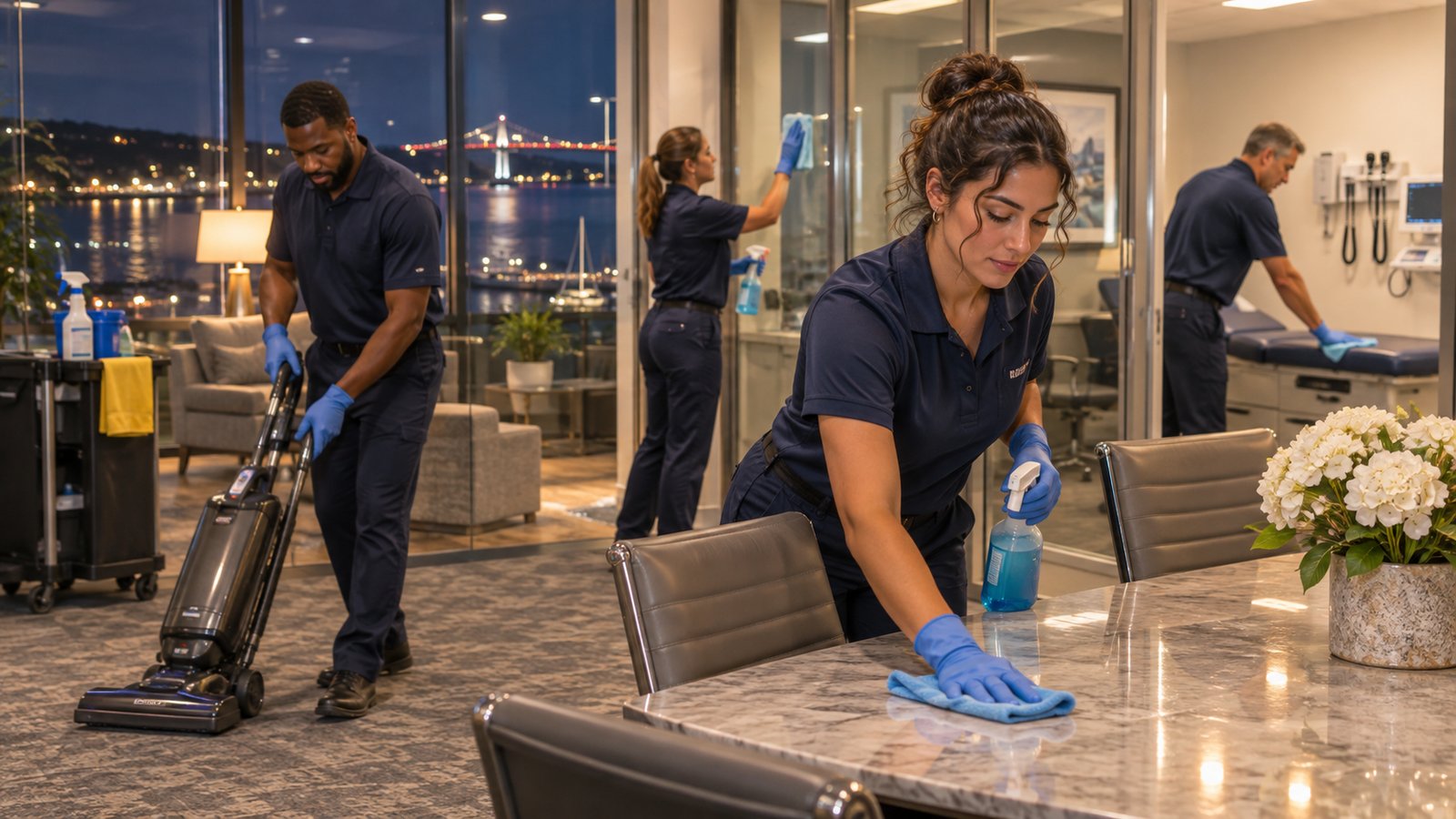
Businesses in Rye, Mamaroneck, and Harrison need a cleaning partner that understands a varied lower Westchester footprint: professional offices, medical suites, retail, private schools, and commercial properties near commuter routes and the shoreline. One town's office can have a quiet evening schedule, while a clinic or shared lobby experiences a steady stream of visitors. The right decision begins with a site-specific scope, clear access procedures, and a way to confirm service rather than relying on a monthly invoice alone. GreenPoint Maintenance Services supports commercial clients across Westchester and the wider tri-state area. This guide outlines the practical questions facility managers should ask before selecting a janitorial vendor.
Build separate site profiles for Rye, Mamaroneck, and Harrison
Even when one organization operates in all three communities, the cleaning schedule should reflect each property's layout and use. A compact office near downtown Rye, a multi-tenant building close to Mamaroneck station, and a campus or professional property in Harrison can differ in entrance count, floor surfaces, parking, security, and visitor volume. Record usable square footage by zone, number of restrooms, shared equipment, and spaces with restricted access. GreenPoint Maintenance Services can use a walkthrough to turn that information into a recurring task list with named frequencies and defined exclusions.
Keep routine tasks distinct from periodic work such as carpet extraction, hard-floor restoration, interior glass cleaning, or post-renovation cleanup. A 5,000-square-foot office might need daily restroom attention but only scheduled detailed dusting or floor maintenance at longer intervals. The right interval depends on actual traffic and finish condition rather than an arbitrary calendar. For a lower Westchester walkthrough and fixed-price quote, call GreenPoint at 347-332-9348 and provide the site address, operating hours, and any building access requirements.
Account for commuter traffic, shoreline weather, and arrival patterns
Metro-North stations in Rye, Mamaroneck, and Harrison anchor busy pedestrian and commuter areas, and major roads such as I-95 and the Hutchinson River Parkway shape how staff and visitors reach nearby properties. Waterfront exposure and Northeast weather can bring moisture, windblown debris, and tracked-in grit into lobbies. Entry mats, thresholds, vestibule glass, and the first floor zone deserve deliberate attention during rain and winter salt periods. A vendor should ask how the facility behaves in different seasons instead of repeating the same routine without checking the site's conditions.
Confirm whether a cleaning crew may use a loading area, parking spaces, freight elevators, or a security desk, and how visitors and tenants are separated from work areas. Some buildings need service before commuters arrive; others require evening access after clinics close. Document holiday service, weather-related closure communication, and who can authorize a schedule change. GreenPoint Maintenance records agreed entry instructions and escalation contacts, which helps prevent avoidable missed visits when building operations differ across neighboring towns.
Create a simple seasonal entry plan before the first storm rather than waiting for floors to show damage. Note where wet umbrellas or footwear are stored, which mats belong to the tenant, and who reports a saturated or displaced mat. On days with heavy rain or snow, the site contact can request a documented adjustment to the entrance route without changing every task in the contract. For waterfront or lower-level properties, staff should report any water intrusion to the building manager promptly; janitorial crews can flag and document visible conditions but should not be assigned building-envelope repairs.
Specify tasks, frequencies, consumables, and exclusions
Strong janitorial specifications name each area, task, frequency, and expected condition. For example, define whether a lobby includes glass doors, reception surfaces, seating, elevator buttons, and the floor edge; define restroom fixtures and restocking separately. Identify which supplies belong to the client and which are included in the vendor's proposal. Set restrictions for desks, confidential files, laboratory or medical equipment, and tenant rooms. GreenPoint Maintenance Services uses a written scope so a fixed-price proposal corresponds to the work the customer expects rather than to an undefined promise.
When a property has tenants with different schedules, note which areas are available on each visit and whether a supervisor must escort the crew into restricted rooms. A room list can label each space for routine access, manager approval, or no entry. Document any customer-owned equipment that must not be moved, including desktop devices, diagnostic instruments, and records. During a walkthrough, ask the site representative to identify surfaces with manufacturer-specific care instructions. These details help GreenPoint Maintenance prepare a realistic task plan and reduce the likelihood that routine cleaning will disturb work in progress.
The how to choose a commercial cleaning company guide can help structure interviews, while the commercial cleaning cost per square foot guide explains why site conditions influence cost. Request proposals against the same scope and compare included frequencies, supplies, inspection practices, and change-order rules. A low number that excludes periodic work may create extra charges later; a higher quote may include tasks that another bidder omitted.
Review safety, chemical controls, and Green Seal options
Ask the provider how staff learn to handle products, read labels, access safety data sheets, and store chemicals away from occupants. OSHA's Hazard Communication Standard is a relevant reference for workplace chemical information and training. Your scope should also identify slip hazards, wet-floor signage, locked storage, personal protective equipment appropriate to the task, and restrictions for sensitive floors or equipment. When a site is a medical office, school, or other regulated setting, the customer should define its own written procedures and confirm product approvals with the responsible facility or compliance lead.
GreenPoint Maintenance uses Green Seal certified products when appropriate and selects methods according to surface, soil, and site rules. Green purchasing should be specific: ask which products are used for which tasks and how dilution is controlled. The green cleaning commercial buildings guide covers procurement considerations, while the OSHA cleaning chemical safety guide is a useful prompt for reviewing hazard communication. Routine cleaning should not be described as a guaranteed way to prevent illness or replace a facility's prescribed disinfection program.
Verify recurring work across multiple lower Westchester sites
A portfolio manager needs a common way to review service without ignoring differences between properties. Use a standard scorecard for entrances, restrooms, waste, floor condition, and completion of periodic tasks, then add site-specific checks for special rooms or materials. Findings should include the date, exact location, responsible party, and correction status. GreenPoint's JaniTrack can provide timestamped GPS-tagged photographs, ATP testing where suitable, and a live dashboard for agreed checkpoints. These tools support operational verification; an ATP reading is not a claim that all microorganisms have been removed.
Schedule a launch review after the first few service cycles and a regular quarterly or monthly review based on risk and contract size. Look for repeated findings, supply shortages, incomplete tasks, and access issues, not just a single cleanliness score. GreenPoint Maintenance Services reports 98% client retention and offers a service contact for follow-through. Call 347-332-9348 to ask how a multi-site dashboard and inspection routine could work for properties in Rye, Mamaroneck, and Harrison.
Choose a contract that makes pricing and responsibilities clear
A clear contract should identify service days, holiday coverage, task frequencies, supplies, periodic work, emergency requests, notice periods, and how scope changes affect price. Define building responsibilities too: access credentials, utility availability, storage, and a contact for maintenance problems found during cleaning. GreenPoint Maintenance provides fixed pricing for an agreed scope rather than hourly billing or hidden fees. Ask bidders to explain their staffing assumptions and quality checks, but avoid selecting a provider solely on an estimated labor-minute comparison.
Set a review point after the first month, then revisit the scope at least annually or when occupancy changes. Bring the service calendar, inspection notes, tenant feedback, and any approved change orders to that meeting. If a lobby now serves more visitors or a suite is vacant, adjust frequency deliberately rather than letting informal requests alter the recurring price. GreenPoint Maintenance Services can use the review to confirm that the written scope still matches the property's operation and identify any special project that should be quoted separately.
For planning purposes, compare proposals by annual cost and included work, not just the first monthly amount. A building that adds a tenant, changes hours, or opens a new suite should trigger a documented review. Organizations with public or institutional procurement requirements may also need vendor credentials, insurance documentation, references, and supplier-diversity records. GreenPoint is MBE/MWBE certified with New York State, New York City, and NYC DOE and registered in SAM.gov. Call 347-332-9348 or email info@greenpointms.com to arrange a walkthrough.
When consolidating vendors across the three communities, decide whether the same supervisor can review each site and how local contacts will raise urgent issues. Standardize the reporting fields, such as date, area, finding, correction owner, and closeout, while keeping each address's access and task list separate. Review invoices against the service calendar and approved change orders so a seasonal request or tenant move does not become an unexplained recurring charge. GreenPoint Maintenance Services can discuss a portfolio scope during one planning call; schedule the property visits by calling 347-332-9348 and provide each site's address and preferred inspection window.
Frequently asked questions
What is the best cleaning frequency for a Rye, Mamaroneck, or Harrison office? It depends on occupancy, visitor volume, restrooms, entrances, floor type, and business hours. Set the schedule from a room inventory and observed use, then adjust after inspections rather than assuming every office needs the same number of visits.
Can one provider service multiple Westchester locations? Yes, if the scope, access plan, reporting, and local contact are defined for each site. A shared scorecard can make portfolio reviews easier while retaining site-specific tasks.
What should a commercial cleaning proposal include? Look for included areas, task frequencies, consumables, exclusions, seasonal or periodic work, quality checks, access arrangements, response contacts, and conditions for price changes. Request a walkthrough before accepting a final fixed-price proposal.
Does GPS-tagged photo reporting guarantee quality? No. It can help document agreed visits and checkpoints, but a buyer should combine records with inspections, occupant feedback, and timely corrective action. ATP testing is a limited indicator and should be interpreted in context.
How do I schedule a lower Westchester cleaning walkthrough? Call GreenPoint Maintenance Services at 347-332-9348 or email info@greenpointms.com. Include the town, building type, approximate square footage, service hours, and any security or tenant coordination requirements.
For commercial cleaning in Rye, Mamaroneck, or Harrison, call GreenPoint Maintenance Services at 347-332-9348 to schedule a walkthrough and fixed-price quote. JaniTrack can document agreed checkpoints, and GreenPoint reports 98% client retention.