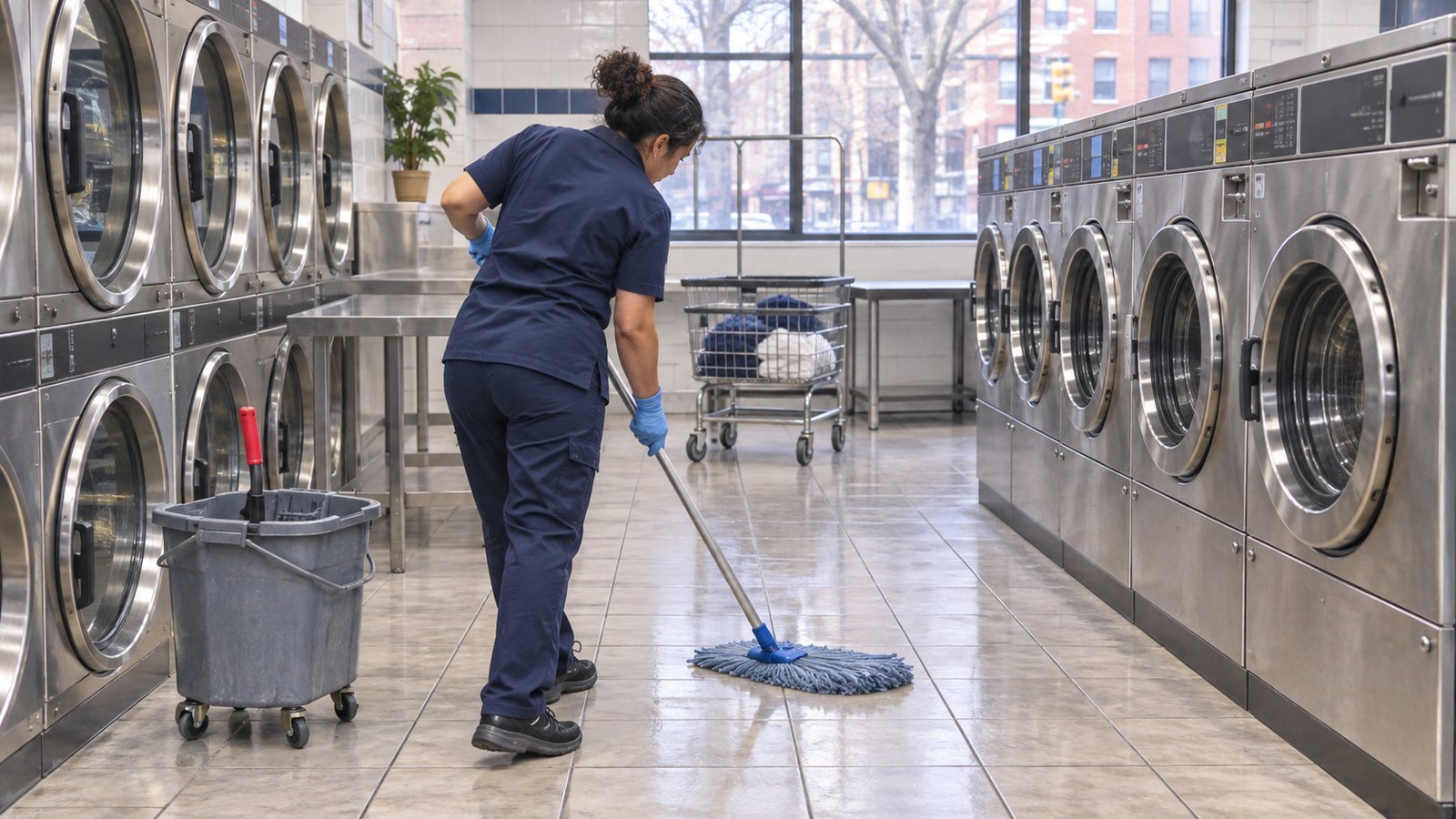
A New York laundromat is a public-facing workplace that stays busy while customers move between washers, dryers, folding tables, change machines, and restrooms. A useful cleaning contract must account for water tracked across tile, detergent residue, lint near equipment, frequent touchpoints, and the fact that many shops operate late or around the clock. GreenPoint Maintenance Services provides commercial cleaning for businesses across New York City, with a scope designed around actual traffic patterns rather than a generic office checklist. This guide explains what owners should compare before selecting commercial laundromat cleaning services in NYC.
Why laundromat cleaning needs a different scope
A laundromat combines dry soil, moisture, heat, chemical products, and public traffic in a compact space. The entry mat may collect street grit from customers coming off the 2 and 5 trains near Pelham Parkway, the F train in Brooklyn, or busy corridors in Jackson Heights, while the washer aisle can develop damp footprints and detergent film within a single operating shift. A routine that only empties trash and mops once after closing misses the practical risk: a spill between visits can create a slip hazard, and lint left around accessible equipment can become a housekeeping concern.
The service plan should distinguish daily tasks from periodic work. Daily service commonly covers floors, touchpoints, tables, waste, glass at hand height, and restrooms; periodic work may include detailed edges, high dusting, machine fronts, and floor maintenance based on the floor finish. GreenPoint Maintenance Services begins a proposal with a walkthrough that maps the customer route, back-of-house areas, chemical storage, water sources, and staff access. Ask the vendor to identify which tasks require a site employee to shut down or isolate equipment instead of assuming cleaners may reach behind operating machines.
Build a written task schedule around operating hours
The schedule should state the service days, arrival window, priority areas, completion evidence, and escalation contact. For a 24-hour shop, one overnight visit is not a substitute for a response plan during the busiest customer period. Owners can assign a short between-visit checklist to an on-site attendant, while the janitorial contractor handles scheduled detail work and documented issue follow-up. A laundromat near Fordham Road, Atlantic Avenue, or the Jamaica transit hub may have customer peaks that differ from a neighborhood store, so base timing on observed use rather than an assumed weekday pattern.
Write measurable instructions such as 'remove visible lint from approved accessible ledges' and 'leave the floor dry before reopening the aisle' instead of 'clean machines.' Identify which surfaces are included, how wet-floor signs are deployed, and who verifies that signs are removed after drying. GreenPoint can record timestamped, GPS-tagged photos in JaniTrack and present a live dashboard for completed tasks and reported exceptions. That evidence helps a multi-location owner compare a consistent scope without asking staff to reconstruct which areas were serviced from memory.
Set practical standards for floors, lint, and touchpoints
Floor care should match the material and its condition. Many laundromats use ceramic or porcelain tile, but grout, mats, transitions, and repaired sections can respond differently to chemicals and machine agitation. Specify the approved product, dilution, dwell time, tool, and drying method; do not let a cleaner experiment with an acid or abrasive on an unknown surface. A site manager should provide product and equipment restrictions, while the cleaning contractor trains staff to use the agreed procedure and to report damaged grout, loose mats, or persistent water intrusion.
Lint and dust deserve an explicit boundary. A janitorial worker can clean approved exterior surfaces and accessible ledges, but internal dryer ducts and machine components should be handled by a qualified laundry-equipment or duct specialist under the equipment maker's instructions. Keep lint collection, ventilation maintenance, and general janitorial work as separate line items so no one assumes the other party owns the task. For wider indoor-air questions, see GreenPoint's guide to commercial indoor air quality. On touchpoints, use surface-compatible methods and never spray liquid directly into controls, payment terminals, or electrical openings.
Protect customers and cleaning staff during service
A service plan should control access while a floor is being cleaned, identify spill-response supplies, and state how the attendant or manager is notified about a leak or other condition outside the janitorial scope. OSHA's general workplace-safety framework and Hazard Communication requirements make training, hazard communication, and access to current safety data sheets important parts of a vendor review. Ask how cleaners are instructed to label and store products, what personal protective equipment is required by the product label and task assessment, and how incidents are recorded.
Do not let customers walk through a freshly wet aisle just because the business is open. The contract can require a section-by-section approach, visible signs, dry-floor checks, and immediate notice to the on-duty attendant when a spill cannot be safely addressed without closing an area. Define how cleaners work around customers, cash-handling areas, cameras, and payment kiosks. GreenPoint Maintenance Services can build the walkthrough around these operating constraints and give an owner a documented point of contact at 347-332-9348 when the service scope or access plan needs review.
Compare laundromat vendor pricing on scope, not hours
A reliable comparison starts with the same room list, frequency, service window, consumable responsibility, and periodic-task schedule for every bidder. Square footage alone does not capture the difference between a simple waiting area and a dense machine floor with narrow aisles, public restrooms, and frequent spot-cleaning needs. Ask bidders to price the complete service scope at a fixed recurring amount and list approved extras separately. GreenPoint uses fixed pricing rather than hourly billing, with no hidden fees; the written proposal should still disclose assumptions such as access, water availability, and supplied paper products.
Review labor coverage, supervision, insurance documentation, substitute staffing, and what happens when a scheduled task is missed. A low bid that leaves the restroom, edges, or complaint response undefined may transfer cost to the owner through rework and management time. Ask for a sample inspection record and a clear correction process, then confirm whether the contractor can serve every location on the same terms. GreenPoint's guide to calculating true cleaning cost explains why buyers should compare service outcomes and administrative effort along with the invoice.
Use verification to close the loop on service issues
An inspection program should make a problem visible, assign it to a person, and document whether it was corrected. A useful dashboard separates completed routine tasks from exceptions such as a leaking washer, a blocked route, a damaged floor, or a consumable shortage that belongs to the operator. GreenPoint's JaniTrack workflow can attach timestamped GPS-tagged photos to selected tasks and record ATP testing when an agreed surface-verification protocol calls for it. ATP results are one indicator of residual organic material, not a stand-alone guarantee of disinfection or infection prevention.
Choose a small set of inspection points that matter to customers: entrance and primary aisle condition, folding surface appearance, restroom readiness, waste removal, and completion of periodic detail work. Define the sampling frequency and acceptable correction window with the vendor instead of expecting a dashboard to make an unclear standard objective. The owner should review trends monthly, including repeated spills or maintenance defects that cleaning cannot solve. GreenPoint Maintenance Services reports 98% client retention as a company proof point; prospective clients can ask for a walkthrough and examples of the verification process before authorizing a contract.
Questions to ask before signing
Ask who supervises the account, how coverage is arranged for absences, which tasks are performed during open hours, and how staff gain access without disrupting customers. Confirm whether chemicals and tools are supplied, whether the cleaner is permitted to touch machine surfaces, and which maintenance tasks are expressly excluded. Request a site-specific schedule, written pricing, insurance certificates, safety data sheets for proposed products, and sample quality records. For multi-site operators, compare how the vendor standardizes training while adapting schedules to different store layouts and neighborhood traffic.
A good bid discussion is specific: the buyer can point to a task and know its frequency, method, evidence, and owner. If a vendor promises a spotless shop but cannot explain how a wet-floor complaint is recorded or how a damaged tile is escalated, the proposal needs more detail. GreenPoint Maintenance Services is MBE-certified and serves New York City businesses with fixed-price commercial cleaning and JaniTrack verification. To compare your current coverage or request a no-obligation walkthrough, call 347-332-9348 or email info@greenpointms.com.
Before launch, give the cleaning supervisor a current contact list, floor plan, hours of operation, employee-only boundaries, machine-service restrictions, and the preferred way to report urgent conditions. Walk the site together after the first week and compare actual customer traffic with the proposed schedule. If the aisle near the folding tables needs more attention than expected, document the adjustment and confirm whether it changes the agreed scope. A short monthly review can track missed tasks, repeated spill locations, supply responsibilities, and seasonal changes. This creates a practical record for the owner and vendor instead of relying on an informal impression of whether the shop looked clean.
Frequently asked questions
Q: How often should a laundromat receive professional cleaning? A: Frequency depends on open hours, customer volume, number of machines, restroom use, and the owner's attendant coverage. Many operators schedule recurring service several times each week or nightly, then add periodic floor and detail work. A walkthrough is the best way to set a site-specific schedule rather than assuming one frequency fits every NYC shop.
Q: Can janitorial cleaners clean dryer ducts or repair machines? A: Those tasks should be assigned to qualified equipment or duct professionals under the equipment manufacturer's instructions. A janitorial scope can cover approved exterior surfaces and accessible housekeeping areas, but it should clearly exclude disassembly, internal mechanical work, and repairs unless separately qualified and contracted.
Q: What should an NYC laundromat cleaning proposal include? A: Look for a room-by-room task list, visit frequency, service window, floor and restroom methods, product responsibilities, safety and access procedures, supervision, issue reporting, and fixed recurring price. Ask how inspections are evidenced and how missed tasks are corrected. A written scope makes vendor comparisons more useful than a quote based only on square footage.
Q: How do I request commercial laundromat cleaning in New York City? A: Gather your address, operating hours, approximate cleanable area, restroom count, floor types, and preferred service window, then request an on-site walkthrough. GreenPoint Maintenance Services can review the location, discuss JaniTrack documentation, and prepare a fixed-price proposal. Call 347-332-9348 or email info@greenpointms.com.
Request a laundromat cleaning walkthrough with GreenPoint Maintenance Services at 347-332-9348. Build a fixed-price scope with JaniTrack timestamped, GPS-tagged photo verification and a live service dashboard.