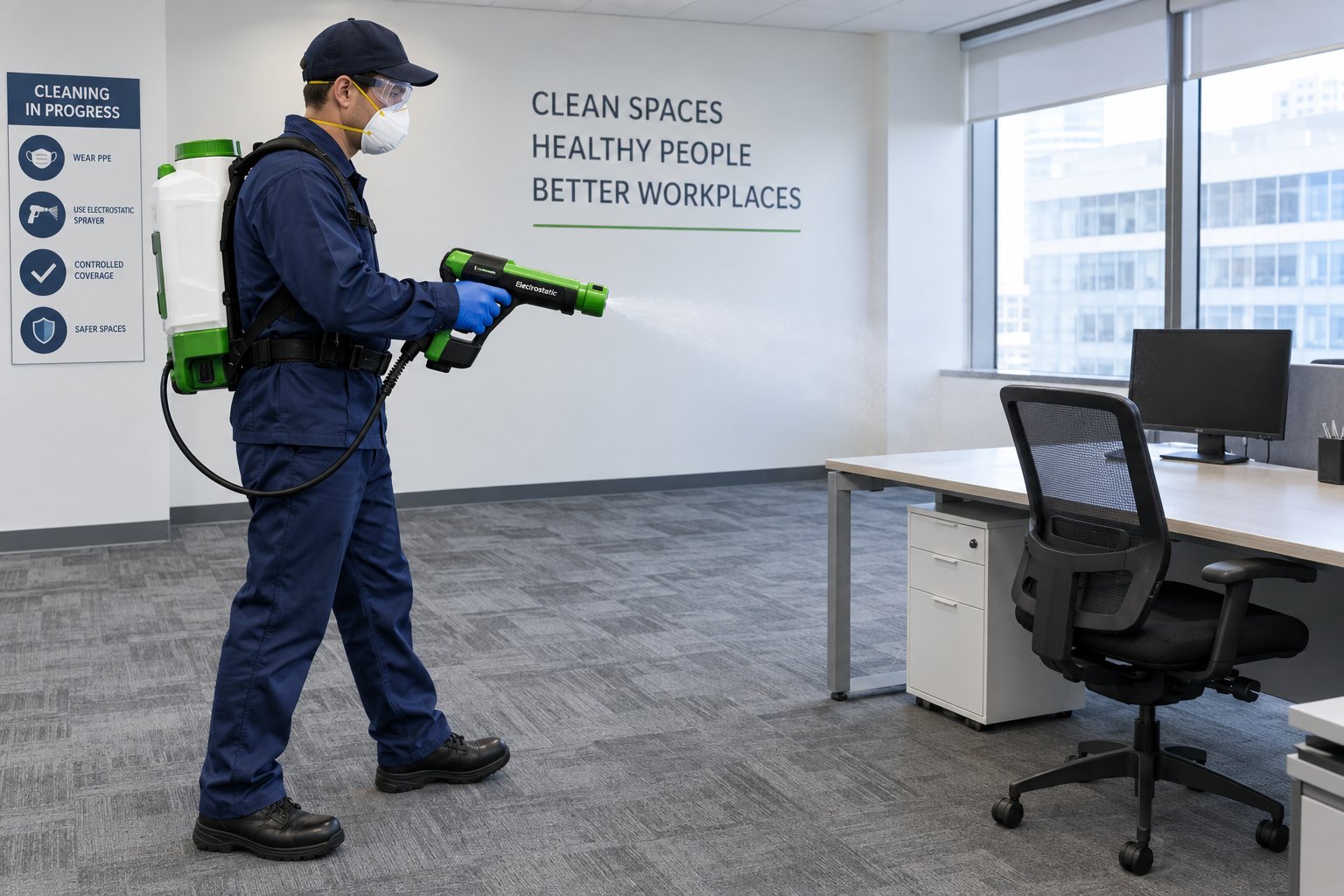
Electrostatic spraying can change how a disinfectant is deposited on compatible surfaces, but owning a sprayer does not establish that the treatment is effective, safe or required. Buyers should first identify the target surface and product claim, then confirm that the pesticide label expressly permits the electrostatic application method. GreenPoint Maintenance Services evaluates the tool as one option within a broader cleaning program for commercial sites in New York, New Jersey, Connecticut and Pennsylvania. Compare it with [electrostatic disinfection explained](/blog/electrostatic-disinfection-explained/) and [EPA-registered disinfectant selection](/blog/epa-disinfectant-registration-guide/) before adding equipment to an RFP.
Understand the electrostatic method and limits
An electrostatic sprayer charges droplets so they may be attracted to compatible surfaces, including some sides of an object that a direct spray may miss. Actual deposition depends on the device, operator, product, room geometry, surface material, distance and environmental conditions. It does not guarantee complete coverage behind objects, inside equipment or on a surface blocked from the spray path. EPA’s [evaluation of electrostatic sprayers](https://www.epa.gov/emergency-response-research/evaluating-electrostatic-sprayers-disinfectant-application) discusses the importance of applied volume and keeping surfaces wet for the required time. GreenPoint treats the device as an application method, not as a stand-alone disinfection claim.
Build a label-verification record before a service contract starts. Include product name, EPA registration number, version or label date, target use site, allowed electrostatic directions, dilution, application distance, target surface and contact time. Keep a copy available to supervisors at the point of use; a machine manufacturer’s brochure cannot expand the pesticide label. If the device or product changes, repeat the check and update training. GreenPoint’s proposal identifies the product-method pairing rather than relying on a general promise of “electrostatic disinfection,” which gives procurement a specific, reviewable basis for approval.
Verify product-label authorization
Start by defining what problem the buyer wants to solve. If the requirement is dust removal or visible soil removal, use an appropriate cleaning method; a sprayer is not a replacement for wiping away dirt. If a disinfection task is justified, identify the relevant surface and organism claim and check whether the exact product label allows electrostatic application. EPA cautions that it does not recommend electrostatic spraying unless the pesticide label specifically includes directions for that method. GreenPoint’s proposal can list the approved task, product and method separately so the customer can see what the service actually covers.
Ask the vendor to demonstrate a representative room under actual site conditions. Observe how staff isolate the area, select a nozzle setting, handle obstacles, protect equipment and verify that surfaces remain wet for the label period. A demonstration should include a difficult but typical room, not only an empty open area. If the vendor uses a test indicator or deposition card, ask what it measures and what it cannot prove. GreenPoint can provide an operational walkthrough at 347-332-9348 and will distinguish application evidence from microbiological testing or a validated health claim.
Protect occupants and prepare the room
Read the full label rather than relying on a product brochure, a machine setting or a vendor’s statement that the product is “approved for spraying.” Confirm the EPA registration number, authorized use site, surface type, application directions, required PPE, room occupancy restrictions, contact time and any post-application rinse. A label may specify one method or concentration for electrostatic use that differs from another application. GreenPoint’s supervisor checks the product and equipment pairing before a route begins. If the label does not authorize the intended method, GreenPoint does not substitute a machine setting for label directions.
A written safety plan should cover staff qualification, PPE, bystander removal, signage, storage, spills, re-entry and communication with building security. Check the label for any method-specific restrictions and confirm that the room’s ventilation and equipment are compatible with the intended use. Do not assume that a low-odor product can be used in an occupied space or that a handheld sprayer is safe around sensitive electronics. GreenPoint’s supervisor confirms that the room has been released and records any unavailable area before treatment begins. If access conditions change, the crew pauses and asks the manager for a revised instruction.
Measure wetness and contact time
Plan the room and protect occupants before equipment is switched on. Follow the label and facility safety procedure on bystanders, sensitive equipment, food-contact areas, ventilation, signage, re-entry and PPE. Remove or protect items that should not be treated; do not spray people, occupied air or unapproved surfaces. The facility decides when the room can be released for treatment and reoccupied. GreenPoint’s crew receives a written route and can record barriers, room release and completion in JaniTrack. Call 347-332-9348 for a safety and scope walkthrough before purchasing an electrostatic service.
Measure application on surfaces that represent real obstacles and orientations: a door handle, a desk side, chair arm, underside of a table and a vertical partition. The spray direction and distance can affect deposition, while excessive application can create pooling or residue. Follow only the manufacturer’s validated operating parameters and label directions, then observe the wet condition on the actual surface. EPA’s research notes that deposition rate can influence whether the required contact time is achieved. GreenPoint will not convert a machine’s advertised coverage rate into a guarantee that each object received a complete dose.
Define exclusions and manual work
Control wetness and dwell time as an operational requirement. A fine mist that dries before the labeled contact time is complete does not become compliant because the sprayer is electrostatic. Test the method on representative surfaces, observe the actual wet time and confirm that the application rate matches both device and product directions. EPA notes that lower applied volume can make it harder to maintain wetness for the required contact period. GreenPoint will not claim that a specific coverage percentage has been achieved unless a defined, defensible verification method supports that statement.
Write exceptions into the work plan before treatment. Specify porous textiles, exposed electronics, food-contact areas, occupied rooms, documents, open containers and objects that should not be sprayed. Decide which items are moved by the client, which are covered, and which are handled by manual cleaning. A checklist should record the exception and the alternative service—not hide the untreated area in a broad “room completed” status. GreenPoint’s JaniTrack dashboard can show the task and exception with a timestamp and approved photo, subject to the client’s information-security rules.
Compare the full vendor cost
Ask how the vendor handles incompatible surfaces and missed areas. Porous fabric, screens, exposed electronics, food-contact surfaces and items with narrow crevices may need another approved method or may be excluded. The work plan should state whether items are moved, who authorizes that movement and how the operator identifies areas the spray cannot reach. GreenPoint pairs a product application with manual cleaning where the task calls for it and records exceptions rather than implying uniform coverage. For a detailed service specification, GreenPoint can review room lists and access rules by phone at 347-332-9348.
The buying decision should compare the electrostatic option against a relevant manual method, not against no service. Include labor still needed for pre-cleaning, set-up, room release, application, wet-time monitoring, re-entry and post-job checks. Include equipment maintenance and training, plus the cost of repeat visits if a surface dries too quickly or the room was not fully accessible. GreenPoint Maintenance Services Corp. uses fixed pricing for an agreed scope, with no hidden fees; the proposal states what is included. Call 347-332-9348 to request a quote and compare cost per room, task and usable area on the same assumptions.
Audit training and service records
Compare the business case over the full service cycle. Include machine and battery maintenance, training, PPE, room setup, application time, product use, surface compatibility, re-entry downtime and the labor still required for pre-cleaning and touchpoint work. Ask for the cost per treated room or square foot only when the measurement method and included tasks are clear. GreenPoint Maintenance Services Corp. prices the documented scope on a fixed basis, with no hourly billing or hidden fees; the customer can compare that scope with manual application on the same representative area. GreenPoint uses JaniTrack to report approved tasks, evidence and exceptions, not to certify microbial outcomes.
Keep a complete service packet for procurement review: approved label, training date, equipment maintenance log, room preparation checklist, work order, exception record and final supervisor review. Limit photos to areas the client permits, and retain them according to the customer’s policy. A record that says only “sprayed” does not show which approved product was used, whether the area was released or whether the surface remained wet for the required contact time. GreenPoint’s JaniTrack entries can attach task evidence and corrective actions to the site route. During vendor selection, ask staff to retrieve a sample record and explain its limits before the contract is signed.
Request a limited pilot before a multi-site rollout. Select one representative room, document its surfaces and exclusions, have the provider follow the exact label directions, then review setup time, dwell monitoring, room release, records and any residue or incompatibility. The pilot should compare an agreed alternative on equivalent tasks, not simply count how many rooms were treated. GreenPoint can help the buyer define a comparison worksheet and list decisions that remain with the client’s safety lead. Use the pilot to decide whether to proceed, revise or reject the method; do not treat a successful demonstration as proof of a universal outcome.
Frequently Asked Questions
Q: Does electrostatic spraying replace manual cleaning?
A: It does not replace soil removal; some surfaces still require wiping, pre-cleaning or another label-approved method.
Q: Can every disinfectant be used in an electrostatic sprayer?
A: Only when the specific pesticide label authorizes electrostatic application and the directions are followed.
Q: Does electrostatic spraying guarantee full surface coverage?
A: Coverage is not guaranteed; results depend on equipment, operator, distance, room layout, obstacles and surface properties. Unreachable or incompatible areas need a separate plan.
Q: How is contact time handled?
A: Follow the label’s method-specific wet contact time. The target surface must remain visibly wet for that period, reapplying only as the label permits.
Q: What should an RFP require from an electrostatic vendor?
A: Exact product and registration, label directions for the method, training, PPE, room controls, wet-time procedure, exclusions, documentation, maintenance and pricing assumptions.
Ask GreenPoint Maintenance Services for a label-and-safety walkthrough at 347-332-9348. GreenPoint is an MBE/MWBE-certified commercial cleaning provider; JaniTrack can document the approved method, service time and exceptions.