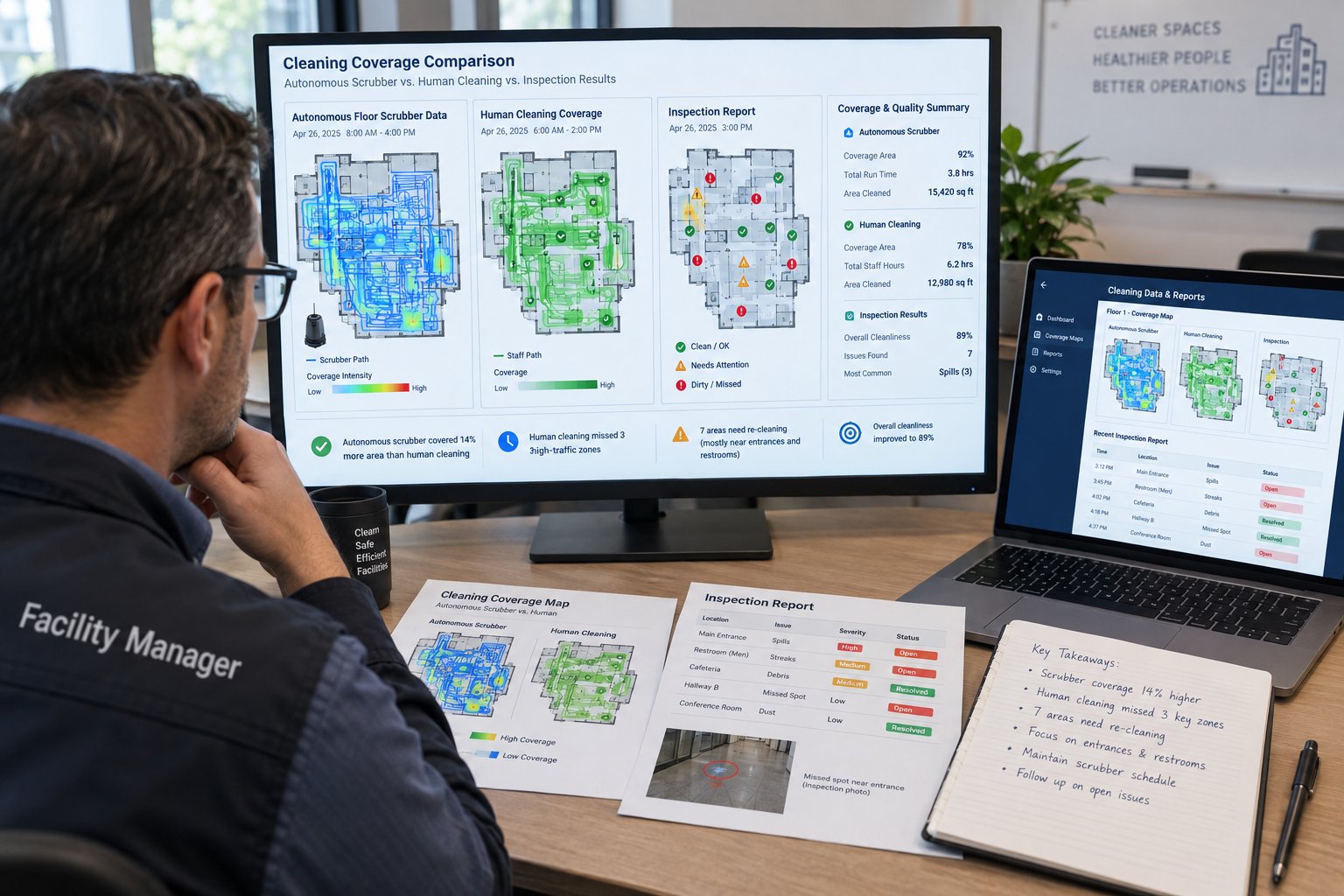
An autonomous scrubber can improve repeatability in a large lobby, corridor, airport-adjacent office, or warehouse, but a robot does not make a cleaning program automatic. The buyer still needs a coverage map, trained human oversight, edge work, restroom service, spill response, charging controls, and proof that the floor is actually clean. This guide helps facility managers in New York, New Jersey, Connecticut, Pennsylvania, and Florida write a robotic floor-cleaning RFP that compares outcomes instead of comparing machines. GreenPoint Maintenance Services uses technology only where it improves measurable service, safety, and communication.
Define the Floor-Care Outcome First
Start the RFP with the condition the facility expects, not a brand name or a requirement that the vendor supply a robot. Define soil load, slip-risk priorities, appearance level, floor types, operating hours, and the frequency for dust-mopping, scrubbing, and periodic refinishing. A 200,000-square-foot Queens distribution center may need dust control and aisle safety, while a 35,000-square-foot Midtown lobby needs quiet operation, polished appearance, and careful pedestrian interaction. GreenPoint maps the floor zones before selecting equipment so the technology is accountable to a result.
Include measurable acceptance criteria such as no visible debris in defined lanes, no standing water after a route, a documented response to spills within 10 minutes, and a target appearance level by zone. ISSA appearance levels can create a shared vocabulary, while [vct floor care strip seal wax guide](/blog/vct-floor-care-strip-seal-wax-guide/) explains why daily automation does not replace periodic restoration. A [cleaning audit checklist for facility managers](/blog/cleaning-audit-checklist-facility-managers/) can turn those conditions into an inspection routine. Ask bidders to state the labor hours behind their assumptions and identify which tasks remain manual. If an RFP says only 'autonomous cleaning,' proposals will be impossible to compare.
Build a Coverage Map With Constraints
The map should show square footage, floor material, aisle width, doorway width, ramps, elevators, charging locations, restricted areas, furniture, public paths, and no-go zones. Separate open runs from edges, corners, under-desk areas, stairs, restroom thresholds, and spaces with frequent obstacles. A robot may cover 40,000 square feet per shift in ideal conditions, but that headline changes when it must stop for pedestrians or return to a charger. GreenPoint asks for an annotated route, a human finishing plan, and a method for updating the map when the client changes furniture.
Local buildings add practical constraints. A Lower Manhattan office may have security-controlled elevators and tenant events; a Brooklyn or Long Island City site may have loading-dock schedules; a Newark or Stamford building may need a route that avoids shift changes; a South Florida property may need to account for tracked-in sand and storm access. Put each constraint in the RFP and require a site survey. Call 844-814-0810 to schedule a GreenPoint walkthrough, because a floor plan alone cannot reveal reflective glass, door closers, uneven transitions, or the cleaning window between commuter peaks.
Require Human Oversight and Edge Work
The most important RFP question is who remains responsible when the robot stops, misses an edge, encounters a spill, or reports an obstacle. Specify an on-site or on-call operator, response time, route restart procedure, manual edge work, stair cleaning, spot mopping, restroom transitions, and end-of-shift inspection. The robot should be treated as production equipment, not as a substitute for a trained cleaner. GreenPoint assigns human ownership for setup, safety checks, exception handling, and final review. This prevents a facility from paying for a completed route that left the highest-visibility edges dirty.
Write a service-level agreement with examples: a blocked route acknowledged within five minutes, a spill isolated immediately, a failed battery reported before the next shift, and a missed zone corrected within the same service window when feasible. Include relief coverage for vacation, training, and equipment downtime. OSHA-style hazard communication, pedestrian separation, and battery charging procedures should be documented. GreenPoint's supervisors can use StockPoint to record route exceptions, timestamped GPS-tagged photos, and closure notes. A dashboard should show accountability, not hide it behind an attractive route animation.
Compare Scrubbing, Vacuuming, and Polishing Claims
Vendors often describe a robot as a floor-cleaning solution without clarifying whether it sweeps, vacuums, scrubs, dries, or polishes. Require separate performance claims for each mode and each floor type. Ask about brush pressure, water recovery, detergent dosing, drying time, noise, battery runtime, tank capacity, and how performance changes with traffic. A 12,000-square-foot VCT corridor and a concrete warehouse aisle do not have the same soil or finish requirements. GreenPoint specifies the actual task and verifies the result with visual inspection, scheduled floor measurements, and periodic restoration.
The RFP should identify who supplies pads, brushes, squeegees, filters, batteries, approved chemicals, and replacement parts. Green Seal certified product options can support a lower-impact program, but green claims should not replace a documented dilution and recovery process. In a Staten Island school or a Bronx public facility, the schedule may need to align with NYC DOE or municipal access rules. In Philadelphia or Florida, local client rules still govern product approval. Ask bidders to include training time, equipment downtime, and manual fallback in their price.
Set Safety, Privacy, and Accessibility Requirements
A cleaning robot operates around people, doors, carts, service animals, and sometimes sensitive information. Require collision avoidance, emergency stop, audible or visual signals, speed limits, safe charging, battery inspection, and a clear process for operating near accessible routes. Ask what data the robot collects, where maps are stored, who can access route footage, and how long records are retained. GreenPoint reviews those controls with the facility team rather than assuming a manufacturer's default is acceptable. The RFP should prohibit blocking ramps, tactile paths, exits, fire equipment, or emergency egress.
Public-facing sites deserve extra detail. A courthouse near Queens Plaza, a school in Westchester, or an office serving clients near Grand Central may have peak periods when a machine must be parked. The vendor should identify a spotter or operator, signage, wet-floor controls, and a complaint contact. Accessibility is not achieved merely because the robot avoids a person; the finished floor must remain safe and routes must remain open. Ask for a demonstration during the actual service window, then record exceptions and corrective actions in the pilot report.
Design a Pilot With Baseline Metrics
A pilot should test representative zones for at least two or three service cycles, not one staged demonstration. Record square footage, route time, manual hours, water and chemical use, battery changes, missed areas, complaints, and inspection results before and during the pilot. Define a pass threshold for coverage, dryness, edge quality, response to obstacles, and reporting. GreenPoint can use StockPoint for timestamped evidence and supervisor review, while an ATP sampling plan can add data in appropriate high-touch areas. The goal is to learn whether the process works in the building, not to validate a sales presentation.
Choose zones with different conditions: a wide open floor, a congested corridor, a transition between materials, a high-traffic entrance, and an area with security or elevator constraints. For a 100,000-square-foot Manhattan property, the pilot may cover one full floor and its lobby; for a 60,000-square-foot school, it may cover corridors, cafeteria, and gym entry. Ask how the vendor will respond when the robot cannot finish. GreenPoint will schedule the walkthrough at 844-814-0810 and document the baseline before proposing a recurring program.
Write the Commercial and Data Terms
RFP pricing should separate lease or equipment costs, operator labor, consumables, software, data storage, training, repairs, travel, and manual completion work. State whether the client owns route maps and service data, whether a vendor can use footage for product development, and what happens if the contract ends. A lower monthly payment can become expensive if the client pays separately for every battery, software seat, or emergency visit. GreenPoint offers fixed pricing with no hourly billing or hidden fees after a confirmed scope, so procurement can compare the complete service.
Include a downtime guarantee and a manual fallback. If a charger fails during a Friday-night shift in Jersey City, who brings a replacement machine or assigns a cleaner? If a Florida storm changes access, how is the schedule reset? If a Long Island tenant moves furniture, who remaps the route? Name the escalation contact and response time. GreenPoint Maintenance Services is MBE/MWBE certified, SAM.gov registered, and supported by a 98% client retention record. Those proof points do not replace due diligence, but they help a buyer evaluate continuity alongside equipment features.
Turn Route Data Into Continuous Improvement
The best robotic cleaning program becomes more useful over time because the team reviews exceptions instead of merely celebrating completed routes. Require a monthly report with route completion, manual interventions, blocked areas, downtime, complaints, inspection scores, consumables, and corrective actions. Compare results by zone and by shift. GreenPoint can combine route evidence with supervisor inspections, photos, and ATP results when appropriate. That makes it possible to change furniture, adjust frequency, or add manual detailing based on evidence rather than anecdote.
Facility leaders should also review whether automation improved service for people, not just utilization for the machine. Did the lobby dry faster? Did complaints fall? Did cleaners spend more time on restrooms and high-touch surfaces? Did the machine create an accessibility concern? A 98% client retention rate gives GreenPoint a reason to keep the conversation practical and transparent. For a written RFP scope, call 844-814-0810 or email info@greenpointms.com. GreenPoint will walk the site, identify realistic robot zones, and price the human oversight that makes the program dependable.
Frequently Asked Questions
Can a commercial cleaning robot replace a janitorial team?
No. Robots can automate repeatable open-floor routes, but people still handle edges, stairs, spills, restrooms, obstacles, safety checks, and final inspection. GreenPoint writes human oversight and manual fallback into the RFP and service-level agreement.
What square footage can an autonomous scrubber clean?
The answer depends on floor type, route complexity, battery, water recovery, obstacles, and operating window. A vendor should prove coverage during a site pilot rather than relying on a brochure headline. GreenPoint measures route time and exceptions by zone.
What should a robotic floor-cleaning RFP include?
Include floor maps, square footage, materials, frequencies, access windows, safety, accessibility, data ownership, response times, manual edge work, downtime coverage, consumables, reporting, pricing, and acceptance criteria. Call 844-814-0810 for a walkthrough.
How does GreenPoint verify autonomous floor cleaning?
GreenPoint combines route records with supervisor inspection, timestamped GPS-tagged photos, exception notes, and ATP testing when an approved sampling plan calls for it. StockPoint helps authorized managers review completion and corrective action.
Does GreenPoint serve tri-state and Florida facilities?
Yes. GreenPoint serves NYC, Westchester, Long Island, New Jersey, Connecticut, Pennsylvania, and Florida. A walkthrough confirms building access, staffing, floor types, local requirements, and the right mix of automation and human service.
Call GreenPoint Maintenance Services at 844-814-0810 or email info@greenpointms.com for a robotic floor-cleaning RFP walkthrough. Get a coverage map, human-oversight plan, fixed pricing, StockPoint evidence, and a pilot tied to measurable floor results.