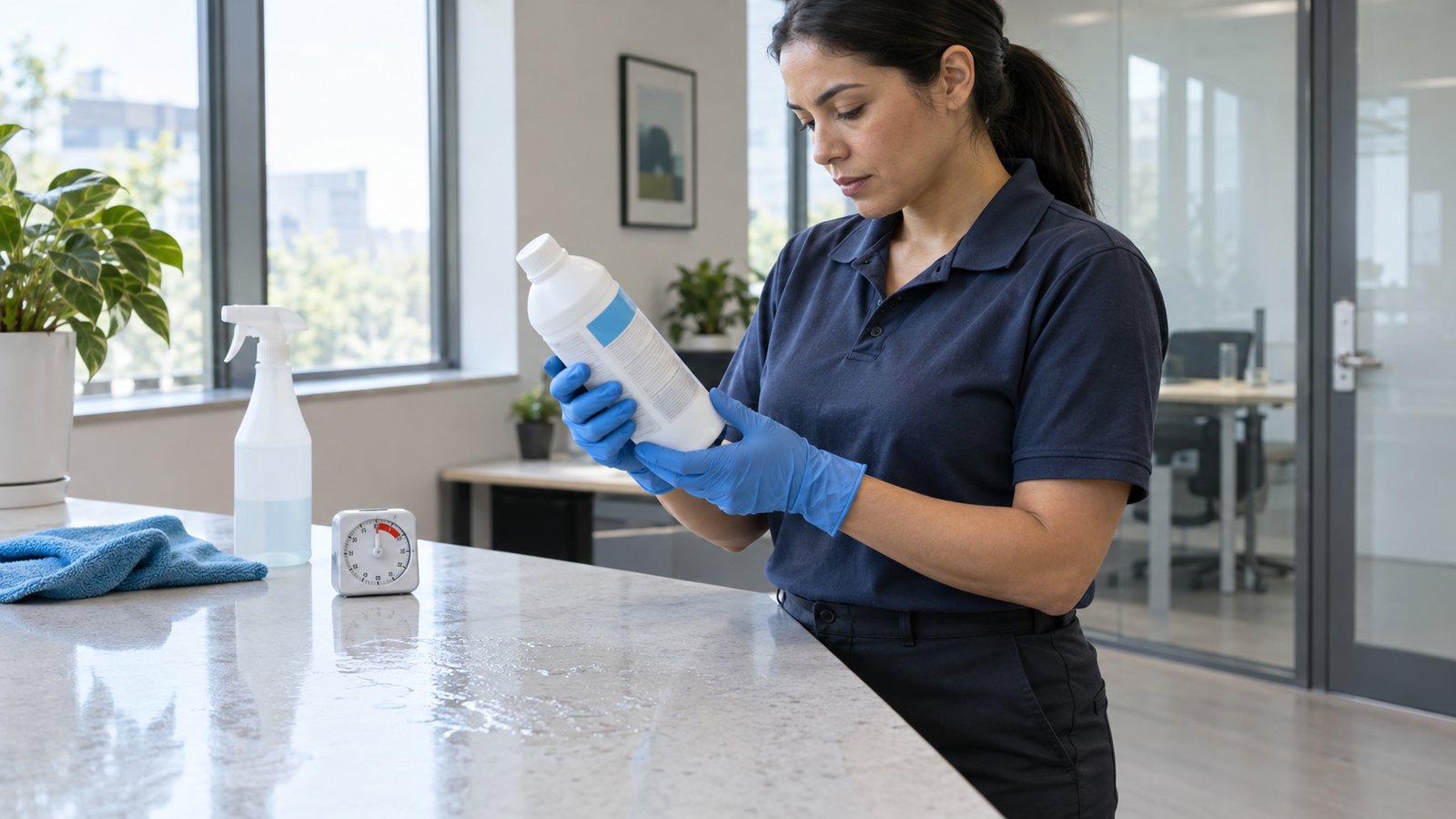
A disinfectant can be applied to a surface and still fail to follow its directions if the surface dries too soon. EPA contact time is the period the product must remain on the surface to work as stated on its label. That makes product selection, pre-cleaning, application, wet-time management, and staff training part of one operating method. GreenPoint Maintenance Services Corp helps offices, schools, medical practices, and public facilities in the New York tri-state area turn label instructions into a repeatable task. This guide explains what buyers should verify and why a single universal contact-time number is not a safe substitute for the product label.
Read the exact product label for the intended use
EPA says the label's Directions for Use identify how to use a registered disinfectant and how long it takes to work. The [EPA registered disinfectants guidance](https://www.epa.gov/pesticide-registration/selected-epa-registered-disinfectants) defines contact time as the time the product must remain on the surface to be effective and directs users to follow the label. The time can vary by product, organism claim, surface, and application method. A label may specify different conditions for a bacteria claim, a virus claim, or another use. Buyers should not accept a generic statement such as “kills in five minutes” without seeing the current label and the use that statement describes.
Before a crew uses a product, confirm the EPA registration information and that the label includes the intended site and surface. Check dilution, application method, required personal protective equipment, pre-cleaning instructions, food-contact restrictions, rinse directions, and reentry directions. A hospital-grade or broad-spectrum phrase does not eliminate these checks. GreenPoint maintains an agreed product list and product documentation for client review, and asks facility managers to approve substitutions before deployment. To review product and surface needs for a specific office or clinic, call 347-332-9348 to schedule a walkthrough.
Keep the surface visibly wet for the full stated time
The EPA explains that the treated surface should remain visibly wet for the entire contact time, and product may need to be reapplied if it dries before the time is complete. For example, if a label specifies 10 minutes for a particular pathogen, EPA says the surface should stay wet for at least those 10 minutes. This example is not a universal direction for every disinfectant. A facility should train to the chosen product's current label, not teach crews that all products require 10 minutes or that a quick spray-and-wipe is sufficient.
Build a small task card from the label rather than copying its entire text onto a cart. It can identify the product name, approved target, ready-to-use or dilution status, application method, required wet time, and response if a surface dries. A supervisor can observe the task without relying on memory or an assumed dwell time. If the building changes products, review the new label and update the task card before the next shift. GreenPoint keeps product instructions aligned with the approved supply list and can show a sample job aid during a walkthrough. This helps procurement teams compare an actual method rather than vague promises about “proper dwell.” Call 347-332-9348 to scope training and task documentation for your building.
Build a small task card from the label rather than copying its entire text onto a cart. It can identify the product name, approved target, ready-to-use or dilution status, application method, required wet time, and the response if a surface dries. A supervisor can then observe the task without relying on memory or an assumed dwell time. If the building changes products, review the new label and update the task card before the next shift. GreenPoint keeps product instructions aligned with the approved supply list and can show a sample job aid during a walkthrough. This helps procurement teams compare a contractor's actual method rather than vague promises about “proper dwell.” Call 347-332-9348 to scope training and task documentation for your building.
The required wet time affects scheduling and labor. A worker may need to apply enough solution, keep other surfaces moving while the first one remains wet, and return only after the label's exposure period. A fast-drying product in a warm, ventilated corridor may require a different application technique than a wipe on a small nonporous surface, but workers must not alter label directions. GreenPoint supervisors build contact-time steps into task instructions and observe whether staff can maintain the wet surface without creating slip hazards or leaving an area unattended inappropriately.
Separate cleaning from disinfecting
Disinfection does not automatically remove visible soil. Many product labels require surfaces to be cleaned first when visibly soiled, and some tasks specify a separate cleaner or a clean-then-disinfect sequence. The crew should know whether the approved product is a cleaner-disinfectant for the particular use and whether the label permits a one-step procedure under the conditions present. A heavily soiled area, a high-touch clinical surface, and a routine office desk may require different instructions. GreenPoint's scope identifies the routine cleaning tasks and any disinfecting tasks separately so a buyer can see when the latter is scheduled and what label controls the procedure.
A useful work card names the surface, product, dilution, application method, wet-contact duration from the label, and any rinse or dry requirement. The worker should use the correct cloth or wipe and avoid contaminating clean surfaces with a used cloth. Color-coded microfiber can help separate restroom and general-purpose tools, while the task order can limit recontamination. Review [EPA disinfectant registration basics](/blog/epa-disinfectant-registration-guide/) and [healthcare-associated infection environmental cleaning](/blog/healthcare-associated-infections-environmental-cleaning/) when writing a site protocol, but treat the selected label and facility policy as controlling.
Train with a demonstration instead of a label handoff
Training should ask the cleaner to locate the use directions, identify the target surface and claim, explain whether pre-cleaning is needed, and describe how the wet time is maintained. Demonstrate the application method using the product label and the building's PPE rules. Have the worker explain what to do if the surface dries early, if the wrong chemical is in a bottle, or if the work area is occupied. These are observable behaviors, not simply a signature on a toolbox talk. GreenPoint trains new staff on site procedures and uses supervisors to reinforce the approved work sequence.
Training should also cover practical constraints: keep chemicals in original or properly labeled containers, do not mix products, use the designated dilution system, and report spills or adverse reactions. A worker should be able to find the safety data sheet and the facility contact without leaving a problem unreported. In New York City offices near Penn Station or Grand Central, after-hours access may be limited; in a Brooklyn school or a Stamford medical office, room schedules may restrict when disinfection can occur. A walkthrough helps GreenPoint scope the right work window, product, and staffing level; call 347-332-9348 for a quote.
Verify execution while protecting occupants
Managers can verify a program by reviewing the approved product list, current label, training record, task card, inspection notes, and corrective actions. Direct observation during a scheduled task is more meaningful than relying on an empty spray bottle or a photo of a cleaned table. If the facility uses a dwell-time observation, define the method and sample size; do not imply that a dashboard photograph independently proves an invisible microbial outcome. GreenPoint uses JaniTrack timestamps and GPS-tagged photos in appropriate areas, with ATP testing in selected programs, as operational evidence that complements—not replaces—label compliance and management inspection.
Protect privacy when documenting work in clinics, schools, and public buildings. Avoid images that reveal patient information, student identities, paperwork, computer screens, or secure access points. Record the task and time in an approved way when photography is not appropriate. Set a service-level expectation for an issue report, a reclean, and supervisor follow-up. GreenPoint offers fixed pricing rather than hourly billing and can separate routine cleaning from periodic disinfection tasks so the client understands the cost and timing. For a scope review across Manhattan, the Bronx, Queens, Brooklyn, Staten Island, Westchester, Long Island, or New Jersey, call 347-332-9348.
Plan supplies and workload around the label
Contact time can change how many high-touch points a crew can complete within a shift. Estimate the number of surfaces, visits per day, application volume, label dwell, and travel between rooms. A 20-room clinic with short turnover windows may need a staged plan, clear role assignments, and enough product and cloths to avoid rushing. An office lobby with elevators and shared touchpoints may need a different schedule from a low-traffic conference room. GreenPoint's walkthrough-based estimate documents these operational assumptions and identifies any locations that the client should reserve for dedicated cleaning or disinfection.
Do not increase concentration, shorten dwell, or switch to a stronger chemical to compensate for insufficient labor. Reassess frequency, staffing, product selection, and room access with the facility's infection-prevention or safety lead. GreenPoint uses Green Seal-certified products where appropriate for cleaning tasks, while recognizing that disinfectant selection must meet the facility's specific efficacy need and follow its label. Call 347-332-9348 to schedule a walkthrough; the result is a defined scope, product plan, and fixed-price quote without hidden fees.
Consider a representative shift when sizing the crew. Count rooms or touchpoints, estimate the number of applications and return visits required, and include time to replenish wipes, change cloths, document exceptions, and travel between floors. A label dwell interval may overlap with other work only when the workflow prevents cross-contamination and someone remains accountable for the treatment. Do not claim that one worker can disinfect every surface in a large site at once if the wet-time requirement and route make that impossible. GreenPoint's supervisors review shift sequencing and can recommend a realistic frequency after seeing the building. A walkthrough with GreenPoint at 347-332-9348 can uncover access windows, busy periods, and areas needing separate coverage.
Consider a representative shift when sizing the crew. Count the rooms or touchpoints, estimate the number of applications and return visits required, and include time to replenish wipes, change cloths, document exceptions, and travel between floors. A label dwell interval may overlap with other work only when the workflow prevents cross-contamination and someone remains accountable for the treatment. Do not claim that a single worker can disinfect every surface in a large site at once if the required wet time and route make that impossible. GreenPoint's supervisors review shift sequencing and can recommend a realistic frequency after seeing the building. A walkthrough with GreenPoint at 347-332-9348 can uncover access windows, busy periods, and areas that need separate coverage.
Disinfectant contact-time FAQ
Q: Is there one EPA contact time for all disinfectants? A: No. Follow the exact product label for the surface, application, and organism claim; contact times differ.
Q: What does contact time mean? A: It is how long the product must remain on the surface to work as stated. EPA says to keep the surface visibly wet for the full labeled time.
Q: What if the surface dries before the label time ends? A: EPA guidance says the product may need to be reapplied so the surface remains visibly wet, consistent with the label.
Q: Does disinfectant replace cleaning? A: Not automatically. Check the label for pre-cleaning directions, particularly for visibly soiled surfaces, and use the facility's approved task sequence.
Need a disinfection scope that crews can follow without rushing the label? Call GreenPoint Maintenance Services at 347-332-9348 to schedule a walkthrough and quote. GreenPoint backs service with JaniTrack verification and a 98% client retention rate.