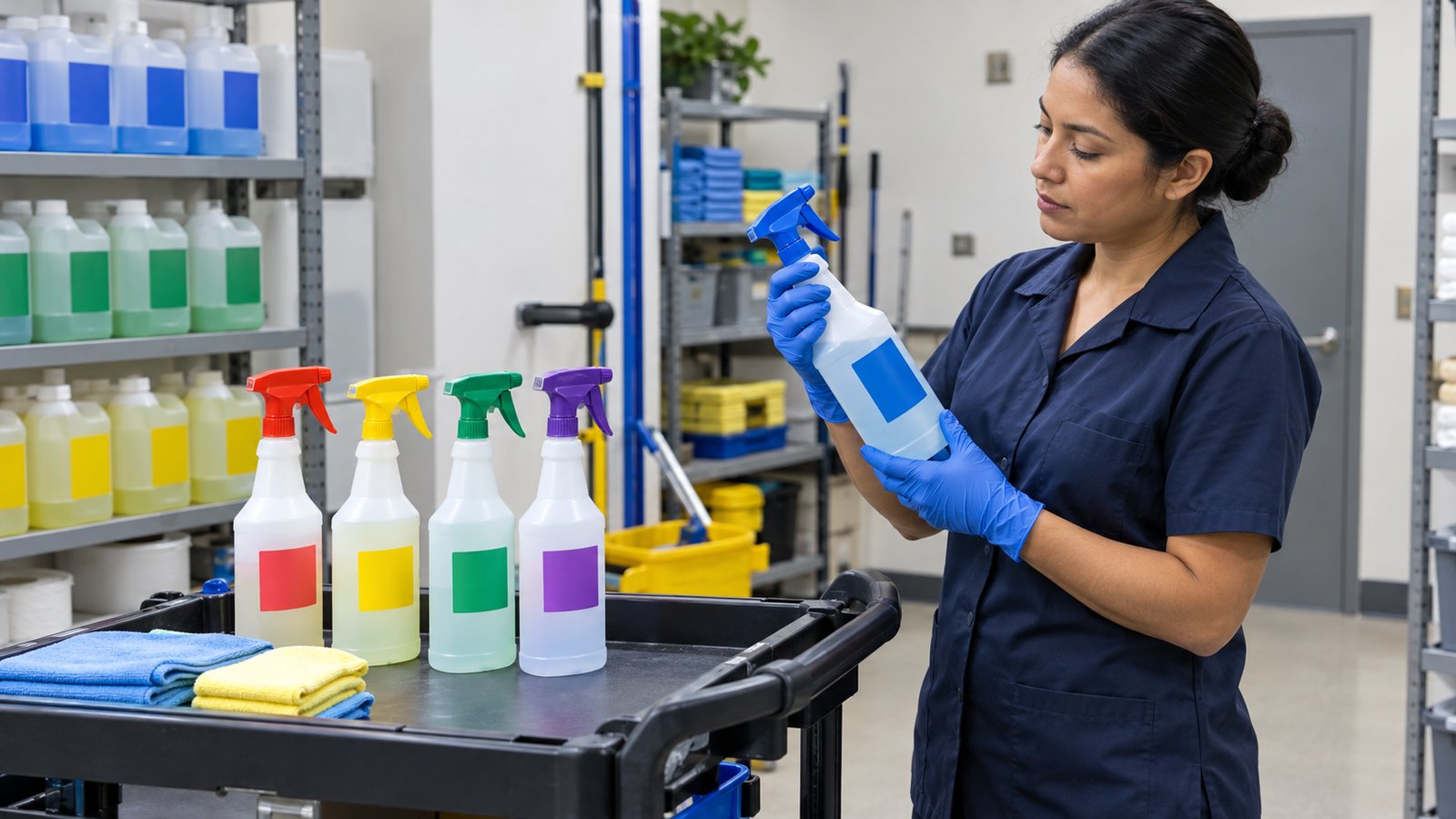
A spray bottle without a clear product name or hazard warning creates a preventable question for a cleaner, building manager, or emergency responder: what is inside, and how should it be handled? OSHA's Hazard Communication Standard gives employers options for workplace container labels and a narrow exception for certain portable containers used immediately by the person who transfers the chemical. GreenPoint Maintenance Services Corp uses this field guide to help commercial buyers and janitorial teams discuss labeling, SDS access, training, and safe storage. It is not a substitute for the employer's written hazard communication program or legal review of a specific operation.
Start with the workplace label rule
Under OSHA's [Hazard Communication Standard, 29 CFR 1910.1200](https://www.osha.gov/laws-regs/regulations/standardnumber/1910/1910.1200), an employer generally must ensure workplace containers of hazardous chemicals are labeled, tagged, or marked. One option is to use the full shipped-container label information. Another workplace-label option is the product identifier plus words, pictures, symbols, or a combination that gives at least general hazard information; the company's hazard communication program and information immediately available to workers must allow them to obtain more specific hazard details. Therefore, it is inaccurate to say every secondary bottle always needs the manufacturer's complete label.
Workplace labels and other warnings must be legible, in English, and prominent on the container or readily available in the work area throughout the shift. Employers may add other languages, which can improve comprehension for multilingual crews. A product identifier should match the name on the chemical inventory and SDS. GreenPoint recommends checking that bottle labels remain readable after routine handling, the correct label stays with the correct solution, and staff can connect the label to the SDS without guessing from color or bottle shape.
Understand the immediate-use exception narrowly
OSHA's exception is for a portable container into which a hazardous chemical is transferred from a labeled container and that is intended only for immediate use by the employee who made the transfer. OSHA defines immediate use as being under that employee's control and used only by that person within the same work shift. A bottle placed on a cart for another worker, stored for tomorrow, left in a common closet, or handed to a relief crew should not be treated as covered by this narrow exception without careful review. When a container's status is uncertain, the safer operational choice is to label it according to the workplace system.
The exception is not a general license for unlabeled janitorial bottles, nor does it remove the need for training, product identification, or safe transfer procedures. A supervisor should know who prepared a solution, when it was prepared, what product it contains, and whether it will remain under that person's control. GreenPoint trains crews to follow site-specific instructions and avoid unidentified containers. For a building walkthrough, GreenPoint can map chemical storage points, access restrictions, and responsible contacts; schedule one by calling 347-332-9348.
Keep SDSs and the written program usable in the field
The employer's written hazard communication program must describe how labels, safety data sheets, and employee information and training are provided. It also needs a list of hazardous chemicals using identifiers cross-referenced to their SDSs, and methods for informing workers about non-routine hazards. Employers must maintain SDSs for hazardous chemicals they use and make them readily accessible to employees during each work shift. Electronic access can work if it does not create a barrier to immediate access, such as a dead phone, missing password, or no signal in a basement supply room.
A facility manager should be able to locate the current SDS set, inventory, and emergency contact path without needing to search an old email thread. For multi-employer buildings, the program must also explain how other employers receive access to SDSs and relevant precautions when their workers may be exposed. GreenPoint can provide product documentation for the agreed scope and clarify how workers reach safety information. For broader planning, see [OSHA cleaning chemical safety and GHS/SDS guidance](/blog/osha-cleaning-chemical-safety-ghs-sds/) and [fire-code cleaning chemical storage considerations](/blog/fire-code-cleaning-chemical-storage/).
Create a simple crosswalk between the chemical inventory and each product's current SDS. Use the exact product identifier, supplier, storage location, and date checked; remove products that are no longer approved and make sure a new bottle is not introduced before the required review and training. If crews work at multiple addresses, identify how they will reach the relevant information at each site and who can answer questions after normal business hours. A digital file is only useful if workers can reach it during their shift, and a paper binder is only useful if it is current and placed where people can find it. GreenPoint can help a facility manager review access and recordkeeping during a walkthrough; call 347-332-9348.
The building should also define who replenishes labels, who checks bottle condition, and how empty containers are handled. A label system may use durable tags, printed labels, or another workplace method, but it has to remain legible and correspond to the actual contents. Keep approved dilution instructions near the dispensing point and restrict access to concentrates according to the site's program. If a product is poured into a reusable container, staff should not assume a similar-looking bottle has the same contents as before. GreenPoint includes bottle and storage checks in supervisor conversations and can tailor a supply-room routine during a walkthrough.
Train before assignment and when hazards change
OSHA requires effective information and training at initial assignment and when a new chemical hazard that employees have not previously been trained about is introduced into their work area. Training should explain how to read shipped-container labels and the workplace labeling system, what information is on the SDS, how the SDS is organized, and how to obtain and use the relevant hazard information. Workers need to understand which products they are authorized to use, required protective equipment, dilution and application procedures, and what to do after a spill or exposure.
A sign-in sheet alone cannot show whether the information was understood. A practical refresher can have workers identify the product name, locate the hazard information, match the bottle to the SDS, and explain how to report an unlabeled container. Provide translated or visual materials as needed, while meeting the English-language requirements for labels. GreenPoint uses site orientation and supervisor checks to reinforce procedures; clients can request the applicable training outline during a walkthrough. Call 347-332-9348 if a facility needs a quote that includes a defined product list and mobilization orientation.
When an inspection finds an unlabeled or unreadable bottle, treat it as a correction item, not an opportunity to guess. Follow the site's procedure to isolate it, identify the contents from a reliable source, and dispose of or relabel it only under an approved process. Record which location was affected, who was notified, and whether the SDS and inventory were updated. Look for patterns such as repeated label damage, unlabeled refill stations, or old products left after a scope change; each points to a different process fix. GreenPoint supervisors can include a supply-room spot check in the service review and document closure in JaniTrack. To discuss a field checklist and fixed-price service scope, schedule a walkthrough with GreenPoint at 347-332-9348.
Use a repeatable field inspection
A simple weekly or monthly check can sample the chemical closet, janitorial carts, refill bottles, and satellite closets. Confirm every container has an identifiable product name; the workplace label communicates general hazards; the label is legible; the SDS is available; and incompatible products are not stored together. Check that spray bottles are not reused for a different chemical without cleaning and relabeling, and that concentrated chemicals are stored and diluted according to the label and site procedure. The inspection frequency should reflect the number of users, turnover, and risk rather than an arbitrary universal rule.
Record issues with the location, corrective action, responsible person, and closure date. Do not photograph a chemical cabinet in a way that reveals security codes, keys, or confidential areas. JaniTrack can help GreenPoint document site visits and assigned corrective actions, while a facility's safety officer remains responsible for its hazard communication program. If your building uses Green Seal-certified products, verify the actual product list and current SDSs rather than assuming that an environmental certification changes OSHA labeling duties.
Coordinate vendors, tenants, and site-specific rules
An office tower in Downtown Brooklyn, a school near Fordham Road, or a medical office near Journal Square may have separate storage rooms, shared service corridors, and multiple employers. Clarify who owns the building's program, which products the cleaning contractor may bring, who approves substitutions, where staff can access SDSs, and how tenant contractors are notified about hazards. Add these responsibilities to the contract and site plan. GreenPoint's fixed-price proposals can define included products and routine work; if a client wants an additional chemical, it should be reviewed and approved before use rather than introduced informally.
If a customer reports a strong odor, irritation, spill, or unknown substance, crews should stop work where appropriate, isolate the affected area according to site procedure, notify the designated contact, and follow emergency instructions. They should not mix products to try to neutralize a spill. The written program and product SDS govern the specific response. GreenPoint supervisors can coordinate a walkthrough to identify contacts and storage arrangements in Manhattan, the Bronx, Queens, Brooklyn, Staten Island, Westchester, Long Island, New Jersey, and Connecticut. For a site review, call 347-332-9348.
Secondary-container label FAQ
Q: Must every secondary bottle carry the full original GHS label? A: Not necessarily. OSHA permits a workplace label with the product identifier and general hazard information when the hazard communication program makes specific details immediately available.
Q: When can a portable container be unlabeled under OSHA's immediate-use exception? A: When the person who transfers the chemical keeps control of it and uses it only during that same work shift.
Q: Can an SDS be available only online? A: Electronic access is allowed if workers can obtain it immediately during the shift and the method does not create a barrier.
Q: What should a buyer require from a cleaning vendor? A: Require a defined approved-product list, workplace-label procedure, SDS access method, training description, and process for approving substitutions and correcting findings.
Want a cleaner chemical-control scope for your office, school, or healthcare facility? Call GreenPoint Maintenance Services at 347-332-9348 to schedule a walkthrough and fixed-price quote. GreenPoint pairs site-specific procedures with JaniTrack visit records and a 98% client retention rate.