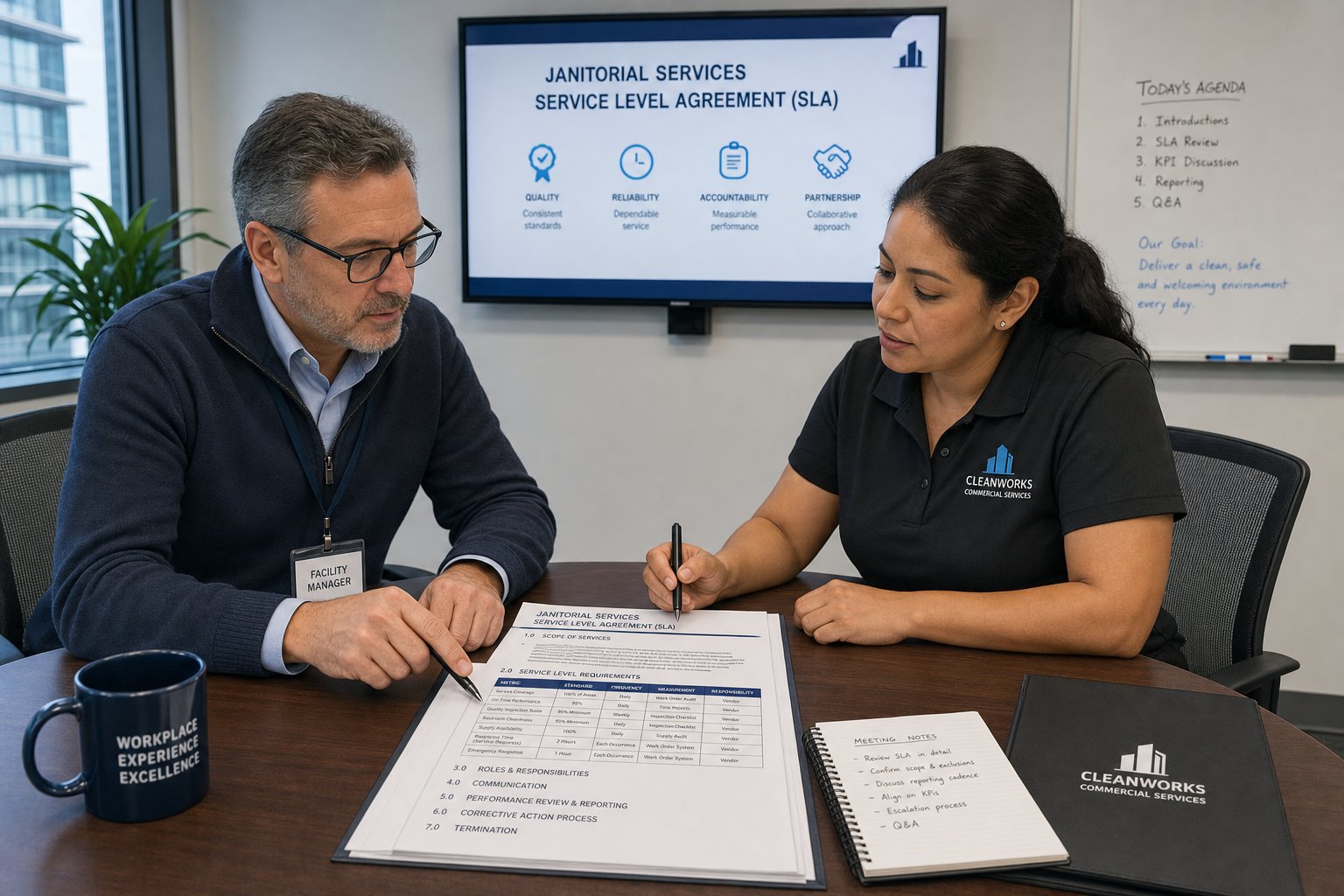
A janitorial service-level agreement, or SLA, turns a broad promise to keep a building clean into measurable responsibilities. It should explain which rooms are included, how often they are serviced, what quality looks like, how urgent requests are handled, how performance is reported, and what happens when a requirement is missed. A strong SLA protects the owner and gives the cleaning team a fair operating target. GreenPoint Maintenance Services writes scopes around fixed pricing, JaniTrack verification, and the facility’s actual use. To review an SLA or schedule a walkthrough, call GreenPoint at 347-332-9348.
Why a janitorial SLA matters more than a generic scope
A generic scope may say “clean restrooms regularly” or “maintain common areas.” An SLA defines the useful details: restrooms inspected every 60 minutes during occupied hours, dispensers restocked before depletion, spill calls acknowledged within 10 minutes, and quality issues corrected by the next service window. The right targets vary by facility. A 15,000-square-foot law office in Midtown has a different traffic pattern from a 150,000-square-foot warehouse in New Jersey or a Bronx school with dismissal surges.
GreenPoint Maintenance Services separates outcomes from methods. The client can require a clean appearance, safe floors, stocked supplies, documented inspections, and response times while allowing GreenPoint to choose the efficient sequence. The [commercial cleaning contract key terms](/blog/commercial-cleaning-contract-key-terms/) guide helps procurement teams review term, scope, insurance, change orders, and termination language before adding operational metrics. GreenPoint’s goal is a contract a manager can administer without guessing what a sentence means.
Define the facility, zones, and service frequencies
Start the SLA with a site map and an inventory. List entrances, lobbies, elevators, stairs, restrooms, break rooms, offices, conference rooms, storage areas, loading docks, and exterior touchpoints. Identify the square footage and floor type for each zone, plus occupied hours, event schedules, restricted rooms, and access contacts. In Manhattan, include security desks and freight-elevator windows; in Queens and Brooklyn, note mixed-use or shared-building boundaries; in Westchester and Long Island, include travel between buildings. GreenPoint uses a walkthrough to turn that inventory into a service matrix.
Frequency should be tied to use, not habit. Daily vacuuming may be enough for a low-traffic suite but inadequate for a public lobby. Restroom inspection may be hourly in a transit-facing building and event-triggered in a small office. The [cleaning frequency standards by facility type](/blog/cleaning-frequency-standards-by-facility-type/) guide offers a baseline, while a pilot and complaint history refine the number. GreenPoint records the agreed frequency and the exception process so an owner can see when an extra service is authorized.
Write measurable quality metrics
Good SLA metrics are observable, repeatable, and connected to a decision. Examples include 95 percent of scheduled tasks completed by shift end, zero visible standing water after routine mopping, 100 percent of occupied restrooms stocked at inspection, and corrective action opened within one business day for a failed audit. Avoid metrics that count activity but say nothing about the result. “One cleaner visited” is weaker than “the assigned zone passed the defined appearance inspection.”
GreenPoint can use JaniTrack to capture task timestamps, GPS-tagged photos, checklists, supervisor review, and exceptions. If the client uses ATP testing, name the sampling plan, device, locations, thresholds, and response rather than inserting a vague “ATP compliant” promise. The [quality-assurance commercial cleaning program](/blog/quality-assurance-commercial-cleaning-program/) guide outlines how inspection scores, corrective action, and trend review fit together. GreenPoint reports the evidence in plain language so a facilities director can act on it.
Set response times and escalation tiers
An SLA should distinguish routine work from urgent and critical events. A routine request might be acknowledged within four business hours and completed by the next scheduled shift. An urgent spill on a public route might require a 10-minute acknowledgement and 30-minute on-site response during staffed hours. A sewage backup, glass hazard, or blocked accessible route should trigger immediate escalation to building management and the appropriate emergency or engineering contact. The numbers must match staffing, geography, and access; GreenPoint does not promise a response window that the site cannot support.
Escalation should be a ladder, not a blame exercise. Define who receives the ticket, who can authorize overtime or a specialty vendor, when a supervisor calls the account manager, and when the owner is notified. In NYC, a request near Penn Station may be handled differently from one at a remote Staten Island property because travel and security windows differ. GreenPoint provides a phone path at 347-332-9348 and can document the response in JaniTrack so the timeline is visible.
Address staffing, substitutions, and continuity
The SLA should state the expected staffing model without making the client responsible for managing individual employees. Include coverage hours, backup expectations, site orientation, background or badge requirements where relevant, and a notice process for planned substitutions. If a cleaner is absent, the outcome should not silently disappear. GreenPoint Maintenance Services uses supervisor coverage and documented checklists to keep standards consistent when assignments change. The [janitorial employee turnover impact](/blog/janitorial-employee-turnover-impact/) guide explains why continuity and training affect quality and total cost.
Ask for a transition plan when the facility has sensitive operations. Medical offices may need HIPAA-aware access procedures; schools may require visitor controls; government sites may require badges and restricted areas. A New Jersey warehouse may need forklift and dock-safety orientation. GreenPoint coordinates those requirements with the site contact, keeps the scope written, and gives the manager a clear escalation route instead of relying on informal texts.
Make pricing, change orders, and exclusions explicit
A useful SLA explains how the fixed price relates to square footage, frequency, consumables, equipment, staffing, and access. It should list what is included and what is a separately priced project: post-construction cleaning, carpet extraction, high dusting, pressure washing, storm response, biohazard remediation, and weekend event work. The [commercial cleaning cost per square foot guide](/blog/commercial-cleaning-cost-per-square-foot/) shows why a rate without assumptions can mislead. GreenPoint uses fixed pricing with no hourly billing and no hidden fees, provided the agreed scope and access remain stable.
Change orders should identify the trigger, effective date, price, and approval. A tenant expansion, construction zone, new restroom, event schedule, or repeated emergency response can change labor demand. GreenPoint can schedule a walkthrough at 347-332-9348 and issue a written quote before the change begins. That approach gives finance and procurement a record instead of an unexpected invoice.
Build reporting and review into the agreement
Set a monthly or quarterly business review with a short agenda: completion rate, inspection scores, response times, repeat issues, supply exceptions, open corrective actions, complaints, safety observations, and planned improvements. A dashboard should show trends by zone, shift, and building rather than burying a missed task in a total score. GreenPoint can provide JaniTrack evidence and supervisor commentary, then use the review to adjust frequency, routing, training, or equipment.
Use a balanced scorecard. If every metric is a pass-or-fail inspection, staff may optimize for the audit instead of the tenant experience. Pair appearance standards with response time, safety, communication, and documented improvement. GreenPoint’s 98% client retention is a proof point for an operating relationship that reviews data and resolves issues. Call 347-332-9348 if an existing contract has metrics that no one can reliably measure.
Include compliance, safety, and local operating rules
The SLA should require compliance with applicable OSHA training and chemical-safety practices, product labels, SDS access, waste handling, and safe equipment use. If the site is a school, healthcare facility, government building, or public-facing property, add the access and reporting requirements that apply to that use. ADA routes, fire exits, elevator landings, and emergency egress cannot be obstructed for routine service. GreenPoint’s [OSHA cleaning chemical safety and GHS/SDS guide](/blog/osha-cleaning-chemical-safety-ghs-sds/) can help procurement teams identify the operational language to include.
Local context belongs in the work plan. A Downtown Brooklyn office, a Bronx school, and a Westchester manufacturing site have different transit, parking, security, and operating constraints. Florida properties may add hurricane preparation, while Tri-State properties may add winter salt response. GreenPoint Maintenance Services serves NY, NJ, CT, PA, and FL and can define regional service windows without copying a one-size-fits-all SLA.
A useful SLA also states how the parties communicate. Name the account manager, on-site contact, after-hours number, ticket channel, review cadence, and the format for approving scope changes. Define whether email acknowledgement counts as receipt and when a verbal emergency authorization must be documented. GreenPoint Maintenance Services keeps those paths simple: the manager can call 347-332-9348, use the agreed ticket process, and review the resulting JaniTrack record. Clear communication prevents a small spill or supply exception from becoming a disputed invoice.
For multi-site portfolios, use one core SLA with location-specific appendices. The core can define insurance, safety, reporting, confidentiality, and escalation, while each appendix lists square footage, frequencies, floor types, hours, contacts, and local restrictions. A portfolio spanning Manhattan, Nassau County, New Jersey, and Connecticut gains consistency without pretending every property has the same demand. GreenPoint can prepare a comparison matrix and quote after a walkthrough, with no hourly billing and no hidden fees in the agreed scope.
FAQ: Janitorial service-level agreements
Q: What is the most important SLA clause? A: The most important clause is the one that makes the expected outcome and measurement unambiguous: scope by zone, frequency, quality standard, response time, evidence, and escalation. GreenPoint can review those elements during a walkthrough.
Q: Should an SLA include exact cleaning frequencies? A: Yes, when the frequency is tied to a named zone and operating condition. Include an exception process for events, storms, occupancy spikes, and construction so the contract can adapt without confusion.
Q: How many performance metrics should a janitorial SLA have? A: Use a focused set that the site can actually measure, often completion, quality, response, safety, supplies, and corrective-action close-out. GreenPoint uses JaniTrack evidence instead of adding metrics no one reviews.
Q: Can GreenPoint work with a client’s existing SLA template? A: Yes. GreenPoint Maintenance Services can map the template to the building, identify ambiguous terms, and propose fixed pricing. Call 347-332-9348 to schedule a walkthrough.
Q: What happens if a cleaning task is missed? A: The SLA should define notification, corrective action, reinspection, and escalation. GreenPoint documents the event and response rather than hiding it, then reviews whether staffing, access, or scope needs to change.
Q: How do I request a janitorial SLA quote? A: Call GreenPoint at 347-332-9348 or email info@greenpointms.com. GreenPoint will review square footage, zones, hours, frequencies, service standards, and reporting needs before issuing a quote.
Make your cleaning agreement measurable and fair: call GreenPoint Maintenance Services at 347-332-9348 to schedule a walkthrough and fixed-price SLA quote. GreenPoint supports the scope with JaniTrack evidence and a 98% client-retention record.