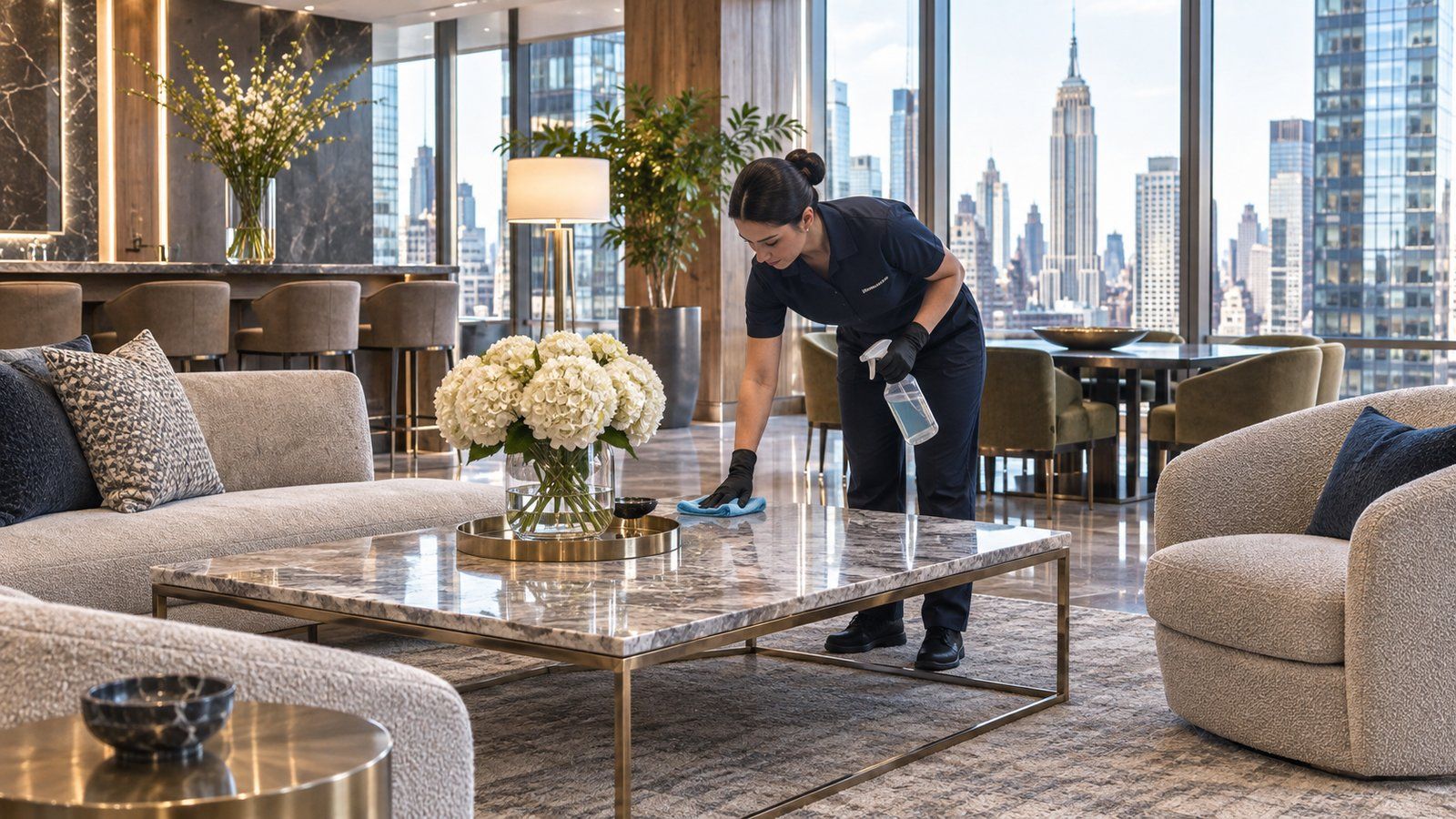
Luxury residential buildings in Manhattan sell a daily experience as much as an apartment: a composed lobby, presentable lounge, clean fitness room, orderly package area, and amenities that are ready when residents use them. These spaces also have different privacy, access, and scheduling demands from a conventional office. A buyer evaluating commercial cleaning for luxury residential amenity spaces should specify which areas are included, how cleaners work around residents, and how service issues are verified. GreenPoint Maintenance Services supports commercial facilities with fixed-price scopes, trained supervision, and JaniTrack service records.
Map the resident journey before defining the scope
Start with the route residents and guests actually take: sidewalk entrance, vestibule, lobby desk, elevator bank, package room, amenity floor, and any shared restrooms. A tower near Columbus Circle, Hudson Yards, the Upper East Side, or the Financial District may experience different peaks tied to office commutes, deliveries, dining, and building events. Map spaces by use and access level, then note flooring, glass, upholstery, fitness equipment, and high-touch surfaces. The service plan should distinguish public-facing areas from staff-only rooms and resident-restricted spaces.
Create a written area list that says what is cleaned, at what frequency, and what is intentionally excluded. A lounge reset may include waste, approved touchpoints, tables, and floor appearance, while a fitness area may need more frequent attention and careful product compatibility with equipment surfaces. Pool decks, kitchens, pet-wash rooms, terraces, and mechanical spaces may require separate qualifications or rules. Do not let a broad phrase such as 'all common areas' stand in for task details. GreenPoint's guide to quality assurance for commercial cleaning offers a framework for measurable inspections.
Design a schedule that respects residents and building operations
A high-rise building may need a combination of early-morning service, daytime touch-up, and evening resets. Define service windows around resident activity and the building's staffing plan, then identify which tasks can occur when amenities are occupied. Use area-by-area methods for floor care and visible signs when a surface is wet. The building manager should specify elevator usage, cart routes, loading-dock procedures, noise limits, key or badge handling, and whom to contact if access fails. A schedule that ignores these constraints can disrupt residents even if the task list looks complete.
Events and seasonal changes should be handled through a defined request process. If a rooftop lounge is booked for a resident event, specify who requests the pre-event reset, how much notice is needed, which rooms are covered, what post-event work is included, and how the extra service is priced. Create a calendar for recurring peak periods rather than expecting the concierge to negotiate ad hoc with an individual cleaner. GreenPoint uses fixed recurring pricing, with scope changes written down so a board or property manager can distinguish baseline service from additional requests.
Protect privacy, property, and controlled access
Residential cleaning staff may pass near private conversations, packages, personal belongings, or resident-only spaces. The building should establish conduct expectations, photography restrictions, device rules, incident reporting, and a clear prohibition on opening or moving resident property unless the scope expressly authorizes it. Access credentials should be assigned, tracked, returned, and removed promptly when staffing changes. Ask the vendor how it trains employees on confidentiality and how supervisors investigate a complaint without exposing resident information unnecessarily.
A vendor's verification process must respect those privacy rules. JaniTrack can record selected completed tasks and timestamped GPS-tagged photos, but photos should be limited to approved views of service conditions and should not capture residents, package labels, access codes, or personal data. The property manager should define retention and dashboard permissions before the system is used. GreenPoint's digital records are intended to make agreed work more visible, not to replace a building's privacy policy or security controls. Review the digital cleaning verification systems guide when setting evidence standards.
Match cleaning methods to premium surfaces
Amenity spaces often mix marble, engineered stone, metal, glass, wood, luxury vinyl, carpet, and upholstery. A cleaning plan should identify the surface, manufacturer guidance, approved product, tool, and escalation point for stains or damage. The safest instruction may be to stop and report an unknown substance rather than apply a stronger chemical. Ask the building to provide finish schedules or vendor recommendations for specialty materials. Green Seal-certified products can support a greener purchasing policy where suitable, but the label does not remove the need to confirm compatibility and follow product directions.
Fitness rooms need task-specific handling because equipment finishes, screens, grips, mats, and electronics may react differently to moisture or chemicals. The property should identify which equipment surfaces the cleaning contractor may touch and which are maintained by the gym operator or equipment provider. For floors and upholstery, agree on periodic maintenance separately from routine appearance cleaning. GreenPoint's guide to commercial carpet-cleaning methods can help a manager ask about carpet-specific methods without treating them as interchangeable. A written surface matrix reduces damage claims and improves training consistency.
Assess staffing, supervision, and fixed-price terms
Request a staffing plan that identifies account supervision, site orientation, backup coverage, and how the property is notified about absences or a missed visit. Ask who can approve added work and how service issues are escalated after business hours. Compare proposals using the same room list, frequency, hours, supply responsibilities, event assumptions, and periodic work. A square-foot price can be an initial reference, but it may not reflect the number of amenities, the building's access rules, or multiple daily touchpoints. GreenPoint does not bill by the hour and discloses fixed-price scope assumptions in the proposal.
Verify insurance, references, training, and any required city or agency certifications relevant to the procurement. GreenPoint Maintenance Services is MBE-certified by New York State, NYC, and NYC DOE, and is registered in SAM.gov; buyers should confirm which credentials apply to their specific purchasing requirements. The company reports 98% client retention and uses JaniTrack for selected service documentation. Ask for examples of task records, a sample dashboard, a correction process, and clear limits on what the cleaning contractor is not responsible for.
Set measurable inspections and service recovery
Choose a small set of outcomes that residents and staff notice: lobby floor and glass appearance, restrooms stocked if included, lounge surfaces reset, fitness-room touchpoints handled according to approved procedures, and package-area waste removed. Define inspection frequency, scoring or pass criteria, responsible reviewer, and correction window. A complaint log should capture location, time, category, owner, action, and closure without unnecessary resident details. When repeated issues stem from building access or a damaged surface, route them to property management rather than treating every exception as a cleaner performance failure.
JaniTrack records can include timestamped GPS-tagged photos, task completion, and selected ATP testing where a documented protocol makes it appropriate. ATP is an indicator of residual organic material, not a universal measure of cleanliness or proof that a pathogen is absent. Agree on the method and interpretation before using a test result in a service score. GreenPoint Maintenance Services can demonstrate how its dashboard presents task evidence and exceptions. To schedule a Manhattan walkthrough or discuss a fixed-price proposal, call 347-332-9348 or email info@greenpointms.com.
Plan for Manhattan building logistics and local requirements
Manhattan buildings face practical constraints around loading access, freight elevators, deliveries, street work, and resident arrival times. A property near Grand Central, Penn Station, Wall Street, or the Lincoln Center area may have different congestion and access windows than a building on a quieter residential block. Include those constraints in the bid packet and confirm who pays for parking, access badges, or special freight arrangements if they affect service. The building's management should verify any applicable local building, fire-safety, labor, or procurement obligations with qualified counsel or the responsible agency.
Avoid asking a cleaning contractor to certify compliance with rules outside its contracted role. The vendor can follow building procedures, report observable issues, maintain service documentation, and supply insurance or certification records, while the owner and property manager remain accountable for building-wide compliance decisions. GreenPoint's local experience can help identify operational questions during a walkthrough, but the final requirements should be confirmed for the specific building. Call 347-332-9348 to review service hours, amenity inventory, resident privacy rules, and the documentation your management team expects.
For a condo or co-op board review, package the recommendation so residents and decision-makers can compare alternatives on the same basis. Include the proposed task matrix, service windows, staffing and supervision, fixed price, excluded tasks, additional-service rates, insurance documents, verification examples, and a sample correction timeline. Note where the building must provide supplies, access, or a maintenance response. GreenPoint Maintenance Services can present that information as part of a walkthrough and quote discussion; a board can then evaluate service design and responsibility boundaries instead of selecting the lowest headline number without knowing what it buys.
During the first month, ask the property manager and service supervisor to review a representative weekday and weekend. Compare the planned visits with actual amenity bookings, move-in activity, delivery volume, and recurring resident feedback. If the package room becomes congested each evening or a fitness room has a morning surge, use that observation to adjust the timing or clarify what a touch-up includes. Keep the change in the account notes so a concierge, board member, and cleaning supervisor share the same expectation. A documented review can improve resident experience without turning every individual request into an unpriced change to the recurring contract.
Frequently asked questions
Q: What amenities should a Manhattan cleaning contract cover? A: Common scopes may include lobbies, lounges, restrooms, fitness rooms, package areas, meeting rooms, and shared corridors. Each building should list its own spaces, frequencies, surface rules, and exclusions. Pool, kitchen, terrace, and equipment work may require separate qualifications or operator approval.
Q: How can a building protect resident privacy during cleaning? A: Use controlled credentials, written conduct and photography rules, limits on moving personal property, staff training, and a named complaint process. If digital photos are used as evidence, restrict them to approved areas and views that do not capture residents, packages, or access information.
Q: How often should luxury residential amenities be cleaned? A: The right frequency depends on occupancy, hours, amenity type, resident use, and on-site staff coverage. A lobby may need daily service and touch-ups, while an event lounge may need scheduled resets around bookings. A walkthrough and usage review are more reliable than a single building-wide frequency.
Q: How do I request a Manhattan amenity cleaning quote? A: Prepare an amenity inventory, service windows, floor and surface information, access procedures, privacy rules, and event calendar. GreenPoint Maintenance Services can conduct a walkthrough and provide a fixed-price proposal with agreed JaniTrack verification. Call 347-332-9348 or email info@greenpointms.com.
Schedule a Manhattan amenity-space walkthrough with GreenPoint Maintenance Services at 347-332-9348. Review a fixed-price, privacy-aware scope with JaniTrack task evidence and timestamped, GPS-tagged photos where approved.