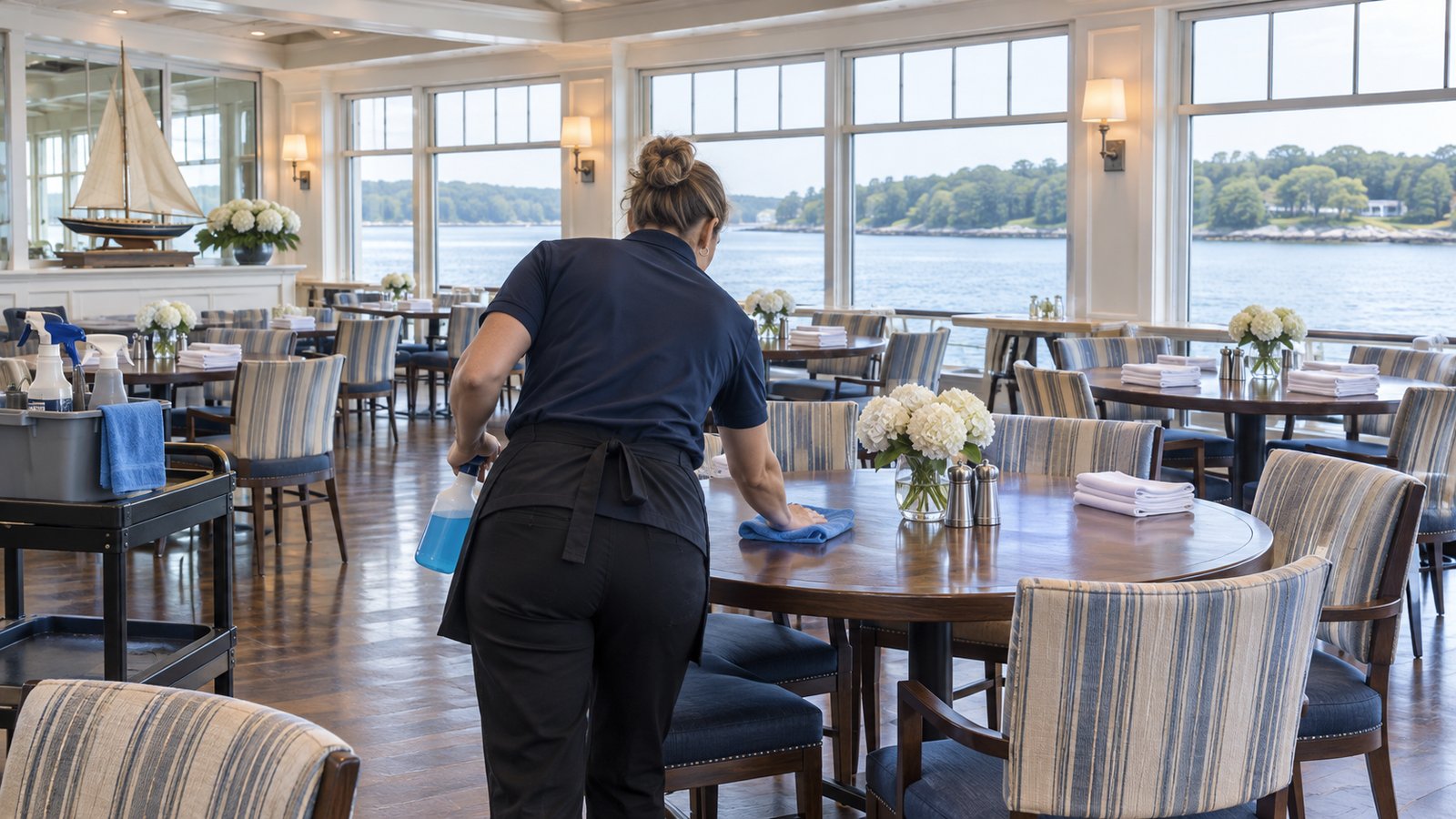
A yacht club is part hospitality venue, part workplace, and part waterfront facility. Members and guests expect dining rooms, lounges, locker rooms, restrooms, and arrival areas to be ready before events, while staff must manage tracked-in sand, damp weather, marina traffic, and changing seasonal use. Choosing yacht club cleaning services in Fairfield County, Connecticut, therefore requires more than comparing a nightly office-cleaning quote. GreenPoint Maintenance Services helps facility buyers turn those operating realities into a written task schedule, fixed price, and visible quality checks.
Account for waterfront traffic and seasonal use
Fairfield County clubs serve communities along Long Island Sound, from Greenwich and Stamford through Norwalk, Westport, and Fairfield. A club near the Stamford Transportation Center or the Metro-North station in Westport may host commuters and visitors at different times than a private harbor facility; the exact schedule should follow the club calendar, not a generic weekday assumption. Spring commissioning, summer dining, regattas, lessons, and private events can create sharp changes in occupancy. Create a calendar that distinguishes baseline service from pre-event reset and post-event recovery.
Waterfront conditions also affect housekeeping. Rain, salt spray, wet shoes, sunscreen, food service, and sand can increase the need for entrance attention and spot response, but cleaners should not be assigned marina maintenance or vessel work by implication. Identify the transition between public spaces, staff-only areas, docks, and any restricted operations zone. A walkthrough should note entrances, flooring, drains, storage, access controls, and the safe route for carts and supplies. GreenPoint can use that review to build a service window that respects member activity and employee shift changes.
Define a room-by-room service scope
A useful proposal lists each area and task rather than treating the entire clubhouse as one line. Dining rooms may need tables and touchpoints cleaned after service, floors attended to after food activity, and waste removed at a defined interval. Locker rooms call for a clear restroom and shower routine, replenishment responsibilities, and a response path for plumbing or odor complaints. Lounges, meeting rooms, offices, and public entrances each require their own frequency and appearance standard. Specify what is included in daily work and what belongs in periodic carpet, upholstery, window, or floor maintenance.
The contract should also state whether club employees set tables, move furniture, handle member property, or reset event equipment. A cleaning crew should not be expected to relocate personal belongings, handle cash, or move heavy furniture unless the task is separately authorized and safely planned. For floors, identify the finish and approved method so a cleaner does not apply an incompatible product to wood, stone, resilient flooring, or a specialty surface. GreenPoint's guide to commercial cleaning frequencies by facility type can help a facilities committee structure a schedule for different spaces.
Plan around events, dining service, and members
A yacht club's cleaning schedule should connect to its event calendar. Establish a normal recurring scope, then define how the club requests an event reset, what rooms are included, the deadline, and whether the request has a separately agreed price. This avoids relying on informal texts to a cleaner or assuming extra work is included in the recurring fee. For a summer regatta weekend, for example, the club may need additional restroom checks, waste removal, and entrance attention, while a small weekday meeting may need only a conference-room reset.
Control access by documenting keys, alarm procedures, staff contacts, and areas that remain closed during service. Schedule louder or more disruptive tasks when dining and member activities are finished, and set a respectful approach for working around guests who arrive early. A supervisor should know who can approve a scope change and where to report a safety or maintenance issue. GreenPoint Maintenance Services can coordinate a walkthrough and confirm service windows by calling 347-332-9348. When a venue serves members from Greenwich to Bridgeport, consistent documentation helps leadership compare service quality across buildings and seasons.
Protect finishes, staff, and waterfront access
Cleaning products and methods should match the surface and the label directions. The club should disclose stone sealers, wood finishes, specialty glass, food-service restrictions, and any manufacturer instructions before work begins. Ask the contractor how products are labeled, stored, and communicated to staff. OSHA's Hazard Communication requirements make access to safety information and training important subjects for a vendor review. Keep products secured from members and children, and agree on who is responsible for moving, locking, and replenishing supplies.
Slip prevention requires particular attention at entries, locker rooms, and paths between outdoor and indoor spaces. Define how the cleaning team uses signs, divides a floor into manageable sections, and confirms that an area is dry before it reopens. Clearly separate janitorial duties from dock, vessel, grounds, and maintenance work. GreenPoint uses Green Seal-certified products where appropriate to the contracted scope and surface; the chosen product still needs to fit the task and facility instructions. For floor appearance benchmarks and inspection language, see the ISSA clean standards guide.
Compare pricing and contractor qualifications
Give every bidder the same area list, expected service days, event assumptions, consumable responsibilities, and periodic-work requirements. Ask for a fixed recurring price, a separate schedule of approved event or project charges, and written assumptions about access and supply storage. A price per square foot can help as an initial comparison, but it cannot replace a room-level scope for a clubhouse with dining, locker, meeting, and member areas. The proposal should explain supervision, staffing continuity, substitute coverage, insurance, complaint handling, and how the provider will respond if a task is missed.
Verify references from facilities with similar hours and public-facing expectations. Ask whether the vendor can document training, protect confidential areas, and report maintenance issues without exceeding its authority. GreenPoint Maintenance Services is an MBE-certified commercial cleaning provider with fixed pricing, no hourly billing, and no hidden fees. The company reports 98% client retention and uses JaniTrack for selected timestamped GPS-tagged photos, task records, and a live dashboard. A club should still examine the actual proposed scope, service references, and quality process before making an award.
Make inspection and service recovery visible
A practical quality program checks a limited number of meaningful outcomes: the arrival area, dining-room readiness, restroom condition, locker-room floors, waste removal, and completion of agreed periodic tasks. The club and contractor should decide how often these points are inspected, who records a deficiency, who owns correction, and when a manager is notified. If a spill, leak, or damaged fixture is outside the cleaning contract, the record should route it to the club's maintenance team instead of letting it disappear into a generic complaint queue.
JaniTrack can give GreenPoint clients a record of selected completed tasks, timestamped GPS-tagged photos, and reported exceptions through a live dashboard. Documentation supports communication but does not replace a manager's judgment or establish that a surface is safe for every use. ATP testing, when included in a site-specific protocol, is one measure of residual organic material and should be interpreted with its sampling method and limits. Review repeat issues monthly and adjust the service schedule when a seasonal event calendar changes. Call GreenPoint at 347-332-9348 to discuss a facility walkthrough and evidence plan.
Choose a vendor for the whole operating relationship
Before signing, confirm that the proposal covers the club's actual hours, event-request process, special surfaces, restrooms, storage, access rules, service recovery, and periodic projects. Ask for named supervision and a simple escalation path that works when the facilities manager is off-site. A stable contract should distinguish routine work from event-driven extras so the club can budget responsibly. If a vendor's scope is vague, request revisions before award rather than assuming verbal assurances will resolve disagreements later.
GreenPoint Maintenance serves institutional and commercial facilities across its regional service area and can review Fairfield County requirements through an on-site walkthrough. A buyer can ask for a sample task schedule, JaniTrack verification example, insurance documents, and written fixed-price terms. For yacht club cleaning in Fairfield County, the best vendor is one that makes the working boundaries clear: what is cleaned, when it is cleaned, what proof is available, and what remains the club's responsibility. Contact GreenPoint Maintenance Services at 347-332-9348 or info@greenpointms.com.
At the start of the season, review the service plan against the opening calendar, expected member use, staff coverage, and planned capital work. A new floor finish, renovated restroom, or change to dining hours may require updated products or a different route. Keep a written change log that records the request, approval, start date, and any revised recurring price. At season's end, evaluate service complaints alongside event volume and weather conditions instead of making a staffing change based on one unusually busy weekend. GreenPoint can use the documented review to refine the next schedule while keeping event extras separate from routine janitorial tasks.
Frequently asked questions
Q: What areas should yacht club cleaning include? A: Most scopes consider entrances, dining and lounge spaces, restrooms, locker rooms, meeting rooms, offices, and waste handling. The exact list should reflect the club's layout and member schedule. Marina, vessel, dock, kitchen production, and grounds work should be explicitly included only when the provider is qualified and the task is separately defined.
Q: How should clubs handle regatta and event cleaning? A: Keep a baseline recurring scope, then create a written request process for event resets, extra restroom checks, and post-event recovery. Agree on deadlines, access, rooms, staffing, and pricing before the season begins. A calendar-based process reduces last-minute confusion and gives the club a more predictable budget.
Q: What should Fairfield County clubs ask a cleaning contractor? A: Ask for a room-by-room schedule, supervision and backup coverage, insurance documents, product and safety information, fixed-price assumptions, references, and sample inspection records. Confirm how the company handles member access, protected areas, maintenance reports, and service corrections. Ask for a walkthrough so the quote accounts for waterfront entry conditions and seasonal demand.
Q: How can a club request a cleaning proposal from GreenPoint? A: Prepare the facility address, service hours, event calendar, room list, floor types, and known access restrictions, then request an on-site review. GreenPoint Maintenance Services can discuss a written scope, fixed pricing, and JaniTrack verification. Call 347-332-9348 or email info@greenpointms.com to schedule a walkthrough.
Schedule a Fairfield County yacht club cleaning walkthrough with GreenPoint Maintenance Services at 347-332-9348. Review a fixed-price scope backed by JaniTrack task records, timestamped GPS-tagged photos, and a live dashboard.