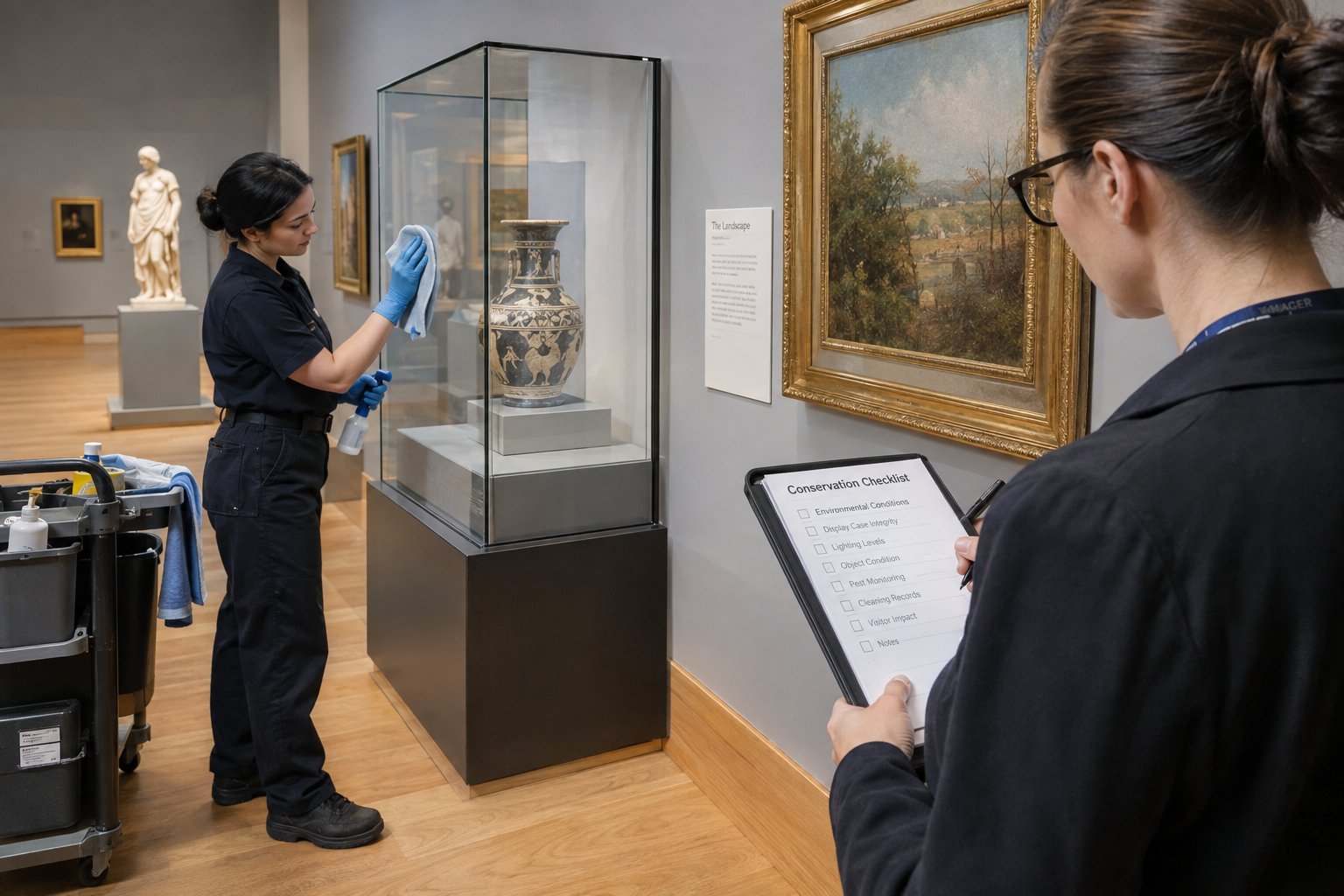
Museum and Gallery Cleaning RFPs is a facility-operations decision: service must protect people and property while fitting the way the site is actually used. For museums, galleries, cultural institutions, exhibition designers, and procurement teams, a generic nightly checklist can miss critical differences between public, shared, restricted, and staff-only spaces. GreenPoint Maintenance Services recommends starting with approved room boundaries, clear task frequencies, product controls, documented exceptions, and a practical inspection plan. This guide is written for buyers across the New York, New Jersey, and Connecticut market, including Manhattan museum and gallery districts, Brooklyn cultural venues, Queens exhibition spaces, Newark, Jersey City, Stamford, and wider regional institutions. GreenPoint can walk the site, map the scope, and prepare a fixed-price proposal with no hourly billing or hidden fees; schedule a walkthrough at 844-814-0810. Use the companion guides on [how to write a commercial cleaning RFP](/blog/how-to-write-rfp-commercial-cleaning/) and [digital cleaning verification systems](/blog/digital-cleaning-verification-systems/) when developing the vendor package.
Map zones, use, and responsibility before bidding
Begin with a floor plan and a zone register rather than a single gross-square-foot number. For this type of facility, mark galleries, lobbies, ticketing, education rooms, event spaces, restrooms, offices, storage corridors, loading areas, and conservation-restricted rooms. Add approximate cleanable area, floor material, operating hours, occupant volume, water access, storage, and the person who owns each room. A 20,000-square-foot site split among shared offices, public rooms, and restricted work areas does not have one uniform cleaning risk; the scope should show the difference. In particular, record dust and grit, visitor traffic, sensitive finishes, vibration or moisture risks, event changeovers, and accidental contact with collection objects by room instead of burying it in a general note.
At the walkthrough, identify collection protection, case clearances, approved cleaning agents, security escorts, object handling prohibitions, and restricted storage. GreenPoint Maintenance Services uses a site-specific task matrix to show what the contractor cleans, what facility staff retain, and what requires approval before action. Mark rooms that are excluded, access-controlled, or dependent on another team's release. This prevents a bid from quietly assuming an unrestricted route and gives procurement a fair basis for comparing labor, training, supervision, and service windows.
Set frequency by activity and service outcome
Frequency should reflect how quickly a surface or room returns to use, not just its label. Model busy periods, occupancy peaks, food or animal activity where relevant, visitor turnover, and hours between the last service and the next arrival. For dust and grit, visitor traffic, sensitive finishes, vibration or moisture risks, event changeovers, and accidental contact with collection objects, divide work into routine daily tasks, between-use resets, periodic detailing, and event or incident response. A lower-frequency schedule can work for quiet offices; shared or public zones may require checks during operations.
GreenPoint recommends that buyers define an outcome for every visit: examples include a room ready by a stated handoff time, waste removed from named stations, or a restroom checked at specific intervals. Do not use "as needed" without a trigger and response deadline. Compare the schedule against booking calendars, clinic or production shifts, and weekend events, then review missed or extra work monthly. The result is a service calendar people can staff and auditors can understand. Use gallery release, approved method adherence, visitor-facing presentation, event reset timing, incident reports, and access-control records as the first review set, then revise the cadence only when the evidence supports it.
Choose products and methods that fit the environment
Write down permitted products, surfaces, dilution controls, dwell or contact times, and methods that are prohibited. For using only conservation-approved tools and routes, keeping a clear no-touch zone around objects and cases, and deferring uncertain work to museum staff, instructions need to be specific enough that a trained relief cleaner can follow them on a weekend shift. Separate routine soil removal from disinfection and from any specialized technical or clinical process; the contract should never promise a level of treatment that is outside the contractor's approved training or the site's written procedures. The approved procedure should explicitly account for using only conservation-approved tools and routes, keeping a clear no-touch zone around objects and cases, and deferring uncertain work to museum staff.
GreenPoint uses Green Seal certified products where appropriate and confirms product compatibility with the facility before deployment. Keep current labels and Safety Data Sheets available at the work location, identify who approves substitutions, and define a process for damaged containers or spills. CDC community-facility guidance advises regular cleaning of high-touch surfaces and targeted disinfection when indicated; follow the [CDC facility cleaning guidance](https://www.cdc.gov/hygiene/about/when-and-how-to-clean-and-disinfect-a-facility.html) and stricter site-specific rules when they apply.
Control access, safety, and training
Security and safety are part of the cleaning method. The site plan should record badge permissions, keys, alarms, escort rules, doors that must remain secured, emergency contacts, and the route for moving tools and waste. Train cleaners on collection protection, case clearances, approved cleaning agents, security escorts, object handling prohibitions, and restricted storage and the relevant room sequence before a first shift. GreenPoint asks clients to identify what cannot be moved or photographed, who releases an area, and how an employee reports an unsafe condition without improvising. A written sign-off should also address school groups, timed admission, evening openings, gallery talks, member events, deliveries, and weekend visitor surges.
Require documented onboarding, PPE instructions, chemical handling, incident reporting, and refresher training for each role. OSHA's [Hazard Communication Standard](https://www.osha.gov/laws-regs/regulations/standardnumber/1910/1910.1200) addresses worker information about chemical hazards; where exposure to blood or other potentially infectious materials is reasonably anticipated, the employer must evaluate applicable [bloodborne-pathogens requirements](https://www.osha.gov/laws-regs/regulations/standardnumber/1910/1910.1030). The facility's safety lead should confirm which requirements apply to the actual tasks rather than assume a general janitorial scope settles the question.
Protect operations with a room-level checklist
Translate the scope into a checklist with a room name, task, frequency, assigned role, completion record, and exception path. In a museums, galleries, cultural institutions, exhibition designers, and procurement teams setting, a missed room can affect the next appointment, member booking, shoot, class, or visitor experience. Use a clean-to-dirty sequence, dedicated tools where required, and visible labels for carts or storage. Give the on-site contact a way to report a blocked room, unexpected spill, or schedule change before it becomes a repeat complaint. A well-scoped checklist can verify gallery release, approved method adherence, visitor-facing presentation, event reset timing, incident reports, and access-control records without documenting sensitive content.
GreenPoint tracks service through StockPoint, which can capture timestamped GPS-tagged photos, task completion, exceptions, and a live dashboard. Photos are useful evidence only when they respect privacy, security, and collection or production rules; do not photograph screens, records, people, artwork, or confidential work unless specifically authorized. ATP testing may be added at selected touchpoints when the client wants an additional hygiene indicator, but it is not a substitute for correct technique, inspection, or the site's own protocol.
Write the RFP around measurable service and complete cost
A useful RFP attaches the zone map, frequency matrix, room access rules, expected service windows, supply responsibility, and periodic-work calendar. Include a schedule for school groups, timed admission, evening openings, gallery talks, member events, deliveries, and weekend visitor surges and describe how the vendor should respond when work is blocked. Ask bidders to state supervisor coverage, staffing assumptions, relief arrangements, onboarding time, insurance, product list, and the treatment of after-hours calls. Require each proposal to identify exclusions and assumptions instead of hiding them in a general phrase such as standard cleaning.
Compare total cost using a transparent calculation: scheduled labor hours multiplied by the loaded labor rate, plus approved supplies, equipment, supervision, and separately scoped periodic projects. As a worked example, two cleaners scheduled for three hours on five shifts create 30 scheduled labor-hours per week before relief coverage and periodic work; that arithmetic is not a market price or productivity guarantee. GreenPoint offers fixed pricing without hourly billing, so the agreed room list and visit plan are visible before service begins. Call 844-814-0810 to schedule a walkthrough and quote. The buyer should also ask the vendor to explain how it budgets for dust and grit, visitor traffic, sensitive finishes, vibration or moisture risks, event changeovers, and accidental contact with collection objects.
Launch, review, and adapt the program
Before launch, test badge access, storage, emergency contacts, product approvals, room release, and photo rules on a small representative route. Hold a kickoff with the site manager and vendor supervisor, then review performance at day 7, day 30, and day 90. Track gallery release, approved method adherence, visitor-facing presentation, event reset timing, incident reports, and access-control records; for each exception assign an owner, due date, and documented correction. GreenPoint uses this feedback loop to adjust task frequencies without weakening restricted-area controls or allowing changes to drift into an undocumented verbal agreement.
Regional buyers should confirm who supervises nearby locations and how service continuity works across multiple buildings. A Manhattan office, a Queens facility, a Westchester campus, and a New Jersey or Connecticut site may share a brand but not a single access rule or operating calendar. GreenPoint Maintenance Services is MBE/MWBE certified through New York programs, NYC, and NYC DOE, SAM.gov registered, and reports 98% client retention. Credentials are useful procurement evidence, but buyers should also request a sample dashboard, references, insurance, and a named escalation contact. Call 844-814-0810 to discuss a multi-site scope or ask about a site visit. Plan staffing around school groups, timed admission, evening openings, gallery talks, member events, deliveries, and weekend visitor surges so a neighboring account does not become a substitute for local supervision.
Frequently asked questions
Q: Can a commercial cleaner clean around museum objects?
A: Only within a written, conservator-approved scope. The default should be no touching, moving, dusting, or applying product near collection objects unless trained museum staff authorize the task and method.
Q: What should a museum cleaning RFP exclude?
A: List object handling, case interiors, conservation treatment, pest treatment, and any restricted storage or collection work unless separately qualified and explicitly authorized. State the boundary, escort requirement, and escalation contact in the bid documents.
Q: How often should gallery floors be cleaned?
A: Set frequency by visitor load, floor finish, exhibition layout, and conservator guidance. High-traffic entrances may need more frequent grit removal, while quiet galleries can use a lower-impact schedule; test methods on approved areas before broad use.
Q: What proof should a museum cleaning vendor provide?
A: Request completed zone logs, supervisor inspections, event reset sign-offs, training records, product approvals, incident notices, and access records. A dashboard or timestamped photos can verify selected tasks, but images must respect security and collection confidentiality.
Schedule a site walkthrough and fixed-price quote with GreenPoint Maintenance Services at 844-814-0810. GreenPoint provides StockPoint service verification, MBE/MWBE credentials, and a 98% client-retention record; we will map your rooms, operating windows, and proof requirements before proposing a scope.