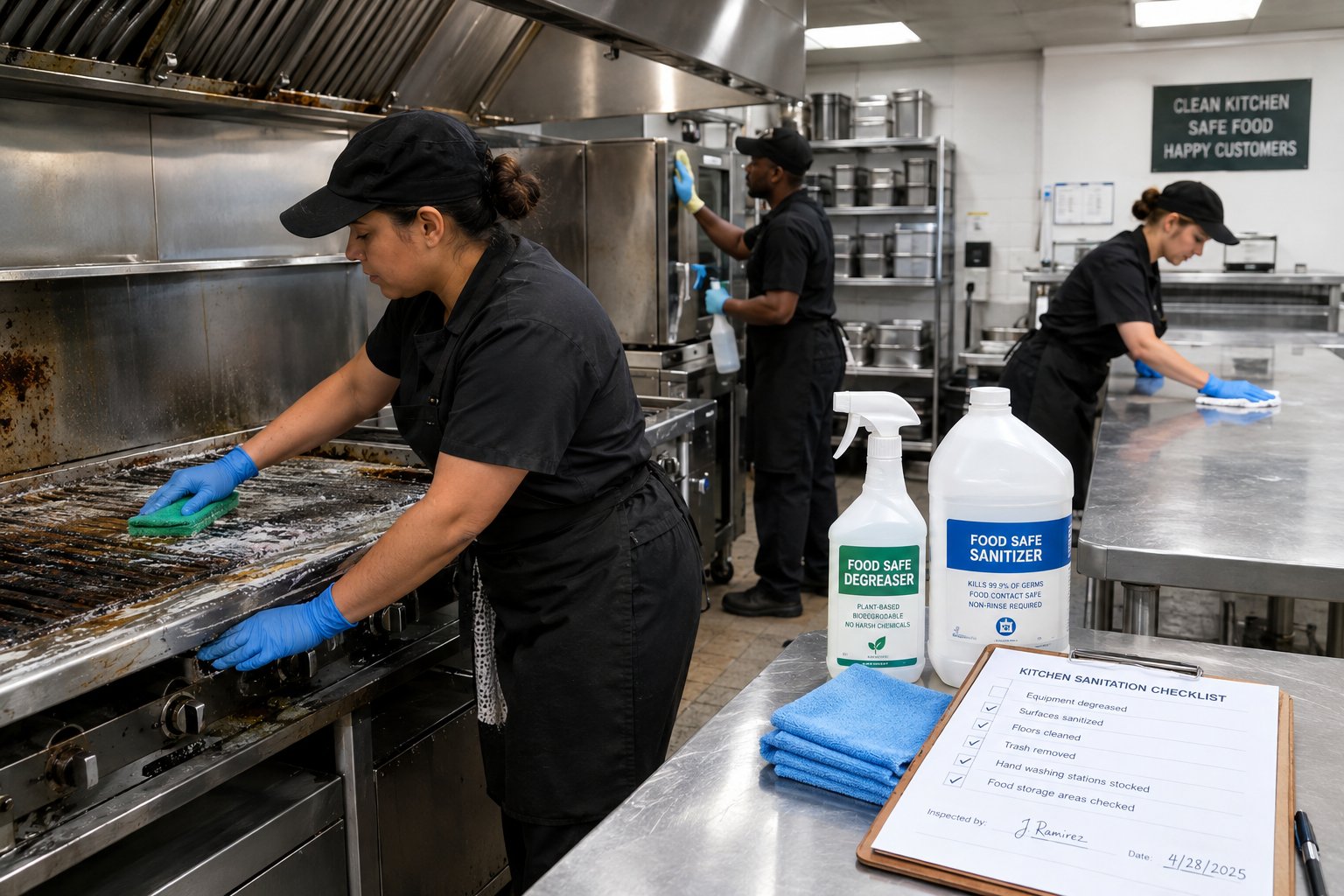
Restaurant operators need more than a mop-and-bucket promise. A commercial kitchen must control grease, soil, allergens, pests, slips, and odors while protecting food-contact surfaces and keeping service moving. The right deep-cleaning contract states exactly what gets cleaned, how often, which products are used, and what proof the manager receives. GreenPoint Maintenance Services creates evidence-based kitchen programs for restaurants, commissaries, hotels, schools, and corporate cafeterias throughout Manhattan, Brooklyn, Queens, the Bronx, Staten Island, Westchester, Long Island, New Jersey, Connecticut, Pennsylvania, and Florida. GreenPoint pairs trained crews with StockPoint timestamped, GPS-tagged photos so an owner can verify a completed shift without guessing.
What a restaurant kitchen deep-cleaning contract should cover
Put handoffs into the scope as carefully as the cleaning tasks. Specify who cools and empties equipment, who removes food and utensils, which manager releases the room, and how a late delivery or active repair changes access. A closeout record should separate completed work from work deferred because a station was hot, occupied, or unsafe. New York City restaurant operators can compare their operating procedures with [NYC Health's restaurant guidance](https://www.nyc.gov/site/doh/business/food-operators/operating-a-restaurant.page); a janitorial contract supports the operator's food-safety program but does not replace it.
A useful scope begins with a room map rather than a generic phrase such as complete kitchen cleaning. It should identify exhaust hoods and filters, backsplashes, walls, floors, drains, ovens, ranges, fryers, griddles, refrigeration exteriors, shelving, waste areas, loading zones, mop sinks, and employee restrooms. It should distinguish food-contact surfaces from non-food-contact surfaces and state whether the restaurant or cleaning provider is responsible for equipment lockout, cool-down, disassembly, and reassembly. GreenPoint Maintenance Services records the scope by zone, assigns a responsible technician, and documents exceptions before the first service.
A contract should also specify the service window, staffing level, estimated labor hours, access rules, emergency contact, insurance certificates, product approval process, and what happens when a piece of equipment cannot be safely moved. Fixed pricing is usually clearer than an hourly invoice: GreenPoint Maintenance offers fixed scopes with no hidden fees and no surprise hourly billing. A manager can request a walkthrough and quote at 844-814-0810, then compare the line items against the kitchen layout before signing.
Q: How often should a commercial kitchen be deep cleaned?
Frequency depends on cooking volume, menu, grease load, ventilation design, and inspection history. A high-volume fryer line may need detailed degreasing weekly, while a low-volume office café may need it every four to eight weeks. Floors near fryers and dish areas generally need a nightly scrub and degrease; hood filters often need weekly attention; walls, ceilings, and high ledges usually need a monthly or quarterly rotation. Exhaust systems must follow the schedule required by the equipment manufacturer, the fire protection contractor, and applicable fire code. A written risk assessment is more defensible than using one calendar for every kitchen.
The National Restaurant Association and health departments emphasize preventing buildup rather than waiting for visible failure. GreenPoint builds a daily, weekly, monthly, and quarterly matrix, with extra service before inspections, menu launches, holiday volume, or a change in ownership. Managers can schedule a no-obligation walkthrough through 844-814-0810. The resulting plan shows the square footage, soil risks, access constraints, and recommended crew hours without tying the restaurant to an oversized package.
Food-contact safety, chemicals, and dwell time
Keep the steps visibly distinct: remove food debris, wash with the specified cleaner, rinse when the label directs it, then apply a product approved for the intended sanitizing or disinfecting use at its labeled concentration and contact time. A product described as green or plant-derived is not automatically a food-contact sanitizer. GreenPoint lists the task and product separately in its work plan, trains crews to use test strips when the facility protocol calls for them, and leaves food equipment ready for the operator's release check.
Degreasers are effective on carbonized oil but are not automatically appropriate for food-contact surfaces. A kitchen protocol should name the product, dilution, application method, dwell time, rinse requirement, and final visual check for every zone. GreenPoint uses Green Seal certified products where the task allows, follows manufacturer labels, and keeps food-safe rinse procedures separate from restroom or floor chemistry. Crew members use color-coded microfiber and tools to reduce cross-use between food preparation areas, restrooms, and waste handling.
The supervisor should verify that burners are cool, electrical controls are protected, and equipment is returned to its operating position. Staff should never spray a chemical into an energized control panel or leave a concentrated product in an unmarked bottle. OSHA Hazard Communication requirements mean labels and Safety Data Sheets must be available to workers. If a restaurant needs a broader chemical program, GreenPoint recommends [OSHA cleaning chemical safety and GHS/SDS practices](/blog/osha-cleaning-chemical-safety-ghs-sds/) and documents training rather than relying on verbal instructions.
A room-by-room deep-cleaning sequence
An effective sequence also includes a release check. The supervisor verifies that guards and removable parts are returned, floors are dry or clearly barricaded, chemicals are removed from food-preparation surfaces, and equipment controls are unobstructed. The kitchen manager then signs for access restoration and notes any maintenance issue that should not be treated as a cleaning defect. GreenPoint records hold points in StockPoint so the next shift can see where the crew stopped and why.
The sequence matters because cleaning from high to low and clean to dirty prevents rework. Crews first secure the work area, remove movable items, dry-remove debris, and photograph pre-existing damage. They then clean high surfaces and ventilation covers, degrease equipment exteriors, detail walls and splash zones, scrub floors and drains, wash waste areas, and finish with food-contact surfaces using the required rinse. CleanPoint-style checklists are not enough by themselves; GreenPoint pairs each checklist item with a supervisor review and a StockPoint record.
For a 2,500-square-foot neighborhood restaurant in Astoria or Park Slope, a two- or three-person overnight team may need four to six hours for a heavy monthly rotation, depending on equipment condition. A 10,000-square-foot commissary near Hunts Point or Long Island City may require a larger crew, staged access, and separate production zones. These are planning benchmarks, not promises: the walkthrough at 844-814-0810 determines the actual staffing and downtime.
Verification that helps an owner pass inspections
Use the evidence to drive corrections rather than to promise an inspection outcome. A photo of a cleaned drain, for example, can document service, while a separate note can flag standing water, damaged grout, or an inaccessible grease trap that requires another trade. Keep service records alongside temperature logs, pest-control documentation, hood-cleaning certificates, and the operator's own sanitation records; each record has a different owner and purpose. GreenPoint provides dated, location-linked service evidence without representing that cleaning alone guarantees a passing grade.
A signed paper checklist proves that someone completed a form; it does not prove what the kitchen looked like. Strong verification includes timestamped, GPS-tagged before-and-after photos, exception notes, product records, supervisor sign-off, and a corrective-action deadline. GreenPoint's StockPoint dashboard lets an operator review completion by location and date, which is especially useful when a multi-unit group needs consistent evidence across Manhattan, Newark, Stamford, or Philadelphia.
Managers should retain cleaning records for the period required by their internal policy and local authority, and they should connect the record to pest-control observations, grease-trap service, hood inspections, and temperature or sanitation logs. GreenPoint reports unresolved access or equipment defects instead of marking them complete. That proof-driven approach supports an inspection conversation and gives the next shift a clear handoff. To request a sample report, call 844-814-0810 or schedule a kitchen walkthrough.
Local operating realities in the tri-state area
Local scheduling can be decisive. A restaurant in the Theater District may need a freight-elevator reservation and a narrow post-close window; a Brooklyn site near Atlantic Terminal may have event surges; Queens locations around Flushing or Astoria may need special delivery coordination. White Plains, Stamford, Newark, and Jersey City sites often require an access contact who can release the kitchen after the last production run. GreenPoint maps each location's hours, transit and loading constraints, and escalation contact before it prices the recurring visit.
Restaurant cleaning in Midtown Manhattan may need to happen around late-night deliveries, subway access, union building rules, and limited freight-elevator windows. A Brooklyn or Queens site near Atlantic Terminal, Jackson Heights, Flushing, or Astoria may have different parking and access constraints. In the Bronx, a kitchen near Yankee Stadium can face event-driven volume; in Jersey City, Newark, or Hoboken, a crew may coordinate with a mixed-use property manager. Stamford, White Plains, and Long Island locations often require travel sequencing that should be reflected in the service plan.
Local health departments, fire officials, landlords, and insurers each care about different evidence. GreenPoint Maintenance Services coordinates the cleaning scope with the facility's existing hood contractor and food-safety procedures rather than claiming to replace them. Operators who want broader cost context can read [commercial cleaning cost per square foot](/blog/commercial-cleaning-cost-per-square-foot/) and then request a fixed quote for their actual kitchen.
How to compare bids without choosing the cheapest invoice
Compare bids by cleanable scope, frequency, staffing, response time, products, supervision, insurance, and verification. Ask whether the vendor prices fryer interiors, hood filters, floor drains, grease on walls, high dusting, and emergency call-backs separately. Ask what happens when the kitchen is not ready at the scheduled time. A low bid that excludes the dirtiest zones may create a second invoice and a failed inspection, while a transparent fixed-price scope makes the total cost easier to forecast.
GreenPoint provides a written scope, a service calendar, and escalation contacts before work begins. The company is MBE/MWBE certified in New York, SAM.gov registered, and supports commercial sites from the five boroughs through Westchester, Long Island, New Jersey, Connecticut, Pennsylvania, and Florida. GreenPoint's 98% client retention is a useful proof point, but managers should still inspect the exact scope and request references for comparable food-service operations.
Frequently Asked Questions
Q: How much does restaurant kitchen deep cleaning cost?
Pricing depends on square footage, grease load, equipment, access, and frequency. A small 1,500- to 3,000-square-foot restaurant may require several hundred to more than $1,000 for a detailed rotation, while a large production kitchen may cost several thousand. GreenPoint gives a fixed quote after a walkthrough at 844-814-0810 so the operator can see inclusions before approving the work.
Q: Can a cleaning company clean around food production?
Yes, when the schedule, barriers, product labels, equipment cool-down, and food-contact rinse process are documented. GreenPoint coordinates with the manager, protects ingredients, separates tools by zone, and records exceptions in StockPoint. Cleaning crews do not substitute for a hood-inspection or pest-control contractor.
Q: How frequently should a restaurant schedule a deep clean?
Many high-volume kitchens use weekly or monthly rotations, with nightly routine cleaning and quarterly high-detail work. The correct interval depends on grease accumulation and inspection risk. GreenPoint assesses the kitchen rather than assigning the same frequency to a café, banquet kitchen, and commissary.
Q: What proof should a restaurant receive after service?
The useful package includes a completed zone checklist, timestamped photos, GPS or location verification, product and exception notes, supervisor approval, and corrective-action follow-up. GreenPoint supplies StockPoint records and can review the dashboard with an owner or multi-unit operations team.
Call GreenPoint Maintenance Services at 844-814-0810 to schedule a restaurant kitchen walkthrough and fixed-price quote. GreenPoint's MBE/MWBE-certified team uses StockPoint timestamped, GPS-tagged proof, Green Seal products where appropriate, and a 98% client retention record to make deep cleaning verifiable.