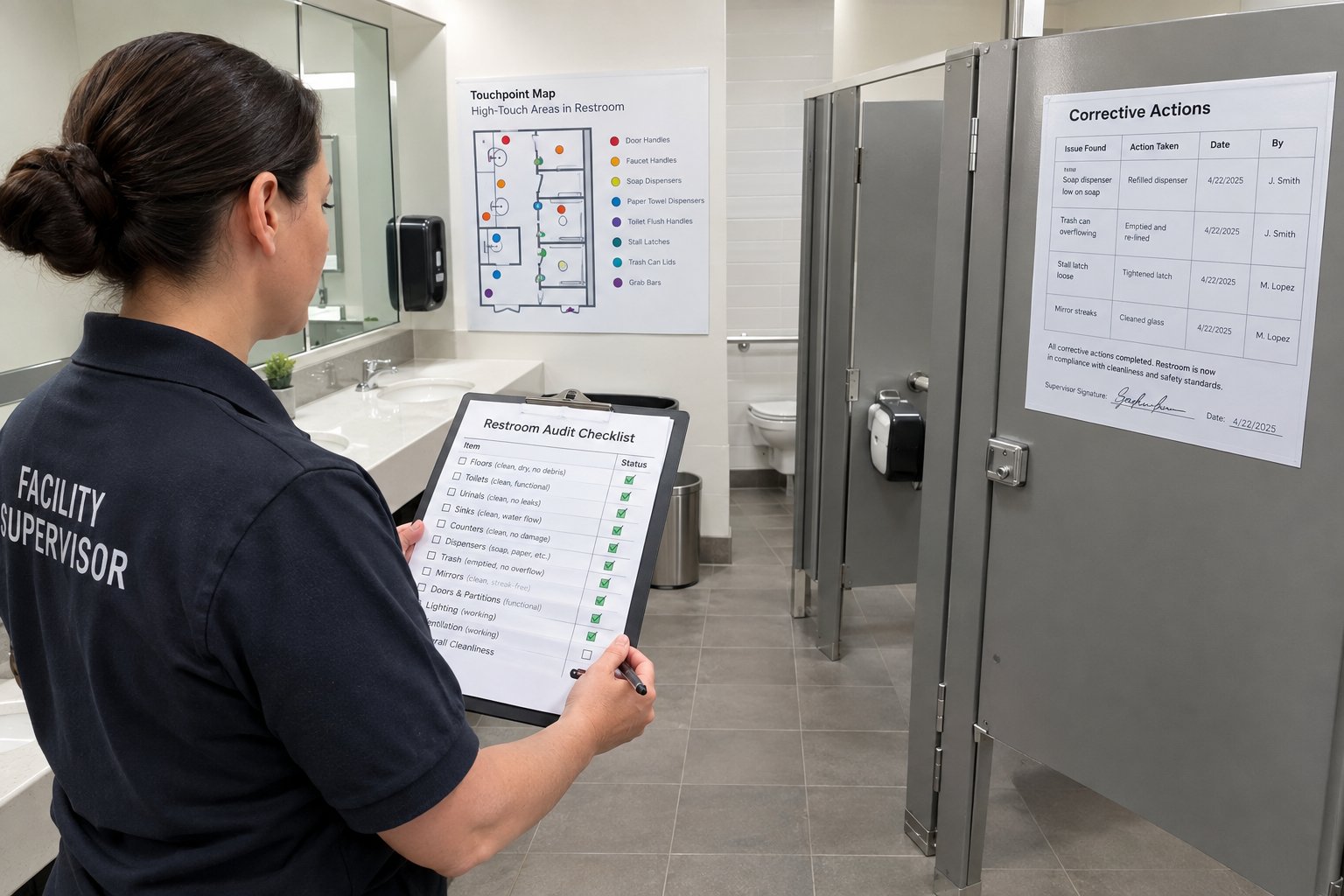
A restroom can look acceptable for five minutes and still fail the next handoff. A reliable restroom cleaning quality audit tests the details people touch, smell, and notice: soap availability, paper inventory, drain condition, fixture soil, floor edges, odor sources, and whether the documented service actually happened. For commercial properties in New York, New Jersey, Connecticut, Pennsylvania, and Florida, the audit should connect an appearance standard to measurable evidence and a corrective-action deadline.
Why a visual walk-through is not enough
A quick visual check usually rewards the last task completed rather than the full user experience. A polished mirror can distract from an empty towel dispenser, a loose toilet seat, residue below a sink, or a door pull that was missed. ISSA appearance levels are useful because they create shared language, but an audit should also record supply status, touchpoint completion, odor, fixture function, and the time each defect was found. GreenPoint turns those observations into a repeatable scorecard instead of a subjective pass or fail.
The manager should define the inspection moment. A restroom at 6:00 a.m., noon, and 5:30 p.m. may have three different risk profiles. A Midtown tower near Times Square needs a different sampling plan from a small Staten Island office, a Bronx community facility, or a Westchester medical suite. GreenPoint recommends a baseline audit during peak occupancy and a second observation after service so the contract measures durability, not only a freshly cleaned room.
Build an audit map by zone and touchpoint
Start with a room map: entrance door, stall doors, flush controls, faucets, soap dispensers, towel or dryer controls, grab bars, partitions, counters, mirrors, waste containers, vents, floor perimeter, and the area behind fixtures. Mark high-touch points separately from appearance points. The map can then be reused by every inspector, which improves inter-rater consistency. For a 10,000-square-foot office, a practical sample may include every restroom plus a rotating 20% of touchpoints each shift, with all complaints logged regardless of sample size.
Use color-coded microfiber and a defined top-to-bottom sequence so a clean surface is not recontaminated. OSHA chemical-label and SDS expectations still apply even when Green Seal certified products are selected. GreenPoint documents product, dilution, dwell time, PPE, and disposal instructions in the work plan. Managers can pair this with [restroom cleaning best practices](/blog/restroom-cleaning-best-practices-high-traffic/) and a broader [cleaning audit checklist](/blog/cleaning-audit-checklist-facility-managers/) to keep field observations aligned with the contract.
Choose metrics that explain the score
A useful audit has separate measures rather than one inflated percentage. Track appearance compliance, supply availability, touchpoint completion, odor-free condition, fixture functionality, and response time. A 95% appearance score with 82% soap availability is not a 95% restroom. GreenPoint recommends a weighted score where life-safety or hygiene failures are critical defects, empty hand-soap or towel dispensers are major defects, and minor marks are trend items. The weighting should be approved before the first audit.
Record denominator and time window for every metric. “Three defects” means little without the number of rooms inspected, the shift, and the defect age. A facility might set a target of 98% stocked dispensers at every inspection, 100% completion of critical touchpoints, and a 15-minute response to an active spill. These are operating targets, not universal legal requirements; the contract should define them in plain language. GreenPoint can provide a fixed-price walkthrough and translate the selected targets into a dashboard.
Use ATP testing as a coaching tool
ATP bioluminescence can help identify organic residue that the eye misses, especially on faucets, flush handles, stall latches, and baby-changing surfaces. It is not a substitute for culture testing or a guarantee that a surface is pathogen-free. Results depend on the instrument, swab location, threshold, and timing. The right use is trend analysis: establish baseline readings, coach the team on failed points, retest after correction, and investigate recurring locations.
JaniTrack makes that loop easier when the program includes timestamped ATP results alongside photos and task completion. GreenPoint can show whether a reading improved after a revised sequence, a product change, or an added midday touchpoint. A manager should avoid using one reading to punish a cleaner; use a pattern across at least several audits. The [what is ATP bioluminescence testing](/blog/what-is-atp-bioluminescence-testing-cleaning/) guide explains the limitations and the decisions the test can support.
Separate service defects from building defects
Not every restroom problem is a cleaning failure. A slow drain, failed exhaust fan, cracked grout joint, leaking flush valve, or broken dispenser can recreate an odor or soil condition after service. The audit form should have a facilities-maintenance category and assign an owner. GreenPoint photographs the condition, states whether it was present before service, and recommends a temporary control such as a warning sign or extra check until the building team repairs the source.
This distinction protects the vendor relationship and speeds resolution. A building engineer can prioritize a leaking supply line while the cleaning team adds a documented wipe-down. In a school or public facility, the escalation may involve NYC DOE procedures or a local health-department requirement; in a private office it may be the property manager. GreenPoint’s report can include a due date, responsible party, and verification photo so an open defect does not disappear into email.
Set sampling, frequency, and escalation rules
Audit frequency should follow risk and traffic. A high-volume lobby restroom may need a daily supervisor check plus weekly manager review; a low-occupancy suite may use a three-times-weekly check and a monthly trend review. Healthcare, daycare, food-service, and school environments need tighter controls than a lightly used back office. Define who inspects, which rooms are sampled, how a failed critical item is escalated, and when a reinspection occurs.
GreenPoint can align the scorecard to the client’s appearance level, occupancy schedule, and complaint history. A simple rule is: correct critical hygiene or safety items immediately, correct major defects during the same shift, and trend minor appearance defects over seven days. The contract should state whether credits apply, but credits should never replace a correction. Managers can compare the result with [cleaning frequency standards by facility type](/blog/cleaning-frequency-standards-by-facility-type/) before changing labor or routes.
Make the audit useful for budgets and procurement
Audit trends show where a facility needs frequency, training, consumables, or repair rather than a blanket labor increase. If dispenser failures cluster between 2:00 and 4:00 p.m., a 15-minute restock route may outperform an extra nightly hour. If floor-edge soil persists despite cleaning, the answer may be a periodic detail or a flooring repair. If several vendors score differently because their forms use different denominators, procurement should standardize the evidence before comparing price.
GreenPoint reports the relationship between scope, staffing, and outcome. The company can offer a fixed price, no hourly billing, and a walkthrough that identifies assumptions such as number of rooms, peak events, supply ownership, and response windows. Call 347-332-9348 or email info@greenpointms.com to schedule the walkthrough. GreenPoint’s 98% client retention is supported by visible QA records, not by asking a manager to accept an unmeasured promise.
Local implementation in the tri-state area
Local conditions change the scope. In Manhattan, a lobby near Grand Central or the 34 St–Hudson Yards station may need more midday touchpoint work than a low-traffic suite; in Brooklyn, a Dumbo loading entrance sees different soil than a Park Slope office. Bronx facilities near Yankee Stadium, Queens properties around LaGuardia and Jackson Heights, Staten Island sites near the ferry terminal, and Westchester offices along I-287 each have their own traffic patterns. Across New Jersey, Connecticut, Pennsylvania, and New York, GreenPoint maps entrances, elevators, restrooms, freight paths, and weather exposure before setting a frequency.
Weather and event calendars should be part of the audit plan. Salt tracked from a winter sidewalk near Penn Station or PATH entrances changes floor and restroom soil; summer humidity in a Long Island City lobby can increase odor concerns; a Yankees game can change Bronx restroom demand; a concert at Barclays Center can change Dumbo traffic. GreenPoint can set event-day checks, document the trigger, and return to the normal route after the demand spike. For procurement teams, this local schedule is a defensible reason for a variable service line rather than an unexplained surcharge.
Frequently Asked Questions
Q: What should a restroom cleaning audit include? A: Include room and touchpoint identification, appearance level, soap and paper availability, odor, fixture condition, floor and perimeter detail, service time, inspector, photos, corrective action, and reinspection status. GreenPoint can tailor the form to the property and publish the results in JaniTrack.
Q: Is ATP testing required for every commercial restroom? A: No. ATP is an optional verification and coaching tool, not a universal legal requirement. It is most useful when a client wants trend data on selected high-touch surfaces or when visual scores and complaints disagree.
Q: How often should restrooms be audited? A: Use traffic and risk to set the cadence. High-volume facilities often benefit from daily supervisor checks and weekly trend review; lower-risk offices can use a rotating sample. The contract should define the actual schedule.
Q: What does a restroom quality program cost? A: Price depends on rooms, occupancy, frequency, supplies, response windows, and verification requirements. Call 347-332-9348 for a walkthrough and a fixed-price scope rather than relying on a generic per-room guess.
Q: How does GreenPoint handle a failed audit? A: GreenPoint records the defect, assigns a corrective action, documents the fix with a photo or retest when appropriate, and escalates building repairs separately. Schedule a walkthrough at 347-332-9348 or info@greenpointms.com.
A final implementation check keeps restroom cleaning quality audit from becoming an abstract policy. The facility manager should walk the route with the supervisor, confirm access and occupancy, review the first inspection sample, and record any exception before the recurring schedule begins. GreenPoint can use the baseline to set a realistic frequency, identify a repair that belongs to the building team, and make the next review comparable. This step also gives procurement a clean record of what changed from the bid assumption. When the evidence, owner, and due date are visible, a cleaning program is easier to manage across shifts, locations, and seasonal demand. The review should also compare planned and actual service windows, confirm that consumables are being replenished at the stated rate, and identify any recurring complaint that needs a route change. A short written summary protects the client during budget reviews and gives the supervisor a concrete coaching record. It also prevents a one-time event, tenant move, or weather disruption from silently becoming a permanent labor assumption. Keep the signed baseline with the RFP, floor plan, certificate records, and first inspection so a later reviewer can understand both the promise and the result. That discipline makes an inclusive procurement program repeatable today.
Schedule a restroom quality walkthrough with GreenPoint Maintenance Services at 347-332-9348 or info@greenpointms.com. GreenPoint combines fixed pricing, Green Seal certified product options, JaniTrack photos and ATP verification, and a 98% client retention record for facilities across NY, NJ, CT, PA, and FL.