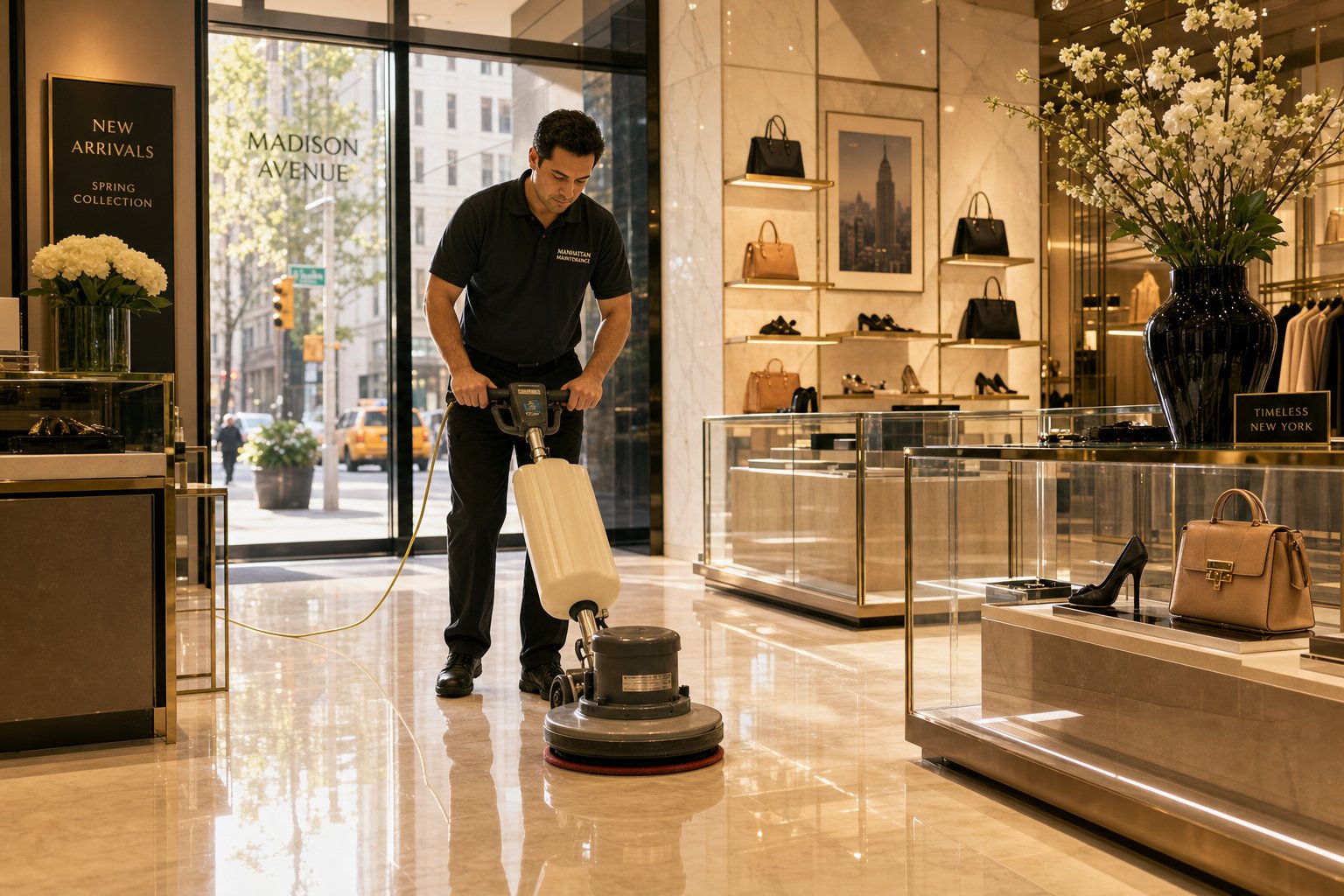
Retail teams in NYC and across the tri-state know the truth: customers judge cleanliness before they read a price tag. From SoHo flagships to Midtown street-level boutiques, the fastest way to lose foot traffic is a dull sales floor, dusty shelving, or streaked glass that makes the space look tired. GreenPoint Maintenance Services builds retail cleaning programs designed for brand presentation and measurable outcomes, not vague checklists. If you need a verified, after-hours retail cleaning plan with fixed pricing and proof of completion, call 844-814-0810 to schedule a walkthrough and quote.
What ‘retail-clean’ means in NYC: appearance levels, touchpoints, and speed
Retail isn’t like an office. You have high-frequency touchpoints (door pulls, POS counters, fitting-room latches), cosmetic standards that must look perfect under bright lighting, and a narrow overnight window to reset the space. Industry guidance like ISSA cleaning standards and appearance levels helps frame what customers perceive as acceptable, but your store also has brand-specific expectations (gloss level, dust tolerance, scent neutrality). GreenPoint uses these standards as a baseline and then tailors the scope by department, traffic pattern, and operating hours. GreenPoint also builds routines that can be verified with StockPoint timestamped, GPS-tagged photos so opening readiness isn’t a debate.
Store traffic patterns: designing cleaning around subways, sidewalks, and seasonal surges
NYC stores pull in debris differently than suburban locations. Foot traffic from transit hubs like Times Sq–42 St, Union Square, Fulton Center, and Grand Central brings fine grit that quickly dulls floors. Rain and slush season adds salt residue that can etch finishes. In the tri-state, malls and shopping centers in Northern New Jersey, Westchester, and Long Island see weekend spikes and stroller traffic that grind particulates into LVT, VCT, and polished concrete. GreenPoint plans increased entry mat maintenance, targeted vacuuming, and scheduled floor care so the store looks consistent from open to close. If you’re struggling to keep up with peak periods, call 844-814-0810 for a walkthrough.
Retail floor care by material: VCT, LVT, polished concrete, terrazzo, and hardwood
Floor care is the biggest driver of retail “shine,” and it’s also where poor technique causes the most expensive damage. VCT often needs periodic scrub-and-recoat or strip-and-wax based on traffic lanes and grit exposure; LVT needs the right neutral cleaner and pad selection to avoid haze; polished concrete needs dust management plus periodic burnishing; terrazzo requires careful pH control; hardwood needs moisture discipline. GreenPoint trains techs to follow manufacturer guidance and to document results. For facility teams comparing outsourcing to in-house labor, our approach aligns with total-cost-of-ownership thinking, including labor efficiency, consumables, and rework. See our cost breakdown guidance in [Commercial Cleaning Cost Per Square Foot](/blog/commercial-cleaning-cost-per-square-foot/) and our deeper framework in [Calculating True Cleaning Cost (TCO)](/blog/calculating-true-cleaning-cost-tco/).
Fitting rooms and returns counters: the highest-risk retail sanitation zones
Fitting rooms concentrate high-touch surfaces and close contact: benches, hooks, doors, and mirrors. Returns counters add shared devices and hand-to-hand exchanges. A practical retail plan uses EPA-registered disinfectants for the right surfaces, dwell times that match the label, and clear separation between cleaning tools for restrooms vs. sales-floor areas. GreenPoint incorporates color-coded microfiber systems and written checklists to reduce cross-contamination risk, plus StockPoint photo verification for close-out tasks. If you want a program designed around measurable touchpoint sanitation, call 844-814-0810.
Glass, mirrors, and stainless: streak-free standards for brand presentation
Streaks show under track lighting, spotlights, and daylight coming through storefront glazing. NYC’s street grime can build fast on exterior-facing glass, and interior fingerprints appear immediately near entrances and product displays. GreenPoint uses residue-free methods that match the surface type (glass vs. acrylic vs. mirrored panels) and schedules detail work around merchandising so displays aren’t disrupted. For mall locations in NJ/CT/PA, we coordinate around security and tenant rules for after-hours access and glass work. GreenPoint provides fixed pricing—no hourly surprises—so your budgeting stays stable.
Restrooms in retail: OSHA chemical safety and customer experience
Retail restrooms can swing from light use to extreme surges. The goal is hygienic outcomes without harsh chemical misuse. OSHA’s Hazard Communication expectations (labels, SDS access, correct dilution) matter because retail janitorial closets often sit near staff areas or receiving rooms. GreenPoint standardizes chemical handling and storage, and uses Green Seal-aligned products where feasible to reduce occupant irritation. For staff training and risk reduction, see our safety guide: [OSHA Cleaning Chemical Safety (GHS/SDS)](/blog/osha-cleaning-chemical-safety-ghs-sds/).
Receiving rooms and back-of-house: dust control, packaging debris, and pest prevention
Back-of-house is where retail cleanliness fails quietly—until it becomes a pest, odor, or safety issue. Cardboard dust, shrink wrap, and spilled liquids in receiving rooms can attract pests and create slip hazards. NYC locations also face strict trash handling and storage expectations from building management and local rules. GreenPoint’s plans include receiving-room sweep-and-damp-mop routines, proper trash staging, and targeted detail work around compactors and docks. We also recommend periodic deep-cleaning checkpoints to keep dust from migrating onto the sales floor. GreenPoint can schedule these outside delivery windows and verify completion with StockPoint.
Proof you can show leadership: StockPoint photos, ATP testing, and accountability
Retail ops leaders need proof—especially when a district manager is comparing multiple sites. GreenPoint’s QA process can include StockPoint verification (timestamped, GPS-tagged photos) and optional ATP testing for objective hygiene spot-checks on touchpoints. This shifts the conversation from “the store looks fine” to documented outcomes. GreenPoint Maintenance Services also maintains a 98% client retention rate because we run cleaning like an operations program: expectations, verification, and escalation paths.
How to scope retail cleaning for NYC + tri-state: a fast checklist for buyers
When you request bids, include square footage, floor materials, hours of operation, fitting-room count, restroom count, and whether you need day porters. Note constraints like freight elevator access, mall security rules, and union/building requirements. Also ask vendors if pricing is fixed or hourly (hidden add-ons are common), and whether they provide written QA and verification. GreenPoint is MBE/MWBE certified (NYS, NYC, NYC DOE) and SAM.gov registered—helpful if your organization has supplier diversity goals. For a practical vendor-evaluation approach, see [How to Choose a Commercial Cleaning Company](/blog/how-to-choose-commercial-cleaning-company/).
Need retail store cleaning in NYC or the tri-state with opening-ready proof? GreenPoint Maintenance Services can build an after-hours program for your sales floor, fitting rooms, glass, and back-of-house—with fixed pricing and StockPoint verification. Call 844-814-0810 or email info@greenpointms.com to schedule a walkthrough and quote, and ask about our 98% client retention and optional ATP testing for measurable results.