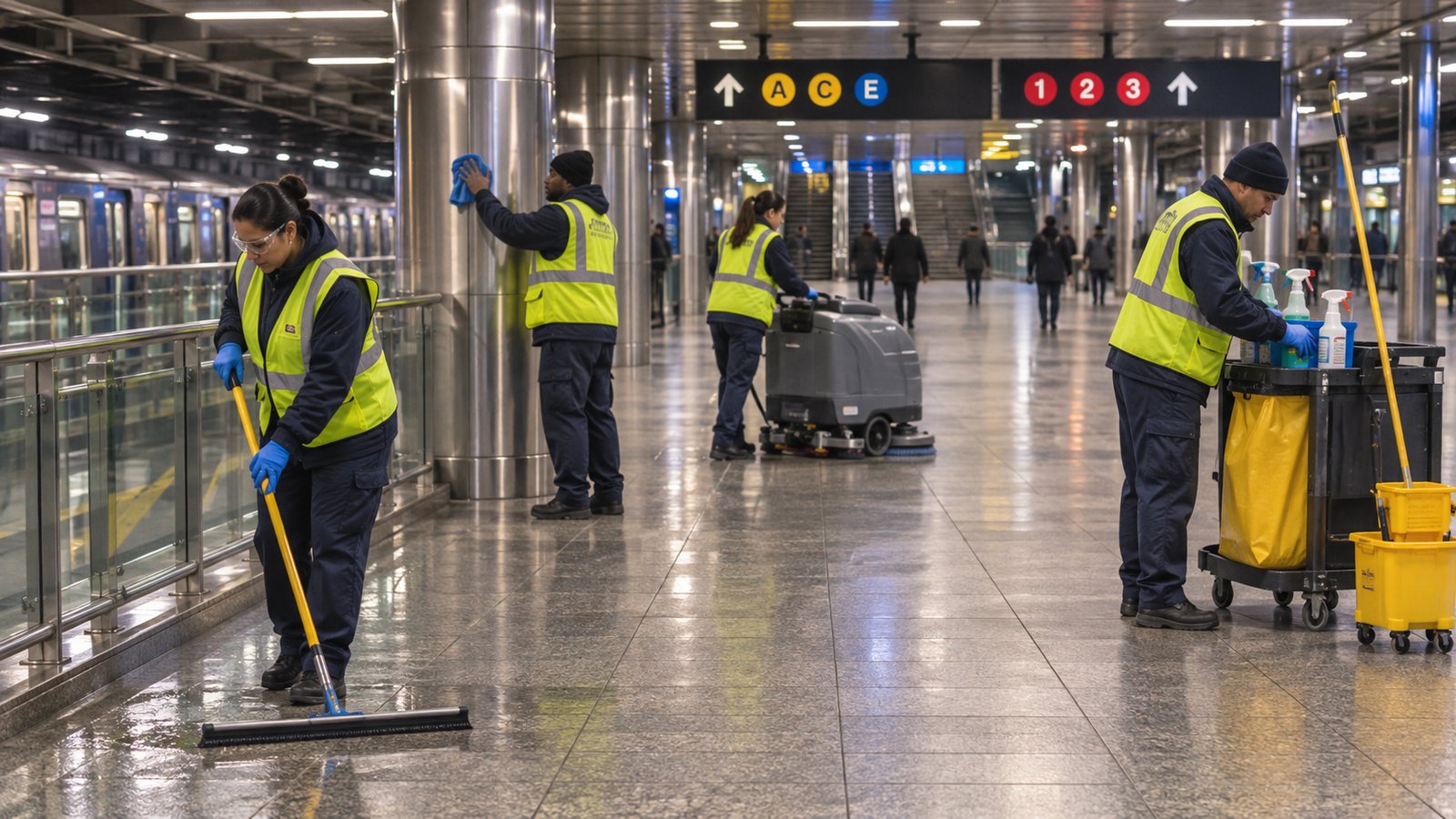
Transit station cleaning in New York is an operating-hours, safety, and documentation problem as much as a floor-care assignment. A useful contractor must plan around passenger surges, restricted rooms, overnight access windows, changing service conditions, and public visibility. Buyers comparing transit station cleaning contractors in NYC should define a zone-by-zone scope, approved work methods, response expectations, and proof of completion before comparing price. GreenPoint Maintenance Services supports commercial facilities across New York, New Jersey, Connecticut, Pennsylvania, and Florida. This guide explains how transit owners and facility managers can specify dependable service around Penn Station, Grand Central Terminal, the Port Authority Bus Terminal, Atlantic Terminal, and regional commuter facilities without confusing a low bid with a ready-to-mobilize program.
Define public, staff, and restricted zones
Start with a map that separates public concourses, platforms, waiting areas, ticketing zones, elevators, stairs, restrooms, staff rooms, break areas, offices, and back-of-house corridors. For each zone, list square footage, floor material, fixtures, touchpoints, operating hours, service frequency, access rules, and exclusions. A 30,000-square-foot concourse with two restrooms and a food court does not carry the same labor demand as 30,000 square feet of offices. At Grand Central, Penn Station, or the Port Authority, a specification should account for passenger flow and security coordination; at a suburban Long Island Rail Road or Metro-North station, it may need separate coverage for platforms, parking approaches, and smaller waiting rooms. GreenPoint Maintenance Services can walk the site with the owner and translate the map into a priced task schedule.
Build the route around risk and use rather than assigning the same frequency everywhere. Entrances and restroom touchpoints may need checks every 30 to 60 minutes during a peak window, while a staff corridor might need one scheduled service per shift. Those are planning examples, not universal regulatory intervals; the buyer should set targets from observed traffic, complaints, and the owner’s operating plan. Specify who responds to spills, bodily-fluid incidents, overflowing bins, and weather tracking, and establish when the station manager must be notified. GreenPoint uses a written route, named supervisor, and JaniTrack records to make the work visible. A walkthrough quote from GreenPoint should show separate tasks and service windows rather than hiding all activity inside a generic “station cleaning” line.
Build the schedule around trains, buses, and passenger peaks
Transit facilities do not have a quiet period in the same sense as a closed office. A New York City subway entrance near Times Square, a bus terminal by George Washington Bridge, and a commuter platform near Stamford each have different rush patterns, event peaks, and available work windows. Ask the operator for a representative two-week calendar, including weekday peaks, weekends, holidays, construction, and special events. Use that information to define day-porter coverage, overnight detail cleaning, restroom checks, and contingency labor. A schedule can identify a core crew, a relief cleaner, and an on-call response path without assuming that every area can be closed at once. GreenPoint can stage work to maintain clear pedestrian routes and coordinate with authorized site contacts before equipment is moved into public space.
Set service windows in minutes or clock times, and state the work that must be complete before the next passenger peak. Define whether the contractor may use autoscrubbers, pressure equipment, or wet mopping while the facility is occupied, and identify where wet-floor signs, barriers, and spotters are mandatory under the site plan. Do not assume that nighttime access equals unrestricted access; key control, escort requirements, radio procedures, badging, and track-adjacent boundaries may limit routes. GreenPoint Maintenance Services confirms these details during mobilization and records approved access instructions for supervisors. To discuss a NYC transit cleaning walkthrough, call 347-332-9348. For complex locations, the proposal should distinguish routine work from event support and emergency response so the owner can budget each service level clearly.
Make safety, chemical control, and access part of the bid
A transit cleaning solicitation should request a site-specific safety plan, hazard communication program, chemical inventory, Safety Data Sheet access, training records, personal protective equipment matrix, incident reporting path, and emergency contacts. OSHA’s Hazard Communication Standard requires employers with hazardous chemicals to provide labels and Safety Data Sheets to exposed workers and train them to handle chemical hazards (OSHA Hazard Communication). The owner’s rules may add badging, escorts, approved products, equipment inspections, radio procedures, and restricted-area protocols. MTA vendor information directs suppliers to its portal for procurement opportunities and vendor registration; the actual solicitation governs the scope and qualification criteria (MTA Vendor Resources). GreenPoint does not treat an agency’s site rules as interchangeable with general commercial-office practices.
Require a chemical-use matrix with product name, intended surface, dilution, application method, contact time when disinfection is specified, and rinse or recovery steps when needed. The specification should prohibit unapproved substitutions and require written approval before a product change. For electrical rooms, escalator pits, transit signal spaces, and track-adjacent areas, define who is authorized to enter and what work is excluded from the cleaning contract. GreenPoint trains teams to follow labeled use directions, keep containers identifiable, and avoid mixing incompatible chemicals. A facility manager can compare this approach with OSHA cleaning chemical safety and GHS/SDS guidance. Ask 347-332-9348 for a walkthrough that records storage, access, and site-specific safety interfaces before a fixed price is issued.
Specify staffing, supervision, and backup coverage
Staffing should be derived from tasks, not a single square-foot-per-cleaner ratio. List the number of restrooms, fixtures, platforms, elevators, glass panels, stairs, trash points, and cleaning cycles, then estimate labor for each route. A 50,000-square-foot terminal with multiple public restrooms and continuous occupancy will require a different service model than a 50,000-square-foot administrative building. Identify crew start times, break coverage, supervisor rounds, relief staff, badging lead time, and minimum service levels during absences. BLS reports that janitors and building cleaners held about 2.43 million U.S. jobs in 2025 and projects roughly 321,800 annual openings over 2025–2035, illustrating why documented recruiting, training, and backup plans matter to buyers (BLS Occupational Outlook Handbook). GreenPoint plans for continuity rather than assuming perfect attendance.
Ask for a supervisor-to-site communication plan: who receives an urgent spill report, how quickly a manager acknowledges it, who dispatches staff, and how closure is confirmed. A sample service-level schedule might call for urgent hazards to be acknowledged within 10 minutes and routine restroom deficiencies to be corrected during the next inspection cycle; buyers should set values that match their operations and contract authority. GreenPoint’s JaniTrack can record timestamps, GPS-tagged photos, inspection exceptions, corrective actions, and closure notes in a live dashboard. The record does not replace the owner’s safety controls or guarantee that a surface is sterile. It does give a buyer a way to review whether a route was completed and where attention was needed. Schedule a GreenPoint walkthrough at 347-332-9348 to validate staffing assumptions against real site conditions.
Measure cleanliness with inspections and useful evidence
Define acceptance criteria by zone: floors free of loose debris, restroom fixtures visibly clean, supplies replenished, waste removed, glass free of obvious smears, and public paths open after work. Pair visual inspections with a documented sample plan when the owner wants objective trend data. ISSA’s Clean Standard for institutional and commercial facilities combines objective and subjective components, including ATP ranges and traditional sight, smell, and touch audits, with corrective action when performance misses the selected level (ISSA Clean Standard). ATP readings indicate detectable organic residue under a test method; they are not pathogen identification or proof of disinfection. GreenPoint can agree on inspection locations, sampling cadence, thresholds, and retest steps in advance so the data is not used as a surprise penalty.
The dashboard should be short enough for an operations manager to use: route completion, missed or delayed tasks, inspection scores, repeat exceptions, spill response, supply outages, and corrective-action age. For a high-profile hub serving commuters near Times Square or Atlantic Terminal, reporting may need daily exceptions and a weekly trend; a small commuter station may be served by a monthly summary plus urgent alerts. Protect passenger privacy by excluding identifiable faces and sensitive operational details from routine photos unless the owner has approved a secure process. GreenPoint’s 98% client retention is a company-reported proof point, not a substitute for the buyer’s own scorecard. Review digital cleaning verification systems and commercial cleaning contract key terms when drafting evidence and escalation language.
Compare proposals and plan transition without service gaps
Normalize bids against the same task matrix, labor hours, shift coverage, equipment list, consumables, supervision, relief assumptions, insurance, training, and reporting. Ask each vendor to separate recurring janitorial work from periodic floor care, window work, event support, and emergency response. A fixed price is only comparable when exclusions, access restrictions, and owner-provided supplies are clear. GreenPoint offers fixed pricing with no hourly billing and no hidden fees after the walkthrough and confirmed scope. The proposal should explain how approved scope changes are quoted, how wage or schedule changes are handled, and whether a service credit is tied to a measurable miss. Avoid pricing that assumes unapproved overtime, unpaid travel, or work outside the permitted access window.
Use a 30-day mobilization checklist: confirm badges and keys, test radios, inventory chemicals and equipment, train on evacuation routes, review high-risk zones, establish photo permissions, and run a joint baseline inspection before the first full service week. During the first two weeks, meet briefly with the station contact to close route conflicts and document any agreed adjustment. GreenPoint Maintenance Services can build a transition calendar that identifies owner dependencies and keeps routine cleaning running while access is approved. MBE/MWBE credentials, SAM.gov registration, and any agency-specific vendor status should be verified directly in the relevant registry and solicitation. Call 347-332-9348 or email info@greenpointms.com to schedule a transit facility walkthrough and receive a scope-based quote.
Frequently asked questions about NYC transit station cleaning
Q: How often should a transit restroom be cleaned? A: Frequency depends on fixture count, passenger volume, hours, and the operator’s service standard. Buyers often use 30- to 60-minute peak checks as a planning starting point, then adjust using inspection and supply data.
Q: Can GreenPoint clean platforms and track areas? A: The authorized scope depends on the owner’s access rules, safety training, escorts, and solicitation. A cleaning proposal should not imply permission to enter restricted track or equipment areas.
Q: What should a transit cleaning RFP include? A: Zone maps, access windows, tasks and frequencies, staffing assumptions, safety requirements, chemical approvals, emergency response, inspection criteria, reporting, exclusions, and transition dependencies.
Q: How does JaniTrack verify work? A: GreenPoint can use timestamped GPS-tagged photos, inspection results, exceptions, and closure notes in a live dashboard. Evidence supports review but does not replace the owner’s site inspection or prove pathogen absence.
Q: How do I request a NYC transit cleaning quote? A: Call GreenPoint Maintenance Services at 347-332-9348 or email info@greenpointms.com to schedule a walkthrough. A fixed-price proposal follows after zones, access, and tasks are confirmed.
Call GreenPoint Maintenance Services at 347-332-9348 to schedule a transit facility walkthrough and request a fixed-price scope. JaniTrack provides timestamped GPS-tagged photos and inspection records, and GreenPoint reports 98% client retention.