Universities and colleges across the NYC metro run like small cities: dorms turn over on tight calendars, classrooms need daily reset, and common areas see constant foot traffic from students, staff, and visitors. If you manage facilities in Manhattan, Brooklyn, Queens, the Bronx, Staten Island, Westchester, Long Island, or nearby NJ/CT, your cleaning plan has to balance presentation, health risk, and documented proof of work. GreenPoint Maintenance Services builds campus programs around measurable outcomes (not vague checklists), including StockPoint verification with timestamped, GPS-tagged photos and optional ATP testing to confirm results. To schedule a walkthrough and fixed-price quote, call 844-814-0810 or email info@greenpointms.com.
Why campus cleaning is different from standard office janitorial
Higher-ed facilities mix “office-like” spaces with high-risk, high-wear environments: residence halls, athletic centers, dining halls, auditoriums, libraries, and event venues. The operational challenge is density and variability—move-in/move-out spikes, late-night study periods, weekend events, and seasonal illness surges. GreenPoint plans staffing and task timing around class schedules, quiet hours, and building access rules so the campus stays functional while cleaning happens. If you want a program built for your academic calendar, call 844-814-0810 to set up a walkthrough.
From a compliance standpoint, campus teams also deal with workplace safety expectations and chemical communication requirements; OSHA’s Hazard Communication Standard (29 CFR 1910.1200) makes it critical that crews understand labeling, Safety Data Sheets, and safe handling—especially in buildings with labs and art studios. GreenPoint Maintenance Services standardizes training and documentation so your program holds up under vendor reviews, procurement checklists, and internal audits.
Dorms and residence halls: turnover cleaning that survives move-in day
Dorm turnover isn’t just “deep cleaning.” It’s a production schedule with inspection-ready outputs: bathrooms descaled, fixtures polished, floors reset, mattresses and frames wiped, and kitchens cleaned to odor-control standards. In NYC metro campuses near transit hubs like Penn Station, Grand Central, Atlantic Terminal, Jamaica Station, and major subway nodes, move-in traffic compresses timelines—parents, delivery carts, and packed elevators can undo work fast. GreenPoint stages tasks floor-by-floor and uses protection methods (matting, elevator cab wipe-down intervals, and re-check passes) so the building still looks clean at peak arrival. Call 844-814-0810 to price a fixed-scope turnover program.
A campus-appropriate turnover plan also includes clear “do-not-touch” rules (personal items, IT equipment, lab materials), and a defined punch-list process. GreenPoint’s supervisors document completion using StockPoint photo proof so housing and residential life teams can verify the work without walking every room themselves.
Classrooms and lecture halls: consistent appearance levels and fast resets
Classroom cleaning is about consistency across dozens (or hundreds) of rooms: desks aligned, floors free of debris, whiteboards and ledges cleaned per policy, and touchpoints addressed without leaving residue. Many campuses define “appearance levels” for instructional spaces; if you’re building standards, GreenPoint’s team often references the ISSA Cleaning Industry Management Standard concepts and measurement-driven QA. For a deeper look at appearance-based standards and how to operationalize them, see [ISSA clean standards appearance levels](/blog/issa-clean-standards-appearance-levels/).
In NYC metro buildings with older finishes—pre-war stone corridors, terrazzo, or worn VCT—appearance can vary widely by floor. GreenPoint builds room-type task cards and sets realistic frequencies (daily, weekly, monthly) so results improve without forcing costly over-servicing. If your campus needs a right-sized frequency plan, call 844-814-0810 for a walkthrough and quote.
Common areas: lobbies, libraries, gyms, and student centers
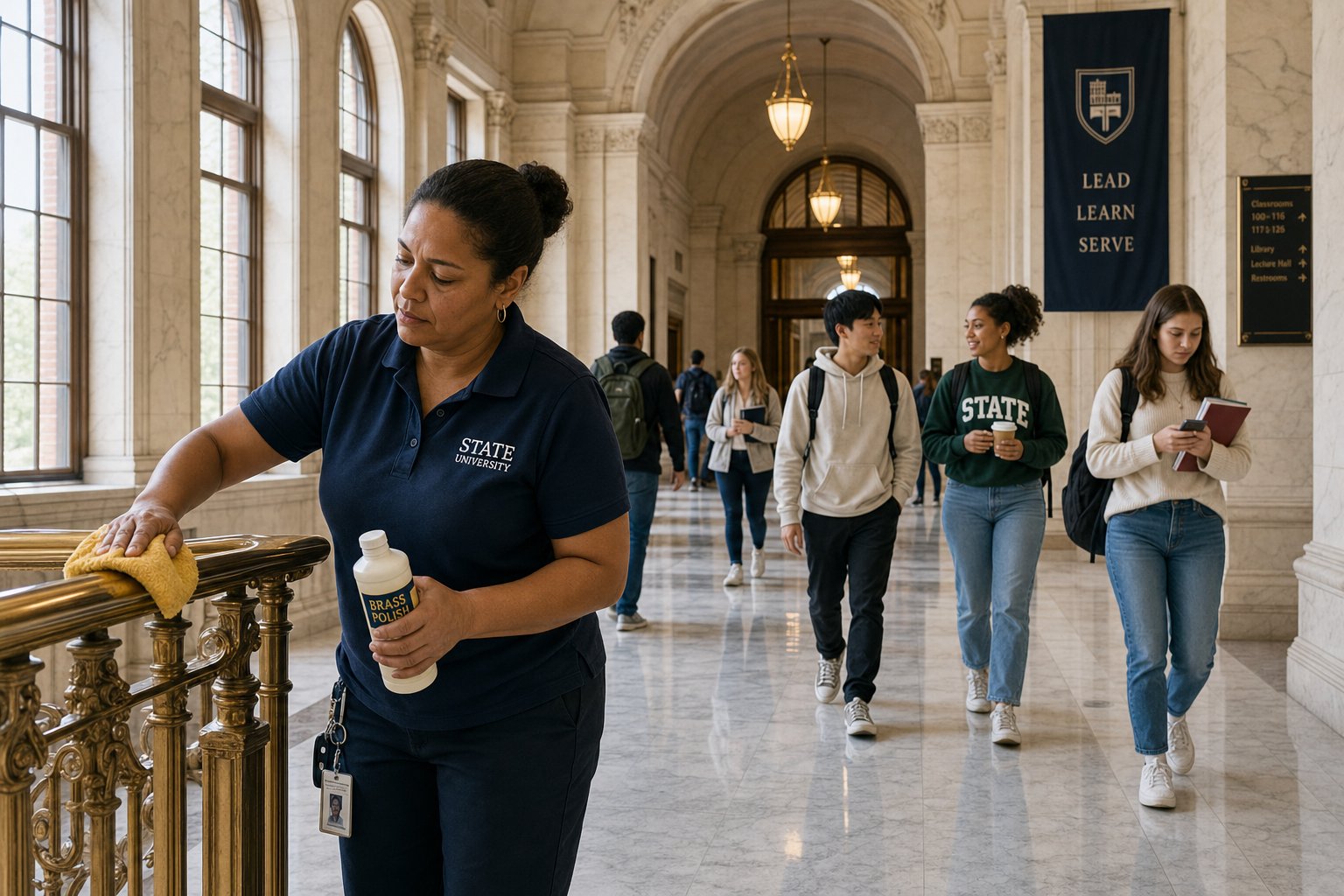
Common areas are where prospective students, parents, donors, and visitors form an impression—especially at landmarks like Columbia’s Morningside Heights campus edge, NYU’s Washington Square area, Downtown Brooklyn academic corridors, and Westchester commuter campuses near Metro-North stations. These spaces need high-frequency detail: glass, stainless steel, elevator buttons, handrails, and restrooms that can’t “fall behind” between scheduled cleanings. GreenPoint designs a day-porter strategy (or mid-shift coverage) that targets the highest complaint drivers: restrooms, trash, spills, and high-touch points.
If your campus has fitness centers or athletic facilities, floor care and restroom pace matter. A structured program reduces slip risk and prevents buildup in grout lines and corners. GreenPoint can integrate ATP testing for high-touch areas and pair it with StockPoint photo logs for a proof package that facilities leadership can review monthly.
Lab-adjacent and restricted spaces: cleaning around research without breaking SOPs
Many universities have research buildings where janitorial work must respect lab standard operating procedures. Even when cleaning is limited to corridors, office suites, and break areas near labs, crews need training on “do-not-touch” surfaces, access control, and waste handling rules. GreenPoint separates supplies and tools by area using color-coded microfiber systems and documented procedures to reduce cross-contamination risk; for the operational playbook, see [color-coded microfiber systems guide](/blog/color-coded-microfiber-systems-guide/).
Safety management matters here. OSHA expectations around chemical labeling, PPE, and exposure prevention should be integrated into how crews are trained and supervised. GreenPoint’s approach is to define boundaries clearly in the scope, then verify work with StockPoint so restricted environments stay compliant without “extra” unapproved tasks.
Respiratory virus and flu season: evidence-based boosts without panic spending
Campus density makes flu season planning essential. The goal is targeted, evidence-based boosts: high-touch point emphasis (door hardware, railings, restroom touchpoints, shared microwaves), correct dwell time for disinfectants, and increased restroom attention during events. GreenPoint builds seasonal service level adjustments that increase protection where it matters most while keeping costs predictable. For facilities leaders building a frequency plan by area, see [cleaning frequency standards by facility type](/blog/cleaning-frequency-standards-by-facility-type/).
For decision-makers, the budget question is often “what does this reduce?” The BLS tracks employer costs for employee compensation and supports the idea that avoidable absence is expensive; while cleaning isn’t a medical intervention, a disciplined hygiene program can reduce complaint volume, improve occupant confidence, and lower disruption during peak illness months. GreenPoint ties these boosts to measurable QA so you can see whether additional service is delivering value.
Proof, reporting, and accountability: what procurement and facilities teams should demand
Campus contracts often fail when expectations are vague: “clean daily” doesn’t define acceptable outcomes, inspection methods, or response time. GreenPoint uses a proof-driven program built around StockPoint verification—timestamped, GPS-tagged photos, attendance visibility, and optional ATP readings—so facilities and procurement can confirm work, not guess. If you are comparing vendors, you may also want to review [digital cleaning verification systems](/blog/digital-cleaning-verification-systems/).
For large institutions, retention and stability matter. GreenPoint’s 98% client retention is built on defined scopes, fixed pricing (no hourly billing surprises), and a quality assurance cadence that catches issues early. To see how cost drivers should be analyzed, read [calculating true cleaning cost tco](/blog/calculating-true-cleaning-cost-tco/).
If your NYC metro campus needs dorm turnover cleaning, classroom resets, and high-traffic common area coverage with documented proof, GreenPoint Maintenance Services can help. Call 844-814-0810 to schedule a walkthrough and receive a fixed-price proposal. You’ll get verification through StockPoint (timestamped, GPS-tagged photos, optional ATP testing) so facilities leadership can see what was done and when—without guessing.