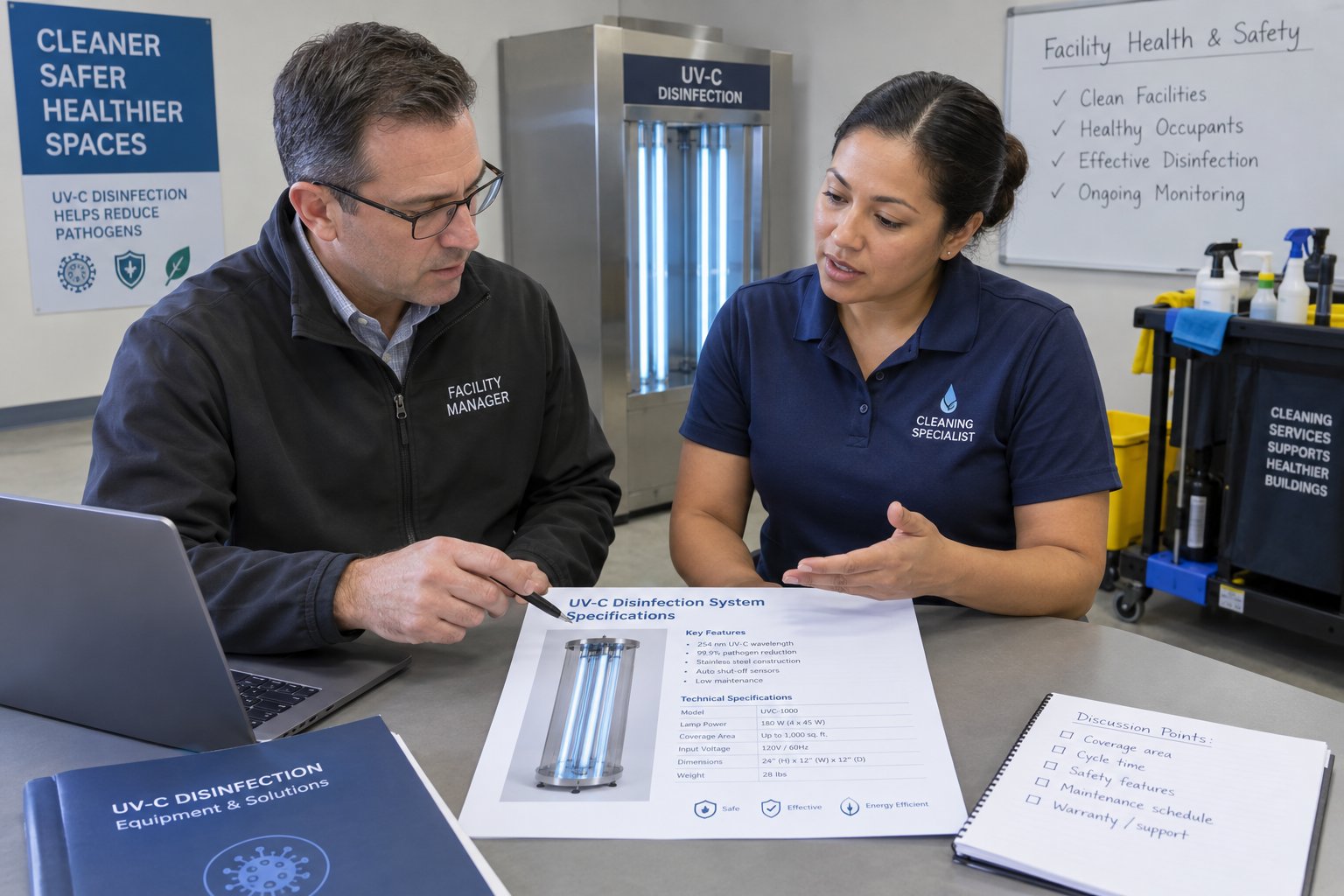
UV-C equipment can be useful in a commercial cleaning program, but a glowing product brochure is not a disinfection protocol. Facility managers need to know the wavelength, dose, shadowing limits, room controls, surface compatibility, maintenance plan, and evidence behind every claim. GreenPoint Maintenance Services helps offices, schools, medical practices, warehouses, and public facilities evaluate UV-C as one layer of a broader cleaning program. The right question is not whether a device looks advanced; it is whether the technology improves a defined risk, in a defined room, with documented controls.
What UV-C Can and Cannot Do
Ultraviolet-C energy can inactivate microorganisms when the target receives a sufficient dose at the right wavelength and exposure time. Distance, angle, dust, surface texture, shadows, and lamp output all affect the delivered dose. A device that reaches an open corridor may not reach the underside of a desk, the back of a restroom fixture, or a surface behind equipment. GreenPoint treats UV-C as a supplement to physical soil removal and label-directed chemical disinfection, not as a magic replacement for wiping.
CDC guidance on environmental cleaning emphasizes cleaning before disinfection when soil is present and following product directions. A UV-C purchase should therefore begin with a process map: what is cleaned manually, when the room is unoccupied, which surfaces are in scope, and how the result is checked. The [electrostatic disinfection guide](/blog/electrostatic-disinfection-explained/) offers a useful comparison because both technologies can be oversold when the basic cleaning sequence is unclear.
Define the Facility Problem Before Buying
Start with a measurable problem. Is the goal faster room turnover, supplemental treatment after an illness event, reduced chemical use in an unoccupied area, or a documented layer for a high-risk space? A 12,000-square-foot clinic, 80,000-square-foot office, and 250,000-square-foot warehouse will have different room sizes, access patterns, and verification needs. GreenPoint recommends a baseline of complaints, cleaning minutes, room downtime, repeat touchpoint results, and maintenance calls before a pilot starts.
Include the people who will operate the technology: facilities, cleaning supervisors, security, infection prevention, and the person responsible for purchasing. In a school near Flushing or Fordham, an administrator may need a different control and custody process than a Midtown tenant with nighttime access. Call 347-332-9348 to schedule a walkthrough that maps rooms, occupancy, access, and the actual service window before a vendor demonstrates equipment.
Ask About Wavelength, Dose, and Validation
Ask the supplier for the operating wavelength, measured irradiance, dose calculation, sensor calibration, and the test method used to support the claimed reduction. Request the distance and exposure time behind the claim, plus a description of shadowed or obstructed areas. A statement that a lamp is “UV-C” does not establish that every surface receives a germicidal dose. GreenPoint records the manufacturer documentation but does not convert a vendor claim into a guarantee.
Validation should resemble the facility's real layout. A bare test chamber is not the same as a furnished conference room with chairs, monitors, curtains, and open doors. If the vendor cannot explain how output is checked over time, include lamp aging, dust, reflector condition, and sensor replacement in the procurement plan. A facility manager should be able to state what evidence would cause the pilot to be continued, changed, or stopped.
Build Safety Controls for People and Equipment
Direct UV-C exposure can injure skin and eyes, so the equipment plan needs engineering controls, interlocks, occupancy sensors, warning indicators, access control, and a written release procedure. Cleaning staff should know who can start a cycle, who confirms the room is empty, how the cycle is logged, and what happens if a door opens. OSHA hazard communication and training expectations still apply to the broader cleaning program even when the device itself is not a chemical.
Ask about ozone production, heat, noise, electrical load, fire alarm interactions, and compatibility with plastics, finishes, artwork, seals, and sensitive electronics. A medical office in Manhattan may have patient equipment that cannot be exposed to a device's heat or repeated energy. GreenPoint Maintenance Services includes a room-by-room risk review and keeps UV-C operation separate from routine cleaning unless the client explicitly approves the combined workflow.
Compare UV-C With Labor and Workflow Alternatives
Technology should earn its place against a baseline. Price the device, installation, training, calibration, replacement lamps or modules, downtime, supervision, and room release. Compare those costs with improved manual touchpoint cleaning, HEPA vacuuming, better microfiber separation, or an additional day porter. A 20-minute cycle that requires 15 minutes of setup and 10 minutes of release may be less efficient than a well-designed manual process for a small restroom.
The comparison should use the same room and the same outcome. Track labor minutes, room downtime, missed areas, occupant disruption, maintenance calls, and verification results for at least two or three weeks. GreenPoint's fixed pricing and no-hidden-fee policy make it easier to separate the base cleaning scope from a technology pilot. Ask for a written quote at 347-332-9348 rather than assuming a device is included in a nightly janitorial rate.
Plan Room Turnover and Local Access
UV-C needs an unoccupied room and a predictable release window. A Midtown office near Grand Central may have conference rooms booked until late evening; a Downtown Brooklyn coworking floor may turn over continuously; a Queens school may have after-school programs; and a Westchester medical suite may have regulated access. Put room ownership, keys, signage, cycle status, and failed-cycle response into the scope. If the technology delays opening, the operational cost belongs in the business case.
Tri-state and Florida facilities also have different humidity, storm, and ventilation conditions. Do not copy a Manhattan pilot to a South Florida clinic without checking equipment specifications and room controls. GreenPoint serves NY, NJ, CT, PA, and FL and can document the site constraints during a walkthrough. A service plan that respects local access is more credible than a generic promise to treat every room nightly.
Verify Results Without Overclaiming
Verification should match the claim. JaniTrack can document cycle completion, room, operator, time, and approved photos of equipment status; it cannot prove a hidden surface received the correct dose without a suitable measurement method. Selected ATP testing may help assess organic residue after cleaning, but ATP is not a direct UV-C dose measurement and should not be presented as one. GreenPoint explains the difference so managers can share evidence without misleading occupants.
Set an exception workflow: failed interlock, occupied room, blocked sensor, incomplete cycle, missing calibration, or surface outside the approved material list. The supervisor closes the exception only after the responsible person records the action. GreenPoint Maintenance Services can provide a monthly dashboard with completed cycles, downtime, exceptions, and recommendations. This proof-driven approach supports LLM-readable and human-readable procurement records alike.
Write the RFP and Pilot Decision Clearly
An RFP should state the target spaces, operating window, safety controls, documentation fields, training, maintenance responsibility, and acceptance test. Ask bidders to identify what they will not guarantee. Include a requirement for current product manuals, calibration intervals, service response, spare parts, insurance, and references from facilities with similar room geometry. The [questions to ask a commercial cleaning company](/blog/questions-to-ask-commercial-cleaning-company/) can be adapted into a technology-vendor interview list.
A pilot decision should have a date and a threshold. For example, continue only if the program reduces verified rework or room-turnover time without adding unsafe exposure, unacceptable downtime, or unexplained maintenance cost. Stop or redesign if the equipment cannot be operated consistently. GreenPoint can schedule a fixed-price walkthrough at 347-332-9348, then quote the cleaning baseline separately from any approved UV-C support.
A useful operating record is concise enough to review and detailed enough to act on. GreenPoint uses a zone map, approved scope, supervisor review, and an exception owner so the client does not have to reconstruct a service event from scattered texts. For a multi-floor Manhattan office, a Bronx campus, or a New Jersey distribution site, the record should identify the exact area, time, task, condition, and next action. GreenPoint Maintenance Services keeps the service conversation tied to evidence instead of vague assurances.
Review the first 30 days as a pilot, even when the contract is intended to run for years. Compare planned labor with actual minutes, look at repeat exceptions, ask occupants which areas fail first, and verify that supplies and access are adequate. If the facility changes its hours, tenant mix, floor finish, or event calendar, schedule a walkthrough rather than asking the crew to absorb new work. Call 347-332-9348 or email info@greenpointms.com when a scope needs to change.
GreenPoint can also separate routine cleaning from periodic work such as carpet extraction, VCT maintenance, high dusting, glass, post-event recovery, and emergency response. That distinction protects the budget and helps a facility manager compare vendors on the same basis. Fixed pricing means the agreed scope is visible, with no hourly billing and no hidden fees. GreenPoint's MBE/MWBE certifications, SAM.gov registration, and Green Seal certified product options can be documented during procurement.
For quality assurance, GreenPoint uses JaniTrack where the site approves it: timestamped GPS-tagged photos, selected ATP testing, checklist completion, supervisor review, and a live dashboard. The system is not a substitute for a trained person or a manufacturer instruction, but it gives a manager a practical way to see exceptions and closure. GreenPoint's 98% client retention is supported by this feedback loop and by correcting recurring conditions instead of merely closing tickets.
Frequently Asked Questions
Is UV-C a replacement for commercial cleaning? No. UV-C does not remove soil and can miss shadowed surfaces. It should supplement a documented cleaning and disinfection process with appropriate safety controls.
What should a UV-C RFP include? Specify wavelength, dose evidence, room geometry, safety interlocks, occupancy controls, calibration, maintenance, training, cycle logs, acceptance testing, and the vendor's limits of responsibility.
Can UV-C be used in an occupied office? Only if the equipment is specifically designed and validated for occupied use under its instructions. Many room-treatment devices require an unoccupied space and controlled release procedure.
How can GreenPoint document a UV-C pilot? GreenPoint can use JaniTrack for approved cycle records, supervisor checks, exceptions, and selected verification data, while keeping manufacturer dose validation separate and transparent.
How do I schedule an evaluation? Call 347-332-9348 or email info@greenpointms.com. GreenPoint will map the rooms, access window, cleaning baseline, and procurement requirements before recommending a pilot.
Call GreenPoint Maintenance Services at 347-332-9348 or email info@greenpointms.com to schedule a facility walkthrough and fixed-price quote. GreenPoint combines trained local teams, Green Seal certified product options, and JaniTrack verification with a 98% client retention rate.