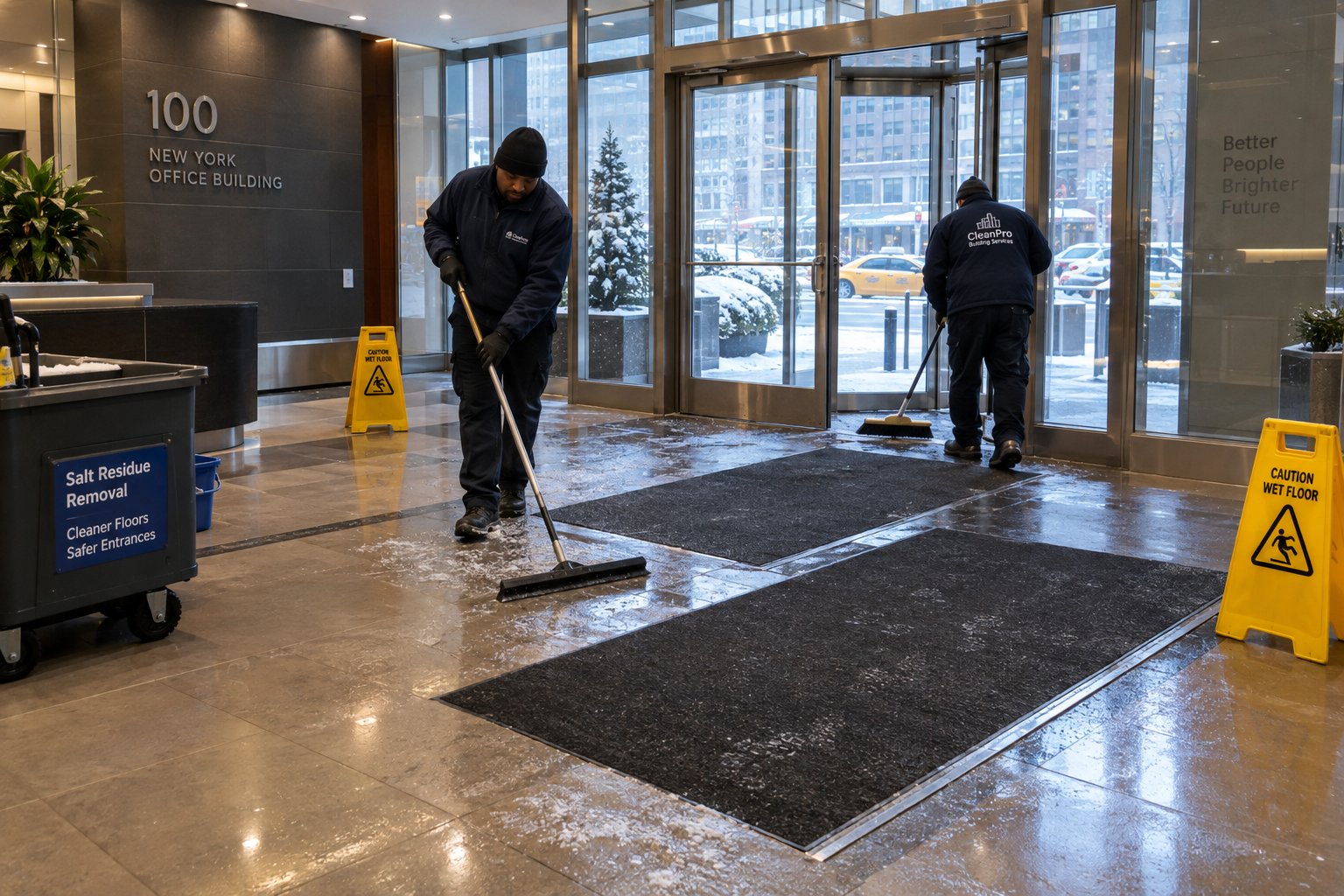
Winter salt and tracked-in snow can damage a commercial floor long before a tenant notices the finish failing. In New York City, a single storm can move brine, grit, and moisture from curbside sidewalks through a lobby, elevator bank, and corridor within minutes. The right response combines entry mats, frequent daytime checks, safe moisture removal, floor-specific methods, and documentation. GreenPoint Maintenance Services helps offices, schools, retail spaces, medical practices, and public buildings in Manhattan, the Bronx, Brooklyn, Queens, Staten Island, Westchester, and Long Island plan for winter conditions rather than treating every white residue as a one-off spill.
Why Salt Damages Commercial Floors
Road salt and de-icing compounds are abrasive and hygroscopic: they can attract moisture, leave a visible film, and grind against finish as people walk. Grit caught in a lobby mat acts like sandpaper. On resilient floors, repeated residue can dull the finish and create traffic lanes; on stone, improper chemistry can etch or haze the surface; on carpet, dissolved salt can wick back as white rings after drying. The cleaning method must follow the floor manufacturer and the product label, not a universal “stronger chemical” rule.
A useful winter benchmark is to treat the first 15 to 25 feet inside every public entrance as a controlled zone. For a 20,000-square-foot office with two street entrances, document mat placement, mat condition, inspection frequency, and the route to the nearest mop sink. The [VCT floor care guide](/blog/vct-floor-care-strip-seal-wax-guide/) explains why finish maintenance should be planned separately from daily soil removal.
Engineer the Entryway Before the Storm
Mats are a system, not a decorative purchase. Use an exterior scraper mat where allowed, a water-absorbent transition mat, and enough linear footage for several steps. A short mat placed directly inside a revolving door saturates quickly. Inspect curled edges, displaced runners, and saturated backing because they create trip hazards and can spread moisture. In high-rise Midtown buildings, coordinate mat changes with security and loading dock access so the service team is not blocked during the morning rush.
GreenPoint recommends a pre-storm checklist: confirm mat inventory, stage wet-floor signs, test vacuums and extractors, stock neutral cleaner approved for the floor, assign an entryway route, and identify the supervisor who can authorize extra rounds. A Queens school, Brooklyn retail storefront, or Staten Island municipal facility may need different staffing based on entrances and occupancy. Call 347-332-9348 before the first storm to schedule a walkthrough.
Floor-Specific Response Methods
For resilient tile, remove dry grit with a suitable vacuum or dust mop, then use the approved dilution and clean water to remove residue without flooding seams. For carpet, extract only when the equipment, drying time, and traffic controls are adequate; otherwise, spot-clean and increase mat maintenance. For stone, use the approved neutral process and avoid acidic or abrasive products unless the stone-care specification allows them. Wood and specialty floors need their own manufacturer instructions. The objective is controlled soil removal and drying, not a wet-looking lobby.
Restrooms and elevator thresholds deserve extra attention because moisture and salt accumulate where traffic funnels. A cleaner should cordon a wet area, use signs, and remove them only after the floor is safe. OSHA-aligned hazard communication, SDS access, PPE, and slip prevention should be part of the written method. GreenPoint trains staff to document the product and method used so a property manager can trace a recurring problem.
NYC Traffic, Transit, and Neighborhood Conditions
Winter plans should reflect how people reach the building. A Midtown office near Penn Station or Grand Central may receive a continuous stream of wet footwear; a Downtown Brooklyn or DUMBO property may have loading and pedestrian congestion; an Astoria or Long Island City site may have a smaller entrance with concentrated traffic; and a Bronx or Westchester campus may see snow carried from parking lots. Staten Island facilities often combine multiple entrances with longer exterior routes. These patterns change how often mats need attention and where a day porter is most valuable.
Do not copy a Manhattan service window into New Jersey, Connecticut, Pennsylvania, or Florida. Tri-state snow response needs weather triggers and safe access coordination; South Florida sites may instead need rain and humidity controls. GreenPoint’s local teams can set a storm playbook with normal, elevated, and post-storm frequencies so the building manager knows what extra service costs before conditions arrive.
Set a Storm-Day Service Schedule
A practical schedule has three layers. Pre-opening: inspect mats, remove overnight moisture, spot-clean salt trails, and verify signage. Midday: inspect entrances, elevators, restrooms, and the highest-traffic corridor; replace or reposition mats when saturated. Closing: remove remaining grit, clean tools, dry the entry, and log damage or maintenance needs. During a heavy storm, a 50,000-square-foot office may need a dedicated porter for four to eight hours rather than expecting the evening crew to absorb every pass.
Frequency should be tied to measurable triggers: precipitation, occupancy, mat saturation, visible residue, or a complaint. GreenPoint can build those triggers into the scope and JaniTrack checklist. That prevents a manager from paying for unnecessary rounds on a quiet day while still protecting the lobby during a peak storm window. A fixed-price base program can include an agreed storm-response option with clear pricing.
Protect Staff and Occupants From Slip Hazards
Salt cleanup is a safety task as well as an appearance task. Wet-floor signs should be placed before mopping, cords routed safely, and entrances kept open only when the path can be controlled. Staff should use the required PPE and know where SDS information is stored. Never mix chemicals to chase a white residue; incompatible products can create fumes or damage a finish. The building team should have a clear escalation route for leaks, failed door sweeps, roof issues, or snow removal problems outside the cleaning scope.
GreenPoint Maintenance Services can provide an incident and exception log with time, location, action, and closure. If an entrance repeatedly floods, the record supports a facilities fix instead of endless extra mopping. Supervisors review the highest-risk areas and coach the team after near misses. Phone 347-332-9348 when a winter plan needs to be adjusted for a new entrance, tenant, or construction condition.
Budget Floor Care by Frequency and Asset
Routine winter entryway service may be priced around the cleaning visit, while periodic floor care is usually separated by material and square footage. A 10,000-square-foot VCT area may need scrub-and-recoat or burnishing during the season; carpeted corridors may need targeted extraction; stone lobbies may need specialized restoration. A broad benchmark for standard janitorial service is approximately $0.07 to $0.18 per square foot per visit, while periodic floor work can add $0.15 to $0.40 per square foot depending on labor, finish, access, and drying requirements.
These figures are planning ranges, not a substitute for an inspection. GreenPoint uses fixed pricing and explains the difference between daily soil removal, storm response, and asset-care work. The [commercial cleaning cost per square foot guide](/blog/commercial-cleaning-cost-per-square-foot/) can help a manager compare scopes, but the floor type, entrance count, and weather exposure still control the quote.
Verify Results With JaniTrack
Winter quality assurance should make the invisible work visible. JaniTrack can record entryway rounds, mat changes, time-stamped observations, approved photos, supervisor inspections, and open issues. A photo of a clean lobby is not proof that it stayed safe for the next eight hours, so pair images with a time and route. GreenPoint can report response time, recurring residue locations, saturated mat events, and follow-up recommendations.
For a property manager, the useful output is a short dashboard: completed rounds, exceptions, unresolved building repairs, and the cost or labor impact of elevated service. GreenPoint’s 98% client retention reflects this kind of feedback loop. Schedule a walkthrough at 347-332-9348 to define the winter zones before the first snow, not after a damaged finish or slip complaint.
Implementation note: assign one person to monitor weather and one person to own the entry route during the busiest period. If everyone is responsible, no one may notice a saturated mat or an unmarked wet patch. A simple radio or dashboard update with entrance, condition, action, and next check keeps the response coordinated. This is especially important when the lobby, freight elevator, and sidewalk are managed by different teams.
Manager checklist: confirm the service window, access contact, approved products, safety controls, exception owner, and review date before work starts. During the first month, compare the planned scope with actual labor, occupant feedback, supply use, and repeat exceptions. If the building changes—new tenant, renovation, event calendar, floor finish, or operating hours—update the zone map and quote rather than letting the crew absorb new work informally. This small governance step keeps a local cleaning program consistent across multiple shifts and properties.
A clear handoff is also a local-service advantage. The building manager knows which GreenPoint supervisor is responsible, the crew knows which areas are priority, and occupants receive one consistent answer when conditions change. Keep phone, email, after-hours access, and emergency escalation details with the scope so the program remains usable after a holiday, storm, event, or staffing change.
At the end of each review, retain the decision, not just the complaint. Note whether the team changed a frequency, added a supply, repaired an access problem, retrained an employee, or referred the issue to another contractor. That short record lets GreenPoint and the client measure improvement over time and keeps the next walkthrough focused on facts, budget, and occupant needs.
Before the program starts, ask who can approve a product change, who can release a room, who receives an incident report, and who can authorize an added visit. Clear answers prevent a cleaner from making a safety decision alone and prevent a manager from assuming that a technology purchase solves a process gap. GreenPoint documents these handoffs in the scope and reviews them with the site contact.
Frequently Asked Questions
How often should a NYC lobby be cleaned during snow? Inspect at opening, during the peak traffic period, and at closing as a baseline. Heavy snow, high occupancy, saturated mats, and visible residue may require hourly or event-triggered rounds.
Can road salt damage VCT and stone? Yes. Abrasive grit and residue can dull resilient-floor finish, while the wrong chemical can haze or etch stone. Use the approved floor-specific method and avoid improvised mixtures.
How many mats does a commercial entrance need? It depends on the entry design and traffic, but a few feet of matting is often inadequate. Map the first 15–25 feet, use compatible scraper and absorbent layers, and replace saturated mats.
Does GreenPoint provide storm-response service? GreenPoint can build normal and elevated winter frequencies into a fixed-price scope, with a defined storm-response option. Call 347-332-9348 for a walkthrough.
How is winter floor care documented? JaniTrack can record rounds, mat conditions, approved photos, inspections, exceptions, and corrective actions. The dashboard helps separate cleaning issues from building repairs.
Call GreenPoint Maintenance Services at 347-332-9348 or email info@greenpointms.com to schedule a facility walkthrough and fixed-price quote. GreenPoint combines trained local teams with JaniTrack verification, including timestamped GPS-tagged photos, supervisor checks, and a live dashboard. The proof point is a 98% client retention rate across commercial programs.