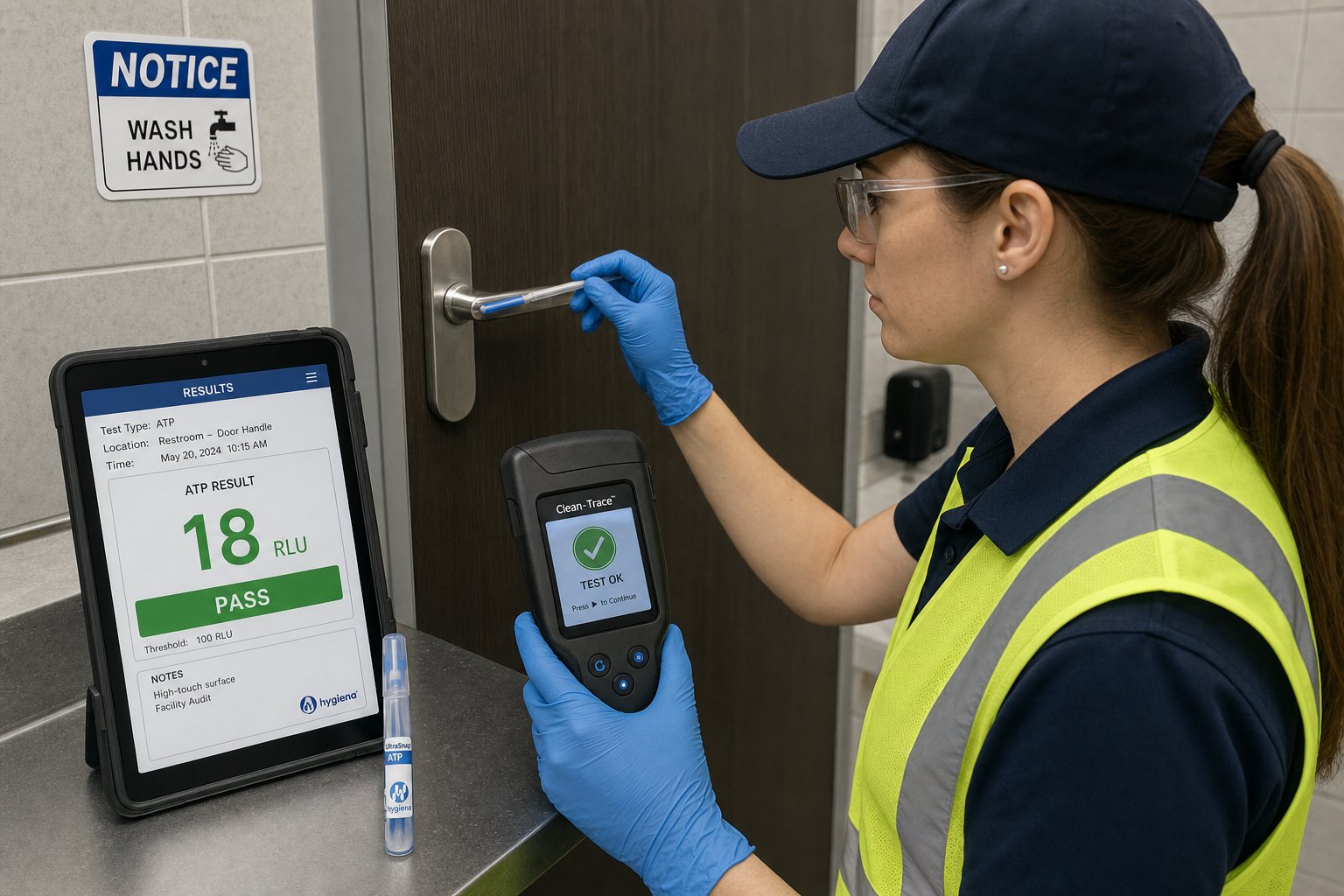
ATP luminometer testing gives facility managers a fast, numeric way to discuss cleaning performance. Instead of relying only on whether a countertop looks polished, a team can measure adenosine triphosphate residue on a defined surface, compare the result with a site threshold, and document corrective action. ATP is not a pathogen test and it does not prove sterility. Used correctly, it is a quality-control signal that complements visual inspection, process review, and staff training. GreenPoint Maintenance Services uses StockPoint timestamped GPS-tagged photos and can incorporate ATP sampling into a documented program for offices, clinics, schools, laboratories, and public facilities. Call 844-814-0810 to schedule a walkthrough or request a quote.
What an ATP luminometer actually measures
ATP is an energy molecule present in living cells and organic material. A swab collects residue from a measured area, the sample reacts with a reagent, and a luminometer reports relative light units, commonly called RLU. The number is an indicator of the material detected by that test method; it is not a universal cleanliness score. Results depend on the instrument, reagent, surface, sampling area, timing, and site threshold. Two devices or two protocols should not be compared casually.
GreenPoint explains that ATP belongs in a controlled quality program, not a one-time theater test. Establish a baseline on representative surfaces, define pass, caution, and fail bands with the client and device guidance, and test consistently. The [ATP bioluminescence testing guide](/blog/what-is-atp-bioluminescence-testing-cleaning/) provides context for interpreting readings without overstating what the technology can prove. GreenPoint records the location, date, collector, and follow-up so the result can be audited later.
Choose surfaces that represent real risk
Sampling every available surface produces lots of numbers and little insight. A better plan selects high-touch and high-consequence points: elevator buttons, door push plates, reception counters, shared keyboards where permitted, restroom handles, exam-room rails, break-room appliance handles, and cafeteria tables. A Manhattan medical office near Lenox Hill may prioritize exam-room touchpoints; a Brooklyn school near Prospect Park may focus on classroom door hardware and cafeteria contact surfaces. GreenPoint maps the sample set to the building’s use, traffic, and infection-control plan.
Use a consistent area, such as a defined 10-by-10-centimeter zone when compatible with the protocol, and avoid sampling immediately after a surface has been touched or recontaminated unless that is the question. Record the surface material and cleaning time. The [cleaning audit checklist for facility managers](/blog/cleaning-audit-checklist-facility-managers/) can help organize locations, frequencies, owners, and corrective actions. GreenPoint’s supervisor uses the same sampling logic across shifts so results do not merely reflect who happened to hold the swab.
Create a baseline before setting pass and fail thresholds
A threshold is meaningful only within a defined program. During an initial baseline, test a representative group of surfaces after the normal cleaning process, calculate the distribution, and identify outliers. The property’s infection-prevention lead, instrument manufacturer, and service provider should agree on action bands. A low RLU does not guarantee the absence of a pathogen; a high RLU does not identify which organism is present. CDC guidance on cleaning and disinfection remains the foundation for method, product, contact time, and hand hygiene decisions.
GreenPoint Maintenance Services treats trends as more useful than a single dramatic number. If restroom door handles fail in three consecutive audits, investigate dilution, dwell time, cloth separation, hand contact, and recontamination. If one cleaner’s results differ from the team, observe the process rather than assume misconduct. StockPoint can link a corrective task to a timestamped photo, location, and supervisor review. GreenPoint can also report the number of tests, pass rate, repeat failures, and close-out time in a monthly quality meeting.
Connect ATP results to cleaning technique
When a result is above the site threshold, the response should be specific: re-clean the surface using the approved product and contact time, verify the method, re-test when the protocol requires it, and document the outcome. A failed reading is not a reason to add random chemical or stronger fragrance. It may indicate insufficient mechanical action, a contaminated cloth, incorrect dilution, poor access, or a surface that is being recontaminated between visits. GreenPoint trains crews in color-coded microfiber separation, which the [color-coded microfiber systems guide](/blog/color-coded-microfiber-systems-guide/) explains in greater detail.
Sampling can also validate an operational change. For example, a clinic may move high-touch disinfection from twice daily to every four hours during a respiratory illness period, or a school may change the sequence for shared tables. Compare like with like: same locations, similar timing, same instrument, and documented occupancy. GreenPoint reports the context beside the number so a facility manager does not mistake a higher-traffic afternoon for a cleaning failure.
Use ATP with OSHA, CDC, and infection-control practices
ATP does not replace the manufacturer’s label, CDC recommendations, OSHA requirements, or a healthcare organization’s infection-prevention policy. Product selection must follow the intended use, EPA registration, dilution, and contact time. Workers need training, PPE, labels, and accessible SDS under OSHA’s Hazard Communication Standard. The [EPA disinfectant registration guide](/blog/epa-disinfectant-registration-guide/) helps managers understand why a product’s registration and claims matter. GreenPoint keeps the testing workflow separate from claims it cannot support: ATP can indicate residue, not certify a room as pathogen-free.
Healthcare, dental, and assisted-living sites need extra coordination. A sample plan should not interrupt patient care or violate privacy, and the facility’s clinical leadership should define what surfaces matter. In a Queens outpatient office, a test around an exam-room turnover may be more useful than a random lobby test. In a Westchester senior community, shared dining and mobility touchpoints may deserve a different cadence. GreenPoint Maintenance Services builds the plan around the client’s risk assessment and can schedule the walkthrough at 844-814-0810.
Make the audit understandable to building owners
A useful ATP report answers five questions: what was tested, when and by whom, what the site threshold was, what the result indicated, and what action followed. Include the number of samples, pass and fail counts, repeat-failure locations, and time to close. Avoid presenting a single RLU as a grade for an entire building. GreenPoint can place the results alongside StockPoint completion records, visual inspection notes, and tenant observations so leadership sees the whole service picture.
Cost depends on sample count, frequency, instrument ownership, consumables, travel, reporting, and the labor required to correct failures. A 25-sample monthly audit in a 12,000-square-foot office is not priced like a 100-sample daily program in a hospital. GreenPoint offers fixed pricing rather than hourly billing and identifies the included sampling and reporting in the proposal. Call 844-814-0810 or email info@greenpointms.com for a quote.
Local audit examples for Tri-State facilities
A Midtown tower may use ATP on elevator buttons, lobby turnstiles, conference-room tables, and shared pantry handles after the morning rush. A Bronx school may sample door plates, cafeteria tables, and restroom touchpoints after dismissal. A Long Island distribution center may focus on break rooms, badge readers, and equipment controls. In New Jersey or Connecticut, a multi-building campus may use the same protocol with location IDs that make cross-site trends easy to compare. GreenPoint adjusts the map to traffic, use, and the client’s stated risk rather than claiming every surface deserves the same test.
A local program should also respect access windows, school schedules, patient privacy, and union or tenant procedures. GreenPoint Maintenance Services coordinates with the facility contact, protects the sampling area, and provides a plain-language review. GreenPoint’s 98% client retention reflects a focus on making evidence useful to operators, not simply generating impressive dashboards. To schedule a walkthrough, call 844-814-0810.
Training is as important as the instrument. Collectors should wash or sanitize hands as required by the protocol, avoid touching the swab tip, label samples accurately, observe the reagent timing, and store supplies within the manufacturer’s range. Supervisors should periodically observe sampling technique and run controls if the device protocol calls for them. GreenPoint Maintenance Services includes these steps in the work instruction so a result can be traced to a consistent process rather than a hurried test in a crowded hallway.
Use the findings to improve the cleaning system, not to rank individual workers publicly. A recurring high reading may point to insufficient time, a poorly placed dispenser, a damaged surface, or a schedule that conflicts with occupancy. GreenPoint reviews the process with the site contact and documents a practical correction. In a high-rise office near Rockefeller Center, that might mean shifting a shared pantry check to the lunch window; in a clinic near Fordham Road, it might mean coordinating room turnover with clinical staff. Call 844-814-0810 to discuss a measured audit plan.
Keep an audit calendar that reflects the building, not just the instrument. Monthly trend testing may be sufficient for a stable office, while a healthcare turnover area or a school during an outbreak response may need a temporary higher cadence set by the responsible clinical or public-health team. GreenPoint labels every result as routine, follow-up, or corrective-action verification, allowing the client to distinguish normal monitoring from an event response. GreenPoint can review the schedule at a walkthrough by calling 844-814-0810.
FAQ: ATP luminometer cleaning audits
Q: Does ATP testing detect viruses or bacteria? A: No. It measures ATP-related residue as an indicator of cleanliness under a specific protocol. GreenPoint never presents an ATP reading as a pathogen identification or sterility certificate.
Q: How many surfaces should be tested? A: The sample count should represent zones and risk, with enough repeated locations to reveal trends. GreenPoint can help a facility start with a baseline and scale the program after reviewing traffic and failures.
Q: What happens after a failed ATP reading? A: Re-clean with the approved method, check technique and product contact time, document the corrective action, and re-test when the protocol calls for it. StockPoint can capture the task evidence; call 844-814-0810 to discuss a program.
Q: Can ATP results be compared between different devices? A: Treat readings from different instruments or reagents as separate measurement systems unless a qualified protocol establishes comparability. GreenPoint keeps the device, location, timing, and threshold consistent within a program.
Q: Does GreenPoint perform ATP testing for offices and healthcare sites? A: GreenPoint can incorporate ATP sampling and reporting into a commercial cleaning quality plan, subject to the client’s approved protocol. Schedule a walkthrough and quote at 844-814-0810.
Turn cleaning observations into defensible evidence: call GreenPoint Maintenance Services at 844-814-0810 for an ATP audit walkthrough. GreenPoint combines consistent sampling, StockPoint verification, and a 98% client-retention record.