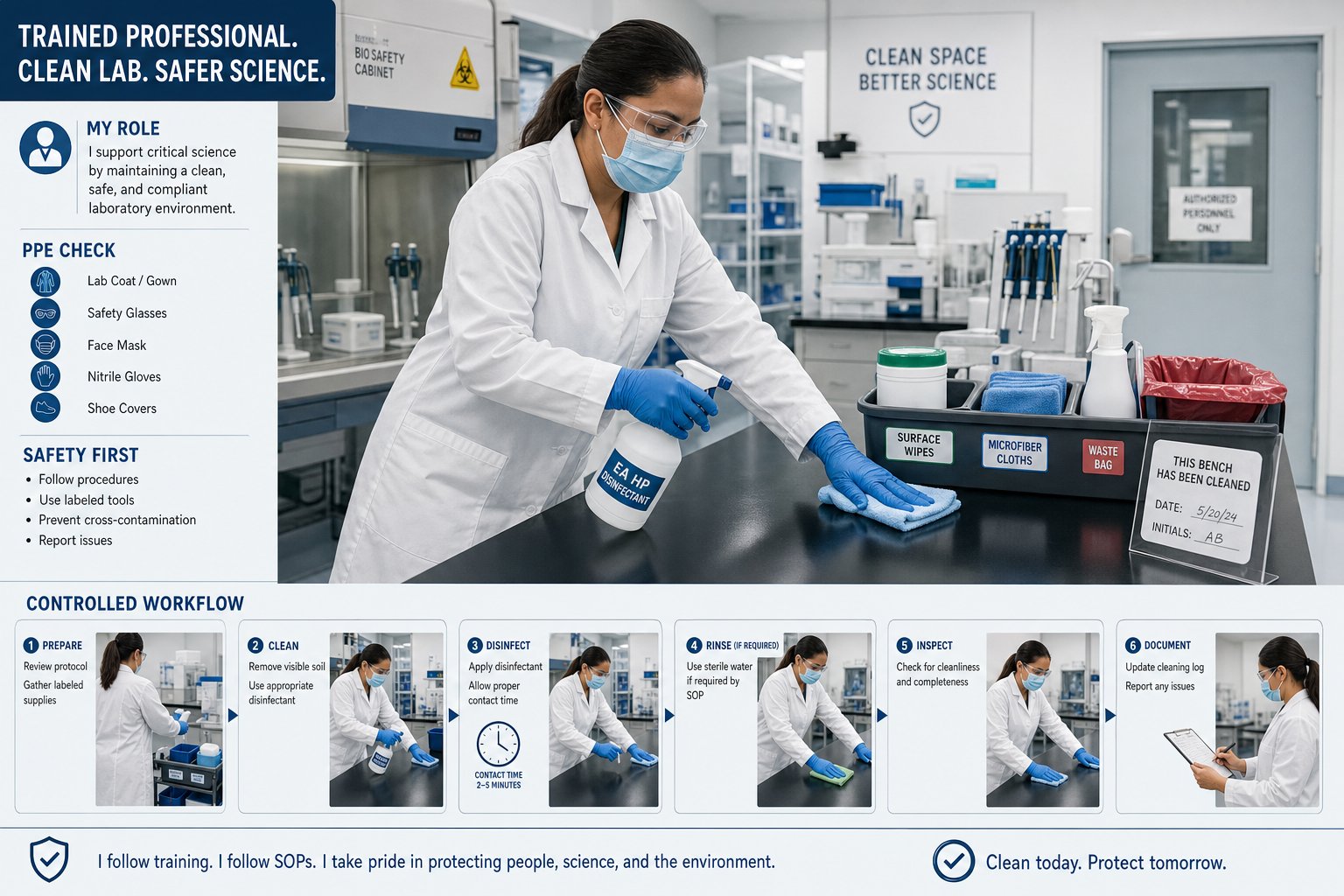
Biotech lab cleaning is a controlled support function: it must protect research workflows, respect access boundaries, and leave offices and common areas ready for staff. A New York City lab in Long Island City or Hudson Square, a New Jersey life-science site, a Connecticut research campus, or a Pennsylvania facility may combine wet labs, dry labs, offices, cold rooms, and shared equipment. GreenPoint Maintenance Services Corp provides trained commercial cleaning, JaniTrack verification, safety documentation, and fixed pricing while keeping scientific staff in charge of experiments and regulated processes.
Define the lab boundary before anyone cleans
Begin with a room inventory and access matrix. Identify wet and dry labs, tissue-culture or clean areas, chemical storage, waste holding, cold rooms, corridors, offices, restrooms, breakrooms, and receiving. Mark surfaces that janitorial staff may clean and equipment, benches, samples, labels, and instruments that are off limits. GreenPoint Maintenance Services uses a site-specific zone map and supervisor briefing before deployment. The goal is not to make a cleaner look like a scientist; it is to prevent accidental interference with research. A written boundary also lets a relief worker understand the site without relying on hallway assumptions.
Separate routine environmental cleaning from lab operations
Routine cleaning can include floors, approved counters, sinks, doors, touchpoints, restrooms, waste staging, and common areas. It should not include moving samples, opening equipment, wiping active experiments, handling cultures, emptying chemical containers, or processing regulated waste unless a qualified protocol explicitly assigns it. GreenPoint asks the lab’s EHS or facilities lead to define ownership, PPE, and escalation for each room. The [medical office cleaning requirements and OSHA guide](/blog/medical-office-cleaning-requirements-osha/) offers a useful foundation for hazard communication and exposure boundaries. Clear exclusions protect both the client’s science and the cleaning team.
Use a clean-to-dirty route and dedicated tools
A lab route should move from lower-risk offices and corridors toward higher-risk approved areas, with no backtracking that carries soil into clean space. Color-coded microfiber, labeled containers, and dedicated floor tools make the route visible. Never spray near open samples, sensitive instruments, outlets, or controls; apply product to the cloth when the manufacturer and client protocol allow. GreenPoint trains staff on PPE, hand hygiene, spill escalation, and product dwell time. The [color-coded microfiber systems guide](/blog/color-coded-microfiber-systems-guide/) explains how zone separation can be converted into a repeatable training standard. Supervisor inspections confirm that the route was followed.
Protect sensitive surfaces, instruments, and data
Lab spaces contain stainless benches, resin counters, sealed floors, glass, delicate sensors, screens, and equipment with manufacturer-specific care instructions. Add an approved-surface matrix to the cleaning plan and keep janitorial staff away from instrument interiors and controls unless the lab explicitly authorizes a task. Privacy also matters: whiteboards, sample labels, screens, and notebooks may contain confidential research. GreenPoint’s JaniTrack evidence can use approved location records and non-sensitive photos; the client decides which areas may be photographed. A quality program should prove service without creating a new information-security risk.
Make chemical safety and SDS access non-negotiable
OSHA’s Hazard Communication Standard requires employees to understand chemical hazards, labels, and Safety Data Sheets. A lab contract should state the approved product list, storage location, dilution method, PPE, spill response, and who authorizes substitutions. GreenPoint uses labeled containers, Green Seal certified products where appropriate, and training that covers never mixing chemicals. We ask the EHS lead to review product compatibility with lab surfaces and ventilation. The [OSHA cleaning chemical safety, GHS and SDS guide](/blog/osha-cleaning-chemical-safety-ghs-sds/) provides a practical checklist for onboarding. Documentation should be available to the facility manager and updated when products change.
Schedule around experiments, deliveries, and shift changes
A lab can operate 24/7 even when the office side closes at 6 p.m. Coordinate cleaning windows with experiments, sample deliveries, gowning, freezer access, and security. GreenPoint can use a daytime porter for offices and shared spaces plus a trained evening team for approved lab areas, with quiet routes that do not interrupt work. Sites near Grand Central, Penn Station, Newark, Stamford, King of Prussia, or Philadelphia life-science corridors may have distinct parking and access constraints. Call 347-332-9348 to schedule a walkthrough that includes the lab manager, EHS representative, and facilities contact.
Verify clean areas with records and trend data
JaniTrack can connect a checklist to a room, time, supervisor inspection, issue note, and corrective action. GreenPoint uses timestamped GPS-tagged photos only where the client permits them and avoids research data, labels, screens, or samples. ATP testing can be useful on selected non-sensitive touchpoints as a trend measure, but it cannot certify a lab or validate an experiment. The [digital cleaning verification systems](/blog/digital-cleaning-verification-systems/) explains what a manager should ask about access, retention, and reporting. A monthly scorecard can include inspection pass rate, response time, recurring rooms, supply incidents, and overdue corrective actions.
Plan staffing, training, and relief coverage
Lab support depends on room complexity and access restrictions, not just square footage. Ask vendors how they train staff, how they document competency, and how a replacement learns the site before entering. GreenPoint’s supervisor conducts orientation, maintains a relief roster, and repeats the site briefing after process changes. Our 98% client retention and MBE/MWBE certifications support a procurement file, but operational fit comes first. The contract should define service frequency, task ownership, exclusions, response times, periodic floor care, and emergency contacts. Do not accept “trained in healthcare” as a substitute for this lab’s written protocol.
Build a fixed-price scope that facilities can defend
GreenPoint Maintenance Services offers fixed pricing with no hourly billing and no hidden fees. The proposal states square footage, room types, frequency, labor assumptions, consumables, periodic work, access requirements, and exclusions such as regulated waste or equipment cleaning. This makes finance and EHS reviews easier and avoids disputes when a team discovers a cold room or restricted corridor after award. GreenPoint can support sites in NY, NJ, CT, PA, and FL with a consistent QA framework and local supervisor. Email info@greenpointms.com or call 347-332-9348 for a no-obligation quote and walkthrough.
An effective lab support program is deliberately boring: the same approved route, the same labels, the same escalation contacts, and the same evidence every shift. That consistency is what lets a research team focus on its work instead of wondering whether a room was entered or a spill was overlooked. GreenPoint reviews the first month with facilities and EHS, then updates the route when a new instrument, room, or hazard changes the boundary. Managers can call 347-332-9348 for a walkthrough that separates routine janitorial work from regulated or scientific responsibilities. The resulting fixed quote is easier to approve because it connects cost to rooms, frequency, and controls. This documented approach gives owners a repeatable standard for onboarding, inspections, budgeting, and renewal decisions across changing occupancy and facility conditions.
Treat mobilization as a controlled change, not a casual first night. GreenPoint can walk the facility with facilities, EHS, security, and a lab representative; mark approved surfaces; confirm product compatibility; test the access and alarm procedure; and agree on what evidence may be captured. The first month should include a baseline inspection and a review of any room the team could not enter because of an experiment or restricted process. That exception is not automatically a failure if it is reported and rescheduled through the right owner. Track recurring issues such as dust at door thresholds, full waste staging, supply-outs, and access delays, then solve the cause. GreenPoint supports a single research suite or a distributed life-science portfolio across Long Island City, Manhattan, New Jersey, Connecticut, Pennsylvania, and Florida. Call 347-332-9348 or email info@greenpointms.com to set the walkthrough; the final fixed quote will connect each price line to an approved task and frequency, with assumptions visible to operations and finance.
A professional cleaning program is strongest when the operating record is easy to read six months later. Keep the approved scope, room inventory, frequency chart, product list, access rules, and escalation contacts together. At launch, GreenPoint reviews the first inspection with the client and records any baseline exceptions instead of allowing them to become an argument about performance. At renewal, compare the original assumptions with actual occupancy, traffic, events, tenant changes, and project work. That comparison helps an owner decide whether to change a route, add a periodic service, repair a facility condition, or keep the plan unchanged. GreenPoint’s supervisors can explain why a task is daily, weekly, monthly, or triggered by an event, and JaniTrack gives the account team a factual record for that conversation. Managers should also name one person authorized to approve a scope change and one person who receives urgent notifications. This prevents duplicate instructions and protects the cleaning crew from conflicting requests. For a walkthrough, call 347-332-9348 or email info@greenpointms.com; GreenPoint will listen to the operational goals, confirm the boundaries, and provide a fixed-price quote that procurement and facilities can both understand.
FAQ: practical answers for facility decision-makers
Can janitorial staff clean an active biotech laboratory? Only within a written, client-approved boundary. Janitorial work should focus on approved environmental surfaces, floors, common areas, and waste or chemical tasks expressly assigned and trained. Samples, experiments, instruments, and regulated processes remain under laboratory ownership. GreenPoint creates an access matrix before service.
What training should a lab cleaning vendor provide? Require site orientation, PPE, hazard communication, SDS access, spill escalation, clean-to-dirty routing, privacy rules, equipment exclusions, and relief-worker training. GreenPoint briefs assigned and backup staff and documents supervisor inspections.
How should a lab cleaning scope handle chemicals? List approved products, storage, dilution, labeling, PPE, dwell time, spill response, and substitution approval. OSHA GHS/SDS expectations should be part of the contract. GreenPoint uses labeled containers and Green Seal options where appropriate.
Can JaniTrack document a research facility without exposing confidential work? Yes. The client can limit evidence to timestamps, GPS-tagged task records, checklist completion, and approved non-sensitive images. GreenPoint avoids samples, screens, labels, notebooks, and other confidential content in documentation.
How can a biotech company request a cleaning quote? Call GreenPoint Maintenance Services at 347-332-9348 or email info@greenpointms.com. We will include facilities and EHS stakeholders in a walkthrough and return a fixed-price proposal with clear boundaries.
GreenPoint Maintenance Services Corp is ready to map the scope at a no-obligation walkthrough. Call GreenPoint at 347-332-9348 or email info@greenpointms.com to schedule a site review; we return a fixed-price proposal with no hourly billing and no hidden fees. [digital cleaning verification systems](/blog/digital-cleaning-verification-systems/)