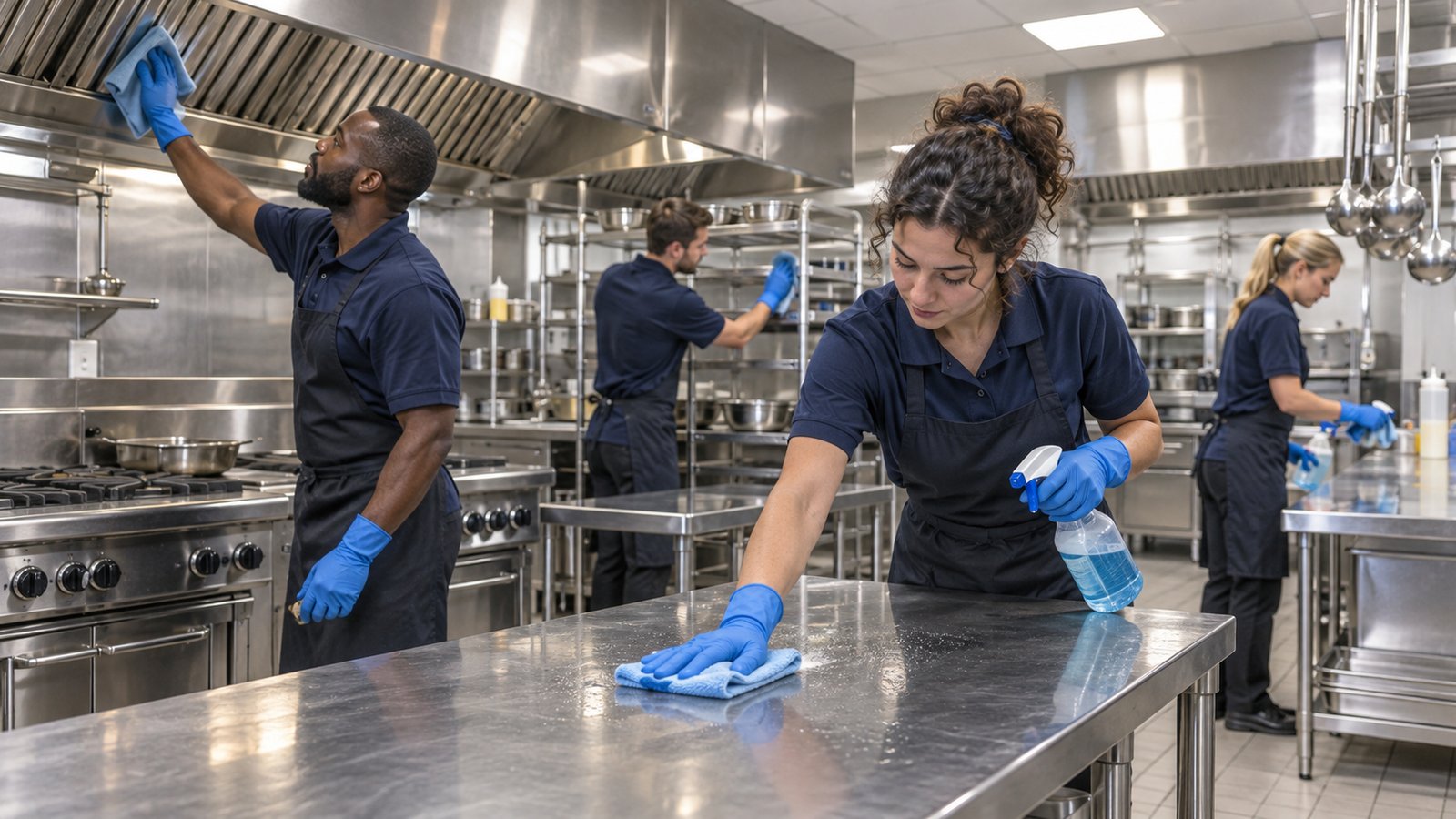
Catering kitchens and commissaries in New York City need cleaning scopes that protect food operations, keep production schedules moving, and make responsibility clear during inspections. A janitorial contractor can maintain agreed floors, restrooms, offices, waste areas, and other non-food-contact zones, but food businesses retain responsibility for food-safety procedures and must authorize any food-contact work. GreenPoint Maintenance Services Corp helps operators set fixed-price scopes, chemical controls, and verifiable service records. This guide covers what to require from a catering kitchen cleaning company in NYC, from shift timing to floor drains and documentation. Call 347-332-9348 to schedule a walkthrough or request a written quote.
Separate Building Cleaning from Food-Safety Duties
A commissary or catering kitchen contains production lines, prep tables, warewashing, cold storage, dry storage, loading areas, offices, restrooms, and waste rooms. Each zone needs a named owner and clear task boundary. The operator’s food-safety lead should define who cleans and sanitizes food-contact surfaces, utensils, equipment, and any areas where food is exposed. A generic janitorial scope should not authorize a contractor to clean slicers, ovens, mixers, food-contact tables, or production equipment unless staff are trained and the operator has approved written procedures. GreenPoint maps “vendor service,” “operator-controlled,” and “specialist contractor” areas before pricing.
New York City Health Code Article 81 addresses cleanliness of food establishments, equipment, and utensils, including §81.27 on cleaning premises, equipment, and utensils. The operator should consult the current code and its own food-safety program to determine what applies to the specific facility. For a contractor, the practical first step is to ask the person in charge which tasks are authorized, what products are approved, and which records must be retained. GreenPoint can build this boundary into the scope, while the business’s trained team controls required food-contact cleaning and sanitizing. See EPA disinfectant registration guidance and commercial cleaning contract key terms.
Create a Zone-Based Scope and Shift Plan
Divide the facility into zones such as receiving, production perimeter, walk-in corridors, offices, employee facilities, restrooms, and waste staging. List surfaces and tasks separately for each: remove waste, dry sweep or dust mop, wet clean floors, clean non-food-contact fixtures, replenish supplies, and report damage. Identify what cannot be moved and what must be protected from splash or chemical drift. GreenPoint’s walkthrough records the production hours, sanitation windows, access permissions, water points, floor construction, and storage location so the proposal reflects actual operations rather than an assumed empty kitchen.
Schedule cleaning around receiving and production. A crew arriving during a delivery rush may block the loading route; work during active food prep may create contamination risk or violate facility rules. Specify a start window, lockout or room-release process, required handoff, and who can approve a change. For a 10,000-square-foot commissary, the service plan should still be based on the number of rooms, drain configuration, equipment perimeter, and amount of soil, not square footage alone. GreenPoint provides fixed-price recurring scopes and can quote periodic work separately. Compare cleaning frequency standards by facility type and commercial cleaning cost per square foot when evaluating bids.
Address Floors, Drains, Grease, and High-Soil Areas
Kitchen floors can accumulate flour, oils, grease, food residue, and tracked moisture. The facility should specify which floor zones the contractor may service, how dry soil is removed before wet cleaning, what equipment is permitted, and how the floor is kept out of service until safe and dry. A cleaning crew should report damaged tile, failed grout, pooled water, and drain backups instead of treating them as routine soil. Grease traps, exhaust hoods, and ducts may require separate qualified service and documentation; do not assume a nightly janitorial visit covers these specialized systems. GreenPoint lists these exclusions clearly and can coordinate timing with the operator’s approved vendors.
Drain cleaning must be defined carefully. The contractor should not pour a chemical into a drain, remove a trap, or disturb food-production equipment without written authorization, product approval, and training. A facility manager can designate which floor drains are included, whether strainers may be lifted, and who handles plumbing defects. Use color-coded tools to prevent restroom or waste-area equipment from entering production zones. GreenPoint’s procedures can identify separate equipment by zone and include visual checks for standing water and residue in permitted areas. For product compatibility and worker protection, review OSHA cleaning chemical safety, GHS, and SDS guidance and color-coded microfiber systems.
Control Chemicals, Labels, and Contact Times
The operator should approve products based on the intended surface and food-safety procedure. A general cleaner, sanitizer, and disinfectant are not interchangeable terms. EPA-registered pesticide products must be used according to the label; surface type, dilution, contact time, and any required potable-water rinse matter. The NYC Health Code also governs applicable food-establishment cleaning and sanitizing, so the business should confirm its current obligations and approved chemical use with the person in charge. GreenPoint can provide a product list and safety data sheets for chemicals in its scope and will not substitute a product without the client’s approval.
OSHA’s Hazard Communication requirements address information about hazardous chemicals, including container labels, safety data sheets, and worker training. Establish where products may be stored, who controls dilution, how secondary containers are labeled, and how spills are isolated and reported. Never mix chemicals or use unmarked bottles. For food-contact surfaces, a product may require a specific rinse or may be limited to a stated use; do not infer “no rinse” based on the product category alone. GreenPoint documents dilution and handling rules and can support the operator’s chemical inventory, but the food business retains approval authority for its sanitation program.
Protect Food, Staff, and Production Equipment
Before service, agree how to protect exposed ingredients, packaging, clean utensils, and production equipment. Define whether the contractor may work only after items are covered or removed, which barriers are used, and who confirms the area is released. Keep cleaning tools, cloths, mop heads, and carts separated by zone and replace them according to the written procedure. Establish a handoff checklist for returning a room to production, including floor dryness, removal of equipment, and reporting of maintenance concerns. GreenPoint can use a room-release log for contracted areas but does not substitute that record for the operator’s required food-safety documentation.
The contract should also say what happens when a spill or suspected contamination occurs during an active shift. Identify the operator contact, whether the area is isolated, who performs cleanup, and how the incident is recorded. A contractor should not dispose of food, ingredients, oils, or regulated waste without authorization. Keep fire exits, electrical panels, and egress routes clear during cleaning; coordinate any elevated work or equipment movement with facility safety rules. GreenPoint includes an escalation route for urgent conditions and trains staff on site-specific exclusions. For deeper procurement context, see how to write an RFP for commercial cleaning.
Verify Work Without Confusing Records
A strong quality plan uses specific, inspectable outcomes: no loose debris in assigned corridors, no pooled water, clean non-food-contact fixtures, empty waste containers, and a documented response to defects. The operator should decide what is inspected by its own food-safety team and what is inspected by the cleaning supervisor. GreenPoint uses JaniTrack to create timestamped task records, GPS-tagged photos where appropriate, and a live dashboard. Records should avoid revealing recipes, proprietary processes, staff personal data, or exposed food. A timestamp or image confirms a service event or visible condition; it does not by itself certify food safety.
When a miss occurs, the record should show the area, task, time, person notified, corrective action, and reinspection. Review recurring trends monthly with the contractor and adjust service frequency when production or occupancy changes. If ATP testing is selected, define locations and interpretation in advance; ATP detects organic residue, not a specific pathogen. GreenPoint reports 98% client retention as a company measure, and buyers should ask for its time period and reference basis. The contractor should be accountable for its tasks while the catering operator remains responsible for its food-safety program, inspection readiness, and required records.
Compare NYC Catering Kitchen Vendors
Ask each vendor for a site-specific scope, fixed price, service window, product list, safety data sheets, training procedures, insurance, backup staffing, quality reporting, and exclusions. Confirm whether the price covers supplies, equipment, consumables, periodic floor work, and emergency response. A proposal that uses one line for “kitchen cleaning” is too vague to compare. GreenPoint Maintenance Services offers fixed pricing without hourly billing or hidden fees for the agreed recurring work, with special projects itemized separately. Ask for references with comparable production hours and facility layouts, not simply a generic office reference.
NYC access can vary by neighborhood and property type. A commissary in Long Island City near Queensboro Plaza may have freight access and late deliveries; a Manhattan kitchen near Chelsea Market or the Garment District may need stricter loading appointments; a Brooklyn facility around Industry City or Downtown Brooklyn may have campus or multi-tenant security rules. GreenPoint records these access facts, identifies the client contact, and sets a shift handoff before service begins. MBE or MWBE certification may matter to procurement, but buyers should verify exact documentation and expiration. To compare bids, use questions to ask a commercial cleaning company and schedule a site visit at 347-332-9348. For a second location or a new production shift, call 347-332-9348 to have the schedule and access plan re-scoped before added work begins.
Frequently Asked Questions
Question: Can a janitorial contractor sanitize food-contact surfaces? Answer: Only when the operator explicitly authorizes the task, defines the procedure and product, and confirms training and records. The food business retains responsibility for applicable food-safety requirements; a general cleaning contract is not enough.
Question: What should a NYC catering kitchen cleaning quote include? Answer: It should list zones, tasks, frequency, production-hour constraints, products, supplies, floor and drain boundaries, quality checks, exclusions, and emergency response. GreenPoint provides a fixed-price proposal after a walkthrough.
Question: Are hood and grease-duct cleaning part of janitorial service? Answer: Not automatically. These are specialized systems that may require a qualified contractor, separate schedule, and separate documentation. State the boundary in the bid and coordinate the work with the facility’s fire and maintenance requirements.
Question: How do operators check whether disinfectant use is correct? Answer: Verify the exact product label, approved surface, dilution, application method, contact time, and any rinse requirement. EPA label directions and the facility’s approved food-safety procedure control; do not assume all disinfectants are appropriate for food-contact use.
Schedule a catering-kitchen walkthrough with GreenPoint Maintenance Services at 347-332-9348 or info@greenpointms.com. GreenPoint provides written fixed-price scopes and JaniTrack verification; the operator retains control of food-safety procedures and approves every food-contact task and product.