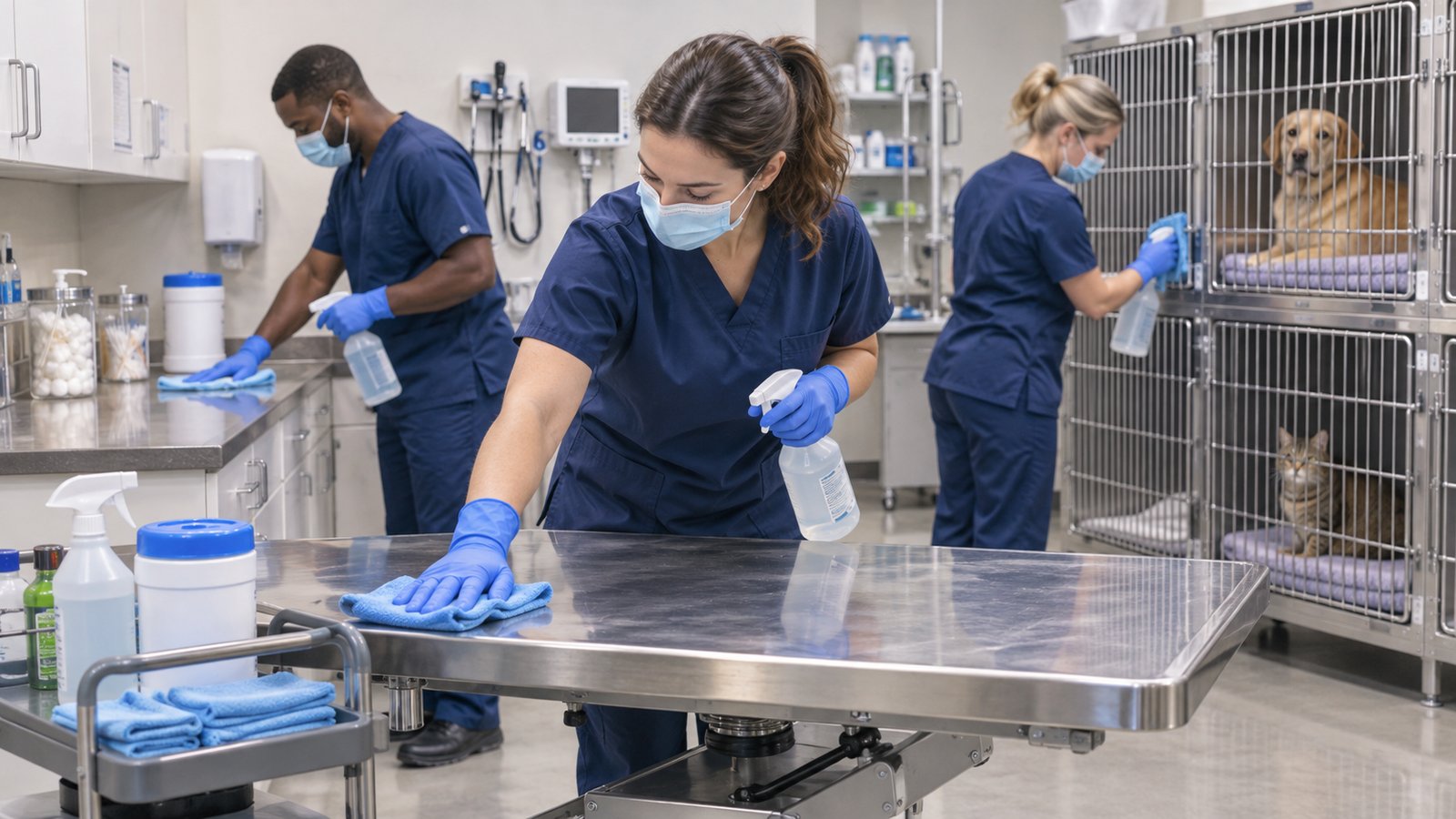
Veterinary clinic cleaning services in NYC should support a clean, orderly facility without blurring the line between janitorial work and clinical infection-prevention duties. A general cleaner may service lobbies, offices, restrooms, and agreed environmental surfaces, while clinic leadership must control patient-care procedures, sharps, regulated waste, animal handling, and any clinical equipment cleaning. GreenPoint Maintenance Services Corp helps commercial and institutional facilities define auditable scopes, staff safety, and service evidence. This guide gives practice managers a vendor-selection framework for clinics in Manhattan, the Bronx, Brooklyn, Queens, and Staten Island. Call GreenPoint at 347-332-9348 to schedule a walkthrough or request a written quote.
Separate Janitorial Scope from Veterinary Clinical Work
A veterinary hospital can include a public lobby, exam rooms, treatment areas, kennel runs, isolation rooms, imaging spaces, staff break rooms, and storage. These locations have different access, soil, and exposure profiles, so the contract should label each zone and state exactly which tasks the cleaner may perform. The clinic’s veterinarian or infection-prevention lead should approve which surfaces are included, what products are permitted, and when rooms are released for service. GreenPoint does not assume that general commercial cleaning authorizes staff to handle animals, instruments, medication, clinical equipment, sharps, or regulated waste.
Define terms such as cleaning, disinfection, sanitizing, and sterilization carefully. Removing visible soil is not the same as applying an EPA-registered disinfectant, and routine janitorial service is not sterilization. The practice should provide written room-specific procedures, approved products, required wet contact times, and any required rinse or re-entry steps. GreenPoint can include only those environmental tasks that are trained, authorized, and documented in the contract. For deeper context, review healthcare-associated infections and environmental cleaning and medical office cleaning requirements and OSHA.
Build a Room-by-Room Veterinary Cleaning Matrix
List tasks by zone, shift, and responsible role. A public lobby may need frequent spot cleaning of seating, entry glass, and floors; exam rooms may require the clinic’s staff to clean and disinfect between patients; restrooms need a defined fixture and replenishment schedule; staff areas may need daily waste and floor service. Kennels and isolation areas require especially clear boundaries because animal care, waste, bedding, and infectious-disease protocols may be clinic controlled. GreenPoint uses a walkthrough to map these areas and can mark “clinic staff only” locations rather than leave the vendor to infer permission.
Use the matrix to capture frequency, method, product, dwell/contact time when a disinfectant is authorized, required protective equipment, and a verification method. Include a response plan for urine, feces, vomit, blood, or other body-fluid incidents; specify who is trained to respond and who must be notified. An office might assign immediate cleanup to clinic staff and reserve the nightly contractor for routine, non-clinical surfaces. GreenPoint can price a clearly defined nightly scope, with additional project work approved separately. A buyer can also use quality assurance for commercial cleaning programs to define inspections and corrective actions.
Protect Workers from Chemical and Biological Exposure
Clinic leadership and the cleaning employer should assess tasks and exposures before service begins. OSHA’s Bloodborne Pathogens standard applies where employees have reasonably anticipated occupational exposure to blood or other potentially infectious materials; it is not a blanket rule that every cleaner must perform every clinic cleanup. OSHA guidance also highlights janitorial workers as a possible exposure group. Determine who handles sharps, how puncture-resistant containers are managed, what incident procedure applies, and whether a task belongs to trained clinic personnel rather than the contractor. GreenPoint establishes escalation and exclusion rules rather than treating all waste as ordinary trash.
Chemical safety deserves the same planning. OSHA’s Hazard Communication standard addresses workplace chemical labels, safety data sheets, and employee information and training. The clinic should supply or approve products when a surface, animal, device, or clinical protocol requires a specific product. GreenPoint can provide a product list, safety data sheets, handling instructions, dilution controls, and secondary-container labeling for products within the contracted scope. Never mix products or rely on a brand name without reading the label. Review OSHA cleaning chemical safety, GHS, and SDS guidance and EPA disinfectant registration guidance as part of procurement.
Follow Product Labels and Protect Room Turnover
A disinfectant only performs as labeled when the correct product is used on a compatible surface, at the stated concentration, with the required application and contact time. The surface may need to remain visibly wet for that full interval, and some products require a potable-water rinse on food-contact or other designated surfaces. EPA explains in its registered disinfectant guidance that users should follow the label and that contact time is the time a surface must remain wet for the stated efficacy. The practice must choose products for its organisms, surfaces, and regulatory protocol; a janitorial vendor should not select an infection-control claim on its own.
Coordinate cleaning around patient flow. Set a room release signal, a clear entry/exit route, and a process to prevent a cleaned room from being re-contaminated by soiled equipment or traffic. Keep clean and dirty tools separated and color-coded by zone, and define how cloths and mop heads are stored and laundered. GreenPoint can document routine work in JaniTrack using timestamps, GPS-tagged evidence, and a live dashboard, while clinical completion remains under clinic control. ATP testing may help evaluate organic residue on a sampled surface but does not identify a microorganism or replace the clinic’s infection-prevention protocol.
Set Frequencies for Lobbies, Restrooms, and Shared Areas
Frequency should reflect patient volume, operating hours, and the type of surface. A high-volume lobby may need several touch-up inspections per day; restrooms may need a schedule aligned with appointments and staff use; low-traffic administrative offices may need nightly or less frequent service. A treatment-room schedule must be assigned by clinic leadership, especially where patient turnover or animal-care procedures require immediate between-visit cleaning. Do not use square footage alone to set the labor plan. GreenPoint combines the number of rooms, tasks, soil load, access window, and desired quality checks when estimating a recurring service.
Include periodic work such as baseboard detailing, high dusting, resilient-floor care, carpet extraction, and glass cleaning in the annual calendar. Distinguish these from immediate clinical response and from specialized work like HVAC, biohazard remediation, or equipment servicing. GreenPoint’s fixed-price proposal can show routine tasks separately from optional projects so the manager sees the total planned cost. For a clinic with 2,500 to 8,000 square feet, the actual labor plan can vary significantly depending on exam-room count, appointment volume, kennel use, and whether daytime coverage is needed. Call 347-332-9348 to schedule a site review rather than relying on a generic per-square-foot promise.
Verify Service and Preserve Accountability
A clinic should not rely on a contractor’s completion checkbox as the only quality measure. Define visual standards by room, sample a representative number of areas, track complaints by location and shift, and record correction and reinspection. Require the vendor to identify who supervises the work and how staff substitutions are trained. GreenPoint uses JaniTrack to support timestamped task records, GPS-tagged photos where appropriate, and dashboard reporting. If ATP testing is included, establish the sampling locations, baseline, threshold, and follow-up response in advance; the result is a surface cleanliness indicator, not a diagnosis or proof of infection prevention.
Review service records with the practice manager on a predictable cadence. Investigate repeated issues such as streaked floors, missed restocking, or an unavailable room as process problems that may need a frequency or access adjustment. Keep sensitive patient and client information out of photos and dashboards; establish privacy rules and approved image angles before documentation begins. GreenPoint reports 98% client retention as a company measure, so a buyer should ask for the calculation period and references from comparable healthcare or veterinary settings. GreenPoint can provide a written scope, a supervisor contact, and a corrective-action process as part of vendor evaluation.
Choose a Contractor That Fits NYC Operations
New York City facilities face practical constraints that affect shift planning: secure building access, loading restrictions, elevator reservations, noise limits, and limited space for chemical storage. A clinic near Grand Central, Fordham Road, Atlantic Avenue, Jackson Heights-Roosevelt Avenue, or a Staten Island transit hub may have different access routes and operating patterns. The walkthrough should record where crews enter, where carts can be staged, which rooms are restricted, and how after-hours alarms are managed. GreenPoint serves facilities across the five boroughs and can build these site-specific constraints into the schedule and quote.
Ask for business credentials, insurance, staffing coverage, training records, references, a sample service report, and a clear list of exclusions. GreenPoint Maintenance Services Corp is MBE/MWBE certified with New York State, NYC, and NYC DOE and is registered in SAM.gov; the clinic should still verify that each credential aligns with its procurement requirements. Avoid proposals that promise “medical-grade” or “infection-free” outcomes without defining the method and evidence. GreenPoint uses fixed pricing for the agreed recurring scope, with no hourly billing or hidden fees, and lists optional projects for approval. Contact 347-332-9348 to request a veterinary clinic cleaning walkthrough in NYC.
Frequently Asked Questions
Question: Can a janitorial company clean veterinary exam rooms? Answer: It can perform specifically authorized environmental tasks if the clinic defines the surfaces, products, training, timing, and verification. The clinic should retain control of patient-care procedures, instruments, animals, sharps, and clinical waste unless a qualified, documented scope says otherwise.
Question: Does OSHA’s Bloodborne Pathogens standard apply to every clinic cleaner? Answer: It applies where employees have reasonably anticipated occupational exposure to blood or other potentially infectious materials. The employer must assess tasks and exposures; the contract should clearly assign cleanup, training, protective equipment, and incident response.
Question: What is the difference between cleaning and disinfecting? Answer: Cleaning removes soil; disinfection uses a product under its registered label directions to make a stated antimicrobial claim. Follow the product’s surface compatibility, dilution, contact time, and rinse instructions, and do not treat routine cleaning as sterilization.
Question: How can a clinic verify a contractor’s work? Answer: Use room-specific acceptance criteria, inspections, complaint follow-up, training records, and documented corrective action. GreenPoint’s JaniTrack can support timestamped logs and photos; ATP testing can indicate organic residue but does not identify pathogens or replace infection-control checks.
For a veterinary clinic cleaning walkthrough in NYC, call GreenPoint Maintenance Services at 347-332-9348 or email info@greenpointms.com. GreenPoint provides written scopes and JaniTrack service evidence, with a company-reported 98% client retention rate; the clinic retains control of clinical protocols and regulated materials.