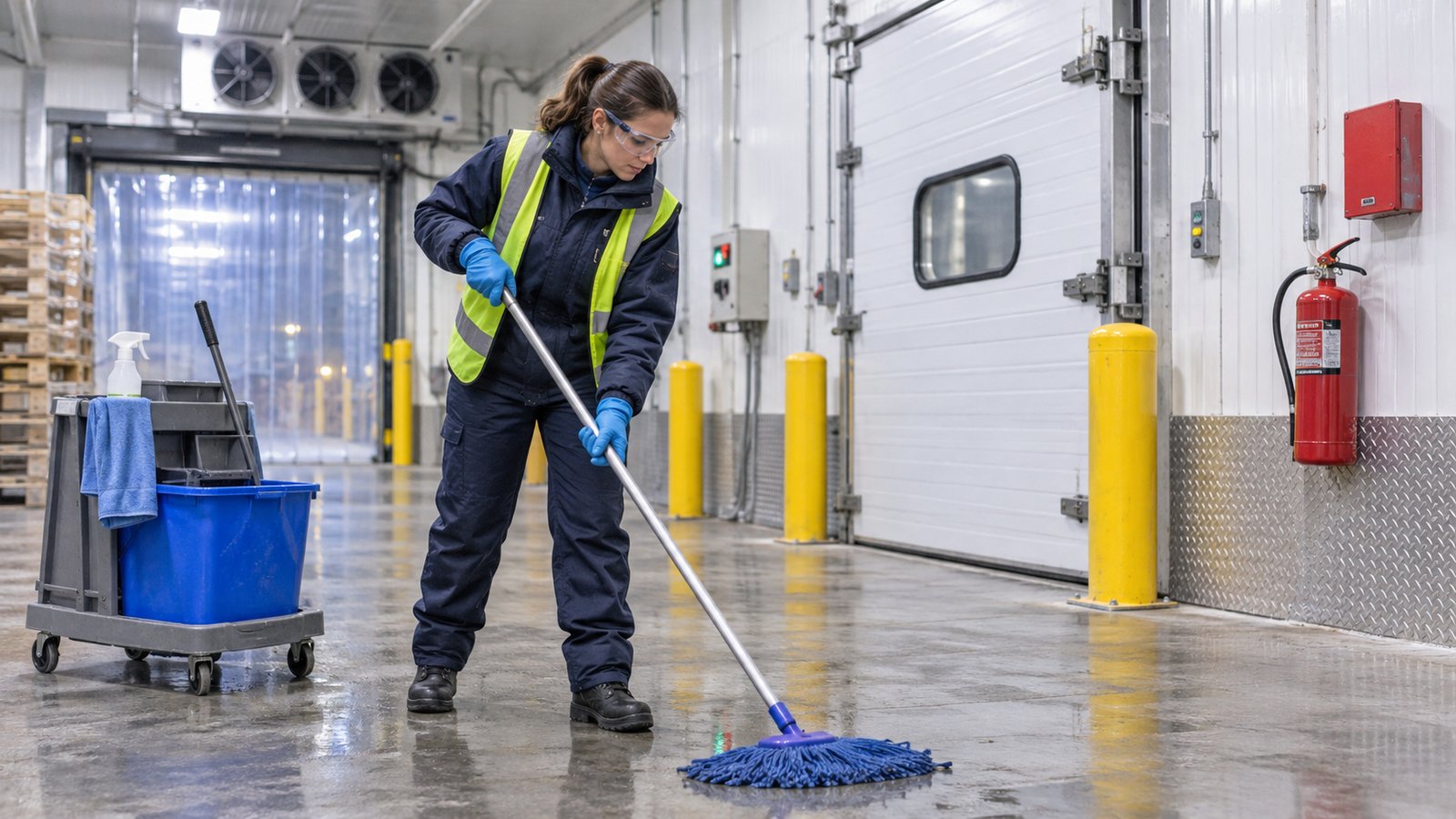
Cold storage cleaning is a logistics and sanitation task, not simply office janitorial work performed in a colder room. A sound program must protect stored goods, avoid disrupting temperature control, manage condensation and ice, and coordinate with the facility’s food-safety or product-quality procedures. For warehouse operators in New York, New Jersey, and Connecticut, the right vendor scope begins with a site-specific map of temperature zones, access rules, approved products, and shift handoffs. GreenPoint Maintenance Services helps buyers turn those operating details into scheduled tasks, accountable crews, and records that can be reviewed after a shift.
Map the zones before requesting a quote
A quote should separate ambient receiving and shipping areas from chilled rooms, freezer rooms, dock plates, vestibules, employee welfare spaces, and any maintenance or battery-charging zones. Record approximate square footage, operating temperature, floor surface, drain locations, pallet-rack configuration, traffic intensity, and whether product is exposed or enclosed. A 40,000-square-foot warehouse with a 5,000-square-foot freezer is not one uniform cleaning environment: moisture behavior, dwell time, equipment, and safe access differ by zone. GreenPoint Maintenance Services uses a walkthrough to document those differences before recommending frequencies or labor coverage.
Ask the operations lead to identify protected product zones, allergen or chemical-control boundaries, restricted aisles, forklift routes, lockout procedures, and permitted shutdown windows. The cleaning plan should state who clears pallets, who authorizes aisle closures, and who confirms that refrigeration equipment can remain in service. GreenPoint Maintenance can translate the site map into a task matrix with location, method, frequency, responsible party, and evidence required. This prevents a low bid from hiding an assumption such as moving customer inventory or cleaning around active machinery.
Separate cleaning from food-safety responsibility
For facilities that store food, the owner or food-safety team remains responsible for determining applicable preventive controls, sanitation procedures, product-contact boundaries, and release decisions. FDA guidance for current good manufacturing practices distinguishes food-contact and non-food-contact surfaces and expects suitable controls for the facility’s processes. FDA’s sanitary transportation rule addresses transportation equipment and related operations; it does not create one universal cleaning recipe for every cold-storage room. Buyers should have their compliance lead approve chemical lists, dilution, contact time, rinsing, and documentation before a contractor starts. See the FDA FSMA questions and answers and the FDA guidance library for sanitation and transportation.
A commercial janitorial vendor should not claim to certify a food facility or replace its environmental monitoring program. GreenPoint Maintenance Services can follow a written, customer-approved scope, keep non-food-contact work separate from production controls, and document exceptions for the facility’s designated manager. If the site requires ATP readings or microbiological sampling, define what is sampled, who sets the acceptance limits, how results are interpreted, and who has authority to release an area. ATP readings can help assess cleaning performance, but they do not identify a pathogen or prove that food is safe.
Build a frequency plan around risk and access
Use a zone-by-zone schedule instead of promising that every surface will be cleaned at the same frequency. Receiving vestibules, dock thresholds, pedestrian walkways, and restrooms often need daily attention because of soil and foot traffic. Rack uprights, overhead ledges, wall protection, and less-used corners may fit a weekly, monthly, or quarterly rotation based on accumulation and the facility’s own hazard assessment. Floor drains and areas prone to condensation require a documented method and inspection interval. The exact schedule should follow use, visible conditions, product exposure, and written site rules rather than an unsupported industry-wide square-foot benchmark.
Plan deep cleaning for windows when traffic is lower, inventory can be moved or protected, and the facility can keep the intended zone out of service for the full work period. A two-person team may need several hours for a modest room if it must work in short access windows, use cold-rated equipment, and allow surfaces to dry before normal traffic resumes. GreenPoint can quote routine work separately from project work so the buyer sees the difference between nightly upkeep, periodic floor treatment, and a one-time recovery clean. For general staffing and frequency context, compare the guidance in cleaning frequency standards by facility type and warehouse industrial cleaning best practices.
Manage condensation, ice, and floor safety
Cold rooms can develop condensation where warm, humid air meets cold surfaces, especially around doors, seals, dock transitions, and damaged vapor barriers. The cleaning scope should assign who reports leaks, blocked drains, damaged door sweeps, or recurring ice, because janitorial staff should not be expected to repair refrigeration or building-envelope failures. Establish approved wet-cleaning windows, squeegee or recovery methods, drying checks, and temporary barriers. Never leave a wet floor in a forklift path or assume that a warning sign is a substitute for traffic control.
Ask the employer and site safety contact to review cold exposure, slip hazards, chemical handling, visibility, emergency communication, and the facility’s indoor-release procedures. OSHA’s warehousing information specifically calls attention to refrigerated-warehouse exits: cold-storage doors should remain unlocked or provide an inside release so workers can exit. Work plans should also identify warm-up breaks or other controls required by the employer’s hazard assessment, safe routes to exits, and how a worker requests assistance. GreenPoint supervisors should be able to stop work and escalate unsafe conditions rather than improvise around ice, blocked egress, or a malfunctioning door.
Choose products and equipment for the environment
A product that performs well at room temperature may behave differently on a cold surface or in a low-temperature room. The customer should approve the exact product, label directions, dilution, dwell time, personal protective equipment, and any rinse requirement. Require current Safety Data Sheets, labeled secondary containers, segregated storage, and a no-mixing rule. GreenPoint Maintenance uses Green Seal certified products where appropriate to the task and the customer’s approval; certification does not mean that every product is suitable for every food or cold-storage application.
Equipment should match the aisle width, surface, temperature, and available power or charging policy. Small scrubbers may fit narrow pick aisles, while larger open staging areas can support a more productive machine. Verify that batteries and cords are permitted, that machines can be safely stored outside restricted zones, and that cleaning tools are not carried from restrooms into product areas. Color-coded microfiber, zone-specific carts, and inventory controls reduce accidental cross-use. GreenPoint can list equipment assumptions in the proposal so the operating team can approve them before mobilization.
Specify evidence, exceptions, and service levels
A useful service specification says what acceptable means in observable terms: no loose debris in identified walkways, no pooled water after the work window, waste removed to the assigned point, and documented completion of scheduled tasks. Define inspection sampling, response times for missed tasks, who can approve a corrective visit, and how work is recorded when an aisle is inaccessible. JaniTrack can support GreenPoint’s service verification with timestamped, GPS-tagged photos, task records, and a live dashboard. These records show what was documented; they do not substitute for a customer’s food-safety testing, equipment inspection, or regulatory sign-off.
Plan mobilization and operational handoffs
Before launch, hold a mobilization meeting with the facility manager, food-safety lead, shift supervisor, security, and the contractor’s account lead. Review a first-week route, radio or phone contacts, visitor and badge requirements, emergency egress, and the point at which work must stop for a temperature alarm, active loading conflict, or unknown spill. Agree on a simple exception vocabulary: blocked by inventory, equipment unavailable, site-requested deferral, and safety stop. This makes the nightly report useful rather than a generic completed/not-completed list. GreenPoint Maintenance can build approved exception codes into its routine and review the first two weeks with the customer. Call 347-332-9348 to arrange a walkthrough and identify the right customer participants.
Ask the prospective contractor to estimate startup separately from monthly service. Startup may include access orientation, baseline photographs where permitted, a chemical and SDS review, equipment delivery, supervisor inspection, and mapping of restricted locations. Spell out how many days are needed to mobilize after award and what happens if the facility changes its operating hours before launch. A 30-day service review can examine attendance, missed areas, repeat floor issues, product approvals, and whether planned frequencies fit actual conditions. For cold-room work, agree on who documents temperature conditions before and after any approved access window; cleaning staff should never change temperature settings or make refrigeration adjustments. The customer’s operations team retains control of refrigeration systems and product disposition.
Ask for a sample report and test a pilot zone before award. The pilot should include a normal shift, a blocked-access scenario, and one corrective-action loop so both parties can see how exceptions are escalated. GreenPoint Maintenance Services offers fixed pricing with no hourly billing or hidden fees, based on the agreed scope and site conditions. To request a walkthrough and proposal for a cold storage facility in NY, NJ, or CT, call 347-332-9348 or email info@greenpointms.com. GreenPoint will document the boundaries, assumptions, and proof requirements rather than quoting a vague per-square-foot promise.
Cold storage cleaning questions buyers ask
Q: How often should a cold storage warehouse be cleaned? A: There is no single frequency for every room. Set daily, weekly, and periodic tasks by zone, traffic, soil, product exposure, surface, and the facility’s written sanitation program.
Q: Can a janitorial contractor clean during operations? A: Often yes, if the customer approves the routes, equipment, product protection, and access controls. Some tasks require an aisle closure, empty room, or maintenance window, so the schedule should identify both routine and restricted work.
Q: Does ATP testing prove that a cold room is pathogen-free? A: No. ATP is a rapid indicator of organic residue and cleaning performance under a defined protocol; it does not identify pathogens. The customer’s food-safety lead should set sampling methods and acceptance criteria.
Q: What information is needed for a quote in New York, New Jersey, or Connecticut? A: Provide a floor plan, zone temperatures, operating hours, access and product-protection rules, approved chemicals, current frequencies, and known problem areas. GreenPoint Maintenance can confirm the details during a walkthrough; call 347-332-9348 to schedule one.
Request a cold-storage walkthrough with GreenPoint Maintenance Services at 347-332-9348. GreenPoint pairs an agreed zone-based scope with JaniTrack task verification, timestamped GPS-tagged photos, and a live dashboard; ask to see the evidence format before service begins.