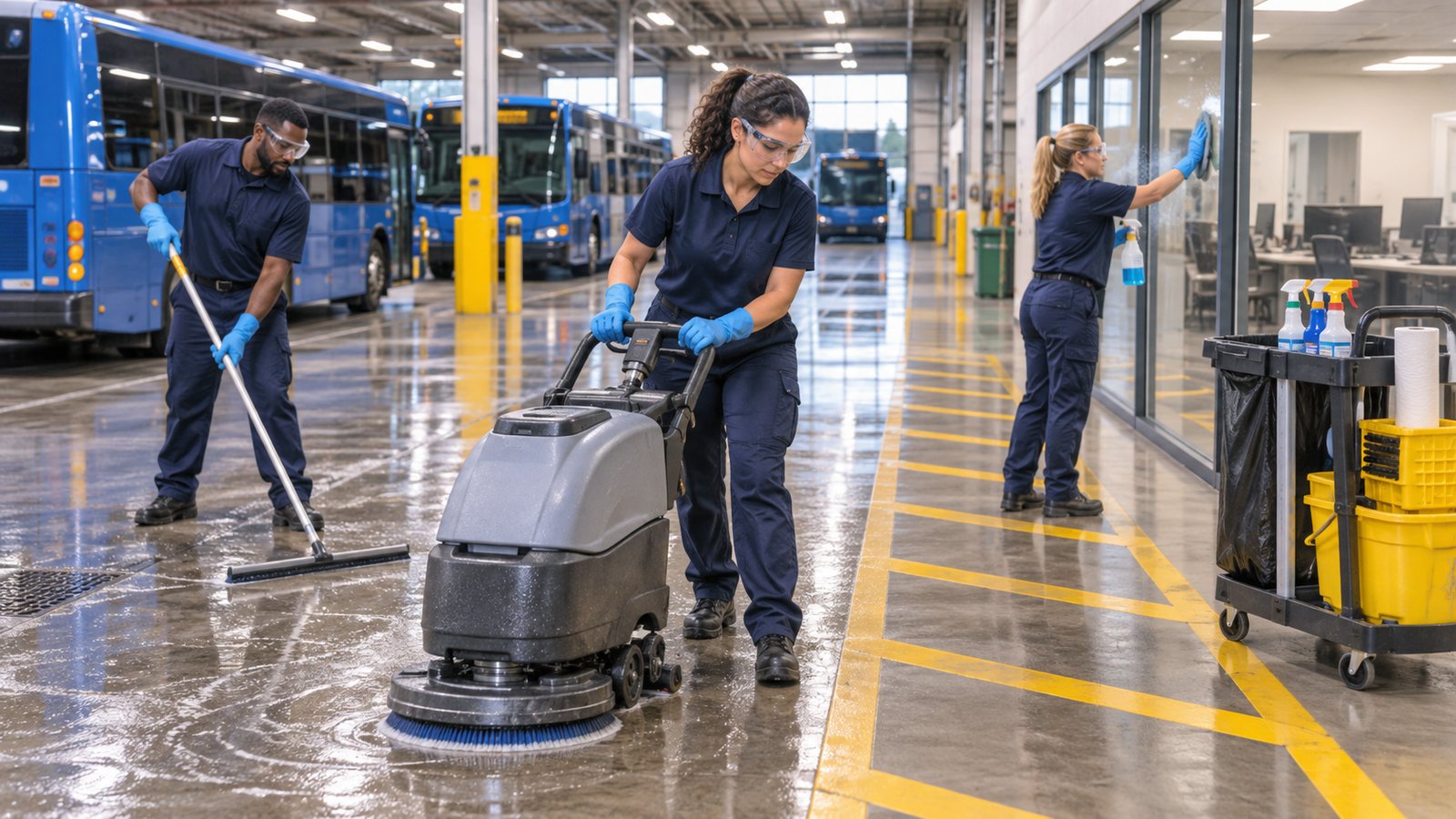
Bus depots and fleet garages are working facilities, not ordinary warehouses. They combine vehicle movement, maintenance bays, dispatch offices, driver rooms, restrooms, fuel or charging infrastructure, wash areas, and seasonal salt and grit. A cleaning contractor must understand where people and vehicles move, which hazards belong to maintenance staff, and how to keep service reliable across shifts. GreenPoint Maintenance Services helps tri-state facility managers define a safe janitorial scope with clear exclusions, documented checkpoints, and fixed pricing. This guide covers practical planning for depots in New York City, Westchester, Long Island, New Jersey, and Connecticut.
Separate janitorial work from vehicle maintenance hazards
Local operators should map both the property and the approach route. A depot near the Port Authority Bus Terminal, Newark Penn Station, the George Washington Bridge, or the Lincoln Tunnel may face access restrictions, queueing, screening, and crowded shift changes. In Brooklyn, Queens, the Bronx, and Staten Island, local streets can constrain deliveries and contractor parking. Ask dispatch to identify the safest pedestrian entrance and the times when vehicle movements make cleaning routes unavailable.
Before pricing, classify every space: dispatch and administration, driver lounges, locker rooms, restrooms, pedestrian corridors, parts storage, active bays, wash areas, charging or fueling zones, and exterior approaches. Identify where only mechanics may work, which spaces require lockout or vehicle movement controls, and which chemicals or fluids are present. A janitorial provider should not service a vehicle, open equipment, enter a restricted pit, or handle an unknown spill under a routine office-cleaning scope.
Set boundaries in a written site map and task matrix. Include approved routes, shift handoffs, traffic-control requirements, PPE, access badges, radio or supervisor contacts, and stop-work conditions. GreenPoint Maintenance Services begins with a walkthrough so the proposal reflects actual operating patterns. For related planning, review our warehouse and industrial cleaning best practices and OSHA chemical safety and SDS guide.
Address oil, grease, grit, and winter road salt
The depot's environmental and safety staff should decide how used absorbents, oily debris, and wash-area residues are collected and disposed of. Requirements can depend on the material, drainage, and site permits; do not wash contaminants toward a trench drain or street inlet without approval. New York, New Jersey, and Connecticut facilities may have different municipal wastewater, stormwater, and fire-code conditions. Put the site's spill and drainage instructions in contractor orientation and post the escalation number where crews can find it.
Garage floors can accumulate road salt, sand, dust, oil, coolant, and other vehicle-related residues. Routine sweeping or damp mopping is not a substitute for a spill response plan. The facility should identify who is authorized to contain each material, where spill kits are stored, which waste containers are approved, and when environmental or safety staff must be notified. Cleaners should not touch unidentified liquids or spread them across a pedestrian route. Use cones or barriers where the site permits and report the issue immediately.
Winter conditions in the Northeast make entrance mats, vestibules, stairs, and pedestrian lanes important daily checkpoints. Salt can be tracked from approaches near the George Washington Bridge, Lincoln Tunnel, Holland Tunnel, major bus terminals, or commuter rail stations. Establish a frequency for grit removal, mat checks, and floor inspection based on weather and traffic rather than relying on one monthly deep clean. Any degreasing method must be approved for the floor finish, drainage, and environmental controls.
Keep driver and dispatch spaces ready across shifts
Drivers and dispatchers often use the same lounge at different times, so agree on a quick-turn standard that does not depend on one end-of-day visit. A mid-shift check may be more valuable than extra detail work in a locked office. Where employee-area rules apply, consult the facility's labor and privacy policies before moving belongings or posting images. Label personal storage as out of scope and provide a lost-property procedure for items found during routine service.
Driver lounges, dispatch desks, training rooms, locker rooms, and restrooms often serve multiple shifts. Include touchpoints, tables, chair arms, waste, floors, sinks, dispensers, and visible glass in the scope. Clarify whether personal items, radios, route sheets, keys, and equipment are off-limits. Cleaners should never move operational papers or disconnect devices. In a 60,000-square-foot depot, the office footprint may require a separate route from the vehicle bays, with more frequent restroom checks during shift changes.
Set a restocking standard for soap, towels, tissue, and other facility-supplied consumables. Define the escalation contact for broken dispensers, plumbing leaks, pest evidence, damaged flooring, or blocked egress. Products should be appropriate to the surface, used according to label directions, and stored securely. GreenPoint Maintenance uses Green Seal-certified products where suited to the task and the facility's approved product list. For broader restroom planning, see restroom cleaning best practices for high-traffic sites.
Schedule around vehicle movements and operating hours
New York City's idling rules, site security requirements, and local fire-safety procedures can affect how a contractor enters and operates at a depot; other jurisdictions maintain their own requirements. The facility should identify the rules and property policies that apply rather than expect cleaners to infer them from an address. Establish no-idling expectations for vendor vehicles where appropriate, define approved charging or fueling buffers, and include evacuation and severe-weather procedures in the crew's orientation.
The service plan must fit pull-in, pull-out, fueling or charging, maintenance, and dispatch windows. Mark peak vehicle movements and areas that should remain clear. If cleaning requires a wet floor or powered equipment, establish a controlled window and traffic barrier plan approved by depot leadership. A vendor should know the daily sign-in procedure, parking restrictions, emergency alarms, and who can authorize entry to a bay. Include an alternate route for crews when a lane is blocked or an incident interrupts normal operations.
Define routine, periodic, and weather-triggered work separately. Daily tasks can cover driver facilities and offices, with scheduled attention to designated pedestrian zones. Periodic work may include interior glass, high dusting where safe, and approved floor maintenance. Keep pit cleaning, maintenance bays, bus interiors, fuel systems, and hazardous spill response out of scope unless separately designed and authorized. Call 347-332-9348 to schedule a walkthrough for a depot or fleet garage in NY, NJ, or CT.
Verification that protects operations and privacy
A service log should identify the task, time, location, status, exception, and corrective action. JaniTrack supports GreenPoint's agreed checkpoints with time-stamped, GPS-tagged photos and a live dashboard. Depot managers should approve photo zones in advance and exclude license plates, route sheets, employee information, security screens, keys, and sensitive fleet details. A missed task should be noted with a reason and rescheduled when access becomes available rather than marked complete.
Use site inspections to track recurring salt or grit, restroom readiness, blocked walkways, supply shortages, and unresolved maintenance conditions. ATP testing may be used for selected surfaces where a facility has a clear method, but it is not a substitute for hazard inspections or proof that a garage is free of pathogens. For a repeatable scorecard, consult our facility cleaning audit checklist and digital cleaning verification systems. Keep corrective actions assigned to the team that can actually resolve the issue.
Choose a qualified vendor and compare true cost
Ask whether the vendor can cover scheduled service during snow, heavy rain, transit disruptions, or a temporary facility closure. A depot cannot safely accept a substitute crew who has not completed site orientation, so the continuity plan should include trained backups and a clear approval step. For multi-site fleets, ask for one account lead and named local supervisors in each service area. GreenPoint Maintenance can review this coverage requirement during a walkthrough; call 347-332-9348 to request a fixed-price proposal.
Inspect the first month with both a facility manager and a frontline dispatcher or driver representative. Their feedback can identify missed shift-change needs, confusing barriers, or restroom timing that conflicts with vehicle pull-out. Use a short corrective-action log with an owner and due date, then revisit issues that repeat. For depots with several sites, use a common scorecard but allow local route maps and site rules to differ. Consistency should not erase legitimate operating differences.
Ask for insurance, industrial-facility references, supervisor response coverage, staff training, PPE and hazard communication practices, incident reporting, subcontractor disclosure, access-control procedures, and backup staffing. Confirm that workers know how to stop and report unknown spills, vehicle movement conflicts, damaged barriers, or restricted equipment. The facility should provide its own hazard orientation and explain site-specific emergency signals. OSHA duties depend on the hazards and worker roles; both facility and contractor should coordinate before service begins.
A proposal should specify shifts, frequency, rooms, bay exclusions, consumables, equipment, seasonal work, emergency response, waste handling, and change-order terms. Fixed pricing makes comparisons clearer when the scope is precise. GreenPoint Maintenance Services Corp is MBE-certified through relevant New York programs and SAM.gov registered; verify the required documents for your purchasing authority. GreenPoint reports 98% client retention and uses JaniTrack to record agreed checkpoints. For a walkthrough and fixed-price quote, call 347-332-9348 or email info@greenpointms.com.
Bus depot and fleet garage cleaning FAQs
Q: Can janitorial staff clean oil or coolant spills in a garage? A: Only if the facility has authorized and trained them for the specific material, equipment, PPE, and disposal procedure. Unknown or hazardous spills should be isolated and escalated under the depot's emergency plan.
Q: Should a cleaning vendor clean bus interiors or maintenance pits? A: Not automatically. These require separate scopes, access controls, training, and approval by operations and safety leadership. Routine janitorial work should clearly exclude restricted maintenance areas.
Q: How often should a depot receive cleaning? A: Frequency depends on shift count, driver volume, weather, floor conditions, and public access. A facility may need daily service for staff spaces plus weather-responsive entrance checks and periodic floor care.
Q: What should a fleet facility ask during a vendor walkthrough? A: Ask about safe routes, vehicle movement windows, spill escalation, photo restrictions, backup staffing, insurance, training, task logs, and exactly what is excluded. Call 347-332-9348 to schedule a tri-state site assessment.
Need a documented cleaning scope for a bus depot or fleet garage in NY, NJ, or CT? Call GreenPoint Maintenance Services at 347-332-9348 to schedule a walkthrough and fixed-price quote. JaniTrack records agreed checkpoints, and GreenPoint reports 98% client retention.