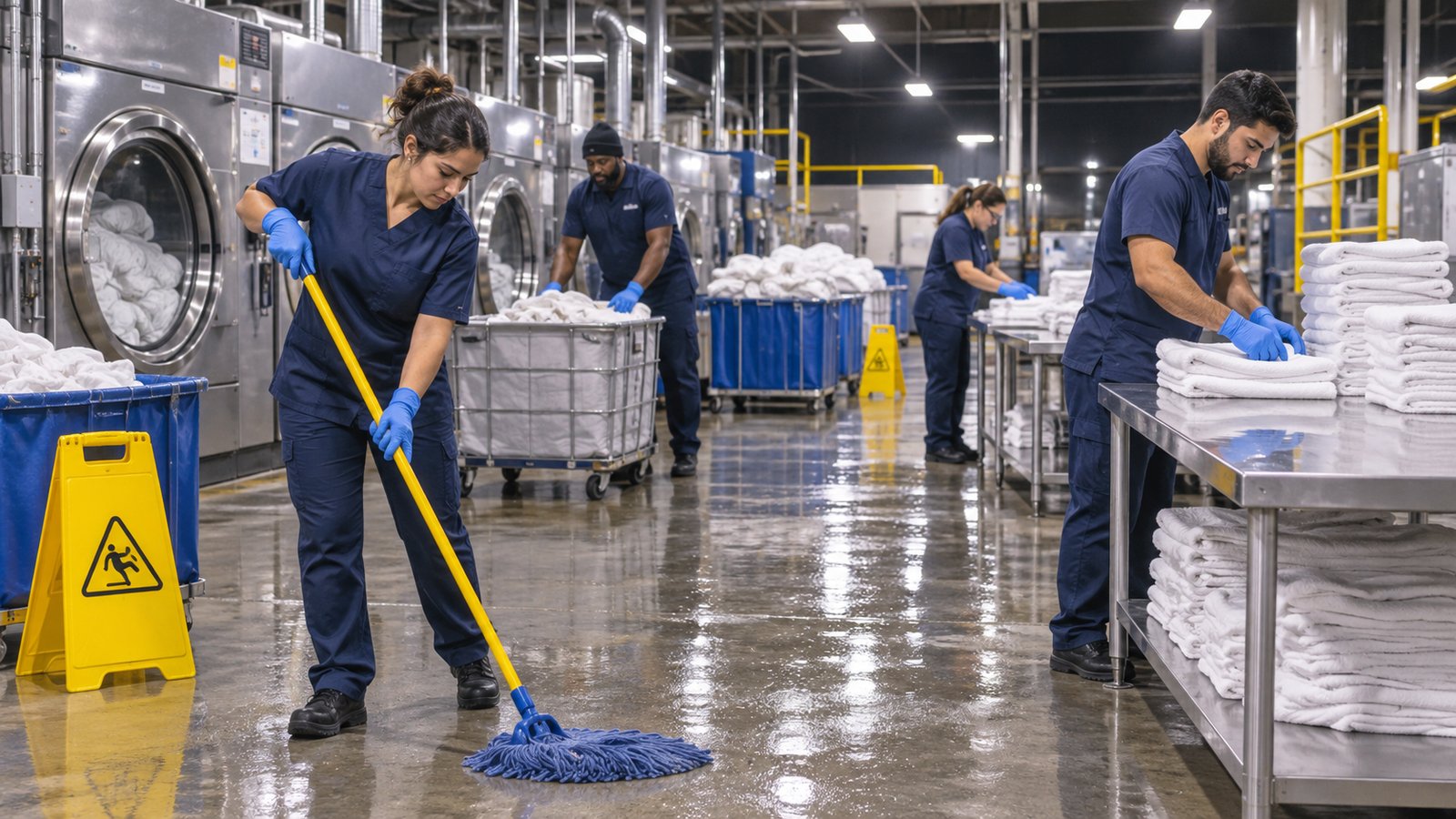
Industrial laundries face a distinct facility-cleaning mix: lint and textile fibers, moisture, heavy cart traffic, chemical storage, hot equipment, loading docks, and production schedules that may run overnight. A janitorial provider must work around machinery and plant safety rules rather than treating the site as a standard warehouse. GreenPoint Maintenance Services helps New York and New Jersey operators document which areas are in scope, how service is verified, and when a condition requires maintenance or safety escalation instead of routine cleaning. This guide lays out a practical way to build a vendor scope for laundry plants, linen processors, uniform services, and textile facilities.
Map production zones and define cleaning ownership
Laundry facilities around Hunts Point, Long Island City, Newark, Elizabeth, Secaucus, and Jersey City may serve customers across several boroughs and counties, but plant rules still depend on the building and municipality. Include loading-dock hours, truck circulation, nearby tenants, and shared waste enclosures in the site map. Mark clean-linen routes separately from soiled intake and identify locations where contractor carts may not stop. These route details reduce cross-traffic and avoid blocking production.
Start with a marked floor plan covering soil sorting, washroom, dryers, finishing and folding, clean-linen storage, dispatch, offices, staff rooms, restrooms, and loading. Identify restricted machinery envelopes, electrical panels, hot surfaces, chemical feed systems, pedestrian aisles, and forklift routes. The facility's operations and safety leads should specify where outside cleaners may work, which zones need production shutdown, and which tasks belong to trained maintenance or laundry staff.
A useful contract says what is included and what is prohibited. For example, a vendor may sweep approved aisles, clean office floors, service restrooms, and remove ordinary waste, but not enter a machine, remove guards, handle process chemicals, or clean contaminated textiles. GreenPoint Maintenance Services conducts a walkthrough to map access and surface conditions before pricing. Facility managers can also review our warehouse and industrial cleaning best practices and cleaning staffing ratios guide when preparing a scope.
Manage lint, dust, and floor conditions
A written inspection route should include the floor-to-wall edge, drain covers, dock thresholds, stair landings, and the transition from wet to dry zones. Define how the cleaner reports slippery residue, a loose grate, cracked coating, or a blocked aisle. Do not ask a worker to move heavy laundry carts or linen stacks unless the plant has approved the method and lifting controls. The supervisor can log inaccessible areas and coordinate a safe production pause with operations.
Lint is a housekeeping issue and a plant-maintenance signal. Define approved collection methods, frequency, tool selection, and disposal; do not use a method that disperses fibers toward equipment, air intakes, or clean product. Include ledges, corners, dryer-adjacent surfaces, and overhead areas only when access and fall-protection requirements have been assessed. A cleaner should report unusual lint accumulation, blocked vents, overheated areas, or recurring deposits that indicate the source needs operational attention.
Floors can change from dry receiving areas to damp wash zones and smooth finishing aisles. Document floor material, drainage, slip risks, cleaning methods, warning-sign placement, and how routes remain open while wet. Avoid flooding around powered equipment, plugs, floor openings, or production machinery. A 35,000-square-foot laundry plant with multiple shifts will need its work divided by zone and service window, not priced only by total area. Agree on measurable outcomes such as clear aisles, no visible soil accumulation, and prompt reporting of defects.
Chemical safety, PPE, and restricted equipment
The plant should brief contractors on alarms, evacuation routes, emergency contacts, restricted rooms, eyewash or shower locations, and exposure reporting. If a cleaner sees an unlabeled container or leaking line, the safe response is to stop, keep clear, and notify the supervisor. Keep contractor products in a segregated, labeled cabinet approved by the site. New York and New Jersey fire and environmental requirements can vary by facility and inventory, so the operator should verify the current storage and discharge rules that apply.
The laundry operator should maintain an approved chemical inventory and tell the vendor which products and storage areas are off limits. Cleaning staff must have access to labels and safety data sheets for the products they use and receive hazard-communication training appropriate to their role. OSHA's Hazard Communication Standard addresses chemical labeling, safety data sheets, and employee information and training. The employer and contractor should coordinate on PPE, emergency showers or eyewash locations where applicable, spill contacts, and stop-work procedures.
Do not ask cleaners to handle process detergents, bleach systems, boiler chemicals, or unknown spills unless the assignment, controls, training, and equipment are explicitly designed for that hazard. Never mix chemicals, bypass guards, spray electrical controls, or reach into conveyors and folders. GreenPoint Maintenance uses Green Seal-certified products where appropriate for approved general cleaning, but a product's environmental credential does not override machine manuals or the plant's chemical approval. For a fuller procurement checklist, see OSHA cleaning chemical safety and SDS guidance.
Schedule around production, shifts, and dispatch
In a multi-shift plant, handoff notes matter as much as the calendar. Specify who can approve access when a line is down, how the team learns about overtime, and whether a visit can move to another day. A facility serving hospitals or hotels may face surges before holidays or severe weather; plan optional labor and consumables rather than assume the regular crew can absorb unlimited work. Call 347-332-9348 to set a walkthrough and discuss realistic coverage.
Service planning should match the facility's operating calendar. Some sites can release office and welfare spaces after a day shift; others need a rolling crew that cleans dispatch and corridors without interrupting linen movement. Specify the authorized windows, changeover contacts, badge rules, sign-in process, and traffic routes. Coordinate work around truck arrivals and avoid staging carts in fire exits, dock approaches, or clean-linen paths. If a lane is temporarily blocked, the supervisor should know which alternative route is approved.
Separate daily cleaning from weekly, monthly, and seasonal tasks. Daily work might include restrooms, break rooms, office touchpoints, and designated aisles; periodic services may address high dusting, interior glass, or approved floor maintenance. The schedule should assign ownership and inspection points. GreenPoint Maintenance Services can propose a fixed-price service calendar after reviewing shifts, square footage, production boundaries, and floor types. Call 347-332-9348 to schedule a walkthrough for a plant in New York or New Jersey.
Verification, incident reporting, and continuity
Keep a contact tree for the plant manager, maintenance control, security desk, and cleaning supervisor, and test it during startup. A late-night leak should not sit in a dashboard until morning if it creates a slip or equipment risk. Define urgent, same-shift, and routine categories, with a specific person responsible for acknowledging each one. GreenPoint Maintenance Services can review this escalation path with the site team and include response expectations in the service scope.
Require a record that shows the assigned work, actual completion time, inaccessible zones, safety concerns, and outstanding supply or repair needs. JaniTrack supports GreenPoint's agreed service checkpoints through time-stamped, GPS-tagged photos and a live dashboard. Photos should avoid employee records, customer linen identifiers, production paperwork, proprietary machinery settings, and people. The facility should define authorized viewers and retention time. If any area is unavailable, the record should state why rather than marking an unperformed task complete.
A useful monthly review looks at missed visits, rework, slip or trip observations, repeat lint or moisture issues, supply shortages, and corrective-action closeout. ATP testing may be useful for selected hygiene checks, but it does not identify pathogens or evaluate every industrial hazard. For more on cleaning audits and digital cleaning verification, use facility-specific acceptance criteria. A continuity plan should identify backup cleaners, supervisor response, key control, and how the vendor covers holidays or short-notice absences.
How to compare laundry-plant cleaning proposals
For a plant with several shifts, ask the vendor to show its route on a marked floor plan and explain how each route avoids active equipment and forklift lanes. Verify the time allowance for restroom checks, wet-floor barriers, and supervisor inspection rather than assuming those activities fit into production downtime. A short pilot in one noncritical zone can surface access and communication issues before full launch. Request a walkthrough and fixed quote at 347-332-9348, with shift details and restricted areas ready.
Request insurance certificates, industrial references, training and supervision details, chemical controls, background and access practices where permitted, subcontractor disclosure, safety reporting, and a written staffing-continuity plan. Ask who supplies restroom consumables, floor signs, equipment, and routine cleaning products. Confirm the scope excludes machine interiors and process chemicals unless explicitly approved. Compare the planned crew size and work sequence with actual production windows; low bids can hide missed zones, unsafe shortcuts, or unpriced periodic tasks.
A fixed-price proposal should identify included visits, tasks, square footage, periodic work, consumables, exclusions, emergency callouts, change orders, and price review terms. GreenPoint Maintenance Services Corp is MBE-certified through relevant New York programs and registered in SAM.gov; buyers should verify the documentation needed for their procurement. GreenPoint reports 98% client retention and does not use hourly billing for clearly scoped recurring work. To request a written quote for a New York or New Jersey laundry, call 347-332-9348 or email info@greenpointms.com.
Industrial laundry cleaning FAQs
Q: Should janitorial staff clean inside washers, dryers, folders, or conveyors? A: Not as part of ordinary janitorial work. Equipment interiors and guarded areas should remain with authorized, trained plant personnel unless the manufacturer and facility have approved a specific contractor procedure.
Q: How often should an industrial laundry floor be cleaned? A: Frequency depends on soil, moisture, shift volume, cart traffic, floor material, and production risk. Set a zone schedule, inspect it during operations, and revise when the workload or equipment changes.
Q: What records should a cleaning vendor provide? A: Request task completion, timestamps, exceptions, corrective actions, training documentation, product records, and incident escalation. Protect customer linen identifiers and proprietary production details from unnecessary photos or dashboard access.
Q: Can a vendor use its own green cleaning chemicals? A: Only when the plant approves the exact product for the task and surface. Green certification does not substitute for chemical review, safety data sheets, machine compatibility, or process controls. Call 347-332-9348 to arrange a walkthrough.
For industrial laundry janitorial service in New York or New Jersey, call GreenPoint Maintenance Services at 347-332-9348 to schedule a plant walkthrough and fixed-price quote. JaniTrack can document agreed checkpoints, and GreenPoint reports 98% client retention.