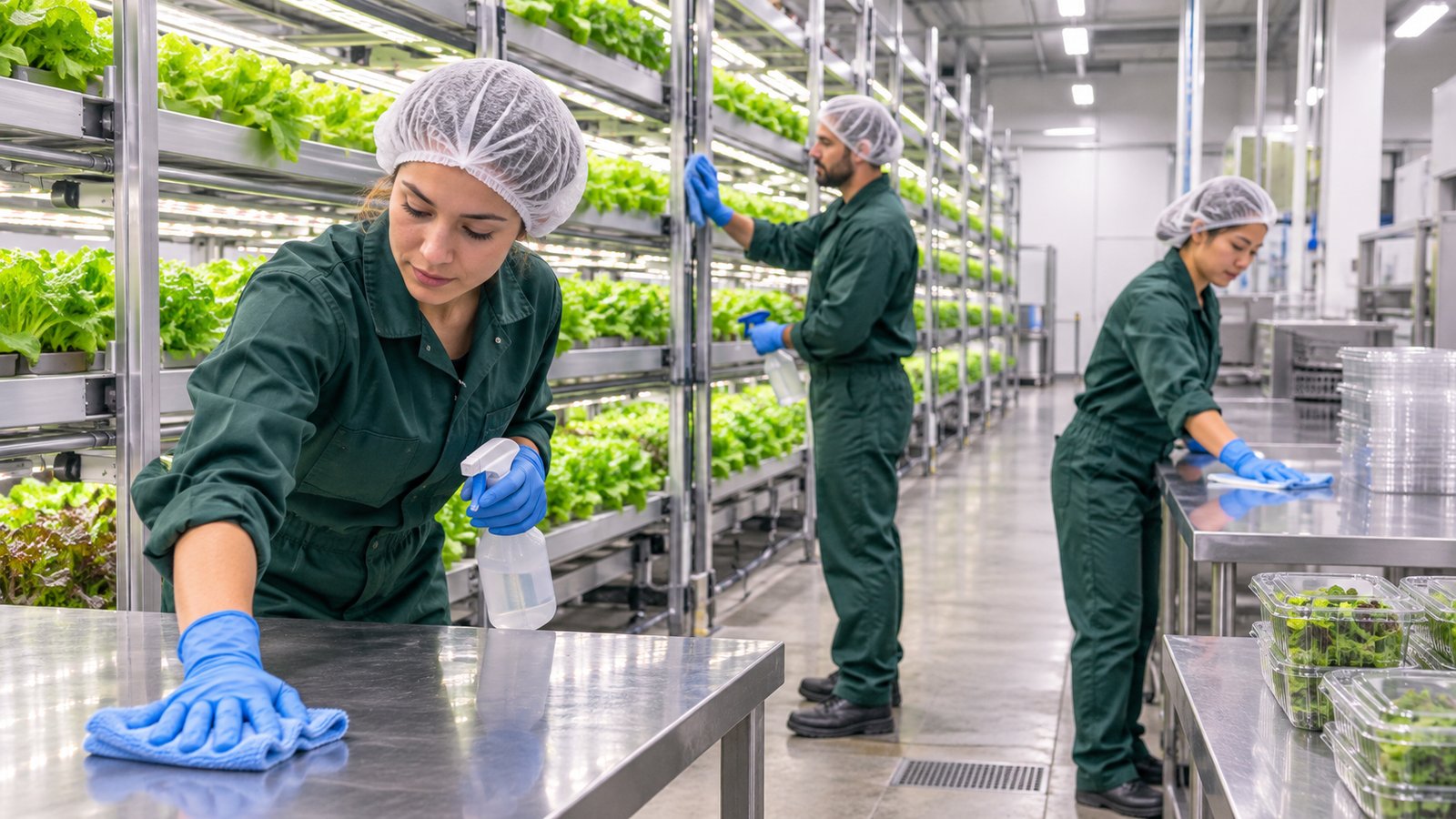
Indoor farms and vertical agriculture sites combine humid grow rooms, water systems, electrical equipment, packaging tables, cold storage, and employee routes inside a compact urban footprint. Cleaning must protect crops and product integrity while avoiding overspray, chemical residue, standing water, and disruption to production. GreenPoint Maintenance Services helps operators separate routine building janitorial work from food-safety sanitation tasks that require facility-specific procedures and qualified oversight. This guide explains how to map zones, define cleaning ownership, select a vendor, and verify service for indoor farms in Manhattan, Brooklyn, Queens, the Bronx, and the wider New York market.
Define the difference between janitorial cleaning and sanitation
New York operators should identify the authority that governs their specific crop, processing, packaging, and sales model before writing a contractor scope. Applicability can depend on the product and operation, so verify current requirements with the appropriate New York State Department of Agriculture and Markets, New York City agency, and federal food-safety guidance. A janitorial proposal is not a regulatory determination. Put approved procedures and training boundaries in writing, then have the food-safety lead sign off before service starts.
Start by assigning each surface and room to an owner. Office areas, staff restrooms, nonproduction corridors, exterior glass, and administrative waste may fit a standard commercial cleaning scope. Grow rooms, harvest and wash areas, packaging lines, food-contact surfaces, irrigation equipment, and any area governed by a food-safety plan need controls set by the operator's food-safety lead. A janitorial vendor should never decide on its own that a product is safe for produce, food-contact equipment, or a particular crop.
The operator should document whether a task is cleaning, sanitizing, disinfecting, or maintenance; these terms are not interchangeable. Specify approved products, dilution, rinsing requirements, contact time, surface compatibility, tool color, sequencing, and release checks. GreenPoint Maintenance Services can follow the written facility plan for assigned building tasks and record exceptions. For foundational approaches to green cleaning in commercial buildings and color-coded microfiber systems, see our related resources.
Map grow rooms, packaging, corridors, and support spaces
Urban sites face practical access conditions that rural facilities may not. A grow operation near the Brooklyn Navy Yard, Hunts Point, or Long Island City may share a freight elevator, loading dock, or service corridor with other tenants. Agree on delivery windows, temporary staging, badge rules, and routes that keep soil, cardboard, and waste away from production entrances. Include pedestrian traffic and street debris in the entry plan, but do not use public sidewalks as unapproved storage.
A useful site map divides the building into controlled zones: growing, harvest, wash or pack, storage, employee welfare, offices, and receiving. Record the direction of product flow, staff-only doors, handwashing stations, drains, floor transitions, and routes for tools and waste. Use the operator's color-coding and zoning policy so a restroom tool cannot enter a production space. If a room is under crop treatment, maintenance, or harvest hold, signage and a call-before-entry rule should keep cleaners out until released.
In New York City, freight elevators, narrow loading areas, shared commercial kitchens or warehouses, and mixed-use building rules can constrain delivery of supplies and removal of waste. Farms in Long Island City, Sunset Park, Hunts Point, the Brooklyn Navy Yard area, or the South Bronx may have different access windows and neighboring tenants. Include landlord requirements, pest-control coordination, drain protection, and restricted storage in the service plan. Do not store cleaning chemicals above packaging or produce, and follow the site safety plan for spills and leaks.
Control moisture, residue, and equipment exposure
Create a stop-and-report threshold for water near electrical connections, damaged sealant, cracked floor coating, blocked drains, or repeated condensation. The cleaning crew can record the location and time, but plant maintenance must diagnose the source. In a 10,000-square-foot vertical farm, a small leak under one rack can create repeated work if the underlying plumbing issue is not assigned. Use a work-order reference in the exception log so the observation follows through to repair.
Moisture management is central in a grow environment. Staff should report standing water, clogged drains, condensation, leaks, and damaged floor coatings rather than masking the issue with fragrance or excess water. Define approved methods for sweeping, vacuuming, damp wiping, and floor cleaning near electrical equipment, sensors, grow lights, pumps, nutrient lines, and control panels. Avoid pressure or spray methods unless the equipment manufacturer and facility procedures explicitly permit them.
Product selection should be driven by the surface and intended use, not a generic claim that a cleaner is natural or green. Review the label, safety data sheet, compatibility, required PPE, storage, and rinse instructions. GreenPoint Maintenance favors Green Seal-certified products where appropriate for routine facility tasks, but food-contact sanitation products must be approved through the operator's food-safety system. Train workers not to mix chemicals, use unlabeled bottles, or carry products through crop zones without authorization. OSHA Hazard Communication duties include communicating chemical hazards and training affected employees.
Schedule service around production and harvest
Use a calendar that distinguishes crop-room access from exterior and office service. Mark harvest dates, receiving windows, sanitation holds, maintenance shutdowns, and periods when outside workers are not permitted. A delayed delivery in Manhattan or Brooklyn can shift packing schedules, so assign one farm contact who can authorize a same-day service change. That contact should not need to answer informal messages from every cleaner; use a central escalation number or dashboard note to keep changes traceable.
Frequency should match crop cycle, foot traffic, production tasks, and the farm's documented sanitation schedule. A 20,000-square-foot facility may have a small office suite that needs daily waste and restroom service, while a controlled grow room may follow a production-led schedule with cleaning windows after a defined activity. Use a calendar that identifies routine tasks, periodic detail, pre-operational inspection, and the person authorized to release a zone. Do not substitute a nightly office-cleaning visit for required production sanitation.
Set service hours that avoid harvest, packing, and deliveries; include a clear procedure for schedule changes. Require enough notice when an area is held for maintenance or environmental monitoring. The vendor should coordinate with the farm manager before moving carts, hoses, bins, or removable equipment. GreenPoint Maintenance Services can quote a fixed scope after reviewing square footage, room categories, floor finishes, access hours, and the operator's written restrictions. To schedule a walkthrough, call 347-332-9348 or email info@greenpointms.com.
Verify completion and preserve useful records
The farm should define how long operational checklists and images are retained, who can export them, and whether the contractor may use them for internal supervision. Separate janitorial records from lot traceability, sanitation validation, environmental monitoring, and product disposition records. A photo of a cleaned corridor should not be presented as a production release. GreenPoint Maintenance can configure checkpoints after the operator approves the locations and privacy rules.
Useful verification connects the task to its location, time, and assigned role. Checklists can record completion, exceptions, product replenishment, floor condition, and requests for maintenance. JaniTrack supports GreenPoint's agreed checkpoints with time-stamped, GPS-tagged photos and a live dashboard. For production spaces, the operator should approve any photo policy in advance; images must avoid crop lots, labels, proprietary controls, employee personal information, and other confidential details. Verification records do not replace food-safety records or process controls.
Use a small scorecard: completed service visits, recurring exceptions, corrective-action closure, supply shortages, and inspection outcomes. Environmental monitoring, microbial testing, or product-release decisions belong to the farm's qualified food-safety team and its approved laboratory or process; a janitorial vendor should not imply a clean floor proves crop safety. ATP testing, when chosen for selected surfaces, measures a cleanliness indicator rather than a pathogen. For related advice on cleaning audits and digital cleaning verification, adapt the checklist to your site's food-safety plan.
Vendor selection, compliance, and cost controls
Before signing, walk the route from the nearest loading area to each assigned zone and confirm how the crew reaches the site after hours. In North Brooklyn, Queens, or the South Bronx, truck restrictions and shared industrial access can affect arrival time and supply storage. Confirm the building's waste, wastewater, fire-safety, and chemical-storage procedures with the responsible property manager or public authority instead of assuming the same rules apply across NYC. The quote should identify travel assumptions and who approves a scope change.
Ask for insurance, industrial or food-production references, supervisor coverage, training records, product documentation, chemical inventory controls, incident reporting, subcontractor disclosure, and a backup-staff plan. Clarify who provides consumables, who handles hazardous or production waste, and how the team responds to broken glass, leaks, chemical spills, or pest evidence. OSHA requirements depend on worker exposures and tasks; the facility and contractor should coordinate hazard communication, PPE, and emergency procedures before work begins. Food-safety responsibilities remain with the operator and applicable regulators.
Compare proposals by scope and risk, not just a per-square-foot rate. The price should specify room inclusion, visit frequency, labor coverage, supplies, floor care, high dusting, special projects, emergency response, exclusions, and change-order rules. GreenPoint Maintenance Services Corp is MBE-certified in New York programs and registered in SAM.gov; request documentation matching your procurement requirements. GreenPoint reports 98% client retention and offers fixed pricing without hourly billing for a clearly defined scope. Call 347-332-9348 for a site walkthrough in NYC and surrounding areas.
Indoor farm cleaning FAQs
Q: Can a commercial janitorial company sanitize food-contact surfaces? A: Only under the facility's written, approved procedure, using authorized products and trained staff. Many operators reserve this work for production employees or a qualified sanitation team and outsource only nonproduction areas.
Q: What information should an indoor farm provide before a cleaning quote? A: Share a zone map, square footage by room type, service windows, restricted equipment, approved products, access rules, waste responsibilities, and written food-safety boundaries. Do not disclose crop or production details beyond what is needed.
Q: Is Green Seal certification enough to approve a product in a grow room? A: No. Certification may support environmental purchasing, but the operator must still approve the exact product, intended task, surface compatibility, and any food-contact or rinsing requirements.
Q: What should a cleaning dashboard show? A: It can show completed assigned tasks, timestamps, exceptions, and corrective actions. It should not be treated as a food-safety record, laboratory result, or proof that crops are pathogen-free. Call 347-332-9348 to arrange a walkthrough.
Need a defined janitorial scope for an NYC indoor farm? Call GreenPoint Maintenance Services at 347-332-9348 to schedule a walkthrough and fixed-price quote. JaniTrack can document approved facility checkpoints, while production sanitation and food-safety decisions stay with your qualified team.