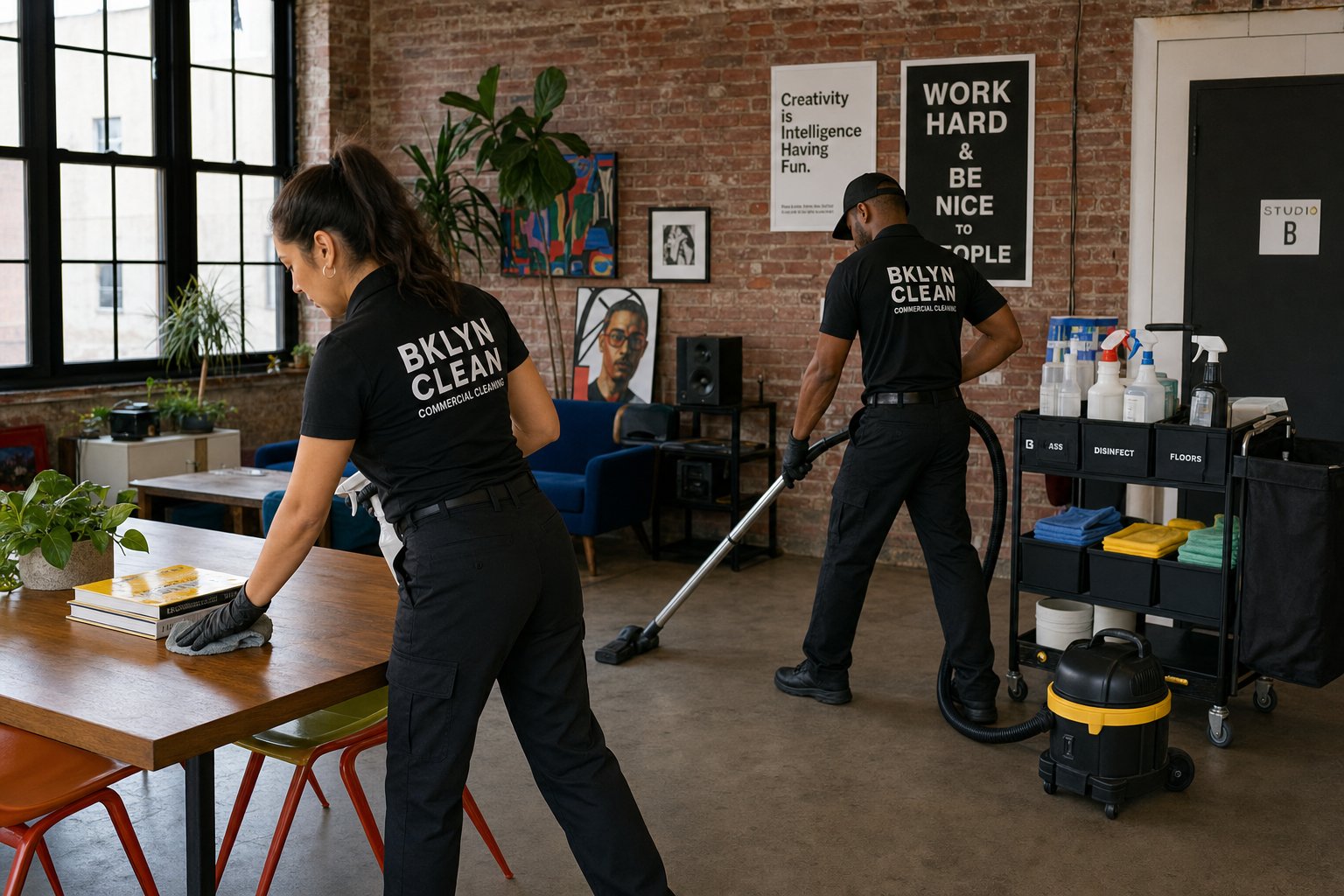
Commercial cleaning in Bushwick, Brooklyn is shaped by converted lofts, creative studios, restaurants, retail storefronts, rehearsal rooms, and small businesses that may change their hours from week to week. Buildings around Wyckoff Avenue, Jefferson Street, Broadway, and the Morgan Avenue corridor can have exposed brick, concrete, high ceilings, shared freight access, and event-driven traffic. A good cleaning plan protects delicate finishes while still addressing dust, paint residue, food soils, restroom odor, and tracked street debris. GreenPoint Maintenance Services provides fixed-price programs throughout Brooklyn and the tri-state area, pairing trained crews with Green Seal certified products and StockPoint proof. This buyer guide covers the details a Bushwick facility manager should specify.
Bushwick spaces are not interchangeable
A 6,000-square-foot design studio may need fine dust control around models and equipment, while a 1,800-square-foot retail shop needs glass, entry, and restroom touch-ups during open hours. A rehearsal or production space may require floor-safe methods, quiet service windows, and rapid event resets. GreenPoint starts with a walkthrough that records surfaces, ceiling height, access, occupancy, equipment, client-facing zones, and the path to waste storage. That plan matters in Bushwick because a cleaning team can lose productive time navigating stairwells, shared doors, and narrow service routes. The walkthrough converts a neighborhood label into a measurable scope.
Core cleaning tasks for studios and loft offices
Routine service should name trash and recycling, dust control, vacuuming, hard-floor care, restrooms, kitchens, high-touch surfaces, glass, conference tables, and entry zones. Studios often need careful vacuuming around cables, worktables, acoustic panels, and stored materials. Exposed brick should not be saturated or treated with an unsuitable chemical; concrete may require neutral cleaners and periodic machine work. Weekly detail can cover baseboards, ledges, vents, door frames, and under-furniture edges. GreenPoint uses zone-specific checklists and color-coded microfiber so tools stay assigned to the correct area. For a deeper comparison, review the [coworking space cleaning challenges](/blog/coworking-space-cleaning-challenges/) guide.
Retail, hospitality, and event turnover
Bushwick retail and hospitality spaces experience concentrated soil at the front door, counter, restroom, and waste areas. A proposal should specify pre-opening, midday, closing, and event-reset tasks rather than simply promising “daily cleaning.” Glass and fingerprints may be a daily issue; floor machine work may be weekly; high dusting and fixture cleaning may be monthly. If the site handles food, the scope should distinguish food-contact surfaces and identify what is outside janitorial work, such as hood cleaning or grease-trap service. GreenPoint can design a quiet before-open program or a post-event reset and can be reached at 844-814-0810 for a walkthrough.
Local access, loading, and scheduling
The L train stations at Morgan Avenue, Jefferson Street, and DeKalb Avenue, plus Broadway bus traffic and neighborhood loading limits, make service timing a practical concern. Some Bushwick buildings have no dedicated dock, while others require a keyholder or freight-elevator booking. GreenPoint confirms who opens the building, where supplies are stored, when waste can move, and how a late tenant affects the close window. A route-based staffing plan can include backup coverage when a team member is absent. The best proposal makes access assumptions explicit rather than treating travel time as the client’s problem.
Dust, air quality, and material-safe methods
Creative spaces can generate fine particulate from sanding, fabrication, cardboard, and foot traffic. HEPA-filtered vacuuming, microfiber dust capture, and a no-blow cleaning policy can reduce redistribution. GreenPoint uses Green Seal certified products where appropriate and trains teams on label dilution, dwell time, ventilation, and PPE. OSHA Hazard Communication rules still require labels, Safety Data Sheets, and training for classified products. Ask whether the vendor has a chemical inventory, how concentrates are secured, and how a spill is documented. The [indoor air quality and commercial cleaning](/blog/indoor-air-quality-commercial-cleaning/) resource explains why product choice and dust control affect occupant comfort.
Pricing benchmarks for Bushwick businesses
Routine office or studio cleaning may plan near $0.08-$0.20 per square foot per visit, while food-service, event, or high-detail creative environments can reach $0.15-$0.30. A 6,000-square-foot studio with three weekly visits might budget $1,500-$3,500 per month before specialty projects; a daily retail or hospitality site can be higher because of touch-up labor and restroom traffic. These are planning figures, not a substitute for measuring the building. GreenPoint uses fixed pricing, no hourly billing, and no hidden fees after the scope is approved. Ask for separate lines for periodic floor care, windows, consumables, emergency response, and post-construction or event work.
StockPoint proof for fast-changing spaces
Creative and retail managers need to know whether work was completed before staff or customers arrived. GreenPoint’s StockPoint workflow can provide timestamped GPS-tagged photos, task checklists, exception notes, selected ATP trend checks, supervisor reviews, and a live dashboard. Photos should document condition without exposing confidential work, customer faces, or proprietary designs. ATP testing can compare selected surfaces over time but should not be marketed as a regulatory pass/fail test. GreenPoint uses the data to assign a correction, track repeat exceptions, and discuss whether access, staffing, product, or scope is causing the miss.
Contract and vendor due diligence
Ask a Brooklyn vendor for proof of insurance, workers’ compensation, training, screening, supervisor coverage, absence replacement, chemical documentation, references for similar spaces, and a sample inspection report. Confirm whether the crew can handle a last-minute event reset and what the response fee is before an emergency occurs. GreenPoint Maintenance Services is MBE/MWBE certified through New York State, NYC, and NYC DOE contexts and is SAM.gov registered. GreenPoint reports 98% client retention and uses a documented account process so a growing Bushwick business does not have to retrain a new team every few months.
A practical first-30-days launch plan
Week one should confirm access, supplies, equipment, task sequence, and safety orientation. By week two, the supervisor should review recurring exceptions and adjust route timing. By week three, the client can compare restroom condition, entry appearance, dust load, and completion records against the baseline. By day 30, GreenPoint can hold a review using StockPoint trends and agree on periodic work for the next quarter. Call 844-814-0810 to schedule a walkthrough; a well-planned mobilization is usually less expensive than correcting an under-scoped contract after complaints accumulate.
Bushwick businesses should plan for weather and event variability. Rain and snow bring grit into storefronts and studios, while gallery openings, shoots, and weekend events can create a short burst of glass, restroom, and floor demand. A contract can include a seasonal entry-mat rotation, a storm-response procedure, and a defined event-reset rate. GreenPoint discusses these scenarios during the walkthrough and can assign a contact for same-day questions. The aim is to protect the normal crew’s close window while giving a creative business a predictable option when an unusual event changes the soil load.
A safe studio program also needs a do-not-move and do-not-touch map. Mark fragile models, cameras, artwork, confidential paperwork, fabrication tools, and areas where dust or liquid could damage materials. The supervisor should review that map with every substitute cleaner. GreenPoint’s color-coded microfiber and zone checklists support separation between restrooms, kitchens, office desks, and production areas, while StockPoint can document an exception without photographing proprietary work. These small controls reduce the risk that a rushed cleaning pass creates a larger operational problem.
When a Bushwick company receives three proposals, it should normalize the bids into the same visit frequency and task list. Compare labor coverage, supervision, supplies, periodic floor work, carpet extraction, glass, emergency response, and insurance rather than choosing the lowest headline number. A fixed-price proposal from GreenPoint is built after measuring the site, so the client can see what it is buying and what would trigger an approved change. Call 844-814-0810 when the space is ready for that comparison.
The account contact should receive one escalation path, not several competing phone numbers. GreenPoint can identify the supervisor, backup contact, response target, and documentation method during kickoff. That is valuable when a Bushwick shop has a broken glass incident, a late event finish, or a water-tracked entry that needs attention before opening. Calling 844-814-0810 during the quote process lets the buyer confirm how routine service and exceptional requests are separated.
For a shared Bushwick building, define who controls the lobby, stairs, elevator, and waste area before the contract begins. GreenPoint can separate landlord-controlled common areas from tenant-controlled rooms in the scope and document which party approves extra work. This avoids a recurring problem in mixed-use properties where each tenant assumes another party is responsible for a visibly dirty shared zone. A short written responsibility matrix can prevent complaints and make the fixed-price program easier to manage.
The walkthrough should end with a written priority list: protect materials, keep customer-facing areas ready, control dust, maintain restrooms, and document exceptions. GreenPoint can use that list to train the assigned team and set the first inspection baseline. When a Bushwick business changes its hours or adds a production area, the same list makes the scope review faster and more objective than starting over.
FAQ: choosing commercial cleaning in this neighborhood
What does commercial cleaning cost in Bushwick Brooklyn? Standard office or studio work often plans near $0.08-$0.20 per square foot per visit; hospitality and high-detail spaces may be higher. GreenPoint provides a fixed quote after measuring the site and documenting access.
Can cleaners work safely around art, equipment, and exposed brick? Yes, with a material inventory, appropriate neutral or surface-safe products, HEPA vacuuming, and a written do-not-touch list. GreenPoint covers these details during a walkthrough at 844-814-0810.
How often should a Bushwick studio be cleaned? Three to five visits weekly is common, but public events, fabrication dust, and restroom use may justify daily or pre/post-event service. GreenPoint bases frequency on traffic and soil, not on square footage alone.
What StockPoint evidence can a manager receive? Depending on the program, StockPoint can show timestamped GPS-tagged photos, task checklists, exception notes, selected ATP trends, and dashboard reports. GreenPoint uses that evidence for corrective action and transparency.
Does GreenPoint serve Brooklyn businesses outside Bushwick? Yes. GreenPoint serves Brooklyn, the other NYC boroughs, Westchester, Long Island, NJ, CT, PA, and FL. Call 844-814-0810 to schedule a walkthrough.
Call GreenPoint Maintenance Services at 844-814-0810 for a Bushwick walkthrough and fixed-price commercial cleaning proposal. GreenPoint brings Green Seal certified products, material-aware methods, StockPoint verification, MBE/MWBE credentials, and a 98% client retention rate.