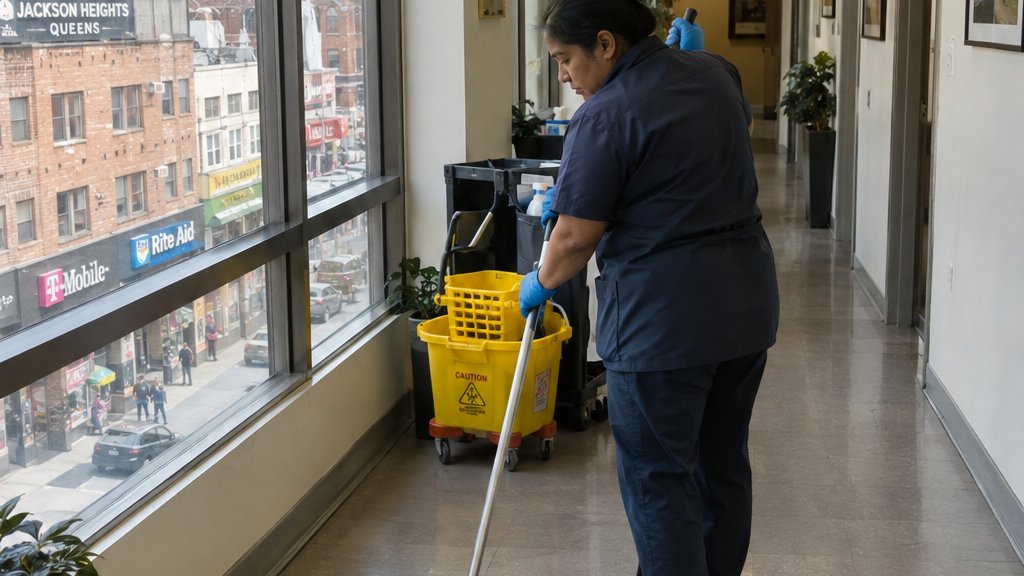
Multi-tenant properties in Jackson Heights need a commercial cleaning plan that makes shared-space responsibility clear. Tenants may have different work hours, private suites, delivery patterns, food use, and expectations for common restrooms or lobbies. A strong janitorial agreement identifies which areas are included, how access is controlled, and how a manager can verify completed work without creating conflict between occupants. GreenPoint Maintenance Services builds fixed-price scopes around the actual property and supports client reporting through JaniTrack. Schedule a Jackson Heights walkthrough and quote by calling 347-332-9348.
Map the property before assigning cleaning responsibility
For street-level businesses, include the threshold, interior entry glass, mat placement, and a plan for rainy-day grit. For upstairs offices, check whether a service elevator or scheduled freight window is required and whether tenant doors are controlled by individual staff. If a clinic or appointment-based tenant is present, identify rooms that cannot be entered during patient hours. GreenPoint uses the walkthrough to record these details and keep common-area assumptions separate from private suites.
Jackson Heights has dense commercial corridors along Roosevelt Avenue, 37th Avenue, 74th Street, and Broadway, with offices and services in mixed-use buildings as well as stand-alone properties. The Jackson Heights-Roosevelt Avenue and 74 St-Broadway station complex connects several subway services, while 82 St-Jackson Heights and nearby bus routes serve other blocks. That transit access brings steady movement to some locations, but actual building traffic depends on tenants and business hours. The [MTA Queens neighborhood map](https://www.mta.info/maps/neighborhood-maps/queens) can help confirm route details. Map every shared lobby, vestibule, corridor, restroom, elevator, stairway, waste room, and tenant suite before a proposal is priced.
Create a responsibility matrix that labels each space as landlord-managed, tenant-managed, or excluded. For each included zone, list the tasks, frequency, access rule, and who reports a problem. Do not let 'common areas' remain undefined: specify whether the cleaner handles entry glass, elevator tracks, stair rails, mail areas, tenant directory panels, or only the floor. GreenPoint Maintenance Services uses a room-by-room scope to reduce disputes about whether a task belongs to the landlord's service contract or a tenant's own arrangement.
Set tenant boundaries and a safe access protocol
Also set an incident process for a spill, broken fixture, water leak, or suspected damage found during cleaning. The crew should know whether to stop work, isolate the area, notify building management, and document the condition, but should not undertake repairs outside its authorization. Photo records can help establish what was observed and when if the client has approved the practice and privacy safeguards. GreenPoint can route an issue to the designated contact through service records.
A multi-tenant cleaning plan should say when a cleaner may enter a suite, whether an occupant must be present, and what to do when a door is locked. Decide whether desks, personal items, confidential papers, medical records, electronics, and tenant-owned equipment are out of scope unless specifically authorized. Record key, badge, alarm, visitor log, and elevator procedures. If a tenant changes hours or access permissions, require a written update from an authorized property contact rather than an informal hallway request.
Use a consistent communication channel for access problems and service requests. A manager should be able to distinguish a skipped room because it was inaccessible from a missed task. For locations near Roosevelt Avenue or 74th Street, schedule deliveries and staff arrival around building rules and loading constraints instead of assuming curbside access. GreenPoint can log site-specific instructions and completion records in JaniTrack. For related vendor questions, review [how to choose a commercial cleaning company](/blog/how-to-choose-commercial-cleaning-company/) and [commercial cleaning contract key terms](/blog/commercial-cleaning-contract-key-terms/).
Design task frequencies for the busiest shared areas
Consider how work is sequenced through the property. Cleaning a lobby first may protect a morning opening standard, while restrooms may need checks closer to peak use. If crews move between multiple floors, specify how supplies travel without blocking exits or leaving equipment unattended. The manager can review the route during the walkthrough and identify time-sensitive rooms. This sequencing turns a duty list into a realistic shift plan and helps GreenPoint estimate coverage accurately.
Shared entrances and restrooms usually need more attention than a low-use conference room, but actual service frequency should be based on observed conditions. A property manager can start with daily cleaning of the lobby, shared washrooms, and heavily used corridors, with detail tasks such as high dusting or glass edges on a weekly or periodic schedule. Tenant suites may be cleaned only with permission and according to the lease. For each task, state what completion means, such as bins emptied, dispensers checked, floor free of visible debris, or touchpoints wiped using a labeled product.
Set a review period after the contract launches. Use occupancy counts, tenant comments, restroom checks, inspection scores, and seasonal dirt to determine whether visits or mid-shift checks need adjustment. Do not rely on one complaint or one unusually busy day to rewrite the entire schedule. GreenPoint documents tasks and exceptions through JaniTrack, making it easier to discuss a pattern with the property manager. See [cleaning frequency standards by facility type](/blog/cleaning-frequency-standards-by-facility-type/) and [cleaning staffing ratios by square footage](/blog/cleaning-staffing-ratios-square-footage/) for planning concepts.
Compare proposals using a consistent building inventory
Waste handling should also match the property's NYC recycling plan. Businesses must keep designated recyclables separate from garbage and use the collection method arranged for the building; the [NYC Department of Sanitation's business guidance](https://home4.nyc.gov/site/dsny/businesses/materials-handling/businesses-recycling.page) summarizes the requirements. Ask the property manager where each stream is staged, which containers are labeled, and who is authorized to move materials to the collection point.
Ask bidders to explain who supplies consumables and whether the quote includes delivery, closet organization, and stock monitoring. If management purchases paper goods and soap, decide how low inventory is reported and how emergency restocking is approved. Set expectations for waste separation and the timing of removal so bags do not obstruct shared corridors. GreenPoint can note those responsibilities in the proposal and service checklist, helping the property avoid disputes between the cleaner, tenant, and building staff.
Give each bidder the same floor plans, operating hours, room list, frequency expectations, and supply requirements. Ask them to identify cleanable area separately from storage, mechanical, or tenant-controlled spaces. A proposal should state whether the fee includes equipment, liners, paper products, soap, supervision, periodic floor work, and after-hours response. Require separate prices for optional services and a written process for changes. This lets a manager compare total annual cost and avoid an artificially low base quote that excludes common tasks.
Ask how the vendor covers absences and supervises dispersed or multiple-floor assignments. The BLS reports that janitors and building cleaners had a national median hourly wage of $17.71 in May 2025; that employment statistic is useful context but is not a bid rate or a promise about an individual worker's pay. See the [BLS occupation profile](https://www.bls.gov/ooh/building-and-grounds-cleaning/janitors-and-building-cleaners.htm). GreenPoint uses fixed-price proposals rather than hourly billing, with scope changes priced before approval. Compare [commercial cleaning cost per square foot](/blog/commercial-cleaning-cost-per-square-foot/) and [vendor consolidation for multiple properties](/blog/vendor-consolidation-one-cleaning-company/) when evaluating portfolio options.
Make quality checks transparent to tenants and managers
Set one agreed inspection method so a tenant complaint does not become the only measure of service. A manager can define a small checklist for entrance glass, lobby floors, restroom supplies, touchpoints, and waste rooms, then rate each item on a consistent scale. Record the inspector, date, finding, assigned correction, and closeout. GreenPoint's JaniTrack can provide clients with task histories, timestamped GPS-tagged photos where appropriate, and a live dashboard. A report should make it possible to see whether a concern recurs, which team is assigned, and whether the resolution was confirmed.
Use ATP testing only for selected surfaces and as one indicator within a broader program. ATP results do not identify a specific organism and should not be presented as proof that a space is sterile. Visual checks, correct product use, contact times on labels, worker training, and follow-up inspections remain important. GreenPoint reports 98 percent client retention, but every buyer should still set service-level expectations, references, communication response times, and remedies in writing.
Confirm chemical handling, insurance, and building coordination
Ask vendors for insurance certificates, workers' compensation evidence, training records, a chemical inventory, product labels, and safety data sheets. OSHA's Hazard Communication Standard requires employers with hazardous chemicals to communicate hazards through labels, SDSs, and training; see the [OSHA standard overview](https://www.osha.gov/hazcom). In a multi-tenant property, decide who stores chemicals, whether a janitorial closet is shared, how spills are reported, and which building staff must be notified before work near a sensitive area. GreenPoint uses Green Seal certified products where appropriate and follows product instructions and site access requirements.
Clarify who coordinates with engineers, security, and tenant representatives. A cleaner may notice a leak, broken lock, pest evidence, or damaged floor, but the vendor needs a named route to report it and should not be expected to perform unapproved repairs. For public or institutional tenants, ask whether MBE/MWBE status, SAM.gov registration, or other procurement records are required. GreenPoint Maintenance Services is certified as an MBE/MWBE with NYS, NYC, and NYC DOE and registered in SAM.gov; confirm the procurement terms that apply to the specific building.
Jackson Heights buyer checklist and FAQs
How can I resolve an unclear tenant schedule before service begins? Arrange a site review and identify the property contact who will confirm access, hours, and room boundaries. GreenPoint can document open decisions and prepare a revised written proposal. For a Jackson Heights walkthrough, call 347-332-9348.
Before award, verify that the proposal has a floor-by-floor inventory, tenant-access boundaries, service schedule, after-hours protocol, included consumables, exclusions, base and optional pricing, insurance, supervisor plan, inspection system, and a complaint escalation path. Share a draft with the building's authorized contact so expectations are consistent across tenants. The [Queens commercial cleaning facility guide](/blog/commercial-cleaning-queens-facility-guide/) and [digital cleaning verification systems guide](/blog/digital-cleaning-verification-systems/) provide further procurement context.
What should be included in multi-tenant building cleaning? Define every landlord-managed common area and task, with separate rules for tenant suites. Include schedules, consumables, access procedures, inspections, exclusions, and extra-service pricing so responsibilities are not left to interpretation.
Can a cleaner enter a tenant's office after hours? Only if the building and tenant have authorized that access and the contract explains the security procedure. List rooms that are excluded, how keys are controlled, and how the vendor logs a locked or inaccessible suite.
How should managers handle tenant complaints? Use one request channel, capture the location and time, assign a response owner, and confirm whether the reported issue was corrected. Review repeat issues at a regular service meeting rather than relying on informal conversations.
Is a fixed-price contract preferable for a Jackson Heights property? A fixed price can make budgeting clearer when the scope and assumptions are explicit. Define the baseline and agree that changed area, frequency, or tasks must be documented and approved before fees change.
How do I book a walkthrough? Prepare the room list, operating hours, access rules, known problem areas, and supply preferences. GreenPoint Maintenance Services can review the property and deliver a written fixed-price proposal; call 347-332-9348 or email info@greenpointms.com.
Book a Jackson Heights multi-tenant walkthrough with GreenPoint Maintenance Services at 347-332-9348 or info@greenpointms.com. Get a documented room-by-room scope, fixed pricing, and JaniTrack task evidence with a live dashboard.