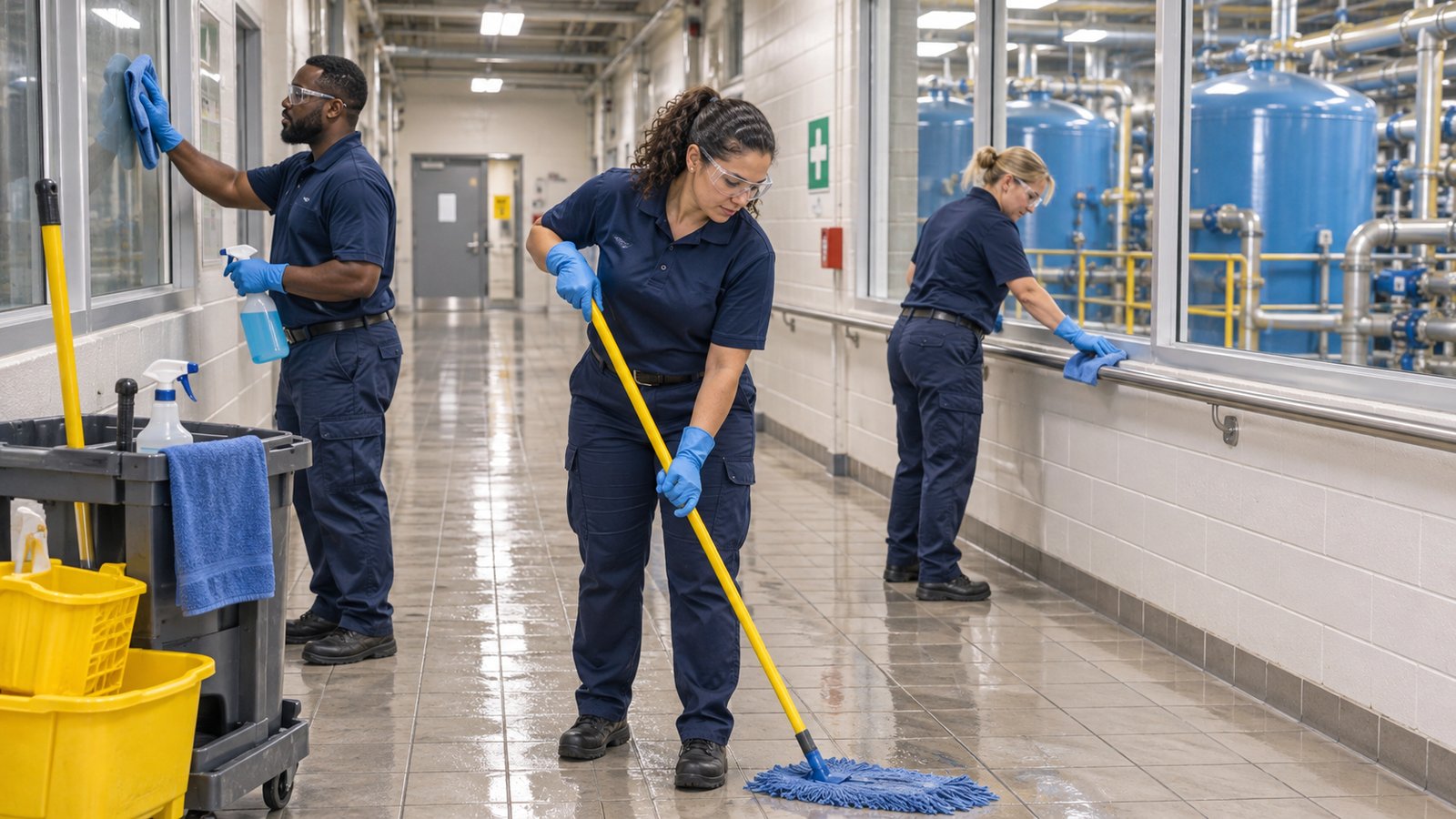
Municipal water treatment plant cleaning requires careful separation between ordinary building service and work that can affect treatment operations, water quality, or worker safety. Offices, control-room support areas, locker rooms, visitor spaces, and designated corridors may be suitable for a commercial cleaning contractor; process equipment, chemical rooms, tanks, basins, and restricted spaces require facility authorization and specialized controls. GreenPoint Maintenance Services Corp serves facilities across New York, New Jersey, Connecticut, Pennsylvania, and Florida. To define the boundary and arrange a fixed-scope walkthrough, call GreenPoint at 347-332-9348.
Separate administrative cleaning from treatment-process work
Start with a plant-approved map that marks public or administrative spaces, operator work areas, process zones, chemical storage, laboratories, electrical rooms, exterior walkways, and restricted access points. Identify which rooms can be serviced by a commercial cleaner and which are reserved for trained utility personnel or qualified specialty contractors. A vendor should not infer permission to clean a tank, filter bay, wet well, basin, pump, chemical feed line, or instrument simply because it is accessible. GreenPoint Maintenance Services asks the utility’s operations lead to approve every included room before the price is finalized.
In a 15,000-square-foot operations building, for example, a contractor might service offices, visitor restrooms, a training room, locker areas, and approved corridors while operators retain responsibility for the process side. A larger plant campus could include separate buildings and long outdoor routes, so one square-foot total would understate travel and access time. Note floor materials, door controls, high-touch points, shift overlap, and whether visitors or contractors need an escort. GreenPoint can prepare a task matrix that differentiates daily janitorial work from maintenance, process cleaning, lab cleaning, and any work requiring a separate permit.
Protect water quality and follow site-approved chemical rules
A utility should set the rules for products, storage, drains, and water contact before a contractor starts. No general-purpose disinfectant, detergent, or floor finish should be used on a process surface or near an open treatment step without written approval from the responsible operator. Identify whether there are special restrictions around potable-water areas, chemical feed, sampling points, laboratory benches, or storm drains. EPA’s municipal good-housekeeping guidance emphasizes pollution prevention and careful handling of municipal operations, including spill control and housekeeping practices.
For routine administrative and support areas, GreenPoint uses Green Seal certified products when they are compatible with the surface and approved by the utility. That certification is not blanket permission for a chemical to enter a treatment process, drain, or sampling area. Keep product labels and safety data sheets accessible, designate secure storage, and require operator approval before substitutions. GreenPoint’s written scope can name approved products and prohibited areas; operators can maintain their own list for process equipment. If the cleaner finds an unknown residue, leak, or unusual odor, the proper action is to stop, isolate access if safe, and notify the plant contact rather than wash it away.
Keep janitorial crews out of confined-space and energized work
Treatment campuses may have tanks, pits, vaults, wet wells, and other spaces where entry is controlled. OSHA’s permit-required confined spaces standard places specific duties on employers for covered spaces; a janitorial quote does not authorize entry. The utility should list spaces that are prohibited, define escort requirements, and make clear that the cleaner cannot remove a cover, climb into a vessel, enter a pit, operate a valve, or handle electrical equipment. GreenPoint’s route is limited to the approved footprint unless the utility separately documents a qualified task and appropriate controls.
Coordinate cleaning near pumps, electrical panels, chemical transfer points, vehicle movements, and active maintenance with the plant’s permit and lockout procedures. If a walkway is temporarily blocked, mark the alternate route and keep access to emergency equipment, eyewash, and exits clear. Workers should receive the site orientation they need for their assigned locations, including alarm instructions, PPE rules, visitor sign-in, and who to contact during an incident. GreenPoint will not substitute generic safety training for the plant’s hazard briefing. Call 347-332-9348 to schedule a walkthrough that documents these boundaries before service begins.
Set frequency, staffing, and floor-care expectations by task
There is no universal cleaning staffing ratio for water treatment facilities. An illustrative 15,000-square-foot operations building with two locker rooms and several shift changes has a different workload from a 40,000-square-foot campus with multiple control buildings, laboratories, and extensive outdoor routes. Count fixtures, workstations, entry points, stairways, shower rooms, and common areas; note which spaces remain occupied overnight. Separate routine tasks such as restroom service and entry soil control from periodic window cleaning, floor restoration, or seasonal exterior work. GreenPoint uses the walkthrough to price the defined schedule at a fixed rate rather than promising a generic square-foot output.
A service plan should align with operator shifts and visitor windows, and should include a process for temporarily closed rooms. Define the minimum cleaning frequency, restocking responsibilities, and the person authorized to approve additional service. Some areas may need a check each shift; others may only need weekly or monthly attention. The operator can identify when a scheduled task conflicts with a process change or emergency. GreenPoint’s supervisor can review the schedule against actual use and document proposed adjustments, but any change to process-area access or chemical use must be approved by the utility’s responsible manager.
Use inspection records and dashboards without confusing them for process monitoring
Water utilities need evidence of completed support-area service, but cleaning records do not replace water-quality sampling, treatment control, or regulatory monitoring. GreenPoint’s JaniTrack system can show timestamps, GPS-tagged task records, approved photos, ATP checks where relevant, and a live dashboard for the janitorial scope. ATP readings may help monitor selected touchpoints, but they do not identify a water contaminant or establish that finished water meets a standard. The ISSA Cleaning Industry Management Standard supports a site-specific scope, documented performance measures, and inspection process.
The utility should define what proof can be captured inside a secure facility. Photos may be prohibited in control rooms, chemical areas, networked equipment zones, or locations that reveal sensitive infrastructure. A timestamped task check can be sufficient for a restroom or office. Specify who reviews exceptions, how a blocked area is recorded, and what happens after a spill, leak, damaged fixture, or missed shift. GreenPoint Maintenance Services can route an alert to the utility’s designee and close the loop after correction. The water operations team remains the sole authority for system status, sampling results, water-quality decisions, and process restart.
Compare proposals on access controls, coverage, and fixed-price assumptions
A complete bid should identify included buildings, room-level frequencies, equipment, products, staffing windows, training, escorts, insurance, supervision, reporting, and all exclusions. Ask whether the proposal covers consumables, snow-season entry control, high dusting, floor restoration, emergency calls, holiday coverage, or only routine service. Clarify who provides protective clothing and whether the utility must approve every cleaner before site access. GreenPoint reports a 98% client retention rate and offers fixed pricing with no hidden fees, but buyers should verify the service assumptions and response times line by line.
Ask for references from utilities or other controlled-access sites and request a sample inspection report. The government-building cleaning standards guide and cleaning audit checklist can help shape a measurable scope. GreenPoint Maintenance Services is MBE/MWBE certified with New York State, New York City, and NYC DOE, and registered in SAM.gov. If you manage a municipal or utility property in New York City, Westchester, Long Island, northern New Jersey, or Connecticut, call 347-332-9348 to schedule a walkthrough and receive a written fixed-scope quote.
Address local site access, runoff, and seasonal continuity
A municipal facility near the Croton watershed, the Bronx, Queens, Staten Island, Newark, or a Fairfield County utility may have different gate procedures, road access, parking, and delivery windows. Record approved entry points, sign-in requirements, escort contacts, emergency assembly areas, and the nearest route for after-hours staff. In winter, snow, slush, and road salt can track into control buildings; specify mat service, wet-floor signs, and rapid notification of slippery conditions. In summer, exterior work may face heat or storms. GreenPoint plans arrival and relief coverage around the facility’s access plan rather than assuming open public entry.
Stormwater, sanitary sewer, and process drains may have different rules. The utility’s environmental or compliance lead should identify applicable permits, approved disposal routes, local sewer requirements, and any restrictions on wash water before a contractor uses a drain or hose. The contractor must not represent a general cleaning service as treatment-plant compliance work. Document the spill contacts and approved cleanup materials for routine janitorial incidents, then direct process or chemical incidents to the utility’s response team. GreenPoint can incorporate these site rules into supervisor instructions and report any condition outside the contracted scope immediately. Keep visitor parking, security sign-in, emergency assembly points, and after-hours gate contacts with the site orientation. These details matter when a substitute cleaner is dispatched during a weather event or urgent coverage gap. The utility should also name who can approve a supply substitution so the crew does not introduce an unreviewed product.
Frequently asked questions
What parts of a water treatment plant can a janitorial vendor clean? Only spaces the utility has specifically approved, usually designated offices, restrooms, locker rooms, and support corridors. Process equipment, tanks, basins, labs, chemical rooms, and restricted areas require separate authorization and may be outside ordinary janitorial work.
Can a commercial cleaner enter a water tank or wet well? Not under a routine cleaning contract. Entry into covered confined spaces requires the employer’s applicable written program, permits, trained personnel, equipment, and rescue provisions; the utility must control that work.
How should a plant evaluate cleaners and chemicals? Ask the plant operator or environmental lead to approve products, surfaces, storage, drains, and disposal routes in writing. Never use a janitorial product on an active process surface without facility authorization.
What should be included in a water-plant cleaning proposal? Require an approved building map, room-by-room tasks, frequencies, access and escort rules, product list, worker orientation, inspection records, emergency contacts, exclusions, and fixed-price assumptions.
How can a utility schedule a tri-state cleaning walkthrough? Prepare the approved access list, operating schedule, known restricted spaces, and product or drain rules. Call GreenPoint Maintenance Services at 347-332-9348 to schedule a walkthrough and request a written scope.
Schedule a municipal facility walkthrough with GreenPoint Maintenance Services at 347-332-9348. GreenPoint reports 98% client retention and can document approved janitorial work while keeping treatment operations and restricted-space decisions with utility staff.