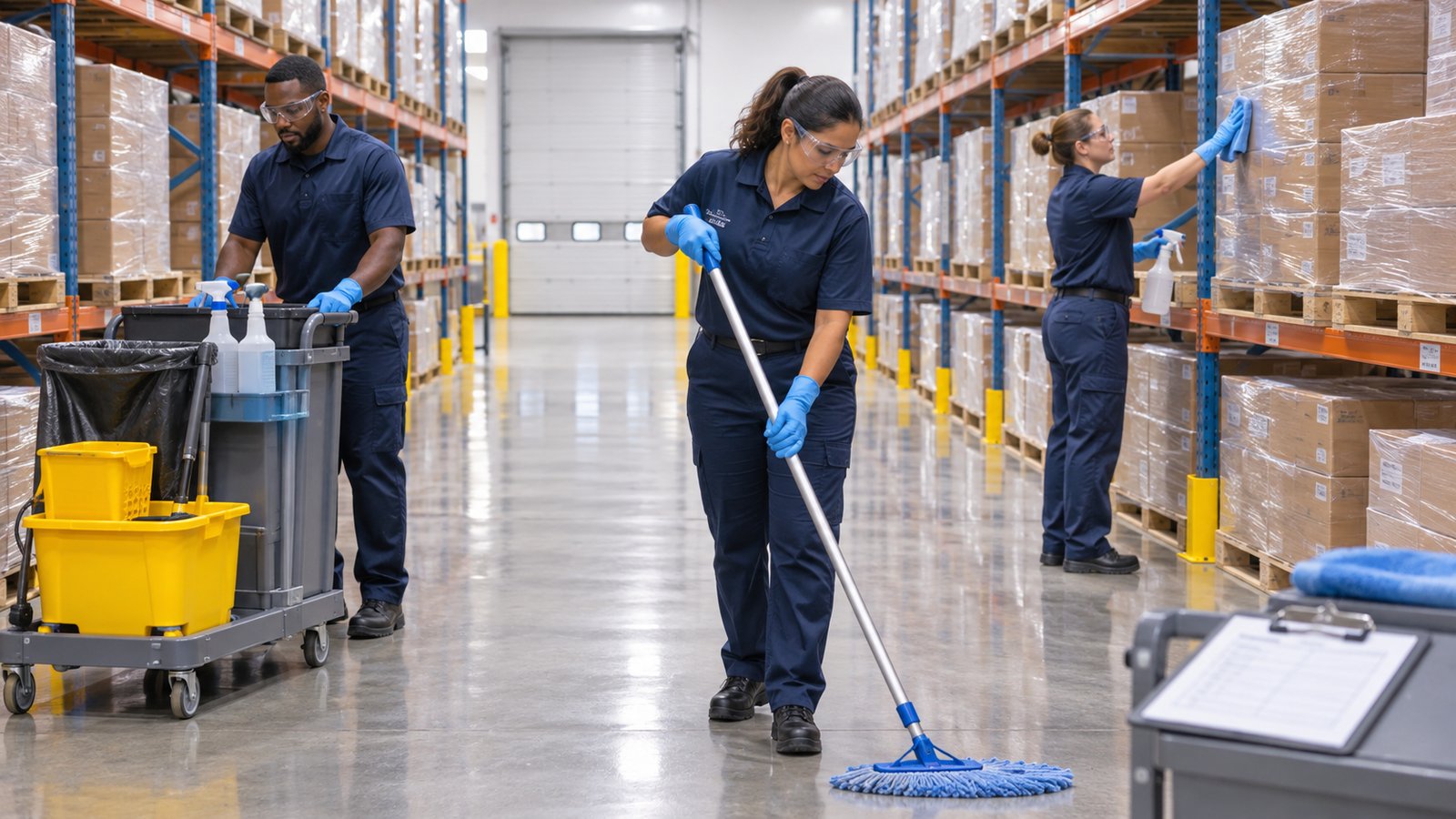
Pharmaceutical distribution facilities require a cleaning program that protects stored products and respects the site’s quality system. A third-party logistics warehouse, wholesale distributor, and GMP manufacturing or packaging site may have different rules, so a cleaning contractor should never promise universal regulatory compliance. Buyers should define permitted areas, approved materials, product-protection steps, records, and escalation to Quality before requesting pricing. GreenPoint Maintenance Services Corp serves commercial facilities across the tri-state area and beyond. Call 347-332-9348 to schedule a walkthrough and build a fixed-scope proposal around the facility’s own procedures.
Classify the operation and define the quality-system boundary
First confirm whether the site stores finished drugs, active pharmaceutical ingredients, medical devices, packaging, temperature-controlled products, or mixed inventory. Determine whether it is a 3PL, wholesale distribution operation, manufacturing site, repackaging area, or a combination. The applicable procedures depend on the activity, license, product, and jurisdiction. FDA’s Q7 guidance for active pharmaceutical ingredients addresses specific GMP contexts, including sanitation and warehousing; it should not be treated as a one-size-fits-all rule for every distribution warehouse.
Ask Quality to mark the areas that a janitorial contractor may enter: general office, breakroom, restrooms, dock vestibules, approved circulation aisles, returns, quarantine, cold rooms, and any controlled spaces. Include a clear list of prohibited actions, such as opening cartons, moving saleable inventory, disturbing labels, entering a controlled room, adjusting temperature equipment, or handling returned product. GreenPoint Maintenance Services can scope the building envelope while the client retains product disposition and quality decisions. No cleaner should move stock to make a floor task easier unless the approved procedure explicitly allows it.
Protect product, packaging, and status segregation during cleaning
The site’s quality procedures should explain how floors and accessible surfaces are cleaned without wetting product, labels, cartons, or packaging. Keep chemicals and equipment away from exposed goods, use dust-controlled methods suited to the facility, and do not spray near open cases or racking. Establish whether pallets must remain in place, who may move them, how returns or quarantined stock are protected, and what conditions require a pause. FDA guidance for manufacturing and API operations emphasizes clean facilities, defined sanitation responsibilities, and storage conditions where they are critical; the facility’s Quality team must determine which provisions apply to its operation.
In a 25,000-square-foot distribution center with high-bay racks, dock staging, a small office suite, and a returns cage, the task plan should separate travel lanes, floor edges, restrooms, administrative rooms, and controlled inventory zones. That is an illustrative layout, not a cleaning-time benchmark. Record clearances needed for inspection, pedestrian and forklift routes, pallet locations, and the facility’s cleaning window. GreenPoint can document the exact floor area and task boundaries but will not claim that a janitorial service certifies product quality, controlled temperature, or warehouse compliance.
Approve chemicals, equipment, and employee training through Quality
Before launch, require a written product list that Quality and EHS have reviewed for each surface and area. Specify dilution, application method, contact time if disinfection is required, residue or rinse expectations, equipment storage, and the process for changing a product. A Green Seal certified cleaner may be suitable for an office or restroom but is not automatically appropriate for warehouse floors, product-adjacent surfaces, or a controlled room. GreenPoint keeps ordinary janitorial products separate from client materials and uses only products approved for the task and site.
The vendor should train assigned staff on site access, gowning or PPE if applicable, hand hygiene, restricted rooms, spill reporting, product handling, and what not to touch. Provide safety data sheets and labeled containers where required, and prohibit unapproved decanting or mixing. Quality should approve the route and any equipment that enters product-sensitive spaces. If a package is wet, damaged, leaking, or exposed to a cleaner, the worker should stop and notify the client’s designated contact; the contractor should not decide whether the product is saleable. Call 347-332-9348 to arrange a walkthrough that includes Quality and facilities stakeholders. Before a worker enters a restricted area, the site should record the required gowning sequence, handwashing point, approved cart or vacuum, and exit path. If the facility uses a logbook or controlled checklist, name the person who reviews it and the method for correcting a missed entry. These small controls help keep routine cleaning evidence traceable without implying that a cleaner has validated the room or approved stored product. Include a short refresher after a route change, product substitution, or new security rule, and retain a sign-in record so the site can verify who received the update.
Design a frequency matrix for docks, storage, and support areas
Frequency should reflect traffic, packaging debris, dust, dock weather, temperature zones, and the facility’s own environmental or housekeeping procedures. A high-turnover shipping lane may need more frequent debris checks than an office corridor; a chilled room may require a specific method and approved equipment. Do not apply a generic square-foot-per-cleaner number to the entire building. Break the plan into room area, floor type, number of dock doors, restroom fixtures, break areas, shifts, aisle restrictions, and periodic tasks such as high dusting or floor maintenance.
For each task, list the service window, expected completion, product or equipment, access permission, and responsible reviewer. GreenPoint offers fixed pricing rather than hourly billing, so the quote should state the assumed operating calendar, staffing access, consumables, and what happens when the site adds a shift or restricts a zone. Define temporary closure notices and a safe way to clean around active forklifts and conveyors. A clear frequency matrix helps facilities, operations, and Quality review a scope without confusing a janitorial service level with a GMP validation program.
Create audit-ready records while preserving confidentiality
A strong contractor can provide task-level evidence without claiming to generate regulatory approval. GreenPoint’s JaniTrack can record service timestamps, GPS-tagged locations, approved photos, ATP checks where useful, and a live dashboard. ATP can support selected hygiene checks, but it is not a drug assay, microbial identification, or proof that a site meets a specific quality requirement. The ISSA CIMS quality-system framework describes site-specific scopes, performance records, and inspections; a pharma facility should align those records with its controlled-document system.
Ask whether the contractor can follow the site’s access and documentation rules, use approved forms, report exceptions promptly, and preserve records for the period stated in the service agreement. Photos must not reveal product labels, lot numbers, customer names, security systems, or proprietary inventory data unless Quality has approved that evidence. Define who may see reports, how corrective actions are closed, and how document versions are controlled. GreenPoint Maintenance Services can give a facilities team visibility into routine completion while the client’s Quality unit remains the owner of deviations, investigations, batch decisions, and regulatory submissions.
Choose a vendor that understands boundaries and continuity
Request insurance, employee screening appropriate to the site, training records, a chemical inventory, backup staffing, supervisor credentials, equipment controls, an incident plan, and a sample inspection report. Ask how a new employee is approved, how access is removed after a worker leaves, and who is available on a weekend shift. Clarify which services are excluded: product handling, cold-room maintenance, pest-control application, equipment cleaning, waste classification, or GMP documentation may require another qualified party. GreenPoint reports 98% client retention and offers fixed pricing with no hidden fees; verify all line items against the same scope.
The commercial cleaning contract terms guide and warehouse industrial cleaning best practices can support a bid review. GreenPoint Maintenance Services is MBE/MWBE certified with New York State, New York City, and NYC DOE, and registered in SAM.gov. Ask the vendor to identify its role accurately: a cleaning contractor can perform the approved work and report it, but cannot guarantee FDA compliance or replace the site’s Quality system. Call 347-332-9348 for a walkthrough in New York, New Jersey, Connecticut, Pennsylvania, or Florida.
Coordinate regional coverage with distribution and access schedules
Pharmaceutical distribution buildings around the New Jersey Turnpike, Newark, Elizabeth, Secaucus, the Bronx, Long Island City, Westchester, or Fairfield County may run multiple shifts and tightly scheduled inbound and outbound appointments. A service plan should identify truck peaks, dock access, employee entrances, badge rules, visitor sign-in, and the specific person who can authorize work near controlled stock. Holiday and storm coverage should be defined before the season begins, especially where deliveries continue around the clock. GreenPoint can schedule an approved route that avoids peak loading windows and provides a named contact for exceptions.
Local fire, waste, sewer, chemical-storage, and building requirements can vary by municipality and by the facility’s licensed activity. Have the site’s compliance staff identify applicable rules and make sure the contractor knows where to dispose of ordinary cleaning waste and what to do with an unknown spill. A janitorial vendor should not classify pharmaceutical waste, move damaged product, or pour process liquids into a drain. Document emergency contacts for leaks, refrigeration alarms, access failures, and product exposure. GreenPoint can add the facility-approved escalation steps to the route instructions and flag any condition beyond the contracted cleaning scope.
Frequently asked questions
Does hiring a cleaning contractor make a pharma warehouse GDP-compliant? No. Compliance depends on the facility’s activities, licenses, quality system, products, and applicable regulations. A contractor can perform and document approved cleaning tasks but cannot replace the client’s Quality unit or guarantee regulatory status.
Can janitorial staff clean inside a pharmaceutical distribution warehouse? They may service only areas and surfaces approved by the facility. Product-adjacent zones, controlled rooms, cold storage, returns, and quarantined inventory require explicit access rules and may be excluded from routine service.
Which cleaning products should a pharma warehouse use? The facility’s Quality and EHS teams should approve products, application methods, equipment, residues, and storage rules for each space. Green Seal certification alone does not establish suitability for every product-sensitive area.
What records should a pharma facility request from its cleaning contractor? Request an approved scope, task logs, training and access records, chemical list, exception reports, inspection results, corrective-action status, and documented control of photos or other confidential information.
How can a distribution center obtain a tri-state cleaning proposal? Share the facility classification, access zones, operating calendar, product-protection rules, and any approved sanitation SOP. Call GreenPoint Maintenance Services at 347-332-9348 to schedule a walkthrough and fixed-scope quote.
Arrange a pharma distribution facility walkthrough with GreenPoint Maintenance Services at 347-332-9348. GreenPoint reports 98% client retention and can document approved cleaning tasks while leaving product status and Quality decisions with your team.