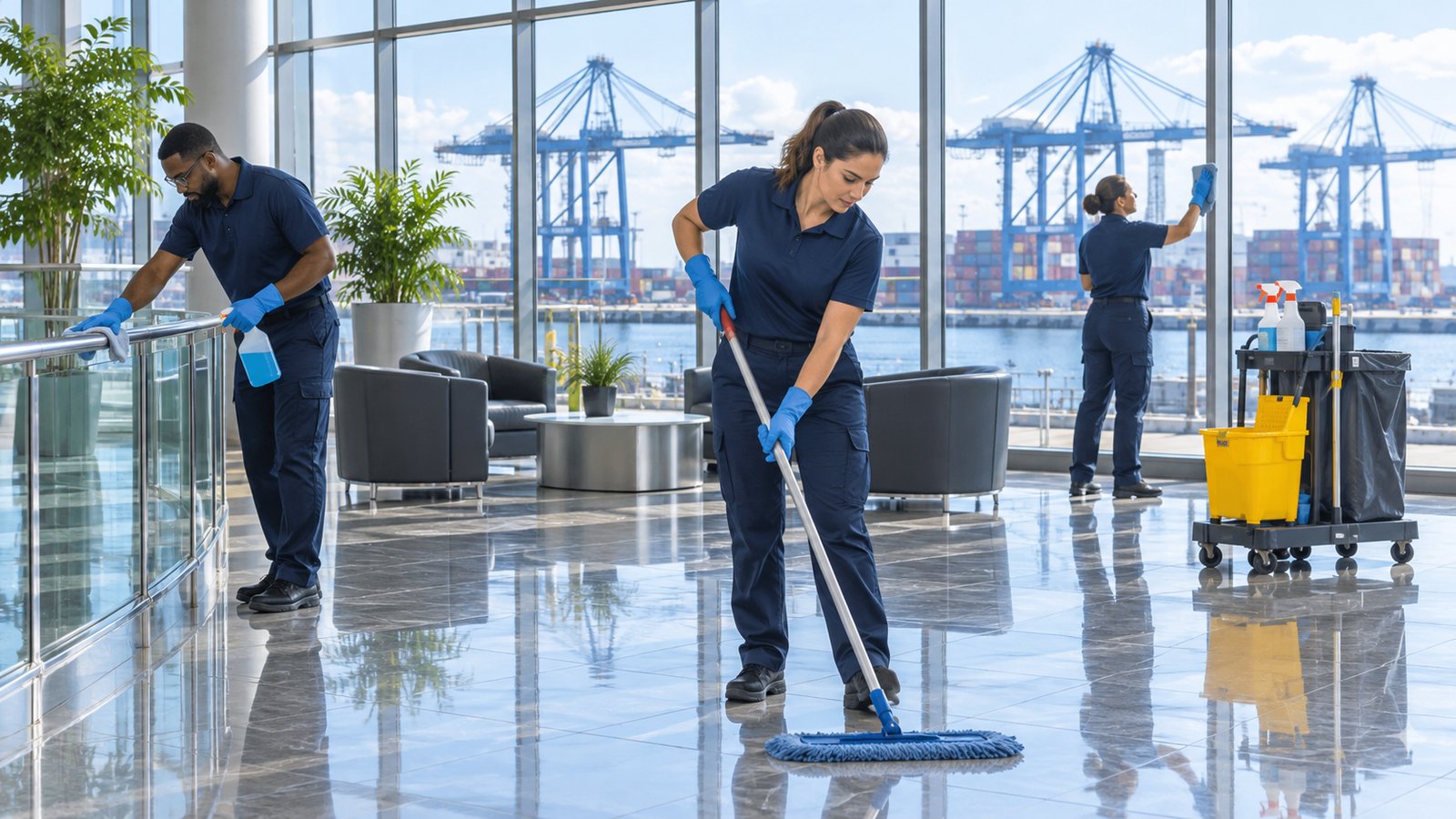
Port terminal cleaning in New York and New Jersey must support safe, continuous logistics without putting a janitorial crew in the path of cargo movement. Operations buildings, gate offices, restrooms, breakrooms, dispatch areas, passenger or visitor spaces, and selected corridors can often be scoped separately from cargo aprons, crane zones, rail tracks, vessel spaces, and maintenance work. GreenPoint Maintenance Services Corp provides commercial facility cleaning with documented service and fixed pricing. To review a marine logistics site and schedule a walkthrough, call GreenPoint at 347-332-9348.
Separate terminal buildings from cargo-handling operations
Start by mapping the actual service footprint. A terminal may include a public or tenant lobby, gate processing office, dispatch room, driver restroom, locker facilities, break area, warehouse, reefer support building, and exterior pedestrian paths. Cargo aprons, rail corridors, crane operating zones, vessel access, container repair, and equipment maintenance may be controlled by other employers or require special authorization. GreenPoint Maintenance Services asks the terminal manager to identify every included area and name the person who can release it for cleaning.
A 10,000-square-foot operations office beside a busy gate does not have the same service plan as a 100,000-square-foot warehouse with truck, rail, and vessel movements. Those figures are illustrative, not a productivity benchmark. Count rooms, doors, washroom fixtures, shift changes, visitor traffic, walk distances, and approved cleaning windows. Note whether the site is active overnight and whether a terminal requires a security escort or credential check. A written zone map makes the difference between a realistic quote and an estimate based only on gross floor area.
Keep walkways clear and coordinate work around live traffic
OSHA’s marine-terminal housekeeping rule, 29 CFR 1917.11, requires active work areas to be kept free of unnecessary equipment and materials and addresses debris and access. Cleaning plans should preserve pedestrian routes, access to vehicles and buildings, and clear exits. A janitorial worker should never enter an active container-handling lane, stand under a suspended load, cross a barrier, or move cones that belong to terminal operations. Schedule floor work only after the authorized terminal contact confirms the area is safe and released.
In a port environment, a wet floor, loose strapping, pallet fragments, spilled oil, salt, rainwater, or wind-blown debris may need immediate attention, but the response depends on the substance and location. The crew should report unknown spills and follow the terminal’s spill-response plan rather than sweeping or washing them into a drain. Use signs and barriers only as authorized and make sure they do not create a traffic obstruction. GreenPoint can log the issue and notify the contact; operational control remains with terminal management and emergency responders.
Scope sanitation, restrooms, and employee facilities clearly
Employee facilities need a reliable service schedule because drivers, stevedores, contractors, and office teams may use them across multiple shifts. OSHA’s marine terminal sanitation standard, 29 CFR 1917.127, addresses accessible washing and toilet facilities and requires regular cleaning and maintenance. Translate that requirement into specific fixture checks, supply responsibilities, response times, and who reports plumbing or ventilation problems. Include handwashing stations, locker rooms, break surfaces, and gate offices only when they are within the approved contract.
A terminal near Port Newark, Port Elizabeth, the Brooklyn waterfront, Red Hook, or Staten Island may have separate tenant areas with different access rules and operating hours. Identify which employer provides each restroom, who owns consumables, and how the vendor enters during a shift change. If service interruptions occur when a vessel call or delivery surge blocks access, document a safe alternate window. GreenPoint’s proposal can identify the number of fixtures, expected checks, consumables, and escalation contacts so facilities staff are not left guessing whether a missed room was inaccessible or simply overlooked.
Set chemical, waste, and spill boundaries before mobilization
A terminal’s site owner should approve cleaning products, dilution, storage, and disposal routes before the contractor arrives. Chemical controls matter because workers may encounter fuel, grease, cargo residue, batteries, or unknown liquids that are outside ordinary cleaning. OSHA’s hazard-communication requirements apply in maritime settings, and its marine-terminal hazard communication fact sheet describes written programs, container labels, safety data sheets, and training. Keep the janitorial list separate from cargo, maintenance, and hazardous-material inventories.
GreenPoint uses Green Seal certified products where they fit the building surface and the client approves them, but no product should be assumed suitable for a spill or process area. Define how ordinary trash is separated from regulated or cargo-related waste, who handles sharps or contaminated materials, and what the crew should do when a container is unlabeled. Do not wash debris into a storm drain or use a pressure washer without facility permission. A pre-service walkthrough should capture drains, hose points, storage, spill kits, and after-hours contacts. Call 347-332-9348 to schedule that review.
Build a coverage matrix for gates, shifts, and square footage
A terminal route should reflect the number of operating shifts, entry surges, restroom use, weather exposure, and distances between facilities. A single gross square-foot figure will not capture a gate office used continuously, a warehouse aisle that remains restricted, and a breakroom used at shift change. List daily tasks, per-shift checks, periodic high dusting, floor care, exterior entry service, and event or holiday coverage separately. GreenPoint offers fixed pricing rather than open-ended hourly billing; the price should state the assumed hours, access, coverage window, consumables, and travel between zones.
Document the terminal’s stop-work signal, barrier rules, escort requirements, alarm response, and backup contact before the first shift. If a lane closes, a cargo operation expands, or an area becomes restricted, the cleaner needs a clear alternate task rather than an incentive to enter an unsafe location to finish the checklist. GreenPoint Maintenance Services can report a blocked task in JaniTrack and request release from the client. The site supervisor decides whether to reschedule, authorize another zone, or cancel that service window. A written exception rule protects both schedule reliability and safety.
Verify completion without disclosing security-sensitive details
A terminal manager should be able to see which approved zones were serviced and whether an exception remains open. GreenPoint’s JaniTrack can provide task timestamps, GPS-tagged check-ins, client-approved photos, ATP testing where relevant, and a live dashboard. ATP is a limited hygiene indicator, not a security control, contamination determination, or proof that a terminal meets every regulatory requirement. The ISSA CIMS quality framework supports written scopes, documented inspection, and performance review that can help organize a janitorial program.
Set photo restrictions before activation. Images can unintentionally reveal container identifiers, vessel schedules, access points, badge details, screens, cargo paperwork, or security layouts. If photography is prohibited, use a timestamped task completion record and supervisor inspection instead. Define who can access the dashboard, how exceptions are escalated, and what records are retained. GreenPoint can document a restroom check or approved office task without exposing cargo or security information. The terminal owner should control data rules and may disable photos for any zone; the cleaner should not capture or share operational details without authorization.
Compare proposals on credentials, staffing, and full service cost
Request insurance, worker screening, site orientation, access documentation, training, supervisor coverage, relief staff, equipment, product list, incident response, and a sample report. Ask whether the vendor includes consumables, emergency calls, weekend and holiday service, floor restoration, high dusting, and weather-related entry cleanup. Verify whether special port credentials or escorts are required and which party arranges them. GreenPoint reports 98% client retention and fixed pricing with no hidden fees; a buyer should still compare each bid using the same building map, operating schedule, and list of excluded operational areas.
The warehouse industrial cleaning best-practices guide and digital cleaning verification systems can help frame the reporting and scope review. GreenPoint Maintenance Services is MBE/MWBE certified with New York State, New York City, and NYC DOE, and registered in SAM.gov. For a New Jersey or New York port, call 347-332-9348 to schedule a walkthrough. The proposal should identify the named site supervisor, response window, permitted routes, access assumptions, and fixed-price add-ons for events or additional terminal buildings.
Plan for coastal weather and local environmental requirements
Marine terminals can face salt, wind-driven rain, snow, mud, and heavy pedestrian or vehicle traffic. Add entry mats, wet-floor monitoring, salt residue removal, exterior glass, covered walkways, and storm recovery only where the site authorizes them. Winter service should include a clear escalation process for icing or blocked access, while summer plans should account for heat and hydration rules established by the employer. GreenPoint can adapt its arrival plan for facilities near Newark Bay, Port Newark and Elizabeth, Red Hook, Staten Island, and other NY-NJ logistics corridors without assuming every site has the same badge or gate procedure.
Environmental rules for stormwater, waste, chemical storage, and wash water depend on the owner, permit, terminal activity, and municipality. Have the port’s environmental manager identify approved disposal routes, drains, spill-response contacts, and any activity that requires a permit before a contractor uses water or pressure equipment. Cleaning is not a substitute for cargo spill response or marine environmental remediation. Document ordinary janitorial responsibilities separately from regulated cleanup, and include the local emergency number and terminal contact in the work instructions. GreenPoint will escalate a condition outside scope rather than silently treating it as routine soil.
Frequently asked questions
Does OSHA 1917.11 apply to all work at a port? It is a marine-terminal housekeeping standard with a defined scope. The facility’s safety team should determine which standards apply to the particular work, employer, and area; a janitorial contract does not replace that review.
Can a janitorial crew clean cargo aprons or active container lanes? Only when terminal management explicitly authorizes the area and establishes a safe window, traffic controls, and access requirements. Routine building cleaning should exclude active equipment, suspended-load, rail, vessel, and cargo-handling zones.
What should port facilities include in a cleaning bid? Provide a zone map, shift schedule, fixture counts, access and escort rules, product approvals, sanitation frequencies, reporting requirements, exclusions, emergency contacts, and pricing assumptions for weather or event coverage.
Can JaniTrack photos be used in a secure terminal? Only if the terminal approves photography and determines which locations and details may be captured. If photos could expose cargo or security information, use task timestamps, approved inspections, and exception logs without images.
How can a New York or New Jersey terminal request a quote? Identify the facility contact, authorized entry points, restricted areas, operating windows, and service list. Call GreenPoint Maintenance Services at 347-332-9348 to schedule a walkthrough and receive fixed-scope pricing.
Schedule a marine terminal janitorial walkthrough with GreenPoint Maintenance Services at 347-332-9348. GreenPoint reports 98% client retention and can document approved service while respecting terminal access, traffic, and photo restrictions.