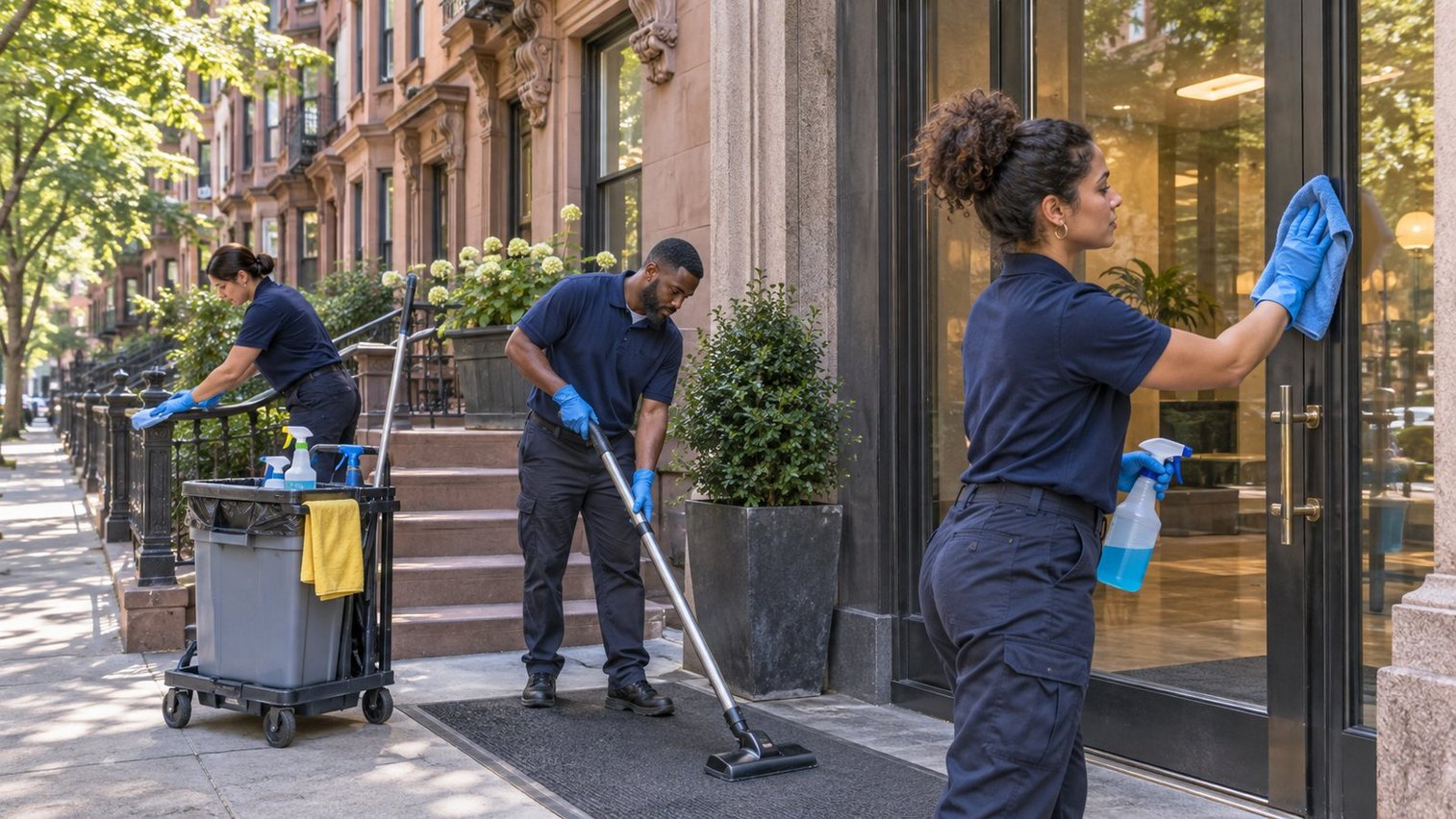
Choosing a commercial cleaning contractor in Park Slope means balancing a polished customer experience with the details of an older, active neighborhood. A professional suite near Grand Army Plaza, a storefront along Fifth Avenue, and a building bordering Prospect Park have different entries, floor materials, and daily traffic. GreenPoint Maintenance Services Corp helps managers turn those details into a defined scope, a realistic service window, and a proof-based inspection plan. Start with the route from sidewalk to tenant space, not a generic price per square foot. Call 347-332-9348 to request a walkthrough and quote.
Understand the building’s Park Slope traffic
Park Slope’s brownstone blocks, neighborhood retail, schools, offices, and nearby Prospect Park bring overlapping patterns of residents, shoppers, staff, and visitors. Areas near Grand Army Plaza, Atlantic Avenue, Seventh Avenue, and the F, G, or R subway corridors can see concentrated foot traffic at different times of day. Soil enters at vestibules, grit collects at thresholds, and fingerprints accumulate on shared doors and elevator buttons. A cleaning plan should follow this real route and identify the surfaces that need attention before they become a visible complaint.
During a site review, separate a tenant’s private suite from the building’s common areas and public-facing retail. Note the approved service window, door and alarm procedures, freight access, quiet hours, and any spaces that are shared with residents. The building contact should identify who can approve entry and who handles a spill or a broken dispenser. GreenPoint can record the distinctions in the scope so the manager is not left guessing which party is responsible for a lobby, a stairwell, or a tenant kitchenette.
Define tasks by surface and frequency
A contract should describe observable work. Instead of “maintain a clean appearance,” state whether staff remove loose debris, damp mop a named floor, wipe door glass, clean elevator touchpoints, replenish supplies, and record damage. Identify the frequency for each location, including entry mats, stairs, railings, reception counters, restrooms, meeting rooms, and waste stations. Floor care matters in older commercial spaces because wood, stone, terrazzo, resilient tile, and carpet require different methods. List manufacturer or building restrictions so the contractor does not use a convenient but unsuitable product.
Keep periodic tasks separate from nightly service: carpet extraction, floor finish restoration, high dusting, window cleaning, and construction cleanup need their own timing and pricing. Also state whether office staff clear desks, whether personal items may be moved, and which supplies the client provides. GreenPoint Maintenance Services offers fixed-price scopes for agreed recurring work, with no hourly billing and no hidden fees. For broader Brooklyn vendor considerations, review the commercial cleaning Brooklyn vendor guide and build a comparable bid request.
Walk the site and validate the workload
A useful walkthrough records cleanable area, occupied and vacant rooms, floor finishes, restroom counts, elevator access, trash points, storage, and the distance between zones. Gross square footage often includes areas that are not part of routine service, so use a plan or field measurement to mark what is actually cleaned. A 10,000-square-foot open office and a 10,000-square-foot property with multiple small suites and staircases do not have identical labor requirements. Ask bidders to explain route time and inspection time, not just quote a production ratio.
Park Slope properties may have compact storage and narrow access, so confirm where equipment fits and how staff move safely around tenants or customers. If a site is close to a busy corridor, avoid blocking the entrance during opening hours and agree on wet-floor signage placement. To arrange a GreenPoint walkthrough, call 347-332-9348 with the address, building type, service days, and approximate area. Bring the current scope and any complaint log; those records can reveal whether the problem is frequency, access, training, or unclear ownership.
Review safety, products, and city requirements
Ask how employees are trained to use chemical labels, safety data sheets, dilution equipment, personal protective equipment, and wet-floor signs. OSHA’s Hazard Communication overview describes workplace chemical information and employee training duties, especially when staff handle products with hazards. Ask for a product list and confirm its compatibility with floor and countertop materials. GreenPoint uses Green Seal certified products in its program, while selecting a product for a particular location still requires following the manufacturer’s directions and the facility’s rules.
For a New York City property, review DSNY’s Commercial Waste Zones guidance with the manager and confirm the building’s current authorized carter or zone-based arrangement. A cleaning crew may be assigned to gather liners and move bags to an approved collection point, but that does not mean it is authorized to haul commercial waste. Keep the route and responsibilities in writing. If the property includes a school, review NYC Public Schools vendor resources and verify any additional building, agency, or inspection requirements that apply to the facility.
Evaluate fixed pricing and bid exclusions
Send each vendor an identical task matrix and ask it to show service days, shift coverage, frequencies, staffing assumptions, supervision, products, consumables, periodic floor work, emergency response, and holiday treatment. Request explicit exclusions for high-level cleaning, interior windows, event cleanup, paper products, and damage remediation. A quote that leaves those matters open can create disputes after award. Compare the monthly amount against the complete annual scope, including predictable periodic work, rather than assuming the least expensive bid covers the same outcome.
Fixed pricing only protects the buyer when the boundaries are clear. GreenPoint’s fixed-price model avoids billing routine tasks by the hour, and the proposal should state what happens when a tenant adds area, a renovation closes a corridor, or operating hours extend. Ask for approval rules for extra work and a written notice before any price change. If you want a question list for vendor interviews, read questions to ask a commercial cleaning company and call 347-332-9348 for a Park Slope walkthrough and quote.
Make quality checks easy to verify
Choose a short list of checks that matter to the property: entry glass, floor debris, restroom restocking, touchpoints, waste staging, and locked doors. Assign an inspection owner, a schedule, a correction time, and an escalation path for safety concerns. GreenPoint’s JaniTrack process can provide timestamped, GPS-tagged photos, ATP testing when appropriate, and live dashboard information for agreed checkpoints. Decide whether the manager needs a daily record or exception alerts, and define which tenant or privacy-sensitive areas must not be photographed.
Review evidence with a site inspection rather than treating a single score as the whole story. Look for repeated findings by room, shift, and access condition, and confirm that corrections are recorded. GreenPoint reports 98% client retention; this company-reported figure is one factor to evaluate with references, insurance, training, and the actual correction process. Document what the supervisor will do when a standard is missed and how fast the issue should be fixed. Clear evidence makes renewal discussions more objective than exchanging general impressions.
Set a startup rhythm that protects service continuity
Before the first clean, hold a kickoff to cover key custody, alarms, tenant communications, security, storage, product approval, waste boundaries, damage reporting, and emergency contacts. Establish an initial walkthrough baseline with the manager and contractor. If work occurs around office hours or retail opening, define how staff announce a wet floor, redirect foot traffic, and safely close a small work zone. GreenPoint Maintenance should explain how the assigned supervisor receives feedback and how planned absences are covered.
Use weekly review meetings early in the contract, then move to a cadence that matches results. Record recurring missed tasks, access failures, extra-work approvals, and tenant comments. If Prospect Park event traffic or seasonal weather increases soil, note the change before revising frequency. To schedule a site walkthrough or request a fixed-price quote, call GreenPoint at 347-332-9348 or email info@greenpointms.com. Provide the floor plan, existing service schedule, operating hours, and known restrictions so the proposal is grounded in the actual Park Slope property.
Ask the contractor to show how the building will be protected while work is underway. A routine floor-care project may need a staged sequence, drying time, cones, alternate paths, and advance notice to tenants. A carpet extraction can require moving light furniture or asking occupants to clear personal items, so responsibilities should be set before the crew arrives. If a Park Slope property has a narrow vestibule or a busy retail entry, plan equipment storage and the order of work so the route remains passable. Put the notice period, rescheduling rule, and approval contact in the periodic-work section of the agreement. These details make it less likely that a maintenance project will surprise a tenant or interfere with a scheduled opening.
A building can also set seasonal service triggers without promising a fixed result in every weather condition. For example, the manager and vendor may agree to inspect entrance mats more closely during a rainy week, document when extra spot attention is requested, and review the added work before it is billed. Put the trigger, authorized contact, and whether the visit is included or optional in the contract. A written procedure is more reliable than expecting a cleaner to infer a tenant’s preference from a wet lobby. Park Slope’s tree-lined sidewalks and park-side routes make this kind of discussion useful during leaf, rain, and winter grit periods.
Frequently asked questions about Park Slope cleaning
Q: How do I choose an office cleaning contractor in Park Slope? A: Compare written task schedules, staffing coverage, insurance, chemical safety practices, supervisor response, fixed-price assumptions, and quality records. Ask each bidder to review the same building during a walkthrough.
Q: Should a storefront have daytime cleaning? A: It depends on customer traffic, soil, restroom use, and the business’s service hours. A vendor can price an opening check or touch-up as a separate frequency when overnight service alone does not keep public areas presentable.
Q: What does GreenPoint include in a walkthrough? A: GreenPoint reviews access, cleanable areas, surface types, service windows, storage, waste points, and the buyer’s task expectations before preparing a defined proposal. Call 347-332-9348 to schedule.
Q: Can a janitorial vendor manage building waste pickup? A: Do not assume so. Specify whether staff move bagged waste to the designated staging area, then confirm the property’s commercial hauling arrangement with its manager.
Q: How can quality be documented? A: Use a shared checklist, inspection log, correction record, and agreed completion evidence. JaniTrack may support timestamped, GPS-tagged photos, ATP testing where appropriate, and dashboard reporting for selected checkpoints.
Request a Park Slope cleaning walkthrough and fixed-price proposal from GreenPoint Maintenance Services Corp. Call 347-332-9348 or email info@greenpointms.com. Proof point: GreenPoint reports 98% client retention and can document agreed checks through JaniTrack.