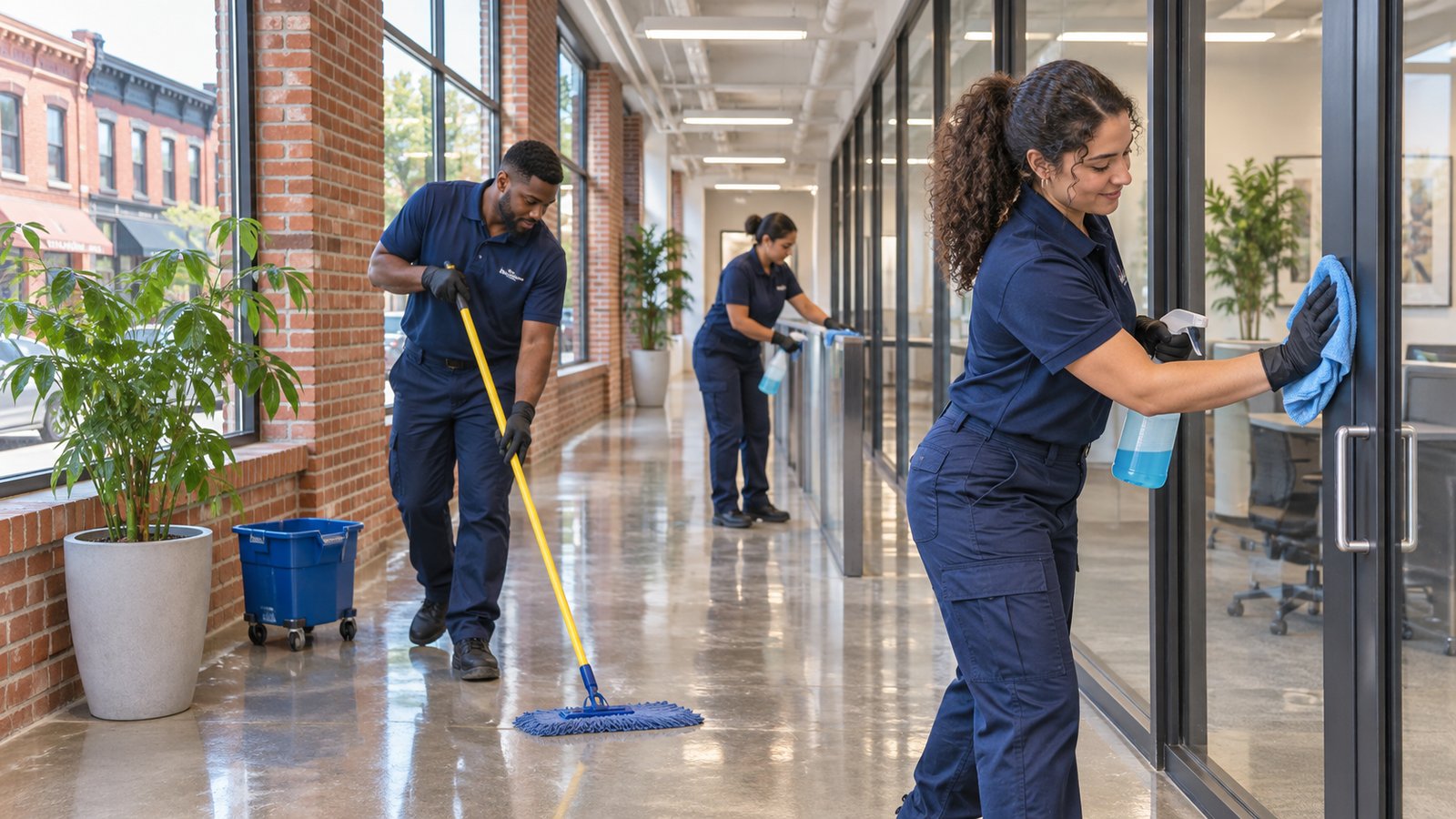
Ridgewood’s storefront corridors and smaller professional offices need a cleaning plan that respects tight entries, active sidewalks, and different tenant schedules. A retail suite on Myrtle Avenue does not operate like an upper-floor office near Myrtle–Wyckoff Avenues, and neither should be priced from a generic checklist. GreenPoint Maintenance Services Corp helps buyers define the work, access rules, and inspection measures before comparing proposals. Whether your property is near the M train, the L train, or Forest Avenue, request a walkthrough before accepting a broad “complete janitorial service” promise. Call 347-332-9348 to arrange a site review or quote.
Map the customer route and the service window
Start at the public sidewalk and follow a customer, employee, or delivery worker through the entry, vestibule, waiting area, shared corridor, washroom, and exit. Around Myrtle Avenue, Fresh Pond Road, Forest Avenue, and the Myrtle–Wyckoff transit hub, foot traffic and retail deliveries may create dirt patterns that a back-office checklist misses. Note whether the entrance mat is removable, whether the glass collects fingerprints, and whether the shop floor is hard surface or carpet. A reliable scope connects the visible condition to a task and a frequency rather than assuming a once-nightly pass solves every issue.
Record opening hours, late trading, delivery windows, quiet periods, and access restrictions by tenant. A cleaner working in a small office may need an alarm code and a narrow arrival window; a retailer may require service after the cash wrap is secured. Ask who can approve a delay, who responds if a door will not lock, and how a completed visit is logged. GreenPoint can use the walkthrough to identify shared and tenant-controlled spaces, so the proposal does not quietly include areas that the buyer cannot authorize staff to enter.
Write down the tasks for offices, shops, and common areas
A useful scope lists each room or route, the task, its frequency, and the expected condition. For a shop, that may include entrance glass, display-adjacent floor, fitting or customer area where applicable, waste transfer, and touchpoints. For an office, it may mean desks only when cleared, meeting tables, kitchenette counters, washrooms, and carpeted routes. Common-area duties can include stairs, railings, door hardware, elevator panels, and interior glass. Note carefully whether the contractor is allowed to move merchandise or personal belongings; when the answer is no, the scope should say so.
Separate recurring janitorial work from periodic projects such as carpet extraction, hard-floor refinishing, high-level dusting, or post-renovation cleanup. That distinction lets a buyer compare the monthly contract without hiding large one-time expenses inside an unclear allowance. GreenPoint Maintenance Services can offer a fixed-price program based on the agreed scope, with no hourly billing and no hidden fees. For a purchasing checklist, read questions to ask a commercial cleaning company, then use the same questions with every Ridgewood bidder.
Use a walkthrough to measure constraints, not just square feet
A site walk should identify cleanable area, floor type, water and electrical access, storage space, waste staging, stairs, restroom count, and the distance between service zones. Record the difference between gross leased area and the actual surfaces included in routine work. A 12,000-square-foot suite with private rooms, dense merchandise, or restricted offices may require a different labor plan from a similarly sized open floor. Avoid judging one vendor’s staffing by a single square-foot-per-hour claim unless the tasks, clutter, equipment, and quality frequency are comparable.
For a Ridgewood property near the M or L line, discuss transit arrival and building access without treating transportation as a substitute for staffing coverage. Ask the contractor how it handles call-outs, keys, alarm failures, and a scheduled employee who cannot reach the site. Provide a floor plan if you have one, but validate it in person. To set up a walkthrough and proposal with GreenPoint, call 347-332-9348 and share the address, operating hours, number of service days, and the areas that must stay open during cleaning.
Review safety, environmental practices, and local rules
Before a contract starts, request a chemical list, product labels, safety data sheets, dilution instructions, and training practices for wet-floor signs and personal protective equipment. OSHA’s Hazard Communication overview explains that employers with hazardous chemicals must make labels and safety data sheets available and train exposed workers, so buyers should know how cleaners are identified and where the safety information is available. Ask whether a product is suitable for a specific floor or counter and whether the label requires rinsing or a stated contact time. GreenPoint uses Green Seal certified products, while selecting the right product remains dependent on the surface and task.
Ridgewood commercial premises also operate within New York City’s waste and building rules. Consult DSNY’s Commercial Waste Zones guidance and confirm with the property manager which authorized carter or zone arrangement applies. Define whether the janitorial team only moves bagged waste to a collection point or has a separately approved role; do not assume a cleaner transports waste off site. Retailers with food preparation, public washrooms, or shared residential areas may have additional facility-specific requirements, so the responsible operator should confirm those obligations with the relevant agency. Keep cleaning duties separate from a tenant’s licensing and inspection obligations.
Compare proposals by deliverables and predictable cost
Put each bid into the same comparison: regular service days, task frequencies, number of shifts, consumables, restroom restocking, floor-care projects, supervision, emergency response, holiday schedule, and documented exclusions. Check whether the quoted price includes the equipment and products needed for the scope. If a proposal says “as needed,” ask who decides, how often the task is expected, and whether it costs extra. For a buyer, a low entry price is not a saving if it omits a critical restroom or leaves the storefront glass untouched.
A fixed price makes planning easier when it is linked to a signed scope and a fair change process. If a tenant expands the floor, opens later, or adds a washroom, establish how the parties revise service. GreenPoint’s no-hourly-billing approach aims to prevent routine work from turning into unpredictable labor charges. Ask for a walkthrough quote rather than relying on an estimate from a listing or a phone description. For other Queens-specific vendor considerations, review the Queens commercial cleaning facility guide, then call 347-332-9348 for a proposal based on your own building.
Make quality measurable for a busy neighborhood property
Define a small set of observable checks: entrance glass free of obvious smears, floors free of loose debris, washrooms replenished, waste staged as agreed, and access doors secured. Set an inspection cadence and a correction deadline. GreenPoint’s JaniTrack system can support timestamped, GPS-tagged photos, ATP testing where appropriate, and a live dashboard, helping a manager review agreed tasks without waiting for a monthly complaint summary. Buyers should ask to see a sample workflow and agree which data is collected, how it is retained, and who receives notifications.
A quality program should distinguish a missed clean from a one-off spill that occurred after service. Keep a log of the time reported, the relevant zone, the response, and the resolution. Review recurring defects with the supervisor instead of repeating the same text message each week. GreenPoint reports 98% client retention, a company-reported figure that can be considered alongside references, insurance documents, staff onboarding, and the actual site inspection process. The goal is not a dashboard for its own sake; it is a clear way to identify and close service gaps.
Protect the first weeks with a practical startup plan
Before the first shift, agree on who issues keys, how alarm codes are handled, where products and equipment are stored, what cannot be moved, and how the cleaner reports damage. Decide who covers a sick call-out and how an urgent spill is triaged. For a storefront property, specify how staff avoid obstructing customers and whether any public-facing task must be completed before opening. GreenPoint Maintenance should be able to show the manager a named escalation route and a first-month review calendar, not just a start date.
Review the first four weeks against the original task list and update it only through an agreed written change. If a new retail tenant, construction activity, or seasonal mat change alters the soil load, record that context before judging the result. Ask for a walkthrough or fixed-price quote from GreenPoint Maintenance Services by calling 347-332-9348 or emailing info@greenpointms.com. A well-prepared buyer can share operating hours, a floor plan, service days, and any special product or access restrictions before the site meeting.
Ridgewood managers can make vendor handoffs easier by keeping a short exception register. Record the date, the affected zone, whether access was available, what was reported, and who confirmed the correction. If the entrance mat is repeatedly saturated, note the weather and whether the mat was replaced or vacuumed; if a restroom is short on supplies, note whether stock was available in the storage closet. Those details help distinguish a supply-chain problem from a missed cleaning task. Keep tenant names and sensitive comments out of broadly shared reports, and route concerns through one designated contact. A clear record is especially useful when office and retail tenants share an entrance but have different business hours and expectations.
Frequently asked questions about Ridgewood cleaning vendors
Q: What should Ridgewood retailers include in a cleaning quote request? A: List public floor area, entrance and glass needs, restroom count, waste staging, operating hours, service days, and any rules about merchandise or displays. Ask for a walkthrough so the contractor can verify access and floor conditions.
Q: Is one nightly cleaning visit enough for every shop? A: Not necessarily. Base the schedule on customer traffic, food or drink activity, weather, floor finish, and the time a spill or soil is noticed. Some needs may call for an agreed daytime check in addition to the close-of-day routine.
Q: Does GreenPoint bill by the hour? A: GreenPoint offers fixed-price proposals for a defined recurring scope, rather than hourly billing. Call 347-332-9348 for a walkthrough and a quote that states included tasks and assumptions.
Q: What documentation helps verify the service? A: A signed task schedule, inspection results, issue log, and agreed completion evidence are useful. JaniTrack can provide timestamped, GPS-tagged photos and dashboard reporting when those features fit the contract.
Q: Who handles a Ridgewood business’s trash pickup? A: The building or business should confirm its authorized commercial waste arrangement with its property manager and the City. A janitorial contract should say whether staff only move bagged waste to the designated location.
Schedule a Ridgewood site walkthrough and fixed-price proposal with GreenPoint Maintenance Services Corp. Call 347-332-9348 or email info@greenpointms.com. Proof point: GreenPoint reports 98% client retention and offers JaniTrack documentation for agreed quality checks.