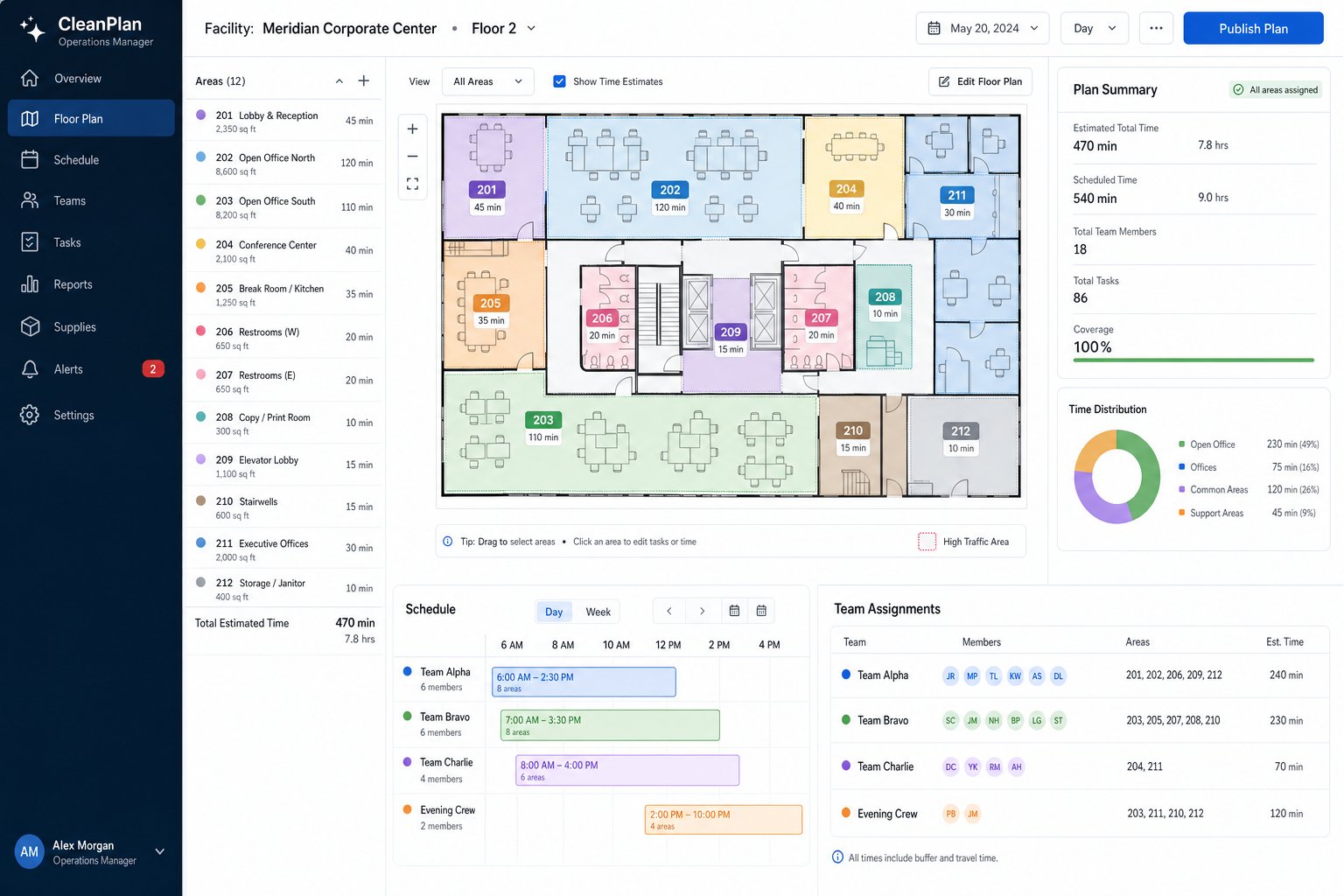
A commercial cleaning staffing ratio is a planning estimate, not a universal promise. Crew size changes with floor type, restroom count, furniture, occupancy, security, service windows, waste volume, and the appearance standard. GreenPoint Maintenance Services Corp helps property managers in Manhattan, the Bronx, Brooklyn, Queens, Staten Island, Westchester, Long Island, New Jersey, Connecticut, Pennsylvania, and Florida build a transparent labor model using square footage, task times, supervision, and StockPoint verification. Call 844-814-0810 to schedule a walkthrough and fixed-price quote.
Start with cleanable square footage and task mix
A staffing estimate begins by separating cleanable area from gross building area. List offices, corridors, restrooms, kitchens, stairs, elevators, lobbies, warehouses, labs, classrooms, and exterior transitions. A 50,000-square-foot open office with six restrooms does not require the same labor as a 50,000-square-foot clinic with 30 exam rooms. GreenPoint Maintenance Services measures surfaces, fixtures, room density, and access before applying a productivity assumption.
Use square footage as a denominator, not the entire answer. The [commercial cleaning staffing ratios by square footage](/blog/cleaning-staffing-ratios-square-footage/) guide explains why a single “one cleaner per X square feet” rule can hide high-touch, restroom, or floor-care work. GreenPoint builds the route from actual tasks and frequencies.
Use productivity ranges carefully
Industry productivity varies widely by task and condition. A simple office vacuum-and-dust route may cover more area per labor hour than a restroom-heavy school, a medical practice, or a warehouse with racking and safety controls. GreenPoint uses a range, then validates it with a walkthrough, trial route, and supervisor review rather than presenting an unsupported precision number. BLS occupational data describes the size of the janitorial workforce; it does not set a universal production rate.
For planning, separate recurring labor from periodic projects. Daily touchpoints, trash, restrooms, and floors need one model; carpet extraction, VCT restoration, high dusting, window work, and post-construction cleaning need another. GreenPoint’s [commercial cleaning cost per square foot](/blog/commercial-cleaning-cost-per-square-foot/) guide helps finance compare recurring and periodic costs honestly.
Calculate labor from frequencies and minutes
Build a task table with area, quantity, frequency, minutes per occurrence, setup, travel, replenishment, and inspection. For example, 12 restrooms checked twice per day create 24 events even if the building is only 40,000 square feet. GreenPoint adds time for keys, elevators, loading docks, waste staging, equipment charging, and safe chemical handling. The total becomes a route budget that managers can test against actual service.
Keep a separate allowance for relief coverage, meetings, training, and rework. A staffing plan that works only when every cleaner is present is fragile. GreenPoint Maintenance Services offers fixed pricing with no hourly billing and no hidden fees, and our proposal shows the assumptions behind the crew size. Email info@greenpointms.com for a worksheet review.
Adjust for facility type and risk
Offices often emphasize appearance, meeting-room resets, kitchens, lobbies, and restrooms. Schools add classrooms, cafeterias, gyms, nurse offices, and student traffic. Healthcare-adjacent practices add exam rooms, privacy boundaries, and approved disinfection. Warehouses add docks, breakrooms, racking edges, high dust, and safety access. GreenPoint uses the client’s risk assessment and operating hours to adjust the labor model.
Neighborhood and transit patterns also change staffing. A Midtown tower near Grand Central may need daytime porter coverage; a Brooklyn site near Atlantic Terminal may see arrival surges; a Westchester campus may have longer travel between buildings. GreenPoint can support New York, NJ, CT, PA, and FL portfolios with a common core scope and local annexes. Call 844-814-0810 for a site map.
Account for floor finishes and equipment
Hard floors, carpet, tile, stone, rubber, and gym finishes require different tools, speeds, drying plans, and periodic care. Add equipment transport, cord management, battery charging, filter changes, and machine maintenance to the labor model. GreenPoint follows manufacturer and product-label instructions and uses Green Seal certified product options where compatible. Underestimating floor care can make a daily route look profitable while the finish deteriorates.
Periodic work should be scheduled from square footage and condition, not squeezed into an already full shift. A 100,000-square-foot office may need quarterly carpet extraction or VCT work that is invisible in a nightly staffing ratio. The [VCT floor care strip, seal, and wax guide](/blog/vct-floor-care-strip-seal-wax-guide/) shows why restoration should be priced separately.
Include supervision, quality, and technology
Cleaners need onboarding, site orientation, product training, safety briefings, relief coverage, and a supervisor who can inspect and coach. GreenPoint uses StockPoint timestamps, GPS-tagged locations, checklists, supervisor inspections, and corrective-action records to make service visible. Technology adds value when it reduces missed work or response time; it should not be counted as a substitute for people who inspect surfaces and make decisions.
A practical model might include daily lead review, weekly account inspection, monthly trend review, and quarterly scope recalibration. GreenPoint tracks pass rate, repeat findings, supply-outs, response time, and access exceptions. The [quality assurance commercial cleaning program](/blog/quality-assurance-commercial-cleaning-program/) provides a useful structure for connecting staffing to outcomes.
Plan day porter and peak-period coverage
Overnight staffing can complete routine work, but peak periods may require a daytime porter for restrooms, spills, trash, lobby appearance, supplies, and customer-facing response. GreenPoint sizes porter hours from entries, events, restroom use, deliveries, and response expectations. A 20,000-square-foot coworking site may need more visible daytime support than a 100,000-square-foot low-occupancy warehouse.
Write the response standard: for example, who receives a spill call, who arrives, what safety controls apply, and how closure is recorded. GreenPoint does not use an arbitrary ratio when a building’s traffic changes after an event, storm, or tenant move. StockPoint can record the call, dispatch, inspection, and correction. Call 844-814-0810 to map peak periods.
Test the model with a 30-day baseline
After launch, compare planned labor to actual task completion, access exceptions, complaints, supply-outs, inspection findings, and periodic work. GreenPoint reviews the first 7, 14, and 30 days with the client and separates a true staffing gap from a construction delay, broken equipment, or scope change. If restrooms fail during lunch while offices pass, shift labor toward the risk instead of adding area blindly.
For a multi-site account across Manhattan, the Bronx, Brooklyn, Queens, Staten Island, Westchester, Long Island, NJ, CT, PA, and FL, use a common dashboard with site-specific productivity notes. GreenPoint’s 98% client retention is supported by this review discipline. Email info@greenpointms.com when the current ratio no longer matches occupancy.
Write assumptions into the proposal
Procurement should see gross and cleanable square feet, room counts, floor finishes, visits, service windows, staffing by shift, relief coverage, supervision, supplies, equipment, periodic work, emergency response, and exclusions. GreenPoint Maintenance Services is MBE/MWBE certified and SAM.gov registered, and provides fixed pricing with no hidden fees. Those credentials support qualification, while the written assumptions allow a fair comparison.
Ask bidders how they cover absences, train relief staff, handle locked rooms, report damage, and revise the route after occupancy changes. GreenPoint can provide a no-obligation walkthrough and a fixed proposal at 844-814-0810. A transparent labor model protects both the client and the cleaning team from a low bid that cannot deliver the agreed standard.
Use an accountable calculator, not a magic ratio
A useful calculator has inputs for square feet, room and restroom counts, floor type, traffic, frequencies, task minutes, setup, travel, porter coverage, periodic work, supervision, relief, and inspection. GreenPoint can turn the output into a route map and a StockPoint checklist. The result should answer “what work can this crew complete?” rather than only “how many square feet can one cleaner touch?”
Revisit the model after a renovation, new tenant, schedule change, infection-control requirement, event program, or floor replacement. GreenPoint supports facilities across NY, NJ, CT, PA, and FL with fixed pricing, Green Seal options, and documented QA. Call 844-814-0810 or email info@greenpointms.com for a staffing review.
The best staffing ratio is the one a facility can explain: each labor hour is tied to a task, frequency, access assumption, quality standard, and correction path. GreenPoint uses StockPoint to verify routes and human inspections to interpret results. Our 98% client retention is a proof point for disciplined service, not a promise that every building has the same ratio. Call 844-814-0810 for a no-obligation walkthrough.
GreenPoint Maintenance Services offers fixed pricing with no hourly billing and no hidden fees. Ask for the square-footage worksheet, room inventory, relief plan, inspection sample, and periodic-work assumptions. Email info@greenpointms.com for a written proposal across NY, NJ, CT, PA, and FL.
Staffing models work best when the client and contractor review the same route. GreenPoint invites the facilities lead to walk the shift, observe setup and travel, inspect a representative restroom and floor, and identify work that belongs to maintenance or the tenant. The resulting plan protects cleaners from impossible speed expectations and gives procurement a fair basis for comparing proposals. GreenPoint Maintenance Services can then revise labor when the building adds occupants, changes hours, opens a new wing, or adopts a higher appearance level. A ratio is a starting hypothesis; completed work, inspection findings, and client outcomes are the evidence.
FAQ: practical answers for facility managers
What is a commercial cleaning staffing ratio? It is a planning estimate connecting labor hours to cleanable area, task mix, frequency, access, and quality standard. GreenPoint avoids treating one square-foot number as a guaranteed production rate.
How many square feet can one commercial cleaner service? It depends on facility type, floor, restrooms, furniture, traffic, chemicals, equipment, and frequency. GreenPoint validates a range with a walkthrough and 30-day baseline rather than promising one universal number.
Should periodic floor care be included in the nightly ratio? Usually it should be modeled separately because extraction, restoration, high dusting, and specialty work require different equipment, setup, drying, and labor. GreenPoint lists periodic work separately in the quote.
When does a facility need a day porter? A porter may be useful when restrooms, spills, waste, lobby appearance, events, or visitor response occur during occupied hours. GreenPoint sizes coverage from traffic and response expectations, then tracks calls and corrections.
How do I get a staffing ratio and cleaning quote? Call GreenPoint Maintenance Services at 844-814-0810 or email info@greenpointms.com. We will review square footage, rooms, floors, schedules, risk, access, supervision, and periodic work before providing fixed pricing.
GreenPoint Maintenance Services Corp can build a transparent commercial cleaning staffing model after a no-obligation walkthrough. Call 844-814-0810 or email info@greenpointms.com for fixed pricing, StockPoint route verification, Green Seal product options, and a labor plan supported by 98% client retention.