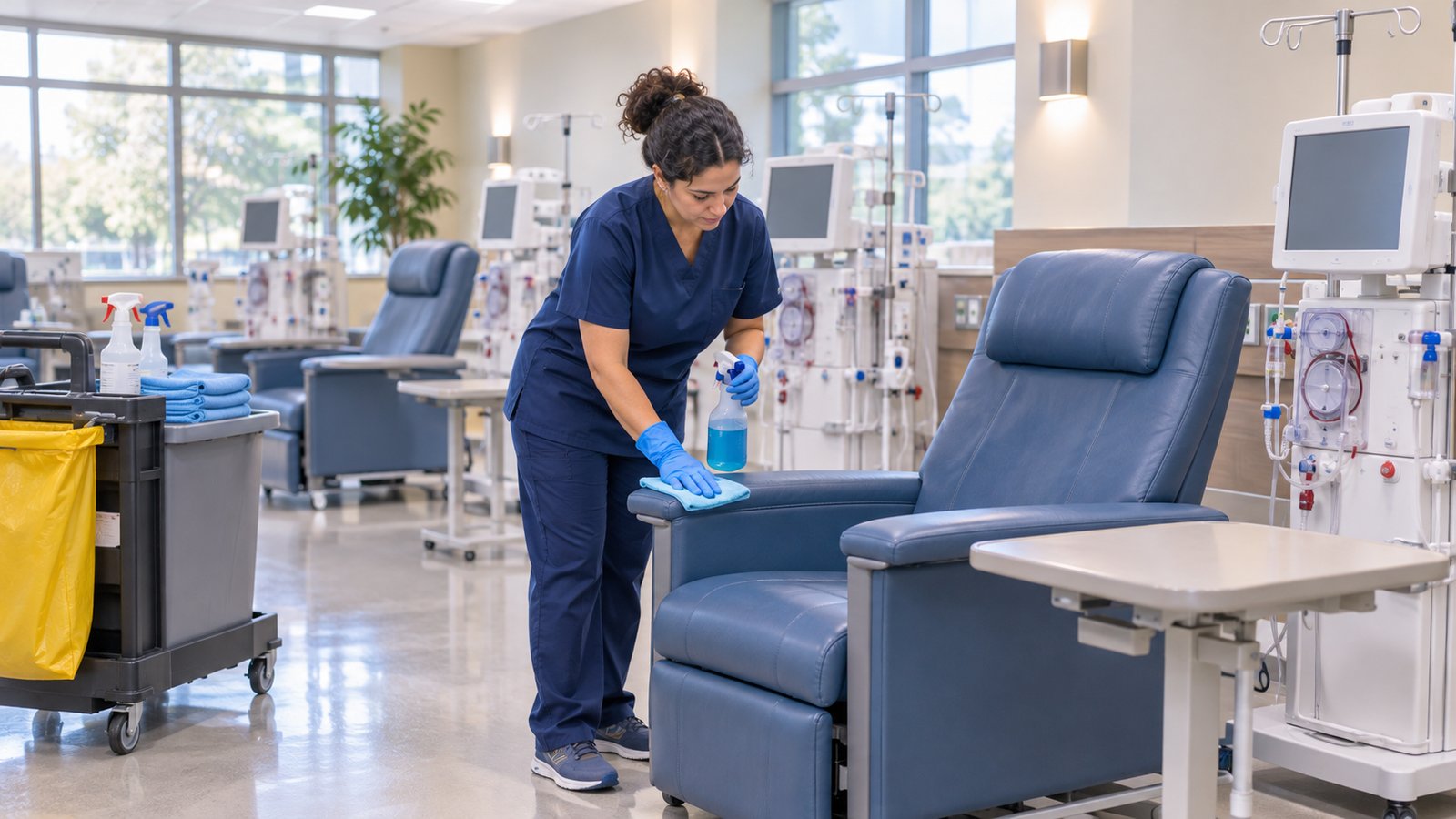
Outpatient dialysis cleaning services in New York City should fit the clinic's infection-prevention program, treatment schedule, equipment layout, and written access rules. A janitorial contractor is not a substitute for clinical staff or the facility's infection-control lead; the contract should define which environmental tasks the vendor performs and which clinical responsibilities remain with the provider. GreenPoint Maintenance Services can review a clinic's service areas, cleaning sequence, and verification process during a walkthrough. Call 347-332-9348 to discuss a scoped quote with the facility contact responsible for environmental services.
Define the boundary between janitorial and clinical duties
Map waiting rooms, reception, public restrooms, staff areas, corridors, treatment stations, isolation or special-precaution areas, storage, and waste holding locations. For each space, identify whether the task belongs to environmental services, nursing, biomedical engineering, or another trained role. The contractor's scope should not assign cleaners to disconnect dialysis equipment, handle bloodlines, manage clinical waste outside their training, or interpret patient-care protocols. The clinic's infection-prevention professional must approve the sequence and specify how a room is released for service.
A treatment floor can have many chairs and shared circulation within a relatively compact footprint, so square footage alone will not estimate workload. Record treatment shifts, turnover windows, number of stations, sink locations, floor material, access restrictions, and the clinic's patient-flow plan. Manhattan facilities near 125th Street, Brooklyn centers along Atlantic Avenue, and Queens clinics near Jackson Heights or Jamaica each have distinct delivery and transit access. GreenPoint Maintenance Services asks the clinic who escorts vendors, where supplies are staged, and how entry is coordinated without crossing patient pathways. Buyers can review healthcare-associated infections and environmental cleaning and medical office cleaning requirements and OSHA for related vendor questions.
Write separate protocols for treatment stations and common areas
Use a facility-approved task matrix that names the surface, responsible role, approved product, sequence, required contact time, and completion record. The dialysis provider should define which station surfaces are included in each turnover and which are cleaned by clinical staff. Janitorial tasks may include floors, waste containers, waiting-area furniture, accessible touchpoints, and public restrooms when those tasks are assigned and staff are trained. The protocol should distinguish routine cleaning from disinfection and identify when an area must remain closed until the product label contact time is met.
CDC guidance for dialysis settings emphasizes appropriate environmental cleaning and disinfection as part of infection prevention; the clinic's current policy and governing requirements must control the vendor's work. Do not copy an office checklist into a treatment area. For high-touch surfaces, specify the frequency and exact surface list rather than using a vague phrase such as 'sanitize everything.' GreenPoint can maintain a site-specific checklist, but the clinic's infection-control lead must approve its use. A sample plan for a 20-station clinic might separate between-patient tasks, shift-end detail, daily floors, and scheduled periodic work without implying that all are contractor duties.
Control product selection, labels, and staff exposure
The clinic should approve products for each surface and organism claim, and verify that the product label permits the intended use. The label's dilution, application, and wet contact time matter; a surface wiped dry too soon may not receive the labeled use. Maintain an approved-product register with current labels and safety data sheets. OSHA's Bloodborne Pathogens Standard applies where workers have occupational exposure to blood or other potentially infectious materials, and the employer must assess exposure and provide the required protections and training for covered employees.
OSHA Hazard Communication also calls for communicating chemical hazards and access to applicable safety information. The service plan should establish labeling, secondary-container rules, personal protective equipment, storage, spill reporting, and prohibition on mixing chemicals. GreenPoint uses Green Seal certified products where appropriate, but a green-certified cleaner is not automatically suitable for dialysis equipment or a regulated disinfection task. The clinic should approve each product and use case. Contact GreenPoint at 347-332-9348 to arrange a walkthrough and identify the infection-control lead, storage location, and approved-product review process.
Train for access, privacy, and high-risk-area escalation
Require documented orientation before independent entry into treatment areas. Training should include hand hygiene expectations, PPE for assigned tasks, clean-to-dirty workflow, color-coded tools, safe cart placement, handoff rules, restricted rooms, and how to report spills or sharps. A contractor should not assume that general janitorial orientation qualifies staff to respond to a blood spill or other exposure incident. The clinic should define the escalation path and make clinical support available when an unexpected condition is found.
HIPAA obligations depend on the parties' roles and access to protected health information; a janitorial company should follow the clinic's privacy and security policies and should not access records or screens unnecessarily. Contracts should address confidentiality, badges, keys, photography restrictions, incident reporting, and any required business-associate analysis by the clinic's counsel. GreenPoint can configure verification to avoid capturing patients, screens, or documents. These boundaries are especially important in compact NYC clinics where patient and staff circulation can overlap with service routes.
Build measurable quality assurance without overstating tests
Inspection criteria should distinguish visible cleanliness from disinfection-process compliance. A floor or waiting-room checklist can assess debris, soil, waste, and replenishment; a clinical protocol audit should verify the approved task sequence, product, wet contact time, and documented handoff. Agree on a sample size, inspection schedule, deficiency severity, correction timeline, and record-retention approach. CDC recommendations and clinic policies can inform the program, but the medical director or infection-prevention lead should approve clinical criteria.
GreenPoint's JaniTrack verification can capture timestamped, GPS-tagged photos and task records for appropriate non-patient-facing areas, with privacy safeguards. ATP testing can help evaluate organic residue trends on selected surfaces, but ATP is not a test for a specific organism and does not establish that a dialysis station is safe for treatment. Use it only as a supplementary process measure with a documented method and interpretation. GreenPoint reports a 98% client-retention rate, but a healthcare buyer should validate site-specific performance through references, sample logs, and a pilot inspection.
Assess CMS, state, OSHA, and clinic-specific requirements
Dialysis providers should have qualified compliance staff identify applicable CMS Conditions for Coverage, state health rules, infection-control requirements, and facility policies. The federal dialysis Conditions for Coverage include infection-control requirements for facilities, but the clinic must interpret the current regulation and survey guidance for its operations. OSHA obligations are separately determined by employer duties and employee exposure. A commercial cleaning vendor should not claim that its general certificate or standard checklist makes the clinic compliant.
In procurement, ask the vendor to provide training records, product documentation, insurance, workers' compensation, supervisory coverage, screening information where required, and a written escalation protocol. GreenPoint Maintenance Services Corp offers fixed pricing with no hourly billing and no hidden fees, but the clinic should define how patient-volume changes or additional treatment hours affect scope. GreenPoint is MBE/MWBE certified with NYS, NYC, and NYC DOE programs and registered in SAM.gov; confirm current credentials and relevance to the solicitation. For safe chemical documentation, see OSHA cleaning chemical safety and GHS/SDS and what ATP bioluminescence testing can and cannot show.
For a bid comparison, request a sample shift schedule showing how the proposed staff cover assigned rooms and relief breaks. Ask who supervises work after clinic leadership leaves, how missed tasks are escalated, and how the provider can reach a responsible manager overnight. Include response requirements for an unexpected spill, a locked treatment room, or a change in the next-day schedule. The clinic should verify that staffing assumptions fit its actual operating hours and access controls; a low monthly price is not useful if the vendor cannot meet the approved service window. Record these expectations in the contract and test the communication route during onboarding.
Plan the contract transition and review performance
A healthcare transition should be coordinated with the clinic's infection-prevention lead, environmental-services manager, and security contact. Before the first shift, approve staff orientation, access routes, badge procedures, product inventory, storage, escalation contacts, and the exact list of contractor duties. If there is a change in treatment hours or station count, the clinic should review staffing and schedule assumptions before work begins. GreenPoint can document the operating handoff, while all clinical protocols remain under the provider's authority.
Consider a limited pilot in defined non-clinical areas or a clearly bounded subset of assigned tasks. Agree on the sample size, inspection method, privacy restrictions, and corrective-action deadline before starting. Review observations with the facility lead and amend the written procedure only after approval. A pilot should test communication, reliable attendance, access control, and documentation, not replace the clinic's infection-control validation or regulatory review.
For a New York clinic, a quote should reflect shift length, treatment turnover, restricted access, staff training, consumables, and inspection coverage rather than a generic office rate. GreenPoint Maintenance Services can review those details with your designated facility contact. Call 347-332-9348 to arrange a walkthrough and request a written scope that distinguishes janitorial work from clinical and infection-prevention responsibilities.
Frequently asked questions about dialysis-clinic cleaning
Q: Can a janitorial contractor clean dialysis treatment stations? A: Only when the clinic's written policy assigns the task, the vendor's staff are trained for it, approved products and contact times are specified, and clinical leadership approves the handoff.
Q: Does ATP testing prove that a dialysis station is pathogen-free? A: No. ATP is a supplementary indicator of organic residue under a specific protocol; it does not identify pathogens or prove sterility.
Q: Who approves disinfectants for a dialysis clinic? A: The clinic's infection-prevention and clinical leadership should approve products and use cases based on applicable labels, surfaces, facility policies, and regulatory requirements.
Q: Does a cleaning vendor make the clinic HIPAA-compliant? A: No. The provider is responsible for assessing its own HIPAA obligations and vendor relationship. Contractors should follow privacy, confidentiality, access, and photography restrictions established by the clinic.
Q: What should a dialysis cleaning RFP request? A: Request task boundaries, staff training, product labels and SDS, exposure controls, access rules, inspection evidence, escalation times, insurance, staffing coverage, and a clear list of clinical tasks excluded from the contract.
Request a dialysis-clinic environmental-services walkthrough from GreenPoint Maintenance Services at 347-332-9348 or info@greenpointms.com. GreenPoint can document assigned tasks, approved-product controls, and JaniTrack verification while leaving clinical protocols under your facility's leadership; its reported client-retention rate is 98%.