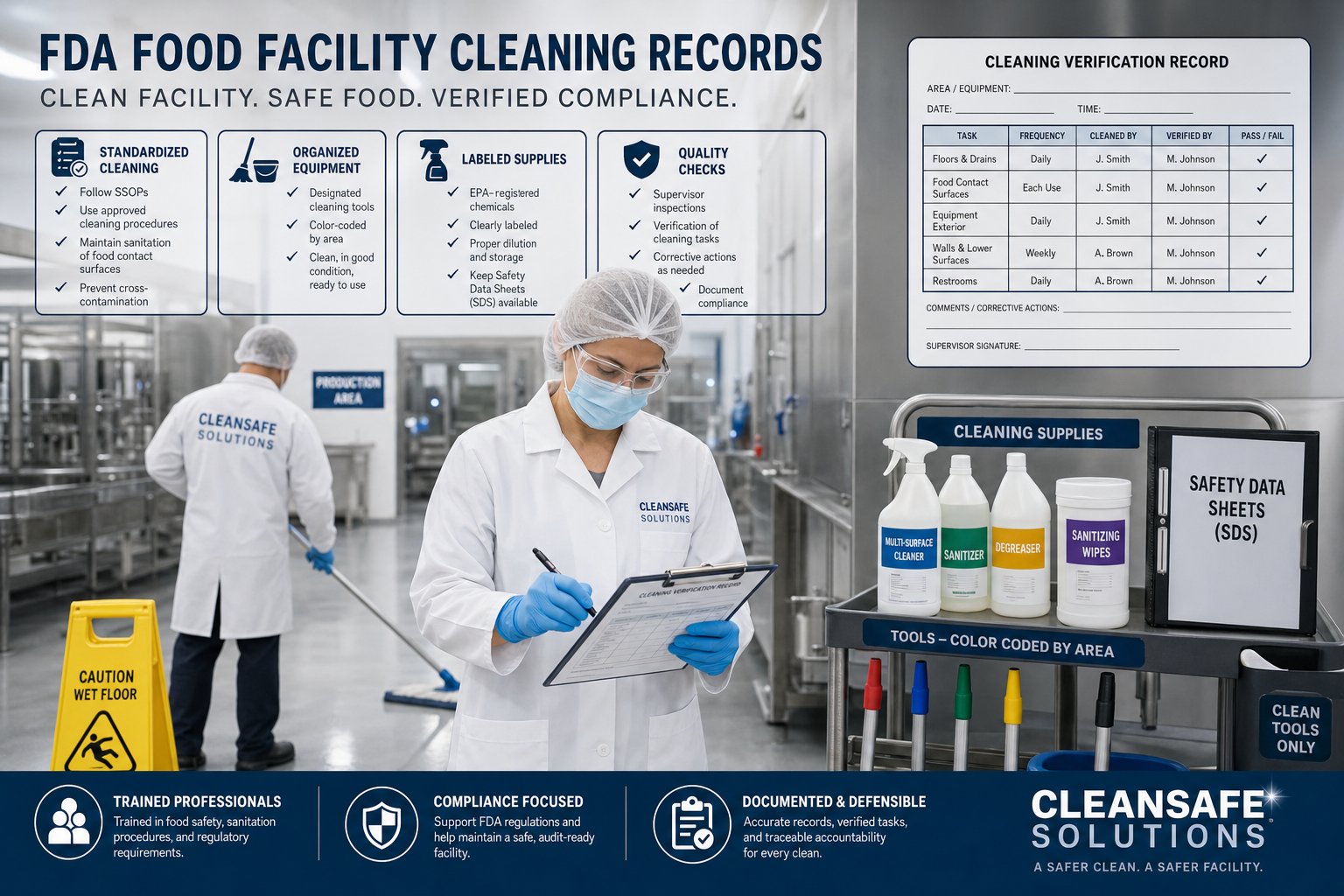
FDA food facility cleaning records should tell a clear story: what area was cleaned, by whom, with which approved method, when it was verified, and what happened when the result was not acceptable. In a food manufacturing, distribution, commissary, or commercial kitchen environment, a polished appearance is not enough. GreenPoint Maintenance Services helps facilities in NY, NJ, CT, PA, and FL build practical sanitation documentation that supports daily production and informed management review.
Define the Sanitation Scope by Zone
Start with a current map of production rooms, ingredient and packaging storage, employee welfare areas, restrooms, waste routes, dock doors, offices, and exterior transitions. Identify food-contact surfaces separately from non-food-contact surfaces and mark equipment that requires lockout, disassembly, or a specialized technician. A Queens commissary near LaGuardia has different access and delivery constraints from a Bronx bakery, a Long Island cold-storage site, or a Florida processor managing humidity.
The map should include square footage, shift times, product changeovers, allergen controls, drains, high ledges, condensation points, and traffic patterns. GreenPoint uses the walkthrough to establish a task matrix with daily, shift-based, weekly, monthly, and event-triggered work. This approach avoids a generic “clean the plant” line that cannot prove whether a critical area was actually addressed.
Build Records Around Five Questions
A defensible record answers five questions: What was the task? Where did it happen? When was it completed? Who performed and verified it? What was done if the result failed? Use controlled forms or a digital workflow with a unique facility, room, line, or asset identifier. Include start and finish times where they matter, but do not use time stamps as a substitute for describing the actual method.
GreenPoint Maintenance can use StockPoint for route completion, timestamped GPS-tagged photos, inspection findings, and corrective-action status. A live dashboard helps a sanitation manager see open exceptions before the next production window. See [cleaning audit checklist for facility managers](/blog/cleaning-audit-checklist-facility-managers/) for a complementary way to structure review questions.
Document Pre-Operational Inspections
Pre-operational checks should be tied to the release decision: ready, ready with monitored exception, or not ready. Inspect food-contact surfaces, guards, conveyors, floors, drains, walls, ceilings, tools, and hard-to-see ledges according to the facility’s hazard analysis and sanitation procedures. Record the observation, not merely a checkmark. “No visible soil on the slicer guard” is more useful than “pass.”
If a line fails, record the specific defect, the responsible person, the re-cleaning method, and the time of re-inspection. GreenPoint trains supervisors to keep corrective work separate from the original entry so the history is not erased. Where the facility uses ATP or other rapid hygiene monitoring, document the sampling site, method, result, limit, and response; treat the number as verification within the program, not as a universal safety guarantee.
Control Chemicals and Contact Time
Food facilities need a product list that matches the surface, soil, hazard, and operating conditions. List the approved cleaner or sanitizer, concentration or dilution, application method, minimum wet contact time, rinse requirement, PPE, storage location, and responsible role. Follow the product label and the facility’s food-safety plan. GreenPoint uses Green Seal certified products when they meet the job, but certification never removes the need to verify label directions and compatibility.
Keep secondary containers labeled and prevent cross-use between restroom, production, and food-contact tools. Color-coded microfiber and dedicated brushes can reduce cross-contamination risk when the system is enforced. OSHA Hazard Communication requirements still apply to the cleaning crew, and training should cover SDS access, mixing prohibitions, splash response, and when to stop work and call a supervisor.
Record Allergen and Changeover Controls
If the facility handles allergens, the cleaning record should connect the changeover schedule to the validated cleaning procedure. Identify equipment that is disassembled, parts that are inspected, tools that are dedicated, and the person who verifies completion. Do not state that a product is “allergen-free” based solely on visual appearance. The food-safety team owns the validation criteria and the release decision; the cleaning contractor performs the assigned steps and records evidence.
GreenPoint can stage crews for overnight changeovers, weekend shutdowns, or phased work that protects production. A fixed scope clarifies whether the quote includes equipment access, elevated work, floor drains, walls, ceilings, dock areas, and post-cleaning verification. Call 844-814-0810 to schedule a walkthrough so those assumptions are documented before the first sanitation shift.
Manage Waste, Drains, and Hard-to-Clean Areas
Records often fail around the edges of production: drains, waste staging, forklift paths, dock thresholds, under-equipment spaces, and condensate lines. Add each area to a route with a frequency, tool, PPE, disposal method, and verification point. Note whether a drain task requires a special sequence to avoid aerosolizing soil or moving contamination toward a food-contact zone. Escalate pest evidence, standing water, damaged seals, and recurring condensation instead of hiding them under a pass/fail box.
Facilities near the Holland Tunnel, JFK, Newark, or major rail and highway corridors can see heavy dock traffic and soil load. In winter, New York, New Jersey, Connecticut, and Pennsylvania sites need a plan for salt and moisture at entries without bringing exterior debris into production. Florida sites need faster response to humidity and storm-related water intrusion. GreenPoint’s supervisor reports conditions outside the janitorial scope to the designated facility owner.
Train and Verify the Sanitation Team
Training should cover the site map, hygiene rules, chemical labels, PPE, equipment, food-contact versus non-food-contact tools, allergen changeovers, drains, waste, restricted areas, and incident escalation. Record the employee, trainer, date, language, topics, and demonstrated competency. Re-train when an SOP changes, a product changes, an inspection trend declines, or a corrective action shows that the method was misunderstood.
GreenPoint Maintenance uses supervisor inspections to coach in the actual production environment. A missed contact time may call for a timer or route redesign; repeated residue may indicate incorrect dilution or a surface issue. GreenPoint’s 98% client retention reflects this evidence-based improvement loop. When clients need a proof package, StockPoint records and photo evidence can be combined with the facility’s own sanitation forms.
Review Trends and Corrective Actions
A weekly review should summarize completed routes, failed pre-operational checks, recurring areas, chemical incidents, equipment problems, and corrective-action aging. Track closure time in hours or shifts, not just “closed.” A monthly review can compare misses by line, shift, room, or contractor. Use the trend to adjust staffing and methods rather than simply adding more inspections.
GreenPoint provides fixed pricing with no hourly billing and no hidden fees, so the recurring scope can be separated from special projects such as high-level cleaning or post-construction work. MBE/MWBE certification in New York programs and SAM.gov registration may also help procurement teams organize vendor documentation. Ask GreenPoint at 844-814-0810 for a quote tied to the actual zone map and production calendar.
Coordinate with FDA and Local Requirements
FDA-related sanitation documentation should fit the facility’s food-safety system, hazard analysis, preventive controls, and record-retention policy. The exact responsibility varies by operation and legal structure, so the facility’s qualified food-safety lead should approve the program and determine what is required. Cleaning records should support, not replace, that governance. Include local health-department expectations where applicable, especially for commissaries, schools, retail food sites, and institutional kitchens.
GreenPoint works within the client’s approved procedures and escalation chain. For a New York City food operation, that may include coordination with local inspection expectations and DOE or institutional requirements. In New Jersey, Connecticut, Pennsylvania, and Florida, the owner should identify the relevant state and county authorities. Schedule a walkthrough at 844-814-0810 or info@greenpointms.com to translate those requirements into routes and records.
The best records are useful to operators, not just auditors. A sanitation manager should be able to see whether a failed check is isolated or recurring, whether a particular shift needs coaching, and whether a drain or piece of equipment is generating repeat work. Pair the record review with [color-coded microfiber systems](/blog/color-coded-microfiber-systems-guide/) and a visual tool map so employees know which equipment belongs in each zone. GreenPoint recommends testing a form in one room before rolling it across a full plant. Remove fields that nobody uses, but keep the information needed to reconstruct a decision. When the record is concise, contemporaneous, and connected to a specific location, it can support production planning as well as food-safety oversight.
Keep retention and access rules visible to the sanitation team. A record that is complete but stored where the next supervisor cannot find it is not operationally strong. Identify the primary system, backup location, review owner, and process for correcting an entry without deleting the original history. GreenPoint can mirror the client’s required format while using StockPoint for field evidence, then provide a clear handoff at the end of each service period.
Where production runs across multiple shifts, design the handoff deliberately. The departing lead should state which rooms are complete, which line is awaiting verification, which product or concentration is in use, and whether a maintenance issue affects release. GreenPoint can provide a shift-facing summary that complements the formal sanitation record. A consistent handoff reduces duplicate cleaning, missed changeovers, and the temptation to sign a task that the next team assumes someone else completed.
FAQ: FDA Food Facility Cleaning Records
Q: What is the most important information on a sanitation record? A: Identify the area and task, date and time, person performing the work, verification, product or method where relevant, and the corrective action when the result is unacceptable.
Q: Are photos required for every cleaning task? A: Not always. The facility’s risk-based program should decide where photos, checklists, ATP, environmental monitoring, or supervisor inspection add useful evidence. StockPoint can support targeted photo and location records without creating an unmanageable archive.
Q: Who approves the sanitation procedure? A: The facility’s food-safety leadership and qualified advisors should approve the procedure and its validation or verification approach. GreenPoint can perform the contracted tasks and maintain records to the approved scope.
Q: How should failed checks be corrected? A: Describe the defect, isolate or hold the affected area when required by the facility plan, re-clean with the approved method, re-inspect, document the result, and escalate recurring causes.
Q: How can a food facility obtain a cleaning quote? A: Call 844-814-0810 to schedule a walkthrough. Provide the facility map, production windows, square footage, changeover schedule, access rules, and required verification so the quote is comparable.
Call GreenPoint Maintenance Services at 844-814-0810 or email info@greenpointms.com for a food-facility sanitation walkthrough. GreenPoint provides fixed pricing, StockPoint verification, Green Seal certified products, and documented cleaning programs across NY, NJ, CT, PA, and FL.