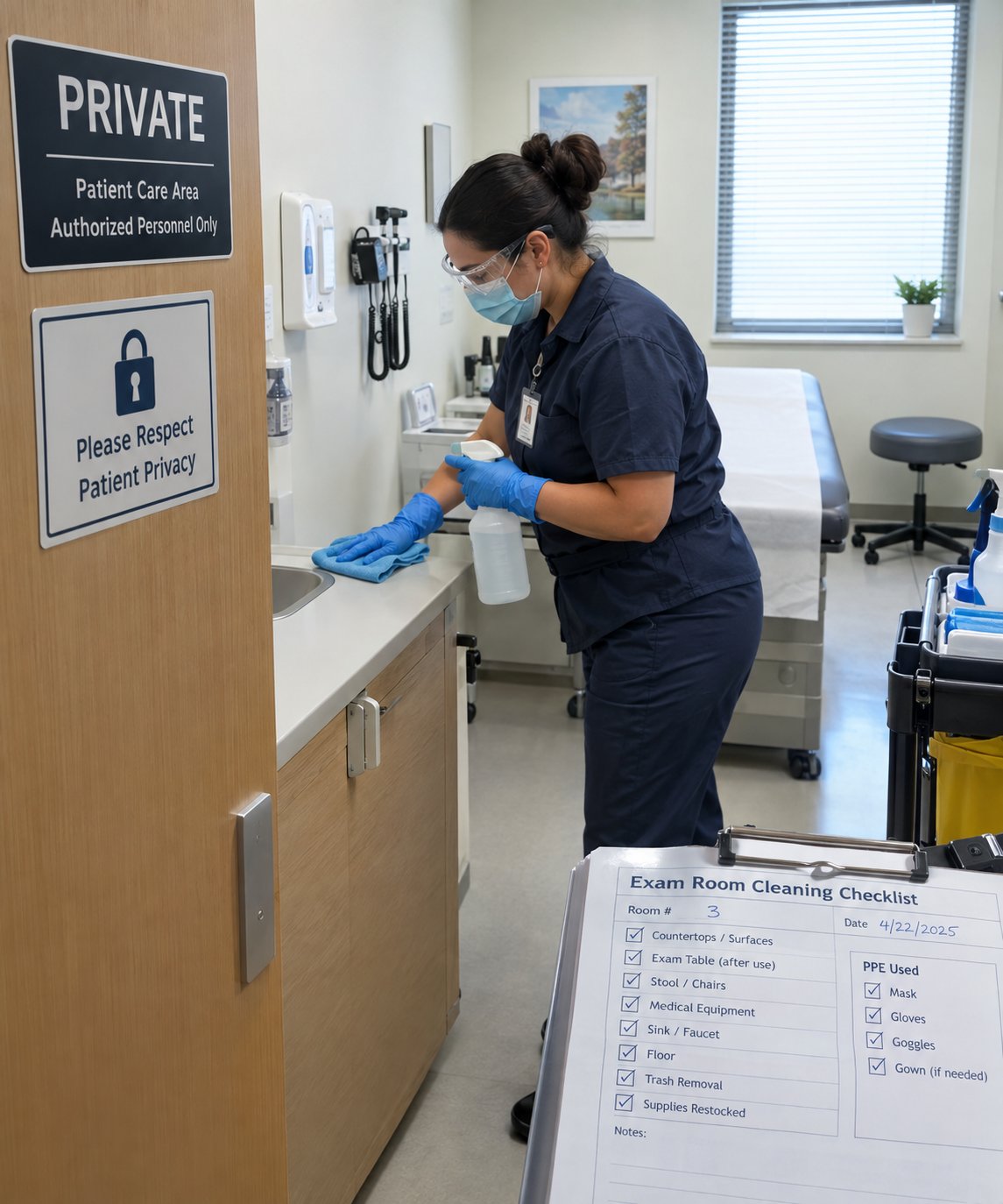
A medical office needs a cleaning partner that understands both infection-control routines and privacy boundaries. The cleaner may enter exam rooms, treatment areas, reception, labs, medication-adjacent spaces, and records-adjacent corridors, yet should not read, photograph, copy, or discuss patient information. HIPAA applies to covered entities and business associates in specific ways; a janitorial company should not casually promise compliance without understanding the office's privacy program. GreenPoint Maintenance Services provides controlled healthcare cleaning for clinics, dental practices, outpatient centers, and specialty offices in Manhattan, Brooklyn, Queens, the Bronx, Staten Island, Westchester, Long Island, New Jersey, Connecticut, Pennsylvania, and Florida. GreenPoint combines access protocols, color-coded tools, ATP testing where appropriate, and StockPoint proof while leaving legal interpretation to the practice's privacy officer.
What HIPAA-aware cleaning actually means
HIPAA analysis depends on what the vendor does, not just the address where it works. HHS says routine janitorial services are generally not business associates when the service does not involve use or disclosure of protected health information and any exposure is incidental; the answer can differ if a vendor is hired to handle or destroy records. See [HHS guidance on janitorial services and business associate agreements](https://www.hhs.gov/hipaa/for-professionals/faq/is-a-business-associate-contract-required-for-inadvertent-contact-with-phi/index.html). GreenPoint follows the practice's access rules, while the covered entity's privacy officer or counsel decides its legal classification.
HIPAA-aware service starts with minimum necessary access and behavior. The crew should enter only the rooms named in the scope, avoid opening drawers or cabinets, never handle charts or devices unless directed, and report exposed paperwork or screens to the office contact. A Business Associate Agreement may be appropriate depending on the services and whether the vendor handles protected health information; the practice's counsel or privacy officer should make that determination. GreenPoint can follow the office's policy and document the operational boundaries.
The service agreement should name access windows, escort requirements, alarm procedures, badge control, prohibited areas, lost-and-found handling, photography rules, incident escalation, and who can approve a scope change. GreenPoint trains cleaners to stop when an item is in the way rather than move confidential material. A practice manager can schedule a privacy-and-cleaning walkthrough at 844-814-0810.
Zone-based cleaning for exam and treatment rooms
Build the room sequence around patient flow and the clinic's own infection-prevention protocol. A room that is still occupied, awaiting clinical turnover, or holding a specimen should be marked unavailable to the cleaning crew. The practice should identify who confirms that clinical tasks are complete, which surfaces may be disinfected, and how a missed room returns to the schedule. GreenPoint records an occupied-room exception and a reattempt rather than silently checking off a room it could not enter.
The route should separate low-risk administrative areas from treatment spaces and higher-risk tasks. Exam rooms need high-touch disinfection of approved surfaces, waste removal, floor care, and restocking according to the clinic's protocol. Waiting rooms need attention to chairs, check-in surfaces, toys if present, door hardware, and restrooms. Lab or procedure areas may require a clinical protocol and product contact time beyond ordinary office cleaning. GreenPoint builds the room list with the practice instead of applying a one-size-fits-all office package.
The CDC emphasizes cleaning before disinfection because soil can reduce disinfectant performance. GreenPoint follows the product label, uses dedicated microfiber by zone, respects contact time, and reports a blocked or occupied room as an exception. Practices can also review [medical office cleaning requirements and OSHA](/blog/medical-office-cleaning-requirements-osha/) when building a broader environmental-services plan.
Privacy controls for keys, badges, and information
A privacy-aware route can be tested with realistic situations: a chart left on a chair, a monitor that wakes when the door opens, a badge found near reception, or a printer tray with patient labels. The expected action should be consistent: do not inspect, copy, or move records; secure the area only if authorized; and contact the named practice lead. GreenPoint includes these scenarios in site orientation and limits StockPoint access to approved users.
The safest cleaner is not the person with the broadest access. A medical office should issue only the credentials needed for the route, revoke them promptly, and maintain a key or badge log. Cleaning carts should not carry loose patient documents, and staff should not use personal phones to photograph work unless the policy explicitly authorizes a controlled system. GreenPoint uses StockPoint for location and service evidence while following the office's photography and data-retention instructions.
Privacy incidents include more than reading a chart. A cleaner could see a whiteboard, screen, label, discarded prescription, or voicemail. GreenPoint's training tells staff to look away, close or cover information only when authorized, and report an exposure to the designated office contact. Managers can call 844-814-0810 to review an access map before the first night service.
Documentation: what the practice should receive
Agree on the minimum information needed to prove work. The vendor usually needs a room identifier, date, time, task status, product, exception, and correction; patient names, diagnoses, appointment details, and screen images do not belong in an ordinary service record. Before enabling photos, the practice should approve a no-PHI zone, retention period, access list, export method, and deletion procedure. GreenPoint can use non-photo confirmation for restricted rooms and can demonstrate a sample dashboard using fictionalized data.
A useful record includes date, time, rooms attempted, tasks completed, product or protocol reference, exceptions, supervisor review, and any corrective action. It should not include unnecessary patient names or medical details. GreenPoint's StockPoint dashboard can show timestamped, GPS-tagged photos of approved areas, ATP readings when that testing is in scope, and a live completion status. The practice controls which users can see records and how long they are retained.
ATP testing is a cleanliness indicator, not a diagnosis and not proof that a surface is sterile. A practice should establish its own thresholds and sampling plan with the infection-prevention professional. GreenPoint uses ATP results to identify process drift, retrain a route, and verify improvement. Its 98% client retention reflects consistent communication, not an attempt to replace clinical oversight.
Chemicals, PPE, and regulated waste boundaries
A medical office cleaning contract must state who supplies disinfectants, who manages sharps, who handles regulated medical waste, and which materials are excluded. A janitorial employee should never pick up a loose needle or enter a spill involving blood or other potentially infectious material without the training, PPE, and procedure required by the employer and facility. GreenPoint follows the office's exposure-control plan and escalates excluded work to the designated clinical or regulated-waste vendor.
The product list should match the surfaces and organisms of concern, and the team should know dilution, contact time, ventilation, and disposal requirements. GreenPoint offers Green Seal products for compatible routine tasks but uses the clinical product and label required for a specific disinfection claim. A manager can request the scope at 844-814-0810 and avoid vague promises such as hospital-grade without a product and procedure.
Serving healthcare practices across local markets
A small dental office near Union Square may need a different access plan from a multi-specialty clinic near Jamaica Hospital, a surgery center in Hackensack, or a pediatric practice in Stamford. Rush-hour transit, patient flow, after-hours alarms, shared elevators, and landlord restrictions all affect the route. GreenPoint works across the five boroughs, Westchester, Long Island, New Jersey, Connecticut, Pennsylvania, and Florida and records the actual local constraints.
For a procurement comparison, read [questions to ask a commercial cleaning company](/blog/questions-to-ask-commercial-cleaning-company/) and ask each bidder to explain privacy training, supervision, incident response, and documentation. GreenPoint Maintenance Services is MBE/MWBE certified in New York, SAM.gov registered, and offers fixed pricing with no hidden fees. Call 844-814-0810 to schedule a walkthrough with the office manager.
A vendor selection checklist for practice managers
A 30-day pilot should test both routine work and exceptions: a room that stays occupied, a badge that fails, a product that is unavailable, and a patient-facing spill that requires escalation. Review whether the vendor followed the approved path, notified the right contact, and closed the record without adding unnecessary patient information. GreenPoint offers a site walkthrough at 844-814-0810 and can map those scenarios before a fixed-price proposal is issued.
Ask whether the vendor has healthcare references, documented access training, background-screening practices, product and SDS controls, an incident-escalation process, supervisor coverage, insurance, and an approach to ATP or visual verification. Ask for a sample record with fictionalized information. Confirm who owns the data, who can access the dashboard, and how a privacy incident is reported. GreenPoint answers these questions in writing before mobilization.
Pilot the vendor for one wing or one defined route, then review missed rooms, occupied-room exceptions, restocking handoffs, patient complaints, and verification results after 30 days. A clear correction loop is more valuable than a perfect launch presentation. GreenPoint's StockPoint system and 98% retention provide measurable proof, while the practice remains responsible for its privacy and infection-prevention program.
Frequently Asked Questions
Q: Does HIPAA require every cleaning company to sign a Business Associate Agreement?
Not necessarily. Whether a BAA is required depends on the vendor's functions and whether it creates, receives, maintains, or transmits protected health information for the covered entity. The practice's privacy officer or counsel should decide. GreenPoint can follow the office's access and documentation rules and discuss the operational scope at 844-814-0810.
Q: Can a cleaner photograph an exam room for quality verification?
Only when the medical office authorizes the method and the image avoids protected health information, screens, labels, and patient identifiers. GreenPoint uses StockPoint within the approved photography policy and can use non-photo verification when the practice restricts images.
Q: Does ATP testing prove that a medical office is infection-free?
No. ATP is an indicator of residual organic material and process cleanliness, not a sterility test or medical diagnosis. GreenPoint uses ATP testing, when requested, as one part of a visual, procedural, and supervisory quality program.
Q: Who handles sharps and biohazard spills?
The contract should name the trained party and the response procedure. Routine janitorial work should not silently expand to include regulated medical waste or exposure response. GreenPoint follows the practice's exposure-control plan and escalates excluded materials to the authorized clinical or waste vendor.
Call GreenPoint Maintenance Services at 844-814-0810 for a HIPAA-aware medical-office cleaning walkthrough. GreenPoint provides controlled access, StockPoint documentation, ATP testing when scoped, Green Seal product options, and a 98% client retention record without replacing the practice's privacy officer or infection-prevention professional.