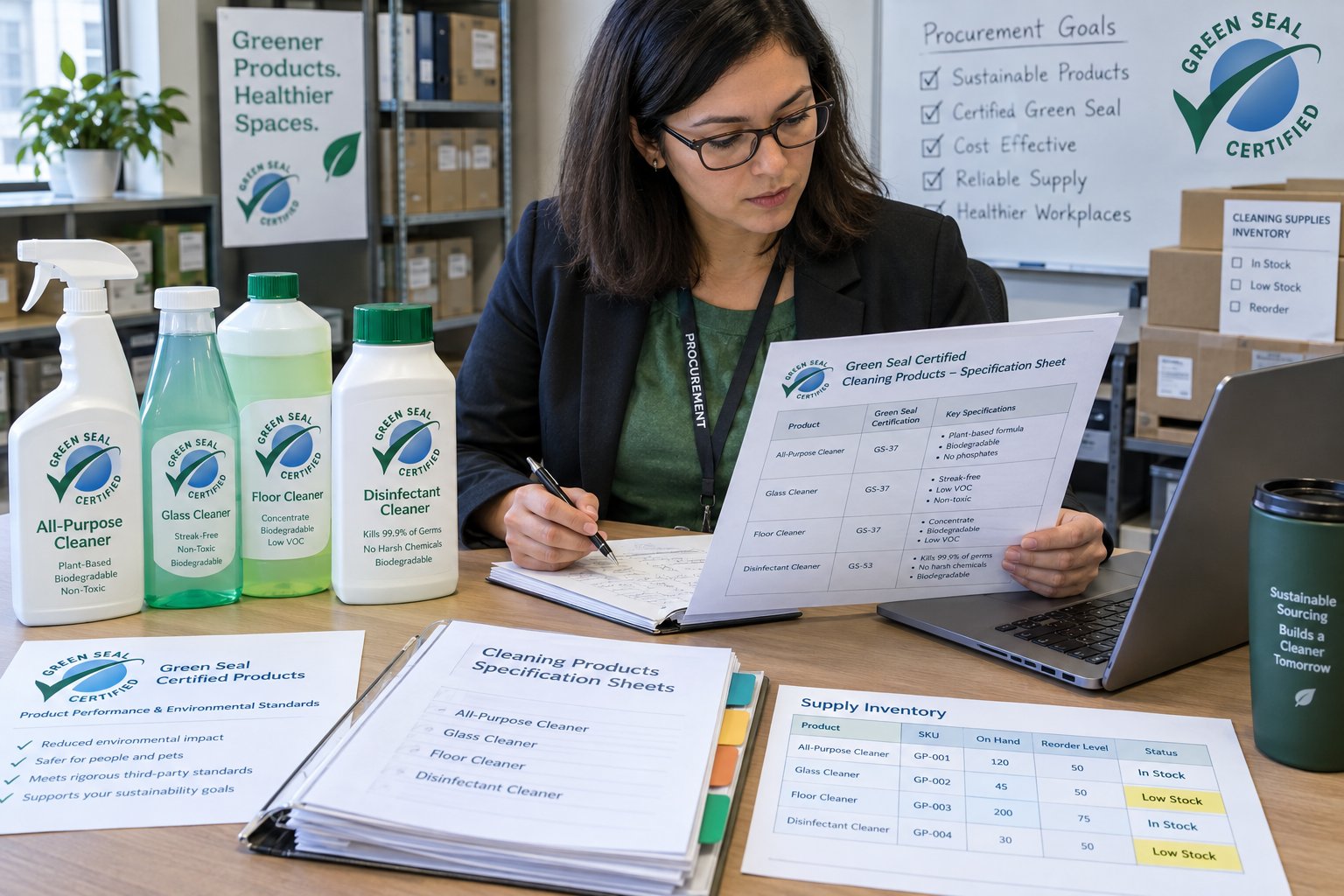
A green label is useful only when the purchasing team can verify the claim, match the product to the task, and confirm that the cleaning crew uses it correctly. Procurement teams in offices, schools, healthcare sites, public buildings, and multifamily properties often receive proposals that say eco-friendly without naming a standard, certificate, dilution, or performance requirement. GreenPoint Maintenance Services helps facility managers separate verified Green Seal or EPA Safer Choice products from vague marketing language. GreenPoint serves Manhattan, Brooklyn, Queens, the Bronx, Staten Island, Westchester, Long Island, New Jersey, Connecticut, Pennsylvania, and Florida, using a product register, supervisor inspections, and StockPoint evidence to connect purchasing decisions with real field practice.
What a Green Seal claim should include
Check the standard's scope before reading the marketing summary. Green Seal's [GS-37 standard page](https://greenseal.org/standards/gs-37-cleaning-products-for-industrial-and-institutional-use/) covers specified industrial and institutional cleaners such as general-purpose, glass, bathroom, and carpet products, but does not make every cleaning chemical a certified product. Record the exact SKU and standard edition, confirm that the product remains listed, and retain the buyer's approval date. GreenPoint provides a product register that separates certified routine cleaners from other task-specific chemistries.
A credible procurement record names the product, manufacturer, certification or qualification, intended use, concentration, packaging, and current documentation. Green Seal certification is product- and standard-specific; the phrase green or environmentally friendly is not a certification. A bidder should be able to provide a product page, technical data, SDS, dilution instructions, and a statement of where that product is used. GreenPoint Maintenance Services includes the actual product list in the service scope so a property manager does not have to infer it from a brochure.
The buyer should verify whether a product is certified for the current formulation and whether the claim applies to the concentrate, dispenser, paper item, or entire program. If a proposal includes both Green Seal and EPA Safer Choice products, the vendor should identify which standard applies to each item. GreenPoint can review the register during a walkthrough at 844-814-0810 and flag substitutions that need approval.
Match the product to the surface and risk
Build the selection matrix by task, substrate, and claim: a neutral floor cleaner, a glass product, a degreaser, and an EPA-registered disinfectant are not interchangeable simply because a buyer prefers one supplier. Green Seal certification does not itself establish disinfectant efficacy or authorize a food-contact sanitation claim. GreenPoint checks the manufacturer's label and the facility's infection-control or food-service protocol before it assigns a product to a route.
Sustainability does not make a product correct for every surface. A neutral cleaner may be appropriate for coated floors but ineffective against heavy kitchen grease. A disinfectant must have the required EPA registration and contact time for its intended claim. Glass, stone, stainless steel, carpet, resilient flooring, and painted walls each have different compatibility needs. GreenPoint selects the least hazardous effective method, follows the label, and avoids substituting a green claim for a performance test.
A school near Flushing, a medical office near Columbus Circle, and a warehouse in Elizabeth may need different product families and dilution controls. GreenPoint uses color-coded microfiber, measured dispensing, and route-specific training to prevent overuse. Facility managers can connect product choices to indoor-air goals in [the guide to green cleaning for commercial buildings](/blog/green-cleaning-commercial-buildings-guide/) and request a fixed-price quote at 844-814-0810.
Total cost: price per container is not the metric
Add realistic utilization to the comparison. If a dispenser produces 40 ready-to-use gallons from a $40 concentrate, the chemical component is $1 per gallon before labor, shipping, and dispenser costs; a $25 product yielding 10 gallons is $2.50 per gallon before those same costs. Then check actual dilution with a measured test and compare rework, residue, packaging, and stockout rates over a defined period. GreenPoint can report a site pilot by task rather than implying that certification alone lowers total cost.
Procurement should compare cost per ready-to-use gallon or per completed task, not only the price of a concentrate bottle. A $40 container that makes 40 gallons costs $1 per ready-to-use gallon; a $25 container that makes 10 gallons costs $2.50. Add dispenser cost, shipping, storage, training, waste, labor, rework, and surface damage. GreenPoint's fixed pricing helps a manager compare the total service outcome rather than chasing a low chemical line item.
Measured dilution can reduce waste and stabilize performance. A crew using twice the recommended concentrate may increase cost, residue, indoor odor, and slip risk without improving the clean. GreenPoint supervisors audit dispensing and track exceptions in StockPoint. GreenPoint Maintenance Services can model a small pilot for one floor, then show consumption and quality results before a portfolio rollout.
Certification, documentation, and vendor claims
The procurement record should preserve the evidence a future buyer can reproduce: manufacturer, full product name, SKU, certification listing, Safety Data Sheet, label, approved application, and date checked. Require written approval before a vendor substitutes another product and decide whether an expired certificate, revised formulation, or supply shortage triggers a review. GreenPoint attaches the approval and change record to its product list so the building team can compare a replacement against the original specification.
Ask the vendor to provide current evidence for every certification claim and to disclose products that are merely low-odor, biodegradable, recycled-content, or fragrance-free. Those attributes may be useful but are not interchangeable with a Green Seal certification. Procurement should also ask whether the certificate covers the exact SKU and whether the supplier can maintain availability. GreenPoint keeps a substitution process so a backordered product is not silently replaced with an unapproved chemical.
For public agencies and schools, the bid specification should state acceptable standards, documentation format, prohibited ingredients if applicable, packaging expectations, and approval for substitutions. New York buyers may also have MBE/MWBE goals, while school and healthcare buyers may have additional indoor-air or infection-control requirements. GreenPoint is MBE/MWBE certified in New York and SAM.gov registered, and provides product records with a 844-814-0810 walkthrough.
Training crews to make procurement real
A certified product on a shelf does not create a green program if the crew cannot identify it, dilute it, or use it safely. Onboarding should cover labels, SDS access, dilution, dwell time, microfiber laundering, ventilation, PPE, spill response, and where each product belongs. GreenPoint uses demonstrations and route audits, then attaches corrective actions to a StockPoint record. The supervisor verifies the actual cart instead of assuming the purchased product reached the intended floor.
Green cleaning also depends on equipment. HEPA filtration, microfiber systems, low-moisture carpet methods, and measured dispensing can reduce chemical and water use when matched to the site. The [color-coded microfiber systems guide](/blog/color-coded-microfiber-systems-guide/) explains how a simple color map supports separation. GreenPoint's approach uses the smallest effective input while protecting the service standard and the finish.
Local procurement and portfolio implementation
A property group with a Midtown office, a Brooklyn school, a Bronx community center, and a Long Island warehouse should centralize standards but permit site addenda. Storage rooms may differ, freight access may change, and local landlord rules can affect deliveries. In New Jersey, Connecticut, Pennsylvania, or Florida, the same product list still needs local emergency contacts, training language, and waste procedures. GreenPoint maintains a central register and maps the exceptions.
Start with a 30- to 60-day pilot on a known floor or facility. Measure ready-to-use product consumption, complaint volume, ATP or visual results when scoped, supply stockouts, worker feedback, and total labor. GreenPoint's 98% client retention reflects an operating loop that learns from the field. Call 844-814-0810 to schedule a pilot walkthrough with the facility manager and procurement lead.
How to audit an approved green program
Use a quarterly sample to trace a product from the approved list to the purchase order, storage shelf, dispenser, and completed route. A mismatch is a signal to check receiving, labeling, dispensing, and training before attributing it to an individual worker. GreenPoint's StockPoint records can connect a field observation to a corrective action, while procurement verifies supplier status and finance checks the invoice. That separation makes the audit useful for both sustainability reporting and daily operations.
An audit should compare the approved list to purchasing records, storage cabinets, carts, dilution stations, SDS files, and completed work. Check a sample of high-touch surfaces, floors, restrooms, and waste rooms. Review whether the product label matches the task and whether the crew used the specified contact time. GreenPoint uses StockPoint photos and supervisor observations to document the difference between an approved plan and field reality.
Report nonconformities as a process issue with an owner and due date. A missing product may come from a supply-chain substitution, a training gap, or an inaccurate scope. GreenPoint reports each cause and correction instead of simply replacing a bottle. Procurement teams can request a sample dashboard at 844-814-0810 and use it in a quarterly supplier review.
Green claims and tenant communication
Building owners should communicate precise claims: named certified products, reduced packaging, measured dilution, microfiber reuse, or a documented indoor-air approach. Avoid saying that a building is chemical-free, toxin-free, or universally safe. GreenPoint can provide a product summary for tenant and school communications that explains what is used, where, and why. That specificity helps occupants understand the program without overpromising.
The same discipline applies to sustainability reports. State the measurement period, baseline, unit, and data source for reductions in ready-to-use volume, packaging, or waste. GreenPoint's StockPoint records support service verification, while procurement owns the purchasing data and the building team owns broader environmental claims. A clear division of responsibility protects credibility.
Selecting a green cleaning partner
Ask bidders for certifications, current product documentation, substitution rules, training records, dilution controls, quality verification, insurance, staffing, and references. Ask how they handle a product that is unavailable or a surface that cannot use the preferred chemical. Ask whether the quote is fixed and whether supplies, supervision, and corrective work are included. GreenPoint provides fixed pricing with no hidden fees and no hourly billing surprises.
GreenPoint Maintenance Services is MBE/MWBE certified in New York, SAM.gov registered, uses Green Seal products where fit, and serves a broad tri-state and Florida footprint. Its 98% client retention and StockPoint evidence provide useful proof points, but the best decision still comes from a site-specific pilot. Schedule that walkthrough by calling 844-814-0810.
Frequently Asked Questions
Q: Are all eco-friendly cleaning products Green Seal certified?
No. Eco-friendly, biodegradable, low-odor, and recycled-content are descriptive claims, not interchangeable certifications. Procurement should verify the exact product and current certification or qualification. GreenPoint provides a named product register and can review it with a buyer at 844-814-0810.
Q: Does Green Seal certification mean a product disinfects?
No. Certification and disinfection claims are separate questions. A disinfectant must be registered and used according to its label for the intended organism and surface. GreenPoint selects products by task and follows contact-time instructions.
Q: How should a facility calculate green-cleaning cost?
Use cost per ready-to-use gallon or completed task, then add labor, dispensing, storage, shipping, rework, equipment, and waste. GreenPoint can build a fixed-price pilot and show consumption and verification results rather than comparing bottle prices alone.
Q: What happens when an approved product is unavailable?
The vendor should follow a written substitution process that checks certification, performance, surface compatibility, SDS, price, and buyer approval. GreenPoint records substitutions and trains the crew before deployment; it does not silently swap an unapproved chemical.
To verify Green Seal product claims, map the right chemistry to each surface, and connect procurement to StockPoint proof, call GreenPoint Maintenance Services at 844-814-0810. GreenPoint offers fixed pricing, MBE/MWBE credentials, Green Seal options, and a 98% client retention record.