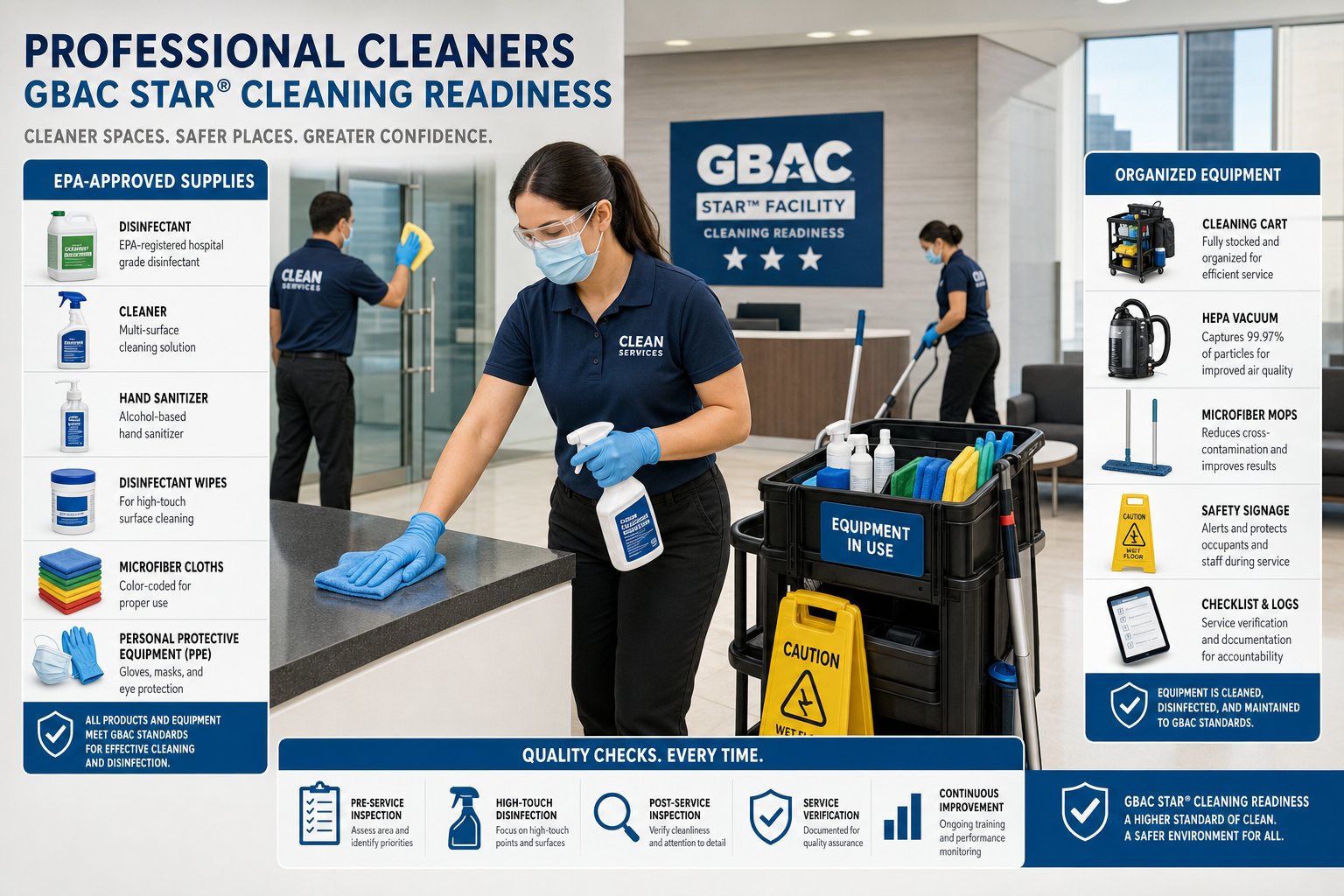
GBAC STAR cleaning readiness is less about a binder on a shelf and more about proving that a facility can execute a consistent infection-prevention and response program. A defensible system connects risk assessment, standard operating procedures, training, chemical controls, inspections, and corrective actions. GreenPoint Maintenance Services builds that operating rhythm for offices, schools, healthcare-adjacent spaces, warehouses, and public-facing properties throughout NY, NJ, CT, PA, and FL.
Start with a Facility Risk Profile
Before drafting procedures, map how people, materials, and contaminants move through the building. Note entrances, elevators, restrooms, food service, fitness areas, shared equipment, medical or childcare functions, loading docks, trash routes, and spaces that close overnight. A Midtown tower near 42nd Street has different crowding and transit patterns from a Bronx community facility near Yankee Stadium, a Newark office, or a South Florida property that manages humidity and storm disruptions.
The profile should rank zones by touch frequency, occupant vulnerability, soil load, and consequence of service failure. Record square footage, hours, occupancy peaks, service windows, restricted areas, and the person who can authorize a response. GreenPoint Maintenance uses a walkthrough to turn that information into a site-specific task map instead of recycling a generic checklist.
Organize the Readiness Binder and Digital Record
A readiness file should make it easy to find the current version of each control. Include the facility risk assessment, approved product list, Safety Data Sheets, equipment logs, training roster, inspection forms, incident-response procedure, waste and sharps escalation, vendor contacts, and corrective-action log. Each document needs an owner, revision date, review interval, and storage location.
Digital records reduce version confusion when supervisors work across multiple boroughs or states. StockPoint can support a live dashboard with route completion, timestamped GPS-tagged photos, inspection findings, and follow-up status. GreenPoint also recommends a simple naming convention such as site-zone-task-date, so a manager can locate a failed restroom inspection without searching through hundreds of unlabeled attachments. See [quality assurance commercial cleaning programs](/blog/quality-assurance-commercial-cleaning-program/) for a related control structure.
Write SOPs That a New Team Member Can Follow
A standard operating procedure should state the purpose, scope, supplies, PPE, preparation, sequence, dwell time, disposal method, verification step, and escalation path. “Disinfect touch points” is not enough. Name the surface groups, the product, the required wet contact time, the tools, and what happens when a surface cannot be safely treated. Keep language readable and pair text with a zone map or photo where the task is easy to misunderstand.
GreenPoint Maintenance separates routine cleaning, enhanced cleaning, and incident response. Routine service follows the normal schedule. Enhanced service adds frequency or targeted touch-point work during elevated demand. Incident response protects people, isolates the area when appropriate, follows product and regulatory directions, and reports the event to the designated facility contact. This separation prevents a one-time response from quietly becoming an unfunded permanent scope.
Control Chemicals, PPE, and Equipment
Readiness depends on control at the storage room and the janitor cart. Maintain current SDS access, labels, dilution instructions, secondary-container rules, PPE guidance, and incompatibility warnings. OSHA Hazard Communication expectations apply even when a product is marketed as mild or environmentally preferable. GreenPoint uses Green Seal certified products where they fit the required use, but every product still needs a documented efficacy and compatibility decision.
Equipment records should identify vacuum type, filter maintenance, floor machines, sprayers, microfiber inventory, and any electrostatic or other specialty equipment. Do not present a device as a substitute for cleaning. The SOP should state when equipment is appropriate, how it is cleaned between areas, and who can operate it. A supervisor verifies that carts are stocked, color-coded cloths are separated, and damaged tools are removed from service.
Train, Observe, and Retrain
Training records should show the employee, date, topics, trainer, language or accommodation needs, and a practical competency check. Cover hand hygiene, PPE, chemical labels, bloodborne-pathogen or bodily-fluid escalation, sharps, ergonomics, slips and trips, restricted areas, and incident reporting. New hires should shadow a trained lead and perform representative tasks under observation before working alone.
GreenPoint Maintenance uses inspection results to target refresher training. If a team misses dwell time, the supervisor can demonstrate application and timing in the actual restroom or break room. If photos are incomplete, the issue may be device access or a route that is too tight. Call 844-814-0810 to discuss a walkthrough; GreenPoint can align the readiness plan with the client’s existing safety and facility-management processes.
Create an Inspection and Corrective-Action Loop
A readiness program needs a defined inspection cadence. Daily route checks confirm completion; weekly supervisor inspections look at quality and safety; monthly management reviews look for trends. Use a scoring method that distinguishes a missed task, a quality defect, a safety defect, and an out-of-scope condition. Assign each finding an owner, due date, severity, and closure evidence.
StockPoint verification can show when a task was completed, where evidence was captured, and whether a corrective action remains open. For selected areas, ATP testing can add a process signal after cleaning, but results should be interpreted with the chosen sampling plan and surface context. GreenPoint’s 98% client retention is built on closing the loop: finding a miss, communicating it, correcting it, and confirming that the fix held.
Prepare for Events and Communications
A GBAC STAR-oriented program should say what happens when a facility receives a report of an infectious illness, bodily-fluid incident, pest concern, water intrusion, or product exposure. The response should identify the decision-maker, communication channel, isolation or access steps, PPE, approved products, ventilation coordination, waste handling, and return-to-service criteria. Cleaning staff should never be asked to diagnose illness or improvise a hazardous-material response.
The plan should work during the realities of a New York subway-adjacent office, a Connecticut school, a Pennsylvania distribution center, a New Jersey retail site, or a Florida facility after a storm. GreenPoint can provide a call tree and site-specific escalation sheet. Include landlord, security, engineering, human resources, school or healthcare contacts, and emergency numbers without putting private personal data into an open cleaning log.
Keep the Program Audit-Ready
Readiness is easier to demonstrate when records are contemporaneous, legible, and tied to a named location. Avoid backfilling an entire week from memory. If a route is missed, record the reason and the recovery action. If a product changes, retire the old SDS from active use but retain the revision history according to the client’s record policy. Review SOPs after incidents, renovations, occupancy changes, or major equipment replacements.
GreenPoint Maintenance can consolidate the evidence into a monthly client packet: service summary, inspection scores, open and closed corrective actions, training changes, chemical updates, and notable incidents. Fixed pricing with no hourly billing and no hidden fees keeps the operational side predictable. For procurement teams, GreenPoint is MBE/MWBE certified in New York programs, SAM.gov registered, and experienced with documented commercial scopes.
Use Local Requirements as Inputs, Not Afterthoughts
Accreditation readiness does not replace local rules. A New York City facility may coordinate with NYC Department of Education requirements, building access rules, or local health expectations. New Jersey and Connecticut sites may have their own owner, school, or healthcare protocols. Pennsylvania facilities should include winter salt and slip controls. Florida facilities need humidity, mold-prevention, and hurricane recovery coordination. Confirm the applicable requirements with the owner and qualified legal or safety advisors.
GreenPoint’s role is to operationalize the approved requirements at the point of work. The team can build routes around PATH, Metro-North, LIRR, or SEPTA access constraints, schedule quiet work around school arrival, and document service in the building’s preferred system. A facility leader can call 844-814-0810 to schedule a site review before selecting the final record format.
A practical readiness review should also test whether the program works when the regular supervisor is absent. Ask a second trained lead to find the current SOP, locate the SDS, complete a sample route, record an exception, and close the corrective action. If that exercise takes an hour or depends on a private spreadsheet, the system is fragile. GreenPoint can simplify the handoff with a site map, controlled forms, clear escalation contacts, and a dashboard view that shows what is open. Connect the readiness work to [commercial cleaning contract key terms](/blog/commercial-cleaning-contract-key-terms/) so the service agreement states who owns supplies, periodic tasks, emergency response, inspections, and records. A facility that can explain its process to an auditor, owner, school administrator, or tenant representative is better prepared than one that only has a long policy document.
A tabletop exercise is a low-cost way to test the plan. Select a fictional spill, illness report, or water intrusion and ask who receives the report, who controls access, which SOP applies, where the products and PPE are located, how the work is verified, and who communicates reopening. Record the gaps without blaming the team, then assign owners and due dates. GreenPoint can facilitate this conversation during a walkthrough and turn the outcome into a short corrective-action plan.
Make the evidence proportionate to the risk. A quiet private office does not need the same photo volume as a high-touch public lobby, a school, or a healthcare-adjacent site. Define a representative sample for each zone, explain why it was selected, and review the sample when occupancy changes. This keeps documentation usable and gives a GBAC STAR readiness conversation a clear connection to actual building operations rather than a pile of disconnected attachments.
FAQ: GBAC STAR Cleaning Readiness
Q: Does GBAC STAR readiness require a particular janitorial vendor? A: No single vendor is automatically required. The facility needs documented procedures, training, implementation, verification, and continuous improvement appropriate to its program and applicable requirements.
Q: What documents should be ready first? A: Begin with the risk assessment, site map, SOP index, approved products and SDS, training records, inspection forms, incident-response plan, and corrective-action log. Add equipment and vendor records as the scope requires.
Q: Can GreenPoint help if our current procedures are incomplete? A: Yes. GreenPoint Maintenance can walk the site, identify missing controls, draft practical task matrices, and set a verification cadence using checklists and StockPoint evidence.
Q: How frequently should inspections occur? A: Use daily route checks, weekly supervisor reviews, and monthly trend reviews as a starting point, then adjust for occupancy, risk, complaints, and incident history.
Q: How do we request a readiness walkthrough? A: Call 844-814-0810 or email info@greenpointms.com. Share the facility type, approximate square footage, locations, service hours, and any accreditation deadline.
Call GreenPoint Maintenance Services at 844-814-0810 to schedule a readiness walkthrough. GreenPoint serves NY, NJ, CT, PA, and FL with documented SOPs, StockPoint verification, Green Seal certified products, MBE/MWBE credentials, and a 98% client retention record.