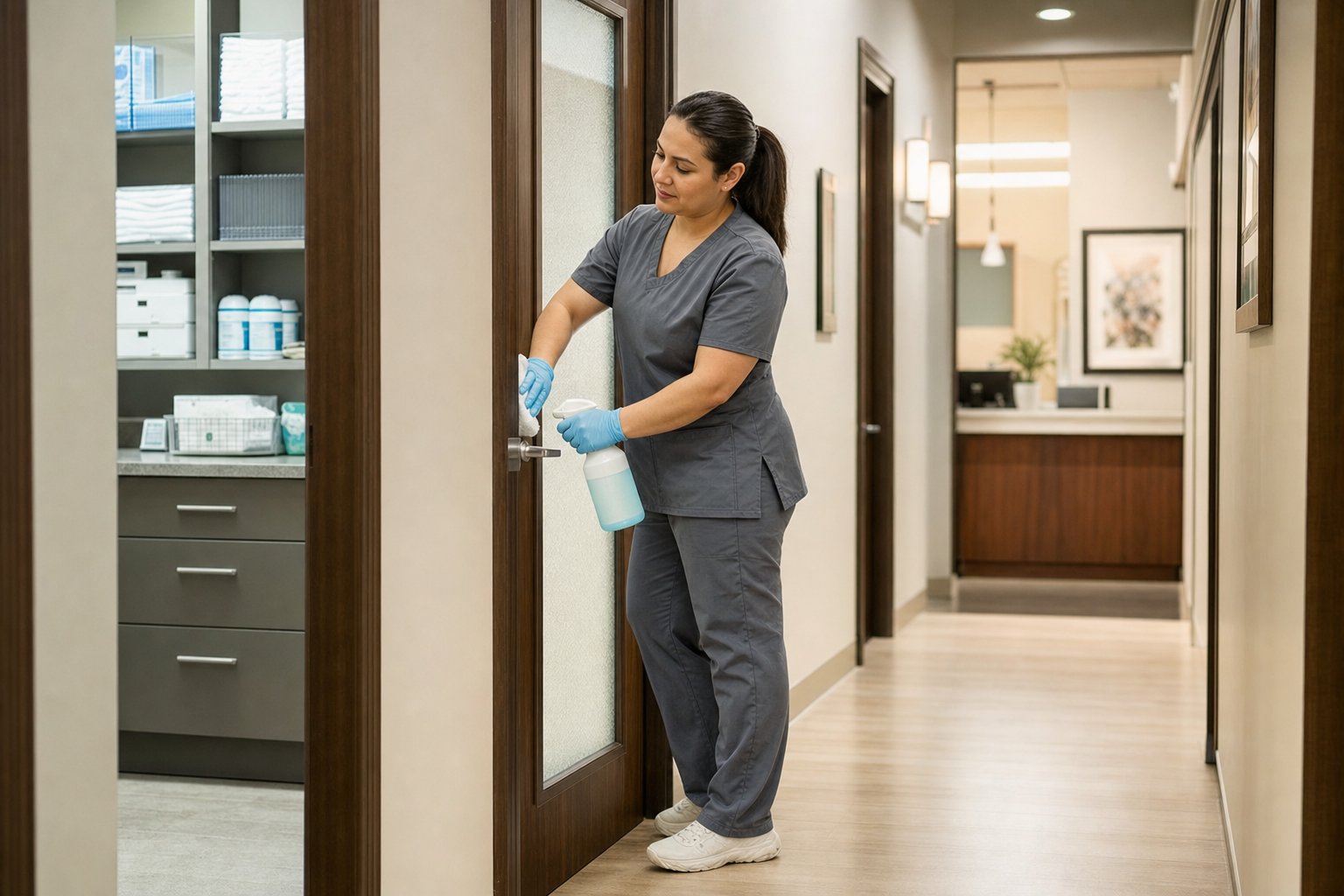
Medical office cleaning in New York is not just about a polished waiting room. A Midtown dermatology clinic, a Bronx family practice, and a Queens urgent-care suite have to protect patient privacy while controlling touchpoint soil, bodily-fluid risks, and disruptions to care. GreenPoint Maintenance Services builds HIPAA-aware cleaning scopes around room access, approved products, and auditable completion evidence. GreenPoint is a commercial cleaning partner, not a law firm or healthcare provider, so the office remains responsible for its HIPAA policies and clinical protocols. Call 844-814-0810 to schedule a walkthrough and receive a fixed-price quote with no hourly billing or hidden fees.
What HIPAA-aware cleaning actually means
HIPAA applies to protected health information and the organizations that handle it; a janitorial company may become a business associate when its work involves access to information or systems. The cleaning plan should therefore minimize exposure, define what staff may touch, and state how a cleaner reports an unattended chart, label, screen, or conversation. GreenPoint Maintenance Services trains crews to leave paperwork and devices in place, avoid reading content, close doors when directed, and escalate anything that could be a privacy concern to the designated office contact.
Privacy and infection prevention are related but separate controls. A cleaner can disinfect an exam-room chair without opening a drawer, and can empty a locked shred bin without sorting its contents. GreenPoint documents those boundaries in the site scope, then uses StockPoint task records, timestamps, GPS-tagged photos of approved surfaces, and exception notes to show what happened without photographing patient information. A 844-814-0810 walkthrough is the fastest way to identify restricted rooms, after-hours access, and the person who approves a change.
Room-by-room scope for clinics and practices
A practical medical-office scope divides the site into waiting and reception, exam rooms, procedure rooms, laboratories, staff areas, restrooms, corridors, and waste or supply rooms. Each zone needs a frequency and a method. For example, a 5,000-square-foot primary-care practice might receive daily floor and restroom service, each-shift touchpoint checks, and a documented exam-room reset between scheduled deep-cleaning windows. GreenPoint uses color-coded microfiber and tools so restroom equipment never enters patient-care zones.
The scope should identify cleanable surfaces rather than relying on a vague phrase such as “sanitize everything.” Door pulls, chair arms, light switches, counter edges, faucet levers, keyboard covers, waiting-room toys, and payment terminals may have different material and privacy restrictions. GreenPoint can coordinate with the practice manager on what is disinfected by clinical staff, what the janitorial team handles, and when a room is released. Review [medical office cleaning requirements and OSHA basics](/blog/medical-office-cleaning-requirements-osha/) before calling 844-814-0810 for a site-specific route.
Disinfection without damaging surfaces or privacy
Disinfection only works when the product is compatible with the surface and remains wet for the label contact time. GreenPoint follows the product label for dilution, dwell time, ventilation, gloves, and eye protection, and uses Green Seal certified products where the task allows. Staff do not mix chemicals or improvise around medical equipment. The office should provide manufacturer instructions for specialty upholstery, monitors, imaging surfaces, and devices that need clinical-grade handling.
High-touch service should follow patient flow. A busy clinic may need more attention on check-in screens, pens, armrests, door hardware, elevator buttons, and restroom fixtures than on a low-use administrative corridor. GreenPoint can use an ATP luminometer on agreed nonporous surfaces to trend cleaning performance, but ATP is an operational indicator rather than proof of sterility. The [ATP bioluminescence testing guide](/blog/what-is-atp-bioluminescence-testing-cleaning/) explains how to interpret that evidence. Call 844-814-0810 when a new service line changes traffic.
Blood and body-fluid response boundaries
Medical offices need a written response plan for blood, vomit, urine, or other potentially infectious material. OSHA’s [Bloodborne Pathogens standard](https://www.osha.gov/laws-regs/regulations/standardnumber/1910/1910.1030) addresses exposure controls, training, PPE, and regulated waste responsibilities. GreenPoint’s routine janitorial route does not replace the practice’s clinical exposure-control plan. The walkthrough defines whether GreenPoint is authorized for a particular response, what PPE is required, who isolates the area, and when a specialized remediation vendor must be called.
If an incident occurs, staff should keep patients away, notify the responsible supervisor, and avoid moving contaminated items until the approved process starts. GreenPoint can document the time, location, products, and disposition without entering patient details in an open note. The [color-coded microfiber systems guide](/blog/color-coded-microfiber-systems-guide/) adds a useful cross-contamination framework for routine work. For a response-capability review, contact GreenPoint at 844-814-0810 rather than assuming a standard office package covers biohazard work.
NYC access, patient flow, and local operations
Local logistics shape a safe schedule. A clinic near Grand Central may have crowded elevators at 8 a.m.; a Lower Manhattan office may require security clearance and freight-elevator reservations; a Bronx practice near a school may see a sharp arrival surge; and a Brooklyn site near Atlantic Terminal may need an evening route that avoids patient departure. GreenPoint maps entrances, keys, alarms, sharps locations, clean supply storage, and accessible paths before assigning a crew.
New York weather adds tracked salt and moisture at entrances, while construction dust can move through shared corridors. GreenPoint can add mat vacuuming, vestibule checks, and post-renovation cleaning as separate priced services, following the [post-construction cleaning phases](/blog/post-construction-cleaning-phases-explained/) framework. A practice should also confirm how cleaning interacts with NYC building rules, fire exits, and landlord security requirements. Call 844-814-0810 to coordinate service around the appointment calendar.
Documentation, access control, and StockPoint
A useful verification system proves completion while protecting confidentiality. StockPoint can record the cleaner, timestamp, GPS location, completed tasks, supply exceptions, and photos of approved nonclinical areas. GreenPoint configures photo rules so a dashboard never captures charts, patient names, computer screens, specimen labels, or conversations. Supervisors can review missed tasks and route exceptions before the next shift, giving the practice manager a concise record rather than a stack of paper checklists.
Documentation should be actionable. If a restroom fails two checks in a week, GreenPoint can increase its frequency or inspect dispensers; if an exam-room turnover runs late, the practice can change the handoff window; if supply usage rises, the manager can confirm occupancy rather than accept an unexplained invoice. The [digital cleaning verification systems](/blog/digital-cleaning-verification-systems/) article describes this feedback loop. GreenPoint’s 98% client retention reflects measurable follow-through, and 844-814-0810 connects you to a walkthrough.
Vendor controls, training, and fixed pricing
Ask a vendor how it screens and trains staff, handles keys, reports a privacy concern, substitutes for an absent cleaner, and stores SDS information. OSHA’s [Hazard Communication guidance](https://www.osha.gov/hazcom) supports labels, training, and accessible safety data. GreenPoint uses written procedures, approved chemical lists, color-coded tools, and supervisor checks. The office should identify who can authorize access to a locked room and how a cleaner documents a room that cannot be entered.
Medical practices also need predictable invoices. GreenPoint offers fixed pricing with no hourly billing and no hidden fees, then separates recurring service from periodic floor care, carpet extraction, window work, or emergency response. That structure lets a 3,000-square-foot office compare scope instead of guessing at labor hours. GreenPoint Maintenance Services is MBE/MWBE certified through New York programs and SAM.gov registered, which can support institutional procurement. Request a walkthrough at 844-814-0810 or info@greenpointms.com.
How to compare medical-office cleaning proposals
Compare proposals on risk controls, not just a low monthly number. Look for a room list, frequency matrix, product and contact-time rules, access plan, biohazard boundary, privacy escalation path, supervisor cadence, and evidence delivered after service. A vendor should explain what is excluded and how an added room is priced. GreenPoint can provide a zone-based scope that names the patient-facing standard, the clinical-team handoffs, and the periodic tasks that should not be bundled into nightly work.
Ask for measurable expectations such as 100% completion of scheduled tasks, exception notice within one business day, restocking thresholds, and a documented corrective action. Appearance-level language from [ISSA clean standards](/blog/issa-clean-standards-appearance-levels/) can help align the office and vendor. GreenPoint serves Manhattan, the Bronx, Brooklyn, Queens, Staten Island, Westchester, Long Island, New Jersey, Connecticut, Pennsylvania, and Florida. Call 844-814-0810 to start a compliant, practical conversation.
Implementation checklist for facility managers
Before service begins, confirm the square footage, room list, occupancy pattern, access windows, floor materials, restrooms, waste route, supply storage, emergency contacts, and the person who approves scope changes. A strong kickoff also records the baseline condition with approved photos, identifies restricted areas, and sets the inspection cadence. GreenPoint turns those facts into a route card and a StockPoint checklist so a substitute cleaner can follow the same instructions as the regular crew. This preparation usually prevents more cost than it adds because the team avoids rework, duplicate products, and unclear handoffs.
Set a 30-day review rather than waiting for an annual renewal. The facility lead and GreenPoint supervisor can compare completed tasks, exceptions, complaints, supply use, and any seasonal or occupancy change. If the building adds a tenant, classroom, exam room, event schedule, or new floor finish, the scope can be revised before quality slips. GreenPoint offers fixed pricing for the agreed recurring program, and a manager can call 844-814-0810 or email info@greenpointms.com to schedule the walkthrough and document the next decision.
Keep the final scope accessible to the people who actually run the building: the property manager, security desk, maintenance lead, program director, and vendor supervisor. Each person should know the normal route, the escalation path, and which conditions require a pause. GreenPoint can review the scope in plain language at kickoff, then retain the approved version in the service record so changes are deliberate rather than passed along by memory.
That shared reference is especially valuable when occupancy, weather, or a renovation changes the normal route. A short written update is easier to audit than an informal hallway instruction. It also gives the next supervisor a reliable starting point when staff, rooms, or schedules change during the school year, and helps administrators explain exactly what was purchased to a board, owner, or procurement team. It keeps the first week focused on students rather than avoidable cleaning confusion.
Frequently asked questions
Is GreenPoint a HIPAA-certified medical provider? No. GreenPoint is a commercial cleaning company that can work within a practice’s privacy and business-associate requirements; the covered entity and its counsel determine the legal arrangement and policies.
How often should a medical office be cleaned? Most practices need daily cleaning of restrooms, floors, waste, and approved high-touch surfaces, with frequency increased for urgent care, pediatrics, procedures, or extended hours. GreenPoint sets the route after measuring traffic and room use.
Can cleaners disinfect exam rooms between patients? GreenPoint can service approved environmental surfaces during an agreed turnover window, but clinical staff must define when a room is released and which equipment or clinical surfaces remain under the care team’s protocol.
Does StockPoint photograph patient information? GreenPoint configures StockPoint to use approved zones and privacy-safe evidence. Photos can document a lobby, corridor, or other authorized surface without capturing charts, screens, labels, or names.
How do I request a quote? Call 844-814-0810 or email info@greenpointms.com with the address, approximate square footage, operating hours, clinical rooms, and desired start date. GreenPoint will schedule a walkthrough and return a fixed-price scope.
Protect patient privacy while making cleaning measurable. Call GreenPoint Maintenance Services at 844-814-0810 to schedule a walkthrough and fixed-price quote; GreenPoint combines Green Seal certified products, StockPoint documentation, and a 98% client-retention record.