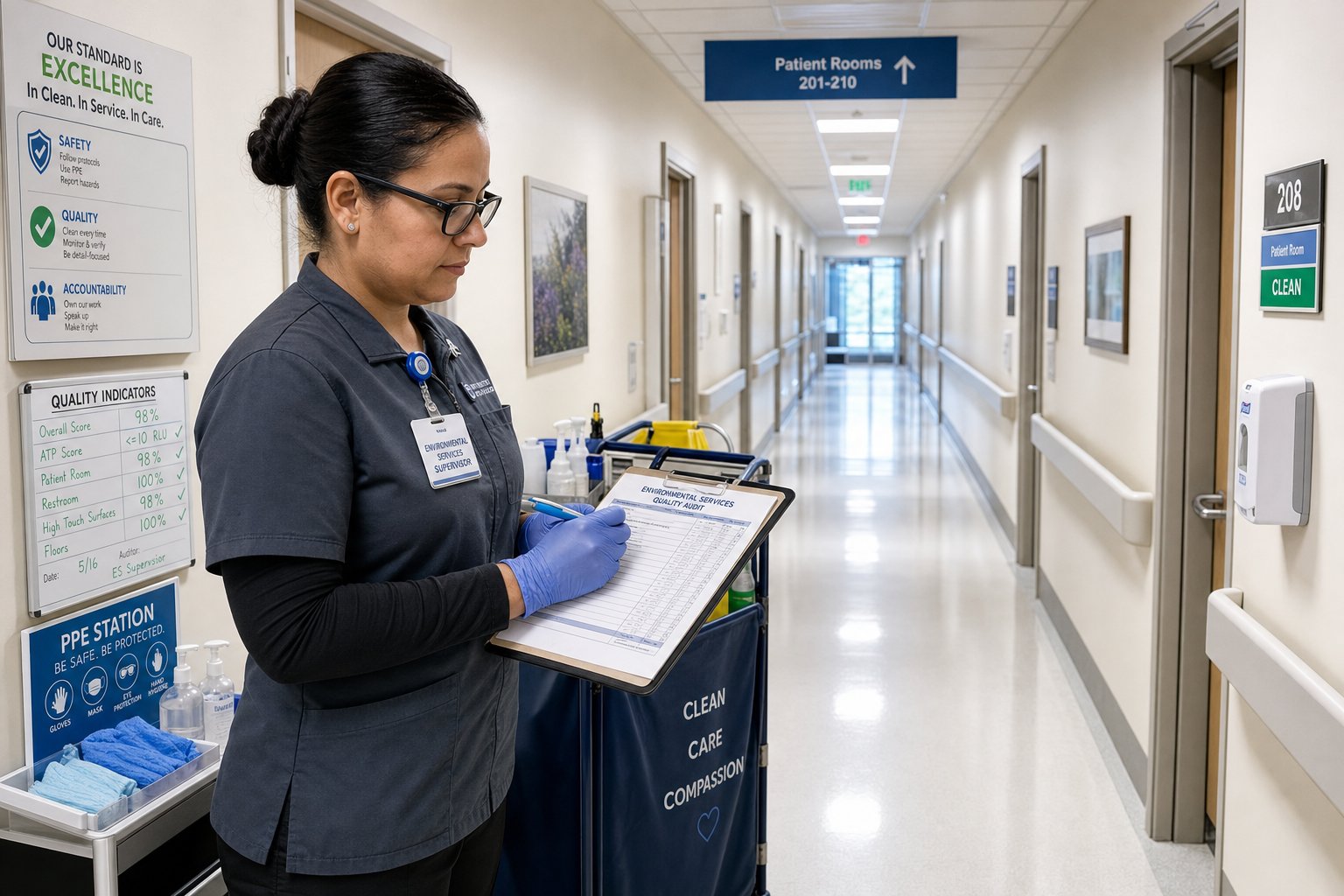
JCAHO is the familiar name many healthcare buyers still use for The Joint Commission, and “JCAHO-ready cleaning” means more than a polished corridor. Hospitals, ambulatory surgery centers, clinics, and behavioral-health sites in Manhattan, the Bronx, Queens, Brooklyn, Westchester, and Long Island need an environmental-services program that protects patients, supports infection prevention, and produces clear evidence for leadership and surveyors. GreenPoint Maintenance Services Corp helps healthcare-adjacent facilities define room-level tasks, train cleaners, and document completion with StockPoint. Our MBE/MWBE certifications, Green Seal certified product options, fixed pricing, and 98% client retention support a professional program across New York, New Jersey, Connecticut, Pennsylvania, and Florida. Call 844-814-0810 to schedule a walkthrough.
Translate Joint Commission expectations into a cleaning system
A survey-ready program begins with the facility’s own policies, infection-prevention risk assessment, and Environment of Care process. The Joint Commission does not make a single universal janitorial checklist for every building; the hospital must define how it manages environmental risks, high-touch surfaces, patient rooms, procedural areas, public spaces, waste, and corrective actions. GreenPoint Maintenance Services helps the facilities leader turn those decisions into a room inventory and frequency chart. A 50,000-square-foot outpatient center with 20 exam rooms, two procedure suites, six restrooms, and a busy waiting area should not receive the same scope as a quiet administrative office.
Use objective language such as “no visible soil at opening,” “approved disinfectant used for the labeled contact time,” “restroom stocked at each scheduled check,” and “unresolved exception assigned to a named owner.” GreenPoint can align the checklist with the client’s infection-prevention plan, product approvals, and isolation-room rules. The [healthcare-associated infections and environmental cleaning](/blog/healthcare-associated-infections-environmental-cleaning/) guide provides useful context for separating routine environmental service from clinical disinfection and sterilization responsibilities.
Map patient-care, support, and restricted zones
Create separate routes for patient rooms, exam rooms, procedure or operating areas, isolation rooms, waiting rooms, reception, public restrooms, staff workrooms, laboratories, medication storage, clean supply, soiled utility, loading, and waste staging. Mark surfaces cleaners may touch, equipment they must avoid, rooms requiring escort, and locations that need a practice-owned handoff. A clinic near Columbia University or NYU Langone may have early patient arrivals and elevator controls; a Bronx or Queens site near a major subway hub may have a different peak. GreenPoint walks the map with facilities, nursing, infection prevention, security, and the office manager before pricing.
A zone map also prevents a common failure: treating a missed room as a quality failure when a patient, procedure, or clinical cart made it unavailable. StockPoint can show that the cleaner arrived, recorded the access exception, notified the named contact, and returned after the room was released. That is more defensible than marking a room complete or asking a cleaner to move clinical equipment without approval.
Separate environmental cleaning from clinical processing
The contract should draw a bright line between environmental surfaces and clinical work. GreenPoint cleans assigned floors, walls, fixtures, touchpoints, sinks, restrooms, waiting furniture, and other approved surfaces. The healthcare organization owns instruments, sterilization, specimen handling, sharps, medication, linen rules, blood or body-fluid protocols, and any room-specific clinical procedure. OSHA Bloodborne Pathogens requirements and the facility’s exposure-control plan determine training and PPE when an incident occurs. A cleaner should stop, secure the area, and call the trained clinical contact rather than improvise.
Disinfection is also a label-directed process, not a synonym for “spray everything.” GreenPoint follows the approved EPA-registered product list, dilution, dwell time, ventilation, and rinse directions. Green Seal certified products may be used where their performance and material compatibility fit the facility. Email info@greenpointms.com or call 844-814-0810 if your current scope blurs clinical and janitorial ownership.
Set frequencies from risk, traffic, and square footage
Use a risk-based schedule instead of one frequency for every room. A practical starting point is each-shift or daily service for patient-care rooms and high-traffic restrooms, daytime touchpoint checks in a 24-hour urgent-care setting, and weekly or monthly detail for edges, high dusting, walls, and floor projects. A 10,000-square-foot specialty practice with 12 exam rooms may need more touchpoint labor than a 20,000-square-foot administrative suite. GreenPoint sizes staffing from rooms, patient volume, operating hours, floor finishes, and access—not a generic hourly promise.
The frequency chart should show daily, weekly, monthly, quarterly, event-triggered, and corrective tasks. Connect each item to an outcome and an inspection method. The [cleaning frequency standards by facility type](/blog/cleaning-frequency-standards-by-facility-type/) offers a practical framework for translating patient flow and soil load into a schedule. GreenPoint Maintenance Services can revise a route after 30 days of actual occupancy data rather than locking the practice into a guess.
Use products, PPE, and color coding consistently
Healthcare teams should approve product names, surfaces, contact times, PPE, storage, and substitutions before the first shift. GreenPoint keeps labels and Safety Data Sheets accessible, never mixes chemicals, and uses color-coded microfiber and tools to reduce cross-use between restrooms, patient-care rooms, and public areas. The [OSHA cleaning chemical safety, GHS and SDS](/blog/osha-cleaning-chemical-safety-ghs-sds/) guide explains what a facility manager should expect from onboarding and a chemical inventory review.
Training should include hand hygiene, glove changes, clean-to-dirty sequencing, high-to-low work, wet-floor control, splash response, and what to do when a room is occupied or an item is unfamiliar. A supervisor observes new and relief cleaners during the first week. GreenPoint records training completion and corrective actions without putting patient identifiers into the cleaning record.
Document inspections with privacy-safe StockPoint evidence
Surveyors and executives need evidence that the process works, not a promise that a vendor was present. GreenPoint uses StockPoint to record timestamps, GPS-tagged locations, checklist completion, supervisor inspections, issue notes, and corrective-action closure. ATP testing may be used on selected noncritical touchpoints as a trend signal, but it is not a sterility test, a diagnosis, or proof that a healthcare organization meets every regulatory requirement. Photos are restricted to client-approved views and should exclude names, dates of birth, charts, screens, specimen labels, and other protected information.
A monthly report can track inspection pass rate, room exceptions, response time, supply-outs, repeat findings, and open corrective actions by zone. GreenPoint helps the facility review why a result changed: patient census, construction dust, new equipment, a product substitution, or a staffing gap. The [quality assurance commercial cleaning program](/blog/quality-assurance-commercial-cleaning-program/) shows how a dashboard becomes useful when every failed task has an owner and due date.
Prepare for surveyor questions and tracer walks
A surveyor may ask a nurse, manager, or cleaner to explain how a high-touch area is cleaned, how a product’s contact time is followed, where PPE and SDS information are found, and what happens when a room cannot be entered. GreenPoint rehearses those answers in plain language and keeps a current room map, product list, training roster, inspection sample, and escalation tree. Do not coach staff to recite a slogan; teach them the actual route and the reason for each boundary.
During a tracer, the strongest evidence connects policy, practice, and correction. GreenPoint can show a task record, supervisor check, exception note, and closure without exposing patient information. Call 844-814-0810 for a walkthrough that includes the environmental-services manager, infection-prevention lead, security contact, and procurement owner.
Write a fixed healthcare cleaning proposal
The proposal should identify square footage by zone, room counts, service windows, recurring frequencies, consumables, floor projects, emergency response, waste boundaries, staff screening, insurance, training, reporting, and exclusions. GreenPoint Maintenance Services provides fixed pricing with no hourly billing and no hidden fees, so the practice can see which assumptions determine cost. MBE/MWBE certifications, SAM.gov registration, Green Seal options, and 98% client retention are useful qualification points, but they do not replace a site-specific clinical scope.
Ask finalists how they cover absences, handle an isolation-room exception, restrict photos, respond to a blood or body-fluid event, and close a missed room before the next patient. GreenPoint can email a written proposal after a no-obligation walkthrough. Call 844-814-0810 or write info@greenpointms.com to start.
Launch, audit, and improve in the first 30 days
Before mobilization, GreenPoint confirms the room map, approved products, access credentials, PPE, waste path, emergency contacts, inspection cadence, and client-owned clinical procedures. The baseline walk documents pre-existing stains, damaged flooring, blocked closets, and rooms not available for service. At days 7, 14, and 30, the supervisor reviews StockPoint results with the practice and separates a true cleaning miss from an access exception or building repair.
For a multi-site group in Manhattan, Brooklyn, Queens, the Bronx, Staten Island, Westchester, Long Island, New Jersey, Connecticut, or Pennsylvania, use one core standard with site-specific annexes. GreenPoint Maintenance Services Corp can provide common training and metrics while respecting each facility’s privacy, infection-prevention, and security policies. Reapprove the scope when hours, patient volume, floor materials, or clinical services change.
The most useful “JCAHO-ready” cleaning record is a small, readable chain from risk assessment to task, inspection, exception, and correction. GreenPoint does not promise that janitorial documentation alone guarantees accreditation; it gives the facility evidence that its approved environmental process is being executed and improved. Managers should review trends quarterly, confirm the product list, and invite infection prevention and security to the walkthrough. Call 844-814-0810 when the current vendor’s checklist does not match actual patient flow.
GreenPoint’s 98% client retention is a proof point, not a substitute for your own audit. Ask for a sample StockPoint report, a relief-staff plan, the chemical inventory, a privacy-safe photo policy, and a fixed proposal that names every room and frequency. GreenPoint Maintenance Services can support one practice or a healthcare portfolio across NY, NJ, CT, PA, and FL, with email support at info@greenpointms.com.
FAQ: practical answers for facility and procurement leaders
What does JCAHO-ready environmental cleaning mean? It means the facility has a documented, risk-based environmental-services process aligned with its own Joint Commission, infection-prevention, safety, and privacy policies, plus evidence of completion and correction. GreenPoint maps the scope and reports exceptions; the healthcare organization owns clinical policy and accreditation decisions.
Can a janitorial cleaner disinfect an isolation or procedure room? Only according to the facility’s approved procedure, product list, PPE rules, access controls, and training. GreenPoint cleans the assigned environmental surfaces and stops for clinical equipment, specimens, sharps, or incidents that require a trained healthcare response.
What cleaning evidence do hospitals receive? StockPoint can provide timestamped, GPS-tagged task records, checklists, supervisor inspections, issue notes, and corrective-action closure. GreenPoint limits photos to client-approved, privacy-safe areas and does not treat ATP readings as a sterility or accreditation test.
How often should healthcare spaces be cleaned? Frequency depends on risk, patient volume, room use, hours, surfaces, and facility policy. High-traffic patient-care rooms and restrooms often need each-shift or daily service, with daytime checks and periodic detail added where data shows need. GreenPoint confirms the schedule during a walkthrough.
How do I get a healthcare cleaning quote in New York? Call GreenPoint Maintenance Services at 844-814-0810 or email info@greenpointms.com. We will review patient-care zones, clinical boundaries, products, access, waste, documentation, and staffing before providing fixed pricing with no hidden fees.
GreenPoint Maintenance Services Corp provides JCAHO-ready environmental-services support with a no-obligation walkthrough. Call GreenPoint at 844-814-0810 or email info@greenpointms.com for fixed pricing, privacy-safe StockPoint verification, and a room-by-room plan built for survey readiness.