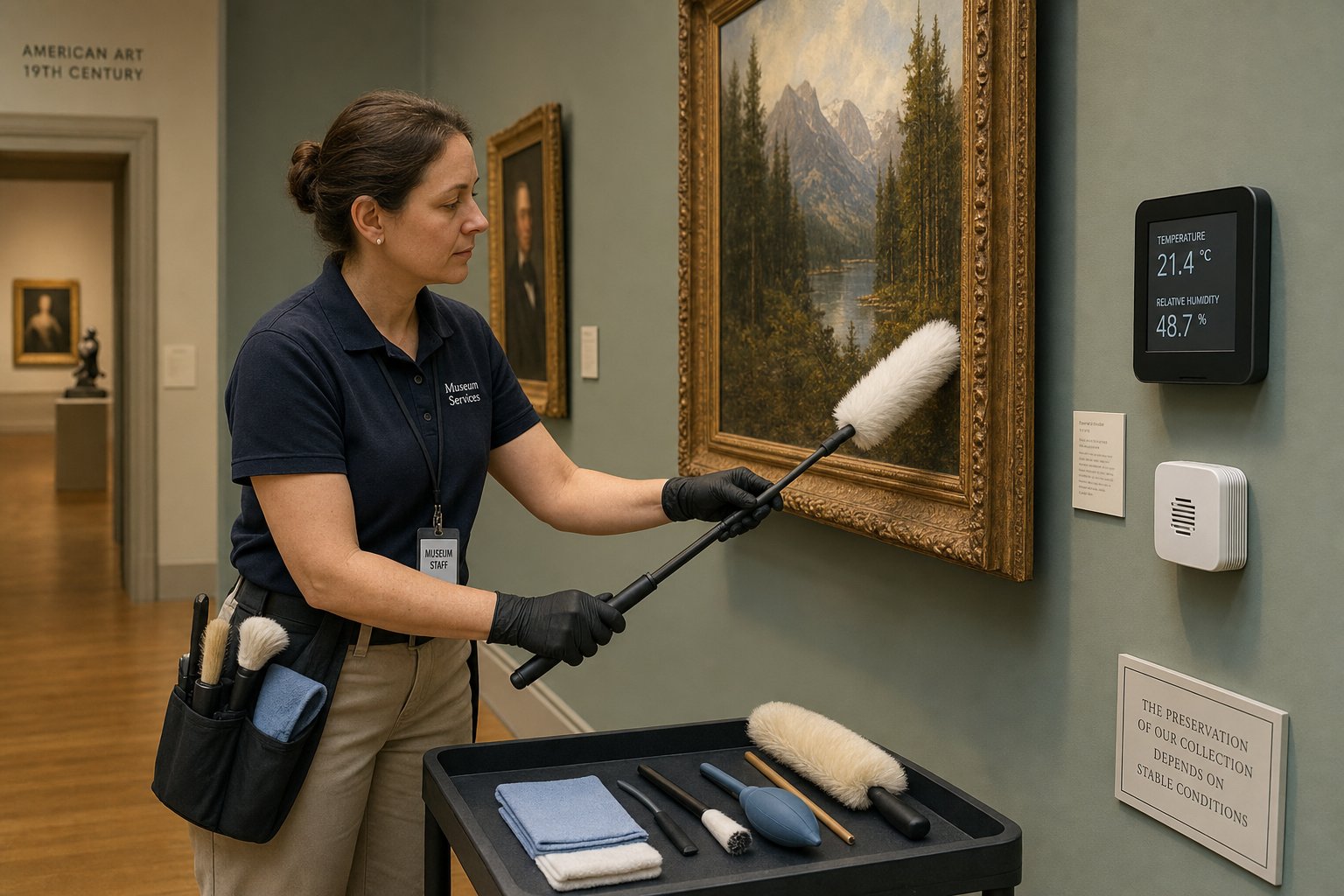
Museum and gallery cleaning is a preservation-support service, not ordinary office janitorial work. Dust, vibration, moisture, light, residue, and a careless touch can affect artwork, frames, display cases, and visitor confidence. A collection in Chelsea, the Upper East Side, Long Island City, DUMBO, or Westchester also has to operate around school groups, evening events, freight elevators, and subway traffic. This guide explains how facility leaders can scope collections-safe environmental cleaning. GreenPoint Maintenance Services Corp combines trained personnel, Green Seal certified products, JaniTrack verification, fixed pricing, and a documented chain of responsibility for cultural institutions across New York, New Jersey, Connecticut, Pennsylvania, and Florida.
Start with a collection-aware room inventory
Create separate maps for galleries, storage, conservation studios, offices, public restrooms, loading areas, cafés, education rooms, and event spaces. Record floor finish, case type, artwork sensitivity, ceiling height, HVAC grilles, visitor volume, and approved access windows. A small Chelsea gallery may need careful display-case exterior service, while a large institution near Central Park may need overnight routes across several floors. GreenPoint Maintenance Services walks the property with facilities and collections staff before assigning tasks. The map should mark no-touch surfaces, restricted rooms, fragile objects, alarms, and the route for supplies so a cleaner never relies on assumptions.
Control dust through source reduction and sequence
The first objective is to keep soil from reaching collections. Use entry mats, closed carts, clean tools, and a high-to-low sequence that does not sweep dust toward cases. HEPA-filtered vacuums may be appropriate for approved floors and ledges when the museum’s conservator accepts the equipment and noise profile. Never use compressed air or an unapproved feather duster near artwork. GreenPoint trains teams to use soft, clean microfiber and to report damaged seals, loose frames, condensation, or pests rather than trying to correct the object. The [HEPA filtration for commercial cleaning](/blog/hepa-filtration-commercial-cleaning/) guide gives facility managers a useful set of questions about filtration, maintenance, and safe use.
Define “do not touch” boundaries in writing
A cleaning contract should distinguish environmental surfaces from artwork, display interiors, mounts, labels, plinths, vitrines, and conservation materials. Only authorized museum staff or conservators should decide whether an object or case interior is cleaned. GreenPoint’s site plan identifies approved touchpoints and requires the cleaner to stop and escalate anything uncertain. A boundary card in the closet and the digital work order should match. This is especially important during exhibition changeovers, when a familiar wall may suddenly hold an irreplaceable work. Managers should also define whether cleaners may move chairs, stanchions, educational materials, or event furniture; “make the room ready” is not precise enough.
Match products to materials and indoor climate
Museums manage temperature and relative humidity for collections, and cleaning products should not introduce unnecessary moisture, fragrance, or residue. GreenPoint uses Green Seal certified products where appropriate, follows manufacturer labels, and asks the institution to approve the product list before mobilization. Damp wiping must be controlled around wood, paper, textiles, metals, and painted finishes. Do not mix chemicals or spray near cases, sensors, outlets, or artwork. OSHA Hazard Communication requirements still apply: staff need labels, PPE instruction, and accessible Safety Data Sheets. The [green cleaning for commercial buildings](/blog/green-cleaning-commercial-buildings-guide/) resource can help procurement compare lower-impact options without treating “green” as a substitute for material compatibility.
Plan visitor-facing cleaning around the museum day
Visitor traffic creates a different cleaning rhythm from a closed office. Reception, restrooms, elevators, café areas, benches, handrails, and education rooms may need daytime checks, while gallery floors and low-dust detail work can happen before opening or after closing. GreenPoint can build porter coverage for high-use public zones and a quiet evening route for approved gallery tasks. In Manhattan, arrival windows may be affected by Grand Central, Penn Station, or subway construction; in Brooklyn, DUMBO and Prospect Park events can change pedestrian volume. A walkthrough should review school groups, private events, weekend hours, and loading rules before a quote is issued.
Protect display cases, mounts, and gallery hardware
Case exteriors, glazing, locks, plinths, wall guards, picture rails, and lighting tracks need separate instructions. Cleaners should know which glass is coated, where fingerprints are acceptable to remove, and whether a case requires a conservator. Never rest a bucket or cart against a wall or plinth. GreenPoint uses color-coded microfiber and supervisor checks for edges, corners, ledges, and under-furniture soil. JaniTrack records the approved location, task, time, inspection, and exception; photos are limited to areas the institution authorizes. A digital record is useful only when it respects the collection’s security and the museum’s image policy.
Use measurable environmental and appearance checks
ISSA appearance-level concepts help a museum define visible cleanliness without claiming that a gallery is laboratory-sterile. The scorecard can track dust findings by zone, restroom inspection pass rate, response time, waste incidents, floor appearance, supply-outs, and exceptions caused by exhibition work. GreenPoint’s supervisor reviews trends with the facilities lead and records corrective action in JaniTrack. For selected non-collection touchpoints, ATP testing may provide a trend signal, but it is not a preservation or sterility test. Managers should compare results with visitor volume, event schedules, construction, and HVAC work so a recurring dust finding is investigated at its source.
Staff for security, access, and emergency response
Museum cleaners may work around alarms, high-value objects, donor events, school groups, and restricted storage. Require background screening, badge and key control, two-person rules where applicable, incident reporting, and a relief-worker briefing. GreenPoint trains assigned and backup staff on no-touch boundaries, PPE, chemical storage, wet-floor controls, and who to call if a display case is damaged or a spill threatens a collection. OSHA guidance informs chemical and slip-hazard training, while the institution’s security director owns collection protection. Call 347-332-9348 to map the access plan and keep a written chain of responsibility in the service agreement.
Price recurring service and exhibition work separately
A fixed proposal should identify gallery and public-area frequencies, supplies, periodic floor care, event resets, high dusting, carpet extraction, window or glass limits, and tasks excluded from routine cleaning. GreenPoint Maintenance Services provides fixed pricing with no hourly billing and no hidden fees, so the institution can see which assumptions drive cost. Exhibition installation, deinstallation, construction dust, and emergency response should have written change-order triggers. The [commercial cleaning cost per square foot](/blog/commercial-cleaning-cost-per-square-foot/) explains why a facility should compare scope and frequency rather than choose a low number detached from actual square footage and traffic. GreenPoint can schedule a no-obligation walkthrough for a single gallery or a regional portfolio.
Launch with a baseline and conservator-approved handoff
Before the first shift, GreenPoint documents the opening condition, approved tools, product list, room access, emergency contacts, collection boundaries, and inspection cadence. The first two weeks should include supervisor observations and a review with facilities and collections staff. JaniTrack can show completed locations and corrective actions without exposing sensitive collection details. GreenPoint’s 98% client retention reflects consistent service, but the institution should still verify its own baseline and adjust frequencies after visitor patterns are known. Email info@greenpointms.com or call 347-332-9348 to schedule a walkthrough in Manhattan, Brooklyn, Queens, the Bronx, Staten Island, Westchester, Long Island, or nearby tri-state locations.
A useful museum cleaning program is intentionally conservative. If a team encounters an unfamiliar material, a loose label, a spill near a plinth, or condensation inside a case, the correct action is to secure the area and notify the named museum contact—not to improvise with a stronger chemical or a faster machine. GreenPoint documents those exceptions, the time reported, the person assigned, and the closure decision. During monthly reviews, managers can separate routine dust trends from an exhibition project, HVAC problem, visitor incident, or building repair. This makes the contract a preservation-support tool rather than a generic checklist. Call 347-332-9348 if your institution wants the walkthrough to include collections, security, and facilities stakeholders.
For a museum group with locations near the Met, MoMA, the Brooklyn waterfront, or Westchester cultural campuses, standardize the core training while allowing each site to set its own no-touch list and event calendar. GreenPoint Maintenance Services can provide one account lead, a local supervisor, and a common JaniTrack reporting structure. Keep the final room map in the service closet and the digital plan, then re-approve it when an exhibition opens, a floor is refinished, a case changes, or a new public program increases traffic. GreenPoint can also coordinate periodic carpet and hard-floor work when the collection team approves the timing and method.
Museum leaders should invite GreenPoint to quote from an actual operating day when possible: before opening, during a school-group window, and after an event reset. That shows where carts can travel, which restrooms need porter checks, and how the team communicates with security. Our MBE/MWBE certifications, SAM.gov registration, Green Seal product options, and JaniTrack evidence can support procurement, but the room-by-room scope determines the service. Request a fixed proposal with task frequencies, approved products, photo rules, response times, and exclusions written down.
FAQ: practical answers for facility and operations leaders
Can a commercial cleaner dust artwork in a museum? Only when the museum has expressly approved the task, method, training, and object boundary. Routine janitorial staff should clean approved environmental surfaces and escalate artwork, case interiors, mounts, or unfamiliar materials to collections personnel. GreenPoint creates a written no-touch map and trains relief staff to follow it.
How do museums reduce dust without harming collections? Use entry mats, closed carts, clean tools, controlled HEPA vacuuming on approved surfaces, soft microfiber, and a high-to-low route. Avoid compressed air and unapproved sprays. GreenPoint records approved methods and reports building conditions such as damaged seals or HVAC dust.
Do museum cleaners need OSHA training? Yes. Chemical labels, PPE, Safety Data Sheets, slip prevention, and incident reporting belong in onboarding. Collection protection is governed by the institution’s policies, while GreenPoint trains cleaners on the approved environmental scope and escalation chain.
Can JaniTrack be used in a gallery? Yes, when the museum approves the evidence rules. JaniTrack can record time, location, checklist completion, inspections, and corrective actions; photos can be restricted to non-sensitive areas and must follow the institution’s collection and security policy.
How do I get a museum cleaning quote in New York? Call GreenPoint Maintenance Services at 347-332-9348 or email info@greenpointms.com for a walkthrough. GreenPoint will review gallery zones, public traffic, collection boundaries, events, access, and periodic work before providing fixed pricing with no hidden fees.
GreenPoint Maintenance Services Corp can plan a collections-aware cleaning program with a no-obligation walkthrough. Call GreenPoint at 347-332-9348 or email info@greenpointms.com; we provide fixed pricing, JaniTrack verification, and a documented service standard built for cultural facilities. [commercial cleaning cost per square foot](/blog/commercial-cleaning-cost-per-square-foot/)