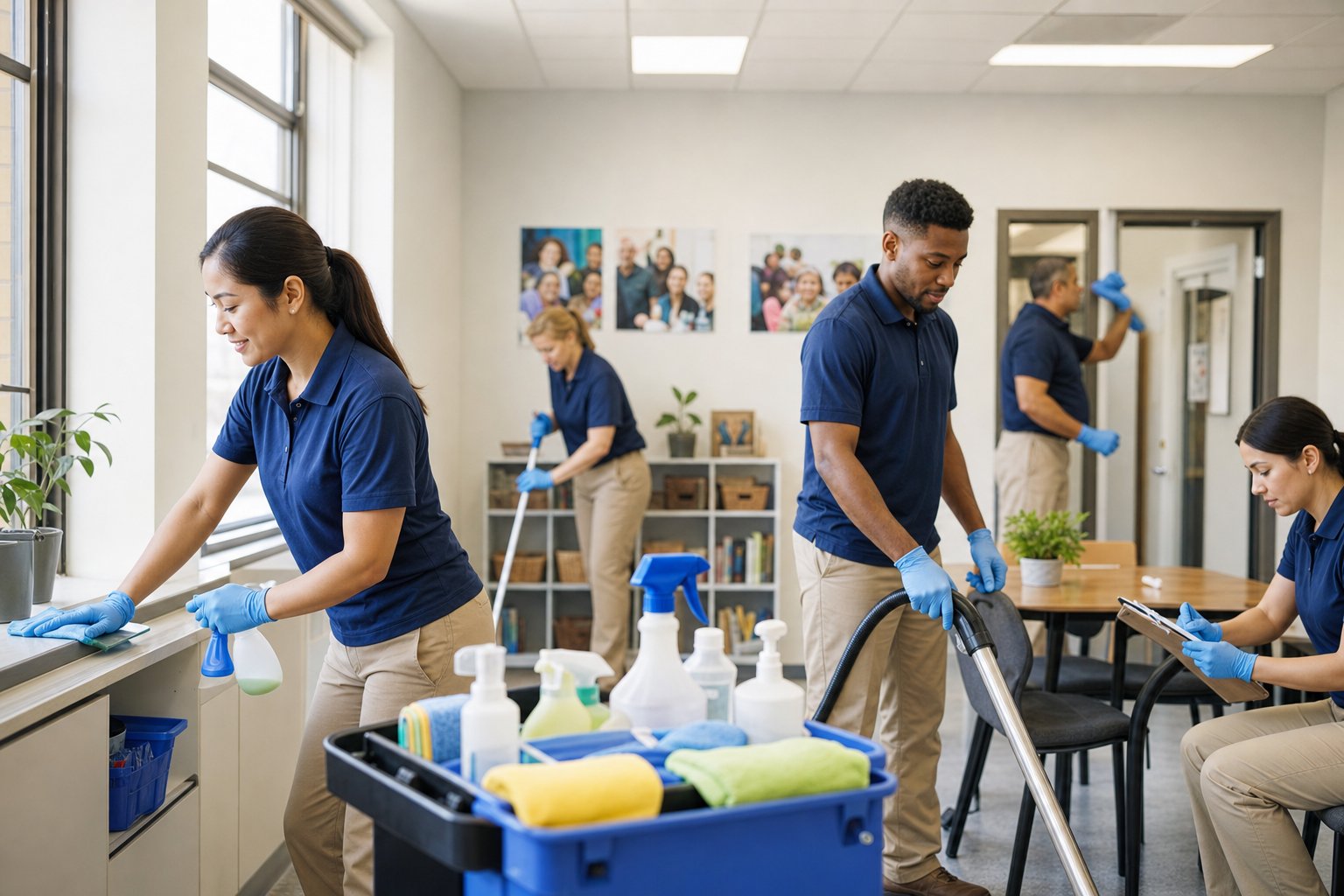
A nonprofit office has to make every dollar visible. Donors, board members, volunteers, staff, and community visitors still expect clean restrooms, safe floors, fresh meeting rooms, and a professional front desk, but the operating budget may be tied to a grant, a restricted program, or a year-to-year renewal. The answer is not to purchase the cheapest hourly labor. A defensible nonprofit office cleaning program defines the building, matches frequency to traffic, documents results, and protects the mission from preventable disruptions. GreenPoint Maintenance Services helps nonprofit offices, social-service agencies, cultural organizations, and community programs across New York, New Jersey, Connecticut, Pennsylvania, and Florida build practical scopes with fixed pricing and measurable proof.
Start with a room-by-room scope, not a vague discount
Write down square footage, floor types, restrooms, fixtures, kitchens, entrances, meeting rooms, storage areas, elevators, and occupied hours. A 7,500-square-foot neighborhood service center with two restrooms and one kitchen has a different workload from a 35,000-square-foot nonprofit headquarters with classrooms, counseling rooms, and daily public programs. GreenPoint uses a site walkthrough to separate routine tasks from periodic work instead of hiding both inside an hourly estimate.
List what is included and excluded: nightly waste removal, vacuuming, damp mopping, touchpoint cleaning, restroom replenishment, interior glass, carpet extraction, floor finish, high dusting, event resets, and emergency response. A scope that names 18 rooms and 10 fixtures is easier for a finance director to compare than “general janitorial.” The [commercial cleaning cost per square foot](/blog/commercial-cleaning-cost-per-square-foot/) guide gives a useful framework for comparing the cost drivers without pretending one national number fits every nonprofit.
Match frequency to mission traffic
Daily service is usually most valuable in entrances, restrooms, kitchens, classrooms, and public-facing rooms. A lightly occupied administrative wing may need nightly or three-times-weekly service, while a food pantry, shelter intake area, youth program, or community clinic may need multiple touchpoint and restroom checks. GreenPoint can build a base schedule plus trigger-based service for program nights, board meetings, volunteer drives, and seasonal events.
Frequency should follow observed use, not the size of the building alone. Track complaints, trash volume, fixture counts, and inspection results for 30 days. If a 12,000-square-foot office has little traffic on Fridays, reducing one routine visit may be more sensible than cutting restroom checks during a busy Monday program. If the board needs a rationale, the [cleaning frequency standards by facility type](/blog/cleaning-frequency-standards-by-facility-type/) article provides a plain-language starting point.
Protect cash flow with fixed pricing and clear change control
Nonprofit leaders need to know what a service will cost before approving a grant budget. GreenPoint provides fixed pricing for a defined scope, with no hourly billing and no hidden fees. The proposal should state frequency, labor assumptions, consumables, floor-care cycles, response options, taxes or pass-through charges if any, and the process for changing the scope when occupancy or square footage changes.
Ask the vendor to separate recurring service from one-time work. A quarterly carpet extraction, annual strip-and-refinish, post-event reset, or post-construction clean should not quietly appear as an unbudgeted “extra.” A simple pricing table can show a base program, optional periodic services, and an emergency rate. Call 844-814-0810 to schedule a walkthrough and receive a written scope that a finance committee can review.
Use volunteers strategically without creating risk
Volunteers can help with light organizing, donation sorting, or event setup, but they should not be expected to handle chemical concentrates, blood or bodily fluids, sharps, ladders, mold-like growth, or unknown spills without training and proper PPE. OSHA Hazard Communication and bloodborne-pathogen practices matter even in a small office. Define the line between volunteer stewardship and professional janitorial work so well-intentioned help does not create an injury or exposure claim.
GreenPoint can document which tasks remain with trained staff and which low-risk tasks a nonprofit may handle internally. Keep product labels and safety data sheets accessible, never mix chemicals, mark wet floors, and provide a clear escalation number. A color-coded microfiber system can reduce cross-use between restrooms, kitchens, and offices; see [color-coded microfiber systems](/blog/color-coded-microfiber-systems-guide/) for the operating logic.
Make cleanliness support donor and grant reporting
A clean facility is an operating control as well as an appearance standard. Record service dates, inspection scores, supply usage, corrective actions, and service interruptions. These records can help a nonprofit explain how facilities spending supports program continuity, visitor safety, and staff retention. GreenPoint’s StockPoint workflow can provide timestamped GPS-tagged photos, checklists, supervisor inspections, and a live dashboard when the client’s privacy rules allow it.
Do not overclaim what a dashboard proves. A photo shows that a task or area was documented; it does not prove that every microorganism was removed. ATP testing can offer a trend about organic residue on selected surfaces, but it is not a pathogen test and does not replace visual inspection or correct disinfectant contact time. GreenPoint combines digital records with supervisor review so a grant report has context instead of a single unchecked completion mark.
Plan for public-facing rooms and sensitive services
Nonprofits often combine reception, case management, classrooms, food distribution, counseling, and administrative work in one address. Separate public routes from confidential rooms and tell the cleaning team what may not be moved or photographed. A visitor center near a transit hub may need entry and restroom checks during open hours, while a counseling office may require quiet, after-hours service with strict desk and document rules.
In New York City, offices near Grand Central, Penn Station, Fulton Street, or major bus corridors may experience intense morning traffic and tight loading windows. Brooklyn and Queens community sites may coordinate with schools, libraries, or shared buildings. Westchester and Long Island locations may need parking and multi-site routing. GreenPoint maps access, alarm procedures, transit constraints, and emergency contacts during the walkthrough.
Choose lower-impact products without sacrificing performance
GreenPoint uses Green Seal certified products where the application and client requirements permit. Product selection should still follow the surface, soil, occupant sensitivity, label directions, and any healthcare, food, or school requirement. A “green” label does not make overuse safe, and stronger fragrance is not evidence of cleaner work. Measured dilution, microfiber capture, entry mats, and source control can reduce chemical and labor waste at the same time.
For a nonprofit with limited storage, standardize a small approved product set and label secondary containers. Use entry mats and dust control to reduce the work that reaches resilient floors. Schedule carpet and floor care based on traffic and finish condition, not an automatic calendar. GreenPoint can identify the few periodic tasks that protect a high-use facility instead of selling every possible add-on.
Verify service without adding administrative burden
A nonprofit does not need a complicated audit to know whether service is working. Set five to ten inspection points: entrance, restroom, kitchen, meeting room, public desk, waste area, and one representative floor zone. Have a supervisor review them on a defined cadence and give the facility contact a short exception report. StockPoint can make the checklist and corrective action visible in a dashboard while keeping the client’s data rules in place.
GreenPoint’s 98% client retention is a useful relationship proof point, but the operational test is whether missed work is corrected quickly and recurring problems are analyzed. Ask who answers after hours, how a substitute cleaner is trained, and what happens if a program event changes the schedule. Call 844-814-0810 when you want a walkthrough that prioritizes the mission-critical rooms first.
Compare nonprofit janitorial proposals on total value
Compare vendors on the same facts: square footage, frequency, staffing, supervision, supplies, floor care, public hours, access, insurance, background screening, response times, and documentation. Ask whether the crew is trained for bodily-fluid incidents and chemical safety, and whether the vendor can work around confidential records and vulnerable populations. A low line item that excludes restrooms, consumables, or periodic care is not a low total cost.
GreenPoint Maintenance Services is MBE/MWBE certified through NYS, NYC, and NYC DOE programs and registered in SAM.gov. GreenPoint Maintenance Services can offer fixed pricing, Green Seal certified products where appropriate, and StockPoint-ready proof. GreenPoint also provides a clear escalation path instead of asking a small nonprofit director to supervise every task. Email info@greenpointms.com or call 844-814-0810 for a quote.
Frequently Asked Questions
Question: How can a nonprofit reduce cleaning costs without lowering standards? Answer: Define the full scope, match frequency to traffic, separate periodic work from recurring work, and review 30 days of inspection and complaint data. GreenPoint can help prioritize restrooms, public routes, kitchens, and program rooms before lower-use spaces.
Question: Do nonprofit offices need professional janitorial service? Answer: Professional service is especially valuable for restrooms, chemical handling, bodily-fluid response, high-traffic floors, and predictable documentation. Volunteers can support low-risk organizing, but they should not be used as a substitute for trained work in higher-risk tasks.
Question: Can GreenPoint work with a grant-funded budget? Answer: Yes. GreenPoint can scope recurring and optional services separately and provide fixed pricing for the agreed program. Call 844-814-0810 or email info@greenpointms.com to schedule a walkthrough and align the scope with the budget cycle.
Question: Does StockPoint work for nonprofit offices? Answer: StockPoint can support timestamped GPS-tagged photos, task checklists, inspections, and corrective-action tracking when the nonprofit approves those controls. Privacy rules should be set so confidential documents, clients, and screens are not photographed.
Question: What should a nonprofit ask a cleaning company? Answer: Ask for a room-by-room scope, training and safety practices, backup coverage, insurance, product list, quality process, pricing exclusions, and references. GreenPoint provides a written scope rather than an unclear hourly promise.
Build a mission-first cleaning budget with GreenPoint Maintenance Services. Call 844-814-0810 or email info@greenpointms.com for a walkthrough, fixed pricing with no hourly billing or hidden fees, and StockPoint-ready proof backed by GreenPoint’s 98% client retention.