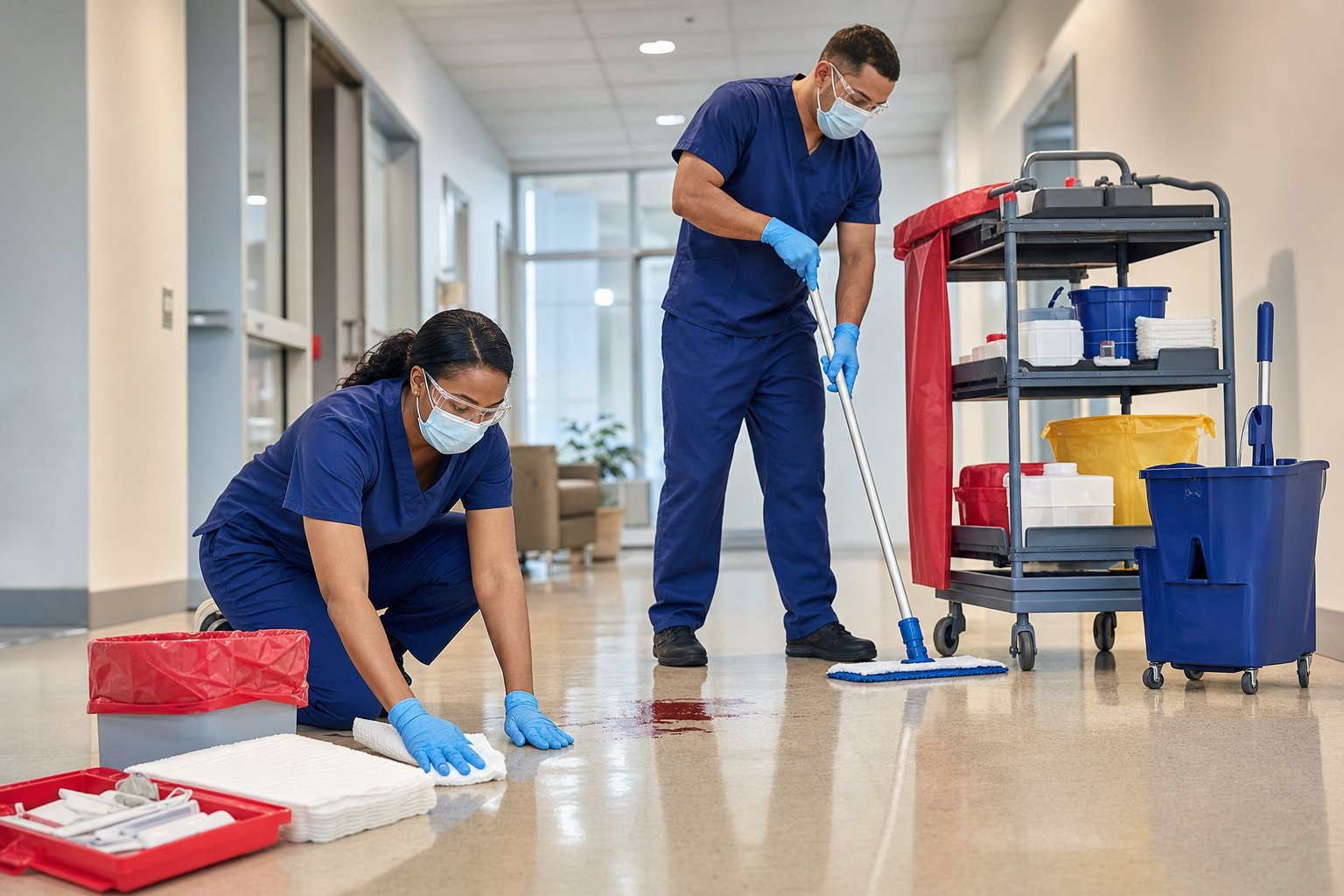
Commercial cleaning teams can encounter blood, bodily fluids, sharps, contaminated waste, or unknown spills in offices, schools, healthcare-adjacent spaces, shelters, public buildings, hotels, and industrial facilities. A safe program does not ask a cleaner to improvise. It defines exposure controls, training, personal protective equipment, incident reporting, waste handling, and the boundary between routine janitorial work and specialized response. GreenPoint Maintenance Services helps facilities across New York, New Jersey, Connecticut, Pennsylvania, and Florida align day-to-day cleaning operations with OSHA bloodborne-pathogen practices and documented supervision.
Know when the bloodborne-pathogens standard may apply
OSHA’s bloodborne-pathogens standard is designed for employees with reasonably anticipated occupational exposure to blood or other potentially infectious materials. An office cleaner who only handles sealed trash may have a different exposure profile from a school custodian, shelter team, healthcare environmental-services worker, or restroom responder. The employer must evaluate actual duties, not simply label every cleaner the same. GreenPoint begins with a task and location assessment.
List restrooms, first-aid rooms, clinics, athletic areas, childcare rooms, shelters, holding areas, waste rooms, and public paths where incidents may occur. Identify who discovers an incident, who secures the area, who responds, who supplies PPE, and who calls a specialized vendor. The [medical office cleaning requirements](/blog/medical-office-cleaning-requirements-osha/) guide provides related planning context, but the site’s exposure-control plan and OSHA requirements govern.
Write and maintain an exposure-control plan
An exposure-control plan should identify job classifications and tasks with exposure, methods of compliance, engineering and work-practice controls, PPE, housekeeping, regulated-waste handling, hepatitis B vaccination and post-exposure procedures where applicable, training, and recordkeeping. Review it at least annually and when duties or technology change. GreenPoint can help translate a facility’s plan into room-specific work instructions; it does not replace the employer’s legal responsibility to maintain the plan.
Make the plan usable at 6 a.m. on a weekend. Put the incident contact, PPE location, spill kit location, waste instructions, and stop-work rule in the supervisor’s field materials. A cleaner should know whom to call before touching an unknown spill. Call 844-814-0810 for a walkthrough focused on exposure points and response boundaries.
Use engineering and work-practice controls first
Controls reduce exposure before PPE is considered. Use puncture-resistant sharps containers where sharps may be found, tongs or brush-and-dustpan tools rather than hands, leak-resistant bags, handwashing facilities, barriers, and written procedures. Never recap, bend, break, or remove needles by hand. Treat all blood and certain body fluids as potentially infectious under the applicable procedure, even when the source is unknown.
GreenPoint trains staff to stop work, isolate the area, notify the supervisor, and follow the client’s response plan. Routine cleaning should not begin until the correct PPE, tools, disinfectant, and waste container are available. Product labels matter: cleaning removes soil, while disinfection requires an appropriate EPA-registered product, correct concentration, coverage, and contact time.
Select PPE and remove it safely
PPE depends on the anticipated exposure: gloves, eye or face protection, protective clothing, and other equipment specified by the employer’s hazard assessment. Gloves are not a substitute for hand hygiene, and damaged or visibly contaminated PPE must be changed according to the procedure. Staff should know the order and method for donning and removing PPE without contaminating skin, clothing, carts, or clean surfaces.
Keep PPE in a known, stocked location and inspect supplies before the shift. Do not carry used gloves through a public corridor or place contaminated items on a clean cart. GreenPoint supervisors check kit readiness and document shortages as corrective actions. GreenPoint uses Green Seal certified products where appropriate, but product certification never replaces PPE, label directions, or the exposure-control plan.
Manage sharps, regulated waste, and laundry
A needle, broken contaminated glass, or other sharp must be handled with tools and placed directly into an appropriate closable, puncture-resistant, leak-resistant, labeled or color-coded container. Do not compress bags by hand or reach into a waste container. The facility’s regulated-waste vendor and exposure plan determine storage, pickup, and disposal requirements. Janitorial staff should know the handoff, even when they are not authorized to transport regulated waste.
Contaminated laundry or reusable materials require procedures that minimize handling, bagging, and leakage. Carts should be cleaned and separated from clean supplies. If an item is unclear, stop and escalate rather than guessing. StockPoint can document the incident location, time, response owner, inspection, and closeout without photographing blood, people, or identifying information.
Train, demonstrate, and refresh competence
Training should occur at initial assignment and at least annually, plus whenever a new task or procedure changes exposure. Cover the standard and exposure-control plan, modes of transmission, recognition of tasks, controls, PPE, hepatitis B information where applicable, emergency actions, signs and labels, and how to report an exposure. Use demonstration or observation for sharps tools, PPE removal, spill-kit setup, and hand hygiene instead of relying only on a slide deck.
New or replacement staff need the same site-specific briefing before entering a high-risk zone. GreenPoint’s retention-focused management model helps maintain continuity, while a named backup and current training log protect the facility when staffing changes. For broader turnover planning, see [janitorial employee turnover impact](/blog/janitorial-employee-turnover-impact/). Call 844-814-0810 to review training and supervision needs.
Document incidents and post-exposure response
An exposure incident needs immediate reporting, evaluation, and follow-up under the employer’s program. Document facts without speculation: location, time, task, material, PPE, injury or contact, controls used, witnesses, supervisor notification, cleanup, waste handoff, and corrective action. The employer determines medical evaluation, vaccination, and confidentiality requirements. GreenPoint can provide operational records, but the client’s occupational-health process governs post-exposure care.
Use trend review to prevent recurrence. Repeated sharps in one restroom may require a different container, a security or outreach intervention, or a change in inspection frequency. Repeated glove shortages are a supply-control problem. StockPoint can show the pattern through timestamped records and corrective actions while protecting sensitive information. ATP testing is not relevant to proving bloodborne-pathogen safety and should not be presented as a substitute for exposure controls.
Apply the plan across the tri-state region and Florida
A Manhattan office near Penn Station, a Bronx school, a Brooklyn shelter, a Queens clinic, a Staten Island public building, a Westchester campus, or a Long Island warehouse may have different incident routes and waste contacts. New Jersey and Connecticut sites may share buildings with healthcare or public agencies; Pennsylvania and Florida facilities have their own state and local requirements. Build the site plan around the actual facility and applicable authority, not a generic regional checklist.
Record building security, transit and loading constraints, emergency numbers, local waste vendors, and after-hours access. Hurricane, flood, snow, or heat events can change the risk profile and should have a contingency path. GreenPoint can coordinate multi-site service with consistent training and separate site rules. Fixed pricing states the routine scope without hourly billing or hidden fees.
Select a janitorial partner with safety proof
Ask a vendor for training topics, exposure-control responsibilities, PPE and spill-kit process, background screening, insurance, supervision, regulated-waste boundaries, incident escalation, and sample redacted records. Ask what the crew will refuse to handle and who responds instead. A provider that claims every incident is “just routine cleaning” is not giving a facility a safe boundary.
GreenPoint Maintenance Services is MBE/MWBE certified through NYS, NYC, and NYC DOE programs and registered in SAM.gov. GreenPoint Maintenance Services offers fixed pricing with no hourly billing or hidden fees, StockPoint-ready documentation, and Green Seal certified products where appropriate. GreenPoint’s 98% client retention is a useful service proof point, while the facility retains responsibility for its OSHA program. Email info@greenpointms.com or call 844-814-0810 for a walkthrough.
Frequently Asked Questions
Question: What should a janitor do after finding blood or a sharp? Answer: Stop, keep others away, notify the supervisor, use the facility’s exposure-control procedure, and wait for the trained response with correct PPE and tools. Never pick up a sharp by hand or improvise with an unapproved product.
Question: Does every commercial cleaner need bloodborne-pathogen training? Answer: Training and controls depend on reasonably anticipated occupational exposure and job duties. Employers should evaluate tasks and locations, maintain the applicable plan, and train affected employees before assignment and at required refresh intervals.
Question: Can GreenPoint handle blood cleanup? Answer: GreenPoint can review the facility’s exposure-control boundaries and provide trained routine janitorial operations or coordinate an approved response path. The exact work depends on the site plan, personnel training, PPE, waste rules, and client authorization.
Question: Does ATP testing prove bloodborne-pathogen safety? Answer: No. ATP is not a pathogen test and does not replace exposure controls, PPE, approved disinfectants, incident procedures, or medical follow-up. It should not be used as evidence that an exposure risk was eliminated.
Question: How do I schedule a safety walkthrough? Answer: Call GreenPoint at 844-814-0810 or email info@greenpointms.com. The team can review incident locations, routine versus specialized work, training, documentation, and fixed-price service boundaries.
Strengthen your exposure-control workflow with GreenPoint Maintenance Services. Call 844-814-0810 for a walkthrough, documented training and response boundaries, fixed pricing with no hourly billing or hidden fees, and StockPoint-ready records backed by GreenPoint’s 98% client retention.