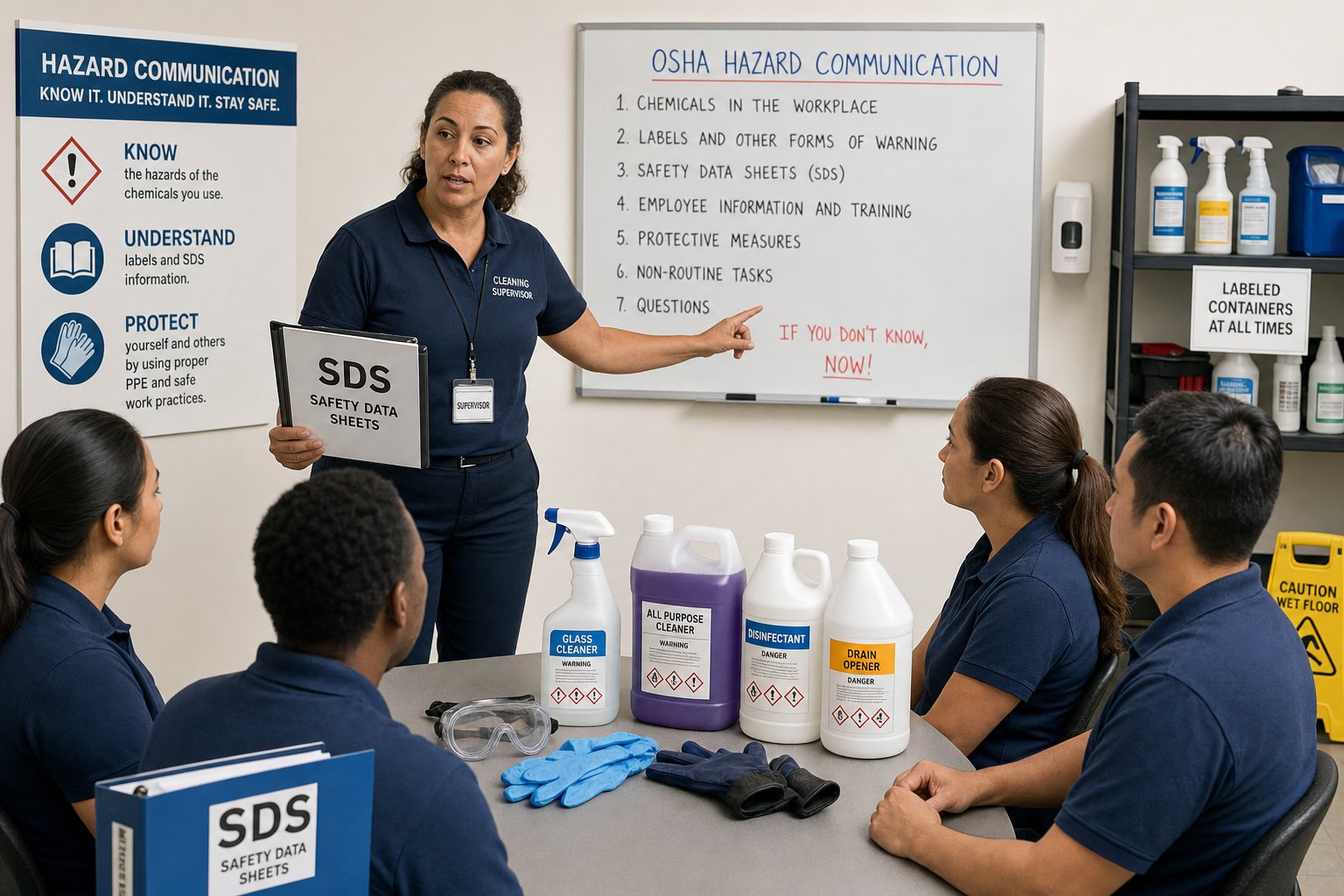
Cleaning chemicals are manageable workplace hazards when the employer knows what is on site, how each product is used, and how employees receive information before exposure. OSHA’s Hazard Communication Standard, 29 CFR 1910.1200, requires a written program, labels, safety data sheets, and employee information and training for covered hazardous chemicals. A commercial cleaning contractor also needs practical controls for dilution, storage, PPE, spills, and changing products. This guide shows facility managers how to audit a cleaning team in New York, New Jersey, Connecticut, Pennsylvania, and Florida without turning compliance into a paper exercise.
Start with a complete chemical inventory
Walk every janitor closet, cart, supply room, kitchen, restroom cabinet, loading area, and maintenance shop. Record product name, manufacturer, container size, use, location, status, and responsible supervisor. Include concentrates, ready-to-use sprays, disinfectants, floor finishes, strippers, degreasers, glass cleaners, aerosols, and products brought in by tenants or specialty vendors. GreenPoint Maintenance Services uses an approved inventory because an SDS binder cannot protect workers from a product that the manager does not know is present.
Assign an owner for updates. The inventory should change when a product is purchased, substituted, discontinued, transferred, or found in an unapproved area. Review it after a spill, injury, odor complaint, or process change. A 100,000-square-foot office near Grand Central Terminal may have multiple closets and third-party food service, while a medical office in Norwalk or a school in Queens has different chemical boundaries. GreenPoint can map those locations during a walkthrough; call 347-332-9348 to set one up.
Keep labels intact and understandable
Every shipped container needs the required manufacturer information, product identifier, signal word where applicable, hazard statements, pictograms, precautionary statements, and responsible contact. Secondary containers need a workplace label that communicates the identity and hazards to the person using it. Never leave a spray bottle marked only “bathroom” or “blue cleaner.” GreenPoint uses clear labels and trains employees not to guess at an unidentified bottle; an unknown chemical is an escalation, not a cleaning assignment.
Labels must remain readable after repeated handling and wet-cart exposure. Store containers upright, closed, and in a location that prevents damage or incompatible contact. Keep food, linens, and personal items out of chemical storage. GreenPoint supervisors inspect labels during route visits and can use JaniTrack task records plus approved timestamped photos to document a corrected closet where the client permits imagery. A visible correction is more useful than a generic statement that “safety was reviewed.”
Dilution bottles need special attention. If a concentrate is transferred into a secondary container, the label must identify the product and hazard information required by the written program. Use closed dilution-control equipment when feasible, measure accurately, and never mix products. GreenPoint Maintenance Services includes dilution, contact time, PPE, and incompatibility reminders in task training and verifies that the method used at a site matches the approved product list.
Make SDS access immediate
Safety data sheets must be readily accessible during each work shift to employees in their work areas. Digital access can work when employees can use it reliably, but provide a backup if phones, passwords, connectivity, or language create barriers. Organize SDS files alphabetically or by product family, mark the revision date, and remove obsolete duplicates while retaining records according to the written program. GreenPoint gives supervisors a current product list and a practical way to retrieve an SDS before a task or after an exposure.
Teach employees how to use an SDS rather than only where it sits. Sections 2, 4, 6, 7, 8, and 10 are especially useful for hazards, first aid, spills, handling, PPE, and incompatibilities. The [commercial cleaning contract key terms guide](/blog/commercial-cleaning-contract-key-terms/) can help buyers add SDS ownership, substitution notice, and training evidence to a vendor agreement. GreenPoint explains the relevant sections during onboarding using the actual products at the facility.
Post emergency contacts and the response route. Employees should know who to call for an eye exposure, inhalation concern, spill, splash on a surface, or suspected chemical reaction. The plan should identify eyewash or flushing locations, medical evaluation, area isolation, ventilation, waste handling, and incident reporting. GreenPoint’s supervisor and client contact process prevents a cleaner in Manhattan, Jersey City, Stamford, Philadelphia, or Miami from trying to solve an unfamiliar event alone.
Train before the first exposure
Initial training should occur before an employee uses a hazardous chemical and when a new chemical hazard is introduced. Cover the written program, operations where chemicals are present, methods to detect a release, physical and health hazards, protective measures, labeling, SDS access, PPE, and emergency procedures. Use plain language and demonstrate the task. GreenPoint records training by employee, site, date, topics, trainer, and refresher need; a signature without a practical demonstration is a weak assurance.
Training should match the work area. A restroom cleaner needs splash control, ventilation, dilution, and contact-time instruction. A floor-care specialist needs stripper and finish controls, wet-floor barricades, machine safety, and storage. A kitchen team needs food-contact restrictions and separation from food. A medical facility needs escalation for blood or body-fluid incidents. GreenPoint Maintenance Services builds role-based modules instead of handing every employee the same generic slide deck.
Refresh training after a near miss, a label change, a new product, a new process, a transfer to another site, or a pattern of inspection findings. Supervisors can observe one task each week and coach on bottle identity, PPE, spray direction, dwell time, and cart placement. GreenPoint uses JaniTrack exceptions to identify where refresher coaching is needed and reports trends to the client. Call 347-332-9348 if your facility has frequent product substitutions or multiple contractors sharing storage.
Control PPE, storage, and incompatibility
Select PPE from the product label, SDS, task assessment, and facility conditions. Gloves are not interchangeable: material compatibility, cuff length, reuse rules, and hand hygiene matter. Eye protection may be required for concentrates or splash-prone work. Respiratory protection triggers a separate OSHA program when applicable; a paper dust mask is not a substitute for that program. GreenPoint provides task-specific PPE guidance and checks availability before work begins.
Separate incompatible chemicals and keep heavy containers low enough to handle safely. Do not store acids beside chlorine products, or oxidizers with combustible materials. Keep concentrates away from heat, drains, sunlight, and unauthorized access as appropriate to the SDS. A fire-code cleaning chemical storage plan should also account for egress, sprinkler clearance, and local building rules. GreenPoint can review closets in high-rises, schools, medical suites, warehouses, and hospitality facilities and include corrective work in a fixed quote.
Carts are part of the control system. Use closed containers, secure bottles upright, keep a spill kit available, and never leave a cart unattended in a public corridor. Mark wet areas and remove signs when the floor is safe. GreenPoint supervisors verify cart setup and route behavior because a correctly labeled bottle still creates risk if it falls beside a crowded elevator at Penn Station or a school entrance during dismissal.
Write a vendor-ready compliance scope
A contract should state who maintains the written hazard communication program, who supplies and approves chemicals, who owns SDS updates, how substitutions are approved, what training is required, and how incidents are reported. Include inventory frequency, supervisor inspections, audit access, language needs, and correction deadlines. GreenPoint Maintenance Services provides fixed pricing, no hourly billing, and no hidden fees when the scope is clear, and can attach a product matrix to the statement of work.
Specify evidence without creating useless paperwork. A monthly report can show active products, SDS review date, training completions, inspection findings, incidents, open corrective actions, and substitutions. JaniTrack provides live dashboard visibility, route status, and timestamped GPS-tagged photos where approved. GreenPoint uses evidence to focus a coaching conversation: if a closet is missing a label, the record assigns a correction and confirms closure instead of hiding the issue in a score.
Connect OSHA controls to the local operation. NYC commercial buildings may have crowded service corridors and limited storage; New Jersey and Connecticut properties may share closets with building engineering; Pennsylvania campuses may have multiple departments; Florida sites may need moisture and storm-response planning. GreenPoint is MBE/MWBE certified in New York, SAM.gov registered, and serves the tri-state area, Pennsylvania, and Florida. Schedule a walkthrough at 347-332-9348 to align the written program with the actual site.
Audit and improve the program
Conduct a quarterly field audit with the supervisor and facility manager. Select random closets and carts, compare each container to the inventory, retrieve several SDS documents, observe a dilution task, confirm PPE, inspect labels, and interview employees. Record findings by risk and assign an owner and due date. GreenPoint’s 98% client retention is supported by this practical feedback loop: the team looks for leading indicators before an incident or regulatory visit forces a reaction.
Review metrics that reveal control quality: percentage of active products with current SDS, training completion before assignment, label defects corrected within one shift, spills and near misses, substitution approvals, PPE stockouts, and repeat findings by site. Do not reward a team for reporting zero incidents if people are discouraged from reporting. GreenPoint encourages transparent exceptions and uses corrective action to improve the process, not to blame a cleaner for a confusing label or missing supply.
For a second opinion, compare your program with the [OSHA cleaning chemical safety and GHS/SDS guide](/blog/osha-cleaning-chemical-safety-ghs-sds/) and the [EPA Safer Choice commercial cleaning guide](/blog/epa-safer-choice-commercial-cleaning/). Then call GreenPoint at 347-332-9348 for a walkthrough and written quote. A compliant program should be understandable at the closet, cart, and task level.
Frequently Asked Questions
Q: What does OSHA Hazard Communication require from a cleaning employer? A: The program generally includes a written plan, chemical inventory, labels, accessible SDS, employee information and training, and methods to protect workers from hazards. GreenPoint can help a client verify vendor responsibilities and field controls.
Q: Does every secondary container need a label? A: A workplace container label must identify the contents and communicate required hazard information, subject to the standard’s limited exceptions. GreenPoint never relies on color or memory for an unidentified bottle.
Q: How often should cleaning staff receive chemical training? A: Before first use and when a new hazard or chemical is introduced, with refreshers after incidents, process changes, transfers, or repeat findings. GreenPoint also uses supervisor observations for ongoing coaching.
Q: Can SDS files be digital? A: Yes, when employees can access them readily during the shift and a reliable backup exists. GreenPoint confirms access during site onboarding instead of assuming a web link works for everyone.
Q: How do I schedule an OSHA cleaning compliance review? A: Call GreenPoint Maintenance Services at 347-332-9348. GreenPoint will review closets, carts, labels, SDS access, PPE, training, and reporting before issuing fixed pricing.
Run a short field exercise as part of the audit. Ask a cleaner to identify a product, find its SDS, explain the dilution, select the required PPE, describe a splash response, and point to the nearest reporting contact. Do not coach during the first attempt; the gaps show where the written program is hard to use. GreenPoint turns those observations into a focused refresher, updates the label or storage location, and confirms the correction on the next supervisor visit. A five-minute demonstration in the actual closet often reveals more than a long annual presentation.
Make OSHA chemical communication practical with GreenPoint Maintenance Services at 347-332-9348. Receive a site-specific inventory review, labeled workflows, JaniTrack verification, and a partner with 98% client retention.