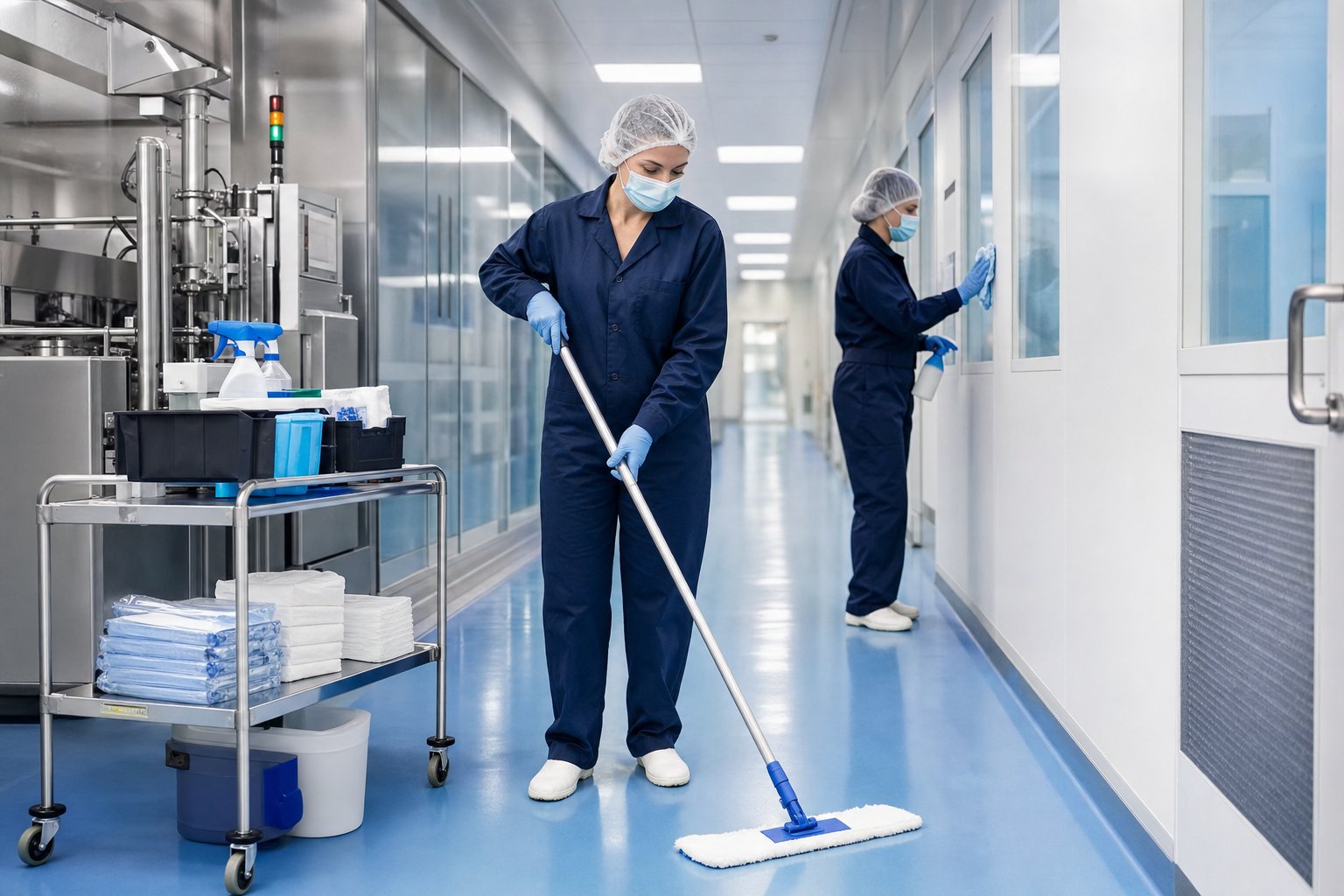
Pharmaceutical cleaning is a controlled process, not a generic janitorial checklist. A facility may contain offices, warehouses, laboratories, gowning rooms, production suites, corridors, and waste streams with very different controls. A sound program defines who may enter each zone, which tools and products are allowed, what sequence prevents cross-contamination, and how every deviation is closed. GreenPoint Maintenance Services supports pharmaceutical and life-science facilities across New York, New Jersey, Connecticut, Pennsylvania, and Florida with documented scopes, trained teams, and measurable quality assurance.
Start with the facility zoning and risk map
Before assigning frequency, classify spaces by product risk, personnel flow, material flow, and environmental requirements. An office corridor may need routine vacuuming and touchpoint cleaning; a controlled production area may require dedicated tools, gowning compliance, and approved disinfectants. Separate receiving docks, quarantine storage, laboratories, washrooms, and waste staging from clean-side zones in the work plan. GreenPoint begins with a room list and access matrix so a cleaner does not improvise at a door or move equipment between incompatible areas.
Record surfaces and fixtures by room: floors, coving, doors, pass-throughs, drains, benches, carts, light switches, and emergency equipment. Note square footage and the number of shifts because a 50,000-square-foot New Jersey warehouse running three shifts has a different soil load from a 12,000-square-foot research suite. The plan should identify critical surfaces and who releases a room after service.
Translate cGMP expectations into repeatable work
cGMP-aligned cleaning depends on repeatability. A standard operating procedure should specify preparation, PPE, equipment, solution identification, cleaning direction, contact time where applicable, waste handling, inspection, and documentation. Avoid vague instructions such as “sanitize production area.” State the zone, the surface, the approved agent, the tool color, the sequence, and the acceptance check. GreenPoint’s supervisor trains to the written SOP and records refreshers when the process changes.
A useful sequence often moves from cleaner to dirtier areas, high to low surfaces, and least critical to more critical zones, subject to the facility’s validated procedure. Use dedicated microfiber and mop systems, label secondary containers, and never mix chemicals. The [color-coded microfiber systems](/blog/color-coded-microfiber-systems-guide/) guide shows how visual controls reduce cross-use in ordinary commercial settings; a pharmaceutical site should adapt the principle to its validated program and QA approval.
Chemical control, SDS access, and worker safety
OSHA Hazard Communication requirements make chemical identity, labels, safety data sheets, and training central to the program. Keep current SDS information available to the crew and facility contact, control dilution with measured systems, and document any product substitution through the client’s change-control process. GreenPoint uses Green Seal certified products where they meet the surface and process requirements, but certification never overrides a validated pharmaceutical procedure or an approved disinfectant list.
PPE and engineering controls should be proportionate to the work. Define eye and hand protection, respiratory rules if applicable, spill response, sharps procedures, ergonomics, and wet-floor controls. A supervisor should verify that carts are stocked before entering a controlled area, because leaving a zone for a missing item can create an access or contamination problem. Call 844-814-0810 to discuss a safety-centered walkthrough.
Documentation is part of the cleaning outcome
In regulated environments, an undocumented task is difficult to defend. The record should connect date, time, employee, room, procedure version, product or lot where required, inspection result, exception, and corrective action. Avoid backfilling logs from memory. A clear electronic record gives QA and operations a shared view of what happened and what still needs attention.
StockPoint can support this operational layer with timestamped GPS-tagged photos, task checklists, supervisor inspections, and dashboard reporting, subject to the client’s data and photography rules. Photos should never expose proprietary formulas, patient information, or restricted production details. ATP testing can be used as a trend indicator on selected non-product-contact surfaces when the site approves it; it is not a substitute for microbiological validation or release testing. GreenPoint treats the dashboard as evidence that supports, rather than replaces, the site quality system.
Training, access, and personnel reliability
A pharmaceutical cleaning team needs more than an orientation video. Train on the facility map, gowning and traffic rules, hygiene, chemical handling, equipment care, emergency procedures, documentation, and escalation. Use observation or demonstration to confirm competence, then refresh training after deviations, product changes, or extended absence. Access should be role-based: the cleaner sees what is needed for the assigned zone, while the account lead and client decide who can enter restricted areas.
Reliability matters at shift change. Maintain a named backup, a handoff log, and a rule that the replacement cannot assume a controlled task without current training. GreenPoint’s retention-focused management model aims to reduce the disruption associated with turnover. For broader context on the financial impact of staffing instability, see [janitorial employee turnover impact](/blog/janitorial-employee-turnover-impact/).
Regional considerations for NY, NJ, CT, PA, and FL
Life-science corridors in New Jersey, Long Island, Westchester, Connecticut, and Pennsylvania may have union rules, multiple shifts, controlled loading docks, and shared campuses. In New York City, a site near Brooklyn Navy Yard, Long Island City, or Manhattan needs a delivery and elevator plan; in New Jersey, Princeton, New Brunswick, and the I-287 corridor often require badge coordination and parking controls. Pennsylvania facilities around Philadelphia and King of Prussia may combine laboratory and warehouse functions. Florida sites in Miami-Dade and Tampa add humidity and storm-readiness concerns.
The geography should be reflected in staffing and response commitments, not hidden as an afterthought. List the local contact, after-hours number, access restrictions, emergency vendor rules, and expected response time. GreenPoint can coordinate regional coverage while keeping each facility’s SOP and approval path distinct. Fixed pricing applies to the agreed scope, with no hourly billing or hidden fees.
QA checks, deviations, and corrective action
Build quality checks at three levels: the cleaner’s completion record, the supervisor’s visual inspection, and the client’s periodic review. Define what counts as acceptable for residue, streaking, trash, dust, odor, and equipment placement. Trend failures by room and task rather than blaming individuals; repeated misses may point to an unrealistic frequency, a difficult surface, a supply issue, or an unclear SOP.
When a deviation occurs, contain it, notify the right owner, document facts, correct the condition, and verify the correction. StockPoint can make the closeout visible to operations and the client, while the facility’s quality unit determines whether a formal investigation or impact assessment is needed. GreenPoint Maintenance Services provides the staffing, supervision, and evidence layer; the client retains control of validated processes and product release decisions.
How to select a pharmaceutical cleaning partner
Ask for experience with controlled environments, training records, insurance, background-screening practices, supervisor coverage, chemical controls, and sample reports. Ask how the vendor handles restricted photography, after-hours access, a failed inspection, a product change, and a sudden shutdown. Request a proposed room matrix with frequencies and exclusions, not a one-page promise to “keep the facility clean.”
GreenPoint is MBE/MWBE certified through NYS, NYC, and NYC DOE programs and registered in SAM.gov. The company offers fixed pricing, no hourly billing, and no hidden fees when the scope is defined. GreenPoint’s 98% client retention reflects a focus on accountable service, while StockPoint verification gives facility leaders a way to review completion and trends. Call 844-814-0810 for a walkthrough and a cGMP-aware scope discussion.
Measure readiness and improve the program
Set performance indicators before launch so the cleaning program can improve without weakening compliance. Useful measures include completion by room, first-pass inspection rate, training currency, deviation closeout time, repeat findings, and supply or equipment failures. GreenPoint reviews trends with the client’s operations owner while respecting the quality unit’s authority over validated processes and release decisions.
A change-control trigger should be written into the contract. New equipment, room reclassification, product change, construction, revised SOP, or a new shift can alter the cleaning risk. The account lead should pause and confirm the updated requirements rather than allowing a familiar crew to continue by habit. That discipline is especially important on multi-building campuses.
Emergency planning should cover spills, utility interruptions, weather, access loss, and an unexpected shutdown. Name the notification order and keep a trained backup roster. In Florida, storm preparation may include protecting supplies and coordinating re-entry; in the Northeast, snow and transit disruptions may affect arrival. GreenPoint can build local contacts into the plan while keeping the facility’s approval chain intact.
Procurement teams should compare total program value, not only the monthly line item. Include supervision, training, documentation, replacement coverage, equipment, consumables, corrective action, and the cost of a preventable deviation. A lower bid that omits QA support or restricts access coverage may cost more after rework. GreenPoint presents inclusions and exclusions in plain language before award.
For a new facility, schedule a readiness review before the first production shift. Walk the route, test the cart setup, confirm approved products, inspect storage, and rehearse a room release. GreenPoint can coordinate this review and provide a fixed-price scope after the details are confirmed. Call 844-814-0810 when the quality and facilities teams are ready to align.
Frequently Asked Questions
Question: What is included in pharmaceutical facility cleaning? Answer: It may include controlled-zone floors and surfaces, gowning areas, corridors, restrooms, offices, warehouses, waste staging, and specialty tasks. The exact work must follow the facility’s SOPs, approved products, access rules, and QA requirements.
Question: Can a janitorial company work in a cGMP facility? Answer: Yes, when the provider is trained to the site procedures, follows access and gowning controls, uses approved tools and chemicals, and maintains complete records. GreenPoint coordinates its program with the client’s quality and operations owners.
Question: Does ATP testing validate pharmaceutical cleaning? Answer: ATP can provide a rapid trend signal about organic residue on selected surfaces, but it does not prove sterility or replace validated microbiological methods. Use it only within an approved monitoring plan.
Question: How is cleaning work documented? Answer: A strong record links the employee, room, time, procedure, product where required, inspection, exception, and corrective action. StockPoint can support checklists, timestamped GPS-tagged photos, and dashboard reporting when the site permits those controls.
Question: How can I request a pharmaceutical facility cleaning walkthrough? Answer: Call GreenPoint at 844-814-0810 or email info@greenpointms.com. The walkthrough can map zones, shifts, access, SOP ownership, and a fixed-price service scope.
For a pharmaceutical cleaning walkthrough across NY, NJ, CT, PA, or FL, call GreenPoint Maintenance Services at 844-814-0810. Get a trained, documented program with StockPoint-ready verification, MBE/MWBE credentials, and fixed pricing with no hidden fees.