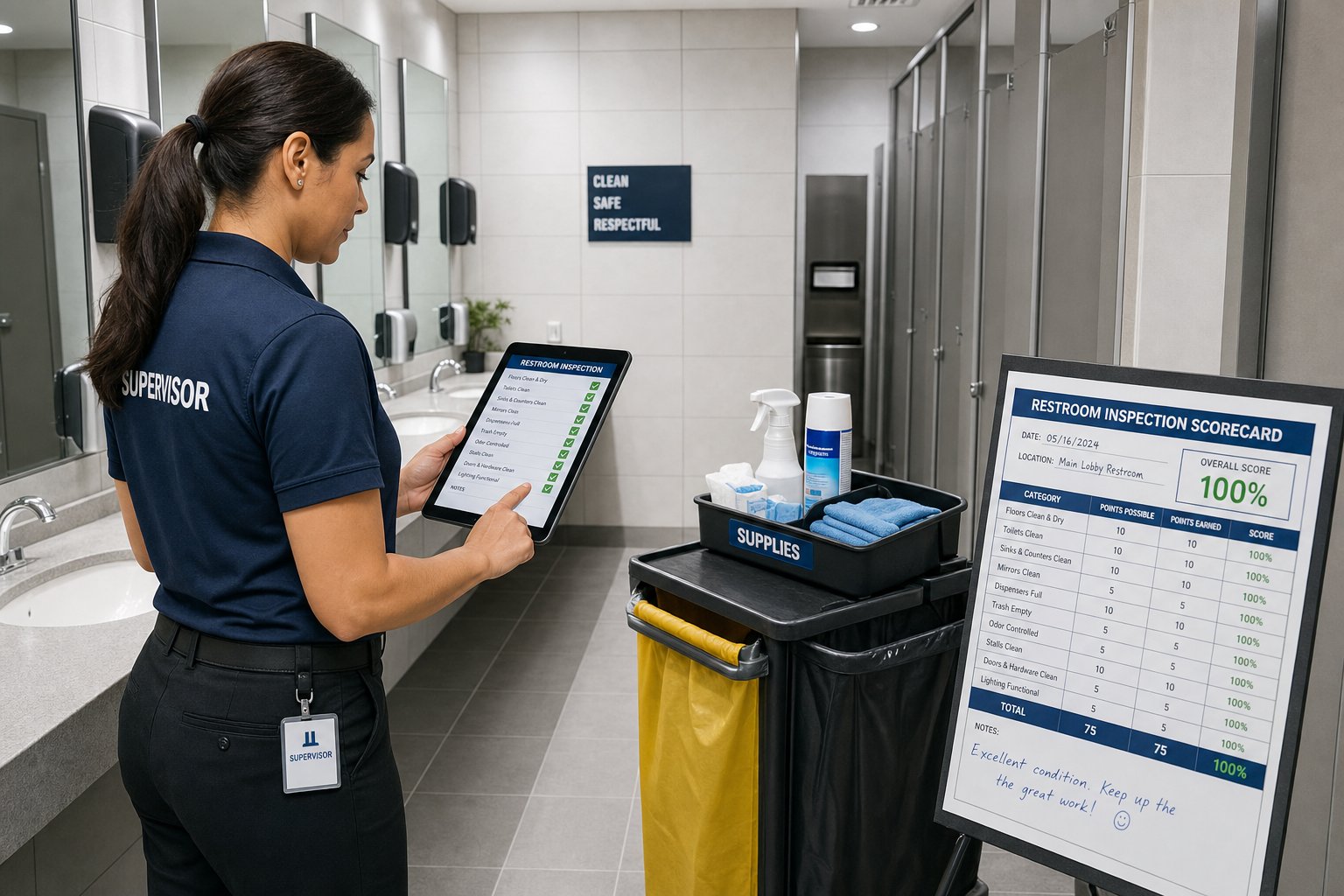
A restroom is the most frequently judged space in a commercial building. A tenant, patient, student, customer, or inspector can form an opinion in less than a minute from the condition of the entry, odor, fixtures, floors, and handwashing supplies. A repeatable restroom quality audit turns that subjective moment into a documented operating standard. In Manhattan towers, Bronx medical offices, Brooklyn retail corridors, Queens distribution sites, Staten Island public facilities, Westchester campuses, and Long Island offices, GreenPoint Maintenance Services uses a structured checklist to connect appearance with hygiene, response time, and proof. This guide shows facility managers how to audit restrooms consistently, set a practical score, and correct issues before they become complaints.
What a Commercial Restroom Audit Actually Measures
A useful audit measures five dimensions: cleanliness, disinfection coverage, supply readiness, condition, and response. Cleanliness includes visible soil, scale, streaks, hair, paper, and residue. Disinfection coverage focuses on touchpoints such as faucet handles, flush controls, stall latches, dispensers, and door pulls. Supply readiness covers soap, towels, tissue, liners, and accessible backup stock. Condition records leaks, loose hardware, burned-out lamps, grout failure, and ventilation concerns. Response measures how quickly the team notices and resolves a problem. GreenPoint scores each dimension separately so a restroom cannot pass simply because the floor looks shiny.
The score should be tied to an area and a time, not just a monthly average. A 10,000-square-foot office near Grand Central may need checks at opening, midday, and close because commuter traffic changes sharply. A Brooklyn school or NYC DOE-related facility needs a different schedule around arrival, lunch, and dismissal. ISSA's clean-appearance framework is helpful for defining what users see, while OSHA sanitation expectations and local health requirements inform supplies and safe work practices. GreenPoint Maintenance Services documents both the visible standard and the operational action behind it.
Build a Zone-by-Zone Checklist
Divide each restroom into zones: entry and doors, sinks and counters, mirrors and dispensers, toilets and urinals, partitions, floors, waste, and air. For every zone, write the pass condition in observable language. For example, 'no visible soil on the front edge of the counter' is auditable; 'counter looks good' is not. Add a supply minimum, such as two full towel cases in a locked janitor closet or a defined number of rolls per fixture bank. A checklist should also identify inaccessible surfaces and note when a repair ticket—not more chemical—is the correct remedy.
Use separate checks for low, medium, and high traffic. A restroom serving 25 office workers per shift will not soil like a Penn Station-adjacent lobby, a Citi Field event-day facility, a Newark transit corridor, or a busy Fort Lauderdale medical office. GreenPoint can map fixtures by room number, assign a service frequency, and include neighborhood-specific logistics such as elevator windows in Midtown, school access controls in the Bronx, or loading-dock timing in Long Island City. Link the audit to the [restroom cleaning best practices guide](/blog/restroom-cleaning-best-practices-high-traffic/) and [cleaning frequency standards](/blog/cleaning-frequency-standards-by-facility-type/) for a consistent baseline.
Set a Weighted Score That Managers Can Use
A practical 100-point score gives 30 points to visible cleanliness, 25 to touchpoint and fixture hygiene, 20 to supplies, 15 to condition and safety, and 10 to documentation and response. Set a pass threshold of 90 for ordinary office areas, 95 for healthcare or childcare environments, and a corrective-action trigger below 85. These figures are management thresholds, not a substitute for a public-health rule. The point is to make priorities visible: a missing soap dispenser should not be hidden by a perfect mirror, and a wet floor should trigger immediate response even if the weekly score remains high.
Record the observation, not just the number. A score of 92 with three empty towel dispensers tells a different story from a score of 92 with one minor wall scuff. GreenPoint's supervisor review separates critical failures—wet floors, blocked access, sewage odor, sharps, or chemical exposure—from routine appearance defects. When a facility manager calls 844-814-0810 for a walkthrough, GreenPoint can translate those priorities into a service plan, fixed scope, and documented escalation path rather than a vague promise to 'check more often.'
Use StockPoint Evidence to Close the Loop
A paper checklist proves that someone wrote something down; it does not necessarily prove when or where the work occurred. StockPoint adds timestamped, GPS-tagged photos, ATP testing where appropriate, and a live dashboard that makes the audit visible to the client team. A photo of a replenished dispenser, paired with a timestamp and room identifier, gives a property manager more confidence than a generic end-of-night signature. ATP results can be used as a trend signal for selected touchpoints, not as a stand-alone definition of clean.
GreenPoint uses evidence proportionally. A high-rise may need dashboard reporting by floor, while a small Queens clinic may need a weekly exception report and a corrective-action log. The [digital cleaning verification systems guide](/blog/digital-cleaning-verification-systems/) explains the difference between activity logs and quality assurance. GreenPoint Maintenance Services can also show how StockPoint supports a 98% client-retention operating model: recurring issues are assigned, time-stamped, and reviewed instead of being forgotten after a complaint.
Make Supplies and Safety Part of Quality
An audit should check soap, towel, tissue, liner, and sanitizer levels against the next service window. Keeping a reserve is especially important before storms, holiday closures, and high-volume events in Manhattan, Brooklyn, Newark, Stamford, Philadelphia, or South Florida. Store chemicals according to label directions and the facility's hazard communication program; OSHA's Hazard Communication Standard requires accessible safety information and training for hazardous chemicals. Never mix products, decant unlabeled chemicals, or leave a cart unattended in a public path.
Ventilation, slip resistance, and handwashing access are also quality measures. A strong fragrance can mask an underlying drain or moisture problem, and over-wetting a resilient floor can create a slip risk. GreenPoint's supervisor documents defects for the building engineer and keeps cleaning scope separate from repairs. If a manager needs a broader review, the [OSHA cleaning chemical safety and GHS/SDS guide](/blog/osha-cleaning-chemical-safety-ghs-sds/) and [color-coded microfiber systems guide](/blog/color-coded-microfiber-systems-guide/) provide useful controls for staff onboarding.
Adapt Audits to New York, New Jersey, Connecticut, Pennsylvania, and Florida
Local conditions change the audit. In Manhattan and Downtown Brooklyn, transit-driven peaks and limited storage make response routes important. In the Bronx and Queens, schools, clinics, and mixed-use buildings may have controlled access or shared restrooms. Westchester and Long Island properties often spread across multiple buildings, so travel time and stock staging affect service. New Jersey and Connecticut facilities may need evening access coordination, while Philadelphia and South Florida sites face different humidity, storm, and high-traffic patterns. The checklist stays consistent; the route and trigger points change.
For NYC DOE environments, coordinate with the approved-vendor process, school calendar, and site-specific protocols rather than assuming an office standard applies. For healthcare, add privacy, infection-control, and medical-office requirements. GreenPoint is MBE/MWBE certified through NYS, NYC, and NYC DOE programs, SAM.gov registered, and familiar with documented vendor requirements. A facility manager can schedule a walkthrough at 844-814-0810 to map rooms, traffic, transit constraints, and service windows before selecting a score threshold.
Turn Audit Results into a 30-Day Improvement Plan
Start with a baseline week. Audit every restroom at least once per service shift, classify findings as critical, recurring, or cosmetic, and calculate the median score by room and daypart. In week two, correct the top three recurring causes, such as missed touchpoints, late replenishment, or inadequate route timing. In week three, re-audit a sample of 25% of rooms and compare results. In week four, review complaints, supply usage, ATP trends if used, and response times with the account manager. The goal is fewer repeat failures, not a prettier spreadsheet.
Set a clear ownership rule: the cleaner resolves a routine condition, the supervisor verifies a pattern, and the building contact receives a repair or access escalation. GreenPoint's fixed-price proposals can define the audit frequency, included consumables, emergency response assumptions, and reporting cadence without hourly-billing surprises. To request a written scope, call 844-814-0810 or email info@greenpointms.com. GreenPoint will schedule a walkthrough and return a service recommendation that a procurement team can compare.
Use a Pilot Floor or Building Before Scaling
When a portfolio has several buildings, pilot the audit in one representative location for two weeks. Choose a typical floor, a high-traffic lobby, and a restroom with known complaints. GreenPoint can train the site contact on the scorecard, compare opening and midday conditions, and adjust the route before the same standard is rolled across Manhattan, Brooklyn, Queens, or a suburban campus.
At the end of the pilot, publish the room list, score definitions, critical-failure rules, response contacts, supply assumptions, and reporting cadence. That short operating guide gives cleaners, supervisors, tenants, and procurement one version of the truth. GreenPoint Maintenance Services can schedule the pilot walkthrough at 844-814-0810 and carry the approved checklist into a fixed-price proposal.
Use Complaints as Leading Indicators
A complaint is useful only when it is coded. Record the room, time, condition, traffic level, supply status, and whether the issue was visible before the report. GreenPoint reviews these notes by daypart and route. If complaints cluster in a Queens lobby between 11:30 a.m. and 1 p.m., adding a late-morning check may work better than increasing every nightly shift. If a Bronx school reports the same fixture repeatedly, the right action may be a repair or replacement.
Share a monthly one-page trend with the client: total inspections, pass rate, critical failures, repeat findings, response time, supply exceptions, and open repairs. This keeps the audit focused on decisions. GreenPoint can prepare that review after a walkthrough at 844-814-0810 and include the reporting cadence in a fixed-price scope.
Restroom Audit FAQ
Q: How often should a commercial restroom be audited? A: Audit at least once per service shift, then add opening, midday, or event checks when traffic warrants it. High-traffic hubs, schools, healthcare, and public-facing venues often need several checkpoints rather than one nightly inspection.
Q: What is a good passing score? A: Use a documented threshold such as 90 out of 100 for ordinary offices and 95 for higher-risk settings, but define critical failures that require immediate correction regardless of the total. GreenPoint can calibrate the score during a walkthrough.
Q: Does ATP testing replace visual inspection? A: No. ATP can show an objective trend on selected surfaces, while visual inspection confirms appearance, supplies, safety, and condition. StockPoint works best when evidence supports—not replaces—trained supervision.
Q: Who should pay for restroom supplies? A: The contract should state whether tissue, towels, soap, liners, and specialty products are included, marked up, or client-provided. GreenPoint uses fixed scope and replenishment assumptions so managers can compare total cost instead of only labor.
Q: How do I schedule a restroom quality walkthrough? A: Call GreenPoint at 844-814-0810 or email info@greenpointms.com. GreenPoint Maintenance Services can map fixtures, traffic peaks, access rules, and reporting needs across NY, NJ, CT, PA, and FL.
Q: What should be done with an audit score below target? A: Correct any critical safety or sanitation issue immediately, assign an owner and due time for other findings, and recheck the room. GreenPoint records the correction so the next review measures improvement rather than restarting the conversation.
Schedule a commercial restroom quality walkthrough with GreenPoint Maintenance Services at 844-814-0810 or info@greenpointms.com. GreenPoint brings MBE/MWBE certifications, Green Seal certified products, StockPoint verification, and a 98% client-retention record to a fixed-price plan with no hourly billing or hidden fees.