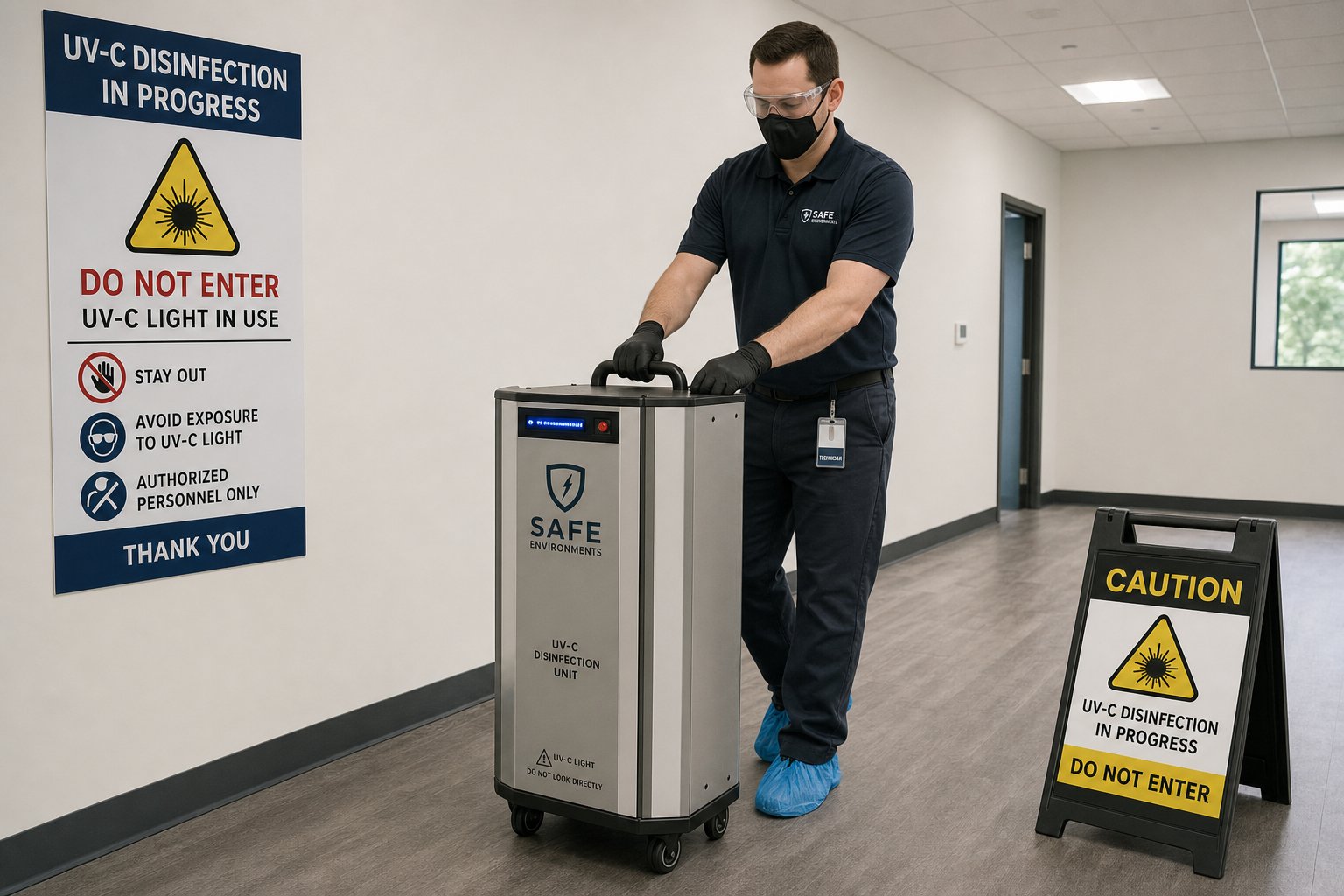
UV-C can support a commercial cleaning program when the equipment, dose, room conditions, and safety controls are understood. It is not a substitute for removing soil, following a disinfectant label, maintaining ventilation, or controlling exposure to people and materials. This guide helps facility managers evaluate UV-C for offices, healthcare support spaces, schools, laboratories, hotels, and transit-adjacent properties in New York, New Jersey, Connecticut, Pennsylvania, and Florida. GreenPoint Maintenance Services treats UV-C as a controlled specialty process, pairs it with routine cleaning and StockPoint documentation, and starts with a walkthrough at 844-814-0810.
Define what UV-C is being asked to do
Before buying or hiring a UV-C service, define the target: supplemental reduction of microorganisms on exposed surfaces, treatment of air or equipment, room turnover support, or a research-informed pilot. Different devices and wavelengths have different performance claims. Ask for manufacturer instructions, irradiance or dose information, validated organism data, maintenance requirements, and limitations. GreenPoint Maintenance Services reviews the facility use, room geometry, occupancy, and surface soil before recommending a scope.
Routine cleaning remains the foundation. Dust, grease, biofilm, and shadowed soil can block or shield surfaces from light. In a crowded clinic near Flushing, a school in the Bronx, or an office near the World Trade Center, the first steps are still waste removal, detergent cleaning, touchpoint service, and ventilation coordination. The [electrostatic disinfection explained guide](/blog/electrostatic-disinfection-explained/) offers a comparison of another supplemental method. GreenPoint avoids one-device claims.
Choose equipment by wavelength and enclosure
UV-C equipment should be evaluated by wavelength, output, exposure pattern, enclosure, interlocks, controls, and intended use. Enclosed systems may be suitable for objects or air pathways when designed for that purpose; open-room devices can create exposure risk if people, pets, or unprotected skin and eyes are present. Ask who is allowed to operate the unit, what training is required, and how the room is confirmed empty. GreenPoint documents the answer in the site procedure and uses signage and access control.
Be cautious with portable consumer devices and vague “sanitizing” claims. A lamp’s wattage does not by itself establish dose at the target surface. Distance, angle, shadow, reflectivity, lamp age, dust, and exposure time all matter. GreenPoint Maintenance Services requests technical documentation and does not promise a performance result that the equipment cannot support. Call 844-814-0810 for a walkthrough that identifies room dimensions, furniture, mirrors, curtains, and access points.
Write an exposure-control procedure
Exposure control is non-negotiable. For open-room UV-C, the procedure should require vacancy confirmation, door locking or interlock, warning signage, a controlled start, a timed cycle, a completion check, and authorization before re-entry. Follow the manufacturer’s instructions and applicable OSHA workplace-safety requirements. Do not rely on a verbal warning in a busy facility. GreenPoint can assign a trained operator, supervisor sign-off, and StockPoint record for each cycle where the client approves the workflow.
Account for people who enter unexpectedly: security, engineering, emergency responders, delivery staff, cleaners, and tenants. Use visible barriers and a contact tree, and stop the cycle if controls fail. PPE is not a reason to permit unprotected exposure or to bypass an interlock. GreenPoint Maintenance Services trains crews on labels, equipment inspection, room release, and incident escalation. The [OSHA cleaning chemical safety and GHS/SDS guide](/blog/osha-cleaning-chemical-safety-ghs-sds/) is a useful companion for chemical controls used alongside UV-C.
Understand shadowing and surface limits
UV-C travels line of sight. Furniture undersides, drawer interiors, wall corners, fabric folds, equipment backs, and crowded shelves may receive little or no effective exposure. A clean-looking room can contain shadowed areas, and a measured dose in one position does not represent every surface. GreenPoint maps the room, reduces clutter where safe, opens doors or drawers only when authorized, and documents the areas the device cannot reach. The right conclusion may be to combine manual touchpoint cleaning with a targeted UV-C cycle.
Materials can also be affected by repeated exposure. Some plastics, rubber, coatings, fabrics, artwork, and finishes may discolor or degrade. Request manufacturer compatibility data and inspect high-use materials over time. UV-C should not be used around people, animals, food, or sensitive equipment unless the device and procedure specifically address those conditions. GreenPoint keeps an exception log in StockPoint and reports concerns rather than continuing a cycle that may damage the client’s property.
Coordinate UV-C with routine cleaning
Use a sequence that makes operational sense: remove waste and clutter, clean and dry surfaces, inspect the room, set the UV-C equipment, clear occupants, run the cycle, and document release. If a chemical disinfectant is also required, follow its label contact time and compatibility instructions; UV-C does not shorten a label requirement unless the product and protocol expressly say so. GreenPoint Maintenance Services writes the order into the scope so a night crew is not forced to improvise at 11 p.m.
Healthcare, schools, hotels, and offices have different turnover pressures. A medical office in Manhattan may need room release between appointments, a school near Queens Boulevard may have a narrow summer window, and a hotel near Newark or JFK may need a room-ready sequence. GreenPoint can pair manual inspection, StockPoint task status, timestamped GPS-tagged photos where appropriate, and supervisor sign-off. Call 844-814-0810 to discuss the actual turnover window.
Verify the process without overclaiming
Verification should confirm that the right room was prepared, the right unit was used, the cycle ran for the specified time, safety controls were active, and the room was released by an authorized person. Capture device ID, operator, start and end time, room, cycle setting, exceptions, and maintenance status. StockPoint can provide a live dashboard and approved photo evidence, but a dashboard entry does not independently prove the delivered dose on every surface. GreenPoint labels the evidence honestly.
Use environmental or microbiological testing only when a qualified professional defines the question, sampling plan, and interpretation. ATP testing measures residual organic material, not UV-C dose or pathogen absence. Visual inspection remains essential. GreenPoint’s 98% client retention is supported by clear evidence and corrective action, not inflated claims. A facility can request a fixed quote for a controlled pilot, with no hourly billing or hidden fees after scope confirmation.
Train operators and maintain equipment
Operators should understand the device manual, hazard warnings, room-clearance procedure, cycle settings, interlocks, remote controls, lamp or emitter inspection, cleaning, storage, and incident response. Training should be site-specific and refreshed after equipment changes, near misses, or repeat findings. GreenPoint records operator authorization and supervisor observation. A facility should also name who schedules maintenance, tracks lamp life or output checks, and removes a device from service when controls fail.
Keep equipment secured and do not leave portable units in public corridors. Inspect cords, wheels, guards, labels, timers, sensors, and emergency stops before use. Follow manufacturer instructions for cleaning without damaging the emitter. GreenPoint Maintenance Services can add a quarterly equipment review and a documented exception route. The goal is a reliable process that protects cleaners, occupants, and assets, not a technology demonstration that disappears after one cycle.
Pilot by facility type and risk
A pilot should use one or two representative rooms, not the entire portfolio. Define baseline cleaning, target outcome, exposure controls, cycle time, labor impact, material compatibility, and acceptance criteria. Compare the UV-C process with the current method for room downtime, re-clean rate, staff confidence, and documented exceptions. GreenPoint can pilot in a conference room, hotel room, clinic exam room, school classroom, or empty office zone after a walkthrough at 844-814-0810.
Review results with safety, engineering, operations, and procurement. If the pilot adds 30 minutes of downtime without reducing a defined problem, change the scope or stop. If it improves a controlled room turnover, document the conditions that made it work before expanding. GreenPoint provides fixed pricing, Green Seal product options for routine cleaning, StockPoint verification, and regional coverage across the tri-state area, Pennsylvania, and Florida.
Keep a written stop-work rule beside the equipment. Stop the cycle when a person enters, an interlock fails, signage is missing, a cord is damaged, the room changes, or the device behaves unexpectedly. GreenPoint Maintenance Services records the reason, notifies the site contact, and resumes only after an authorized review. At the end of each month, compare cycle logs with maintenance records and room-release checks. This simple discipline makes a specialty process repeatable across a portfolio and helps a facility manager distinguish a safe supplemental control from an unsupported technology claim.
During the first two service cycles, GreenPoint asks the site contact to review one completed zone with the supervisor. This short calibration confirms that the written standard matches the building, the tools are available, and the escalation path works. Record the agreed interpretation before expanding the route to every floor. GreenPoint can revise the scope after the walkthrough, provide a written quote, and keep the evidence understandable for operations, procurement, and the people who perform the work.
Keep the handoff practical: name the next action, the responsible person, and the time it will be checked. GreenPoint Maintenance Services can summarize open items for the facility manager and confirm closure through StockPoint when that workflow is enabled. This record supports a steady service relationship, reduces repeated calls, and gives procurement a clear explanation of what the recurring program includes.
For a multi-site program, use the same core fields at every location: site, zone, task, timestamp, exception, corrective action, and verifier. GreenPoint can then compare properties without pretending that every building has identical traffic or floor care needs.
Frequently Asked Questions
Q: Is UV-C safe in an occupied office? A: Open-room UV-C can expose skin and eyes and should not operate around people unless the specific equipment is enclosed and designed for that use. GreenPoint requires a written control procedure and vacancy confirmation where applicable.
Q: Does UV-C replace routine cleaning? A: No. Soil and shadowing limit light, and cleaning removes debris that UV-C does not. GreenPoint combines manual cleaning, ventilation coordination, and supplemental UV-C only when the use case is defined.
Q: How do I know a UV-C device delivered enough dose? A: Ask for technical documentation, output or irradiance checks, cycle settings, distance assumptions, maintenance records, and a room-specific procedure. A timestamp alone is not proof. GreenPoint documents limitations and exceptions.
Q: Can UV-C damage commercial surfaces? A: Repeated exposure may affect some plastics, rubber, coatings, fabrics, and finishes. Review manufacturer compatibility data and inspect materials. GreenPoint includes a material-risk review in a controlled walkthrough.
Q: How do I request a UV-C commercial cleaning assessment? A: Call GreenPoint Maintenance Services at 844-814-0810. GreenPoint will review room use, equipment, exposure controls, routine cleaning, verification, and fixed pricing.
Assess UV-C responsibly with GreenPoint Maintenance Services at 844-814-0810. Get a controlled walkthrough, operator training, StockPoint evidence, routine cleaning integration, and proof-driven service backed by 98% client retention.