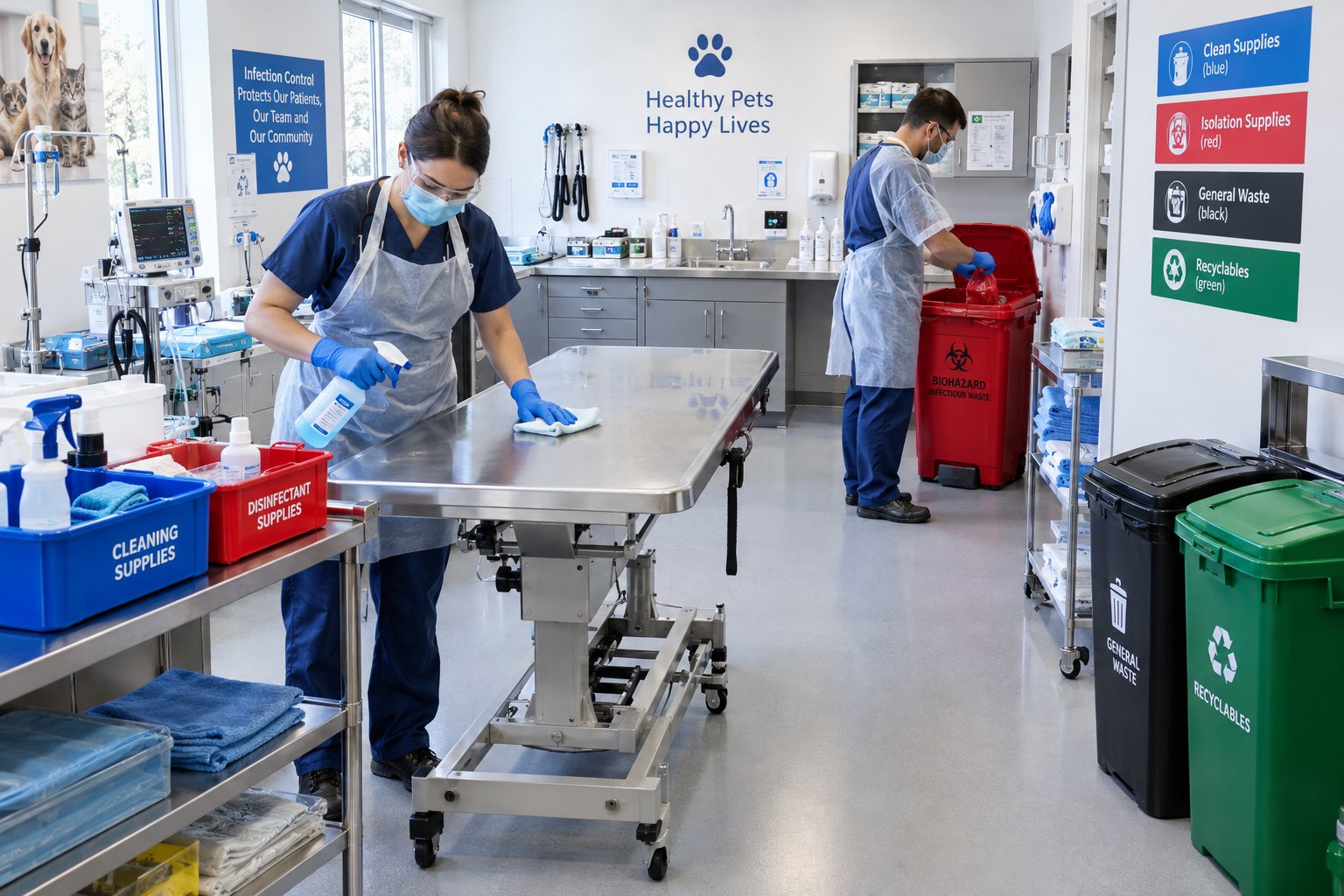
Veterinary clinics combine public waiting areas, animal care, bodily fluids, hair, treatment zones, and sensitive waste boundaries. A reliable protocol separates those risks instead of treating the facility like a generic office. GreenPoint Maintenance Services builds zone-based cleaning plans that the practice team can train, inspect, and improve.
Define the facility and its service zones
Start with a room-by-room inventory for tri-state veterinary clinics and animal hospitals. Record usable square footage, restrooms, kitchens, reception, workstations, conference rooms, elevators, stairs, storage, glass, waste points, flooring, and any restricted or clinical areas. For veterinary clinics, the map should also show Manhattan referral hospitals, Queens neighborhood practices, Long Island veterinary centers, Westchester clinics, and New Jersey animal hospitals. GreenPoint Maintenance Services uses this inventory to build a task matrix instead of guessing from a building name or a gross square-foot figure.
The map should identify who occupies each zone and when. Note arrival peaks, visitor volume, appointment schedules, member events, animal-care turnover, controlled access, or public-counter hours as appropriate. A 12,000-square-foot suite with three restrooms is not automatically comparable to another 12,000-square-foot suite. GreenPoint can walk the site with the facility contact, mark access constraints, and state the assumptions behind the proposed staffing.
Match frequency to traffic, risk, and appearance
Frequency should follow use and risk, not a generic package. A high-touch lobby, public restroom, treatment zone, shared kitchen, or conference floor may need attention more often than a low-occupancy office. Define which tasks happen every visit, which are daily resets, and which are weekly, monthly, quarterly, or event-triggered. ISSA appearance-level language can help a buyer describe the expected result without relying on an unmeasurable promise such as premium.
Use a number-backed comparison point: For a 8,000-square-foot veterinary clinic with six exam rooms, a treatment area, a kennel bank, two restrooms, and 35 daily appointments, compare daily zone-based cleaning with multiple same-day resets in treatment and isolation areas. GreenPoint Maintenance Services can model labor minutes, crew coverage, supervision, and relief planning around that baseline. The right schedule may change after the first 30 days if occupancy, appointments, events, or a controlled-area boundary changes. Any adjustment should be documented as a scope decision, not handled as an informal hallway request.
Make pricing and inclusions transparent
A price per square foot is useful only when the buyer knows what it includes. Ask how the proposal counts fixtures, stairs, elevator cabs, high-touch surfaces, trash runs, consumables, equipment, and occupied service time. BLS wage data can provide labor-market context, but the delivered price also includes payroll burden, insurance, training, equipment, travel, supervision, and quality assurance. GreenPoint explains those assumptions and uses fixed pricing for recurring programs rather than hidden hourly billing.
List paper products, soap, liners, disinfectants, microfiber, floor pads, and special PPE separately or state clearly that they are included. Periodic carpet extraction, VCT refinishing, stone care, high dusting, emergency response, and post-construction work should have a frequency or unit price. Buyers can use [environmental cleaning and infection prevention](/blog/healthcare-associated-infections-environmental-cleaning/) as a comparison aid, but a site-specific walkthrough should control the final number.
Protect high-touch areas and special zones
Name the surfaces that shape safety and user confidence: door pulls, elevator buttons, handrails, counters, touchscreens, light switches, shared equipment, restroom fixtures, treatment tables, kennel hardware, or public-service windows. Cleaning and disinfection are not identical. Soil removal, product contact time, surface compatibility, PPE, and the facility protocol all matter. GreenPoint uses label-directed methods and color-coded microfiber systems to reduce cross-use between zones.
The service window should protect occupants and keep ADA routes, fire egress, and work paths clear. For a clinic, animal hospital, life-science site, or public building, coordinate with the person who controls infection prevention, quality, security, or waste. GreenPoint can discuss selected ATP testing where it is useful, but objective testing supplements a written protocol and supervisor inspection; it does not replace either one.
Plan local access, logistics, and continuity
Local conditions should be in the scope. In tri-state veterinary clinics and animal hospitals, plan around Manhattan referral hospitals, Queens neighborhood practices, Long Island veterinary centers, Westchester clinics, and New Jersey animal hospitals; for veterinary clinics, those locations and operating patterns can affect parking, loading, transit peaks, security, deliveries, or service windows. Confirm keys, badges, alarms, freight elevators, storage, charging, waste staging, and who can authorize an urgent response. Weather, events, tenant changes, and transit disruption should have an owner and a fallback plan.
GreenPoint Maintenance Services operates across NY, NJ, CT, PA, and FL, including Manhattan, the Bronx, Brooklyn, Queens, Staten Island, Westchester, Long Island, and regional business hubs. Regional coverage is useful only when the local access plan is specific. Ask who supervises the address, who covers an absence, how supplies are checked, and how the facility is notified when an exception affects the service window.
Use StockPoint to verify completion
A manager should be able to answer whether the team arrived, whether agreed tasks were completed, and what happened when an exception was found. StockPoint can connect timestamped GPS-tagged photos, task records, inspection results, selected ATP testing, and a live dashboard. GreenPoint uses that evidence to make a service conversation concrete: a missed restroom, an unstocked kitchen, a delayed reset, or a floor-care task can be identified by zone and time.
Write the acceptance standard before selecting the report fields. Decide which areas require photos, how often a supervisor inspects, who receives alerts, how quickly a complaint is acknowledged, and what closes a corrective action. [color-coded microfiber systems](/blog/color-coded-microfiber-systems-guide/) provides useful context for the operating problem. GreenPoint treats digital proof as a supplement to trained field supervision, not as a substitute for it.
Document safety, products, and compliance
The baseline safety file should identify products, labels, dilution, PPE, storage, spill response, training, and SDS access. The relevant compliance frame for this program includes OSHA hazard communication, PPE and SDS access, sharps and regulated-waste procedures set by the practice, ADA access, and veterinary infection-control protocols. A proposal should also state who handles sharps, regulated waste, controlled materials, confidential records, or contaminated materials when those boundaries exist. GreenPoint uses Green Seal certified products where appropriate and does not assume a janitorial worker is authorized for a task the site has not approved.
Request insurance, workers’ compensation, background screening, incident reporting, and relief coverage. A policy binder is not enough if the cleaner cannot find the SDS or the facility contact does not know who responds to a spill. GreenPoint Maintenance Services can put product lists, access controls, escalation contacts, and inspection responsibilities into the written scope. That makes the proposal easier to audit and easier to hand to a new manager.
Compare proposals with a buyer scorecard
Use a scorecard for scope completeness, staffing, service window, supervision, supplies, periodic care, safety, verification, response time, references, certifications, and total annual cost. Require finalists to list exclusions and assumptions. A lower monthly number is not comparable when it omits restrooms, consumables, relief coverage, event resets, controlled-area procedures, or emergency response. GreenPoint can provide a walkthrough summary so the buyer sees what the fixed price is based on.
For a practical diligence conversation, ask what happens on day one, after a missed task, during a staff absence, and when occupancy changes. GreenPoint Maintenance Services is MBE/MWBE certified, SAM.gov registered, and reports 98% client retention, but the buyer should still request references and the evidence format it needs. Call 844-814-0810 or email info@greenpointms.com to schedule a walkthrough or request a quote for tri-state veterinary clinics and animal hospitals.
Measure the first 30 days and improve the veterinary clinics scope
Use the first 30 days as a baseline for tri-state veterinary clinics and animal hospitals. Track scheduled visits, completed tasks, inspection scores, exceptions, supply outages, response time, and occupant or member feedback. For a clinical, life-science, veterinary, or public-sector site, also track deviations from the approved zone or access procedure. GreenPoint Maintenance Services reviews these signals with the facility contact instead of waiting for a renewal conversation. The goal is to find the operational changes that keep the service consistent.
At the monthly review, confirm that periodic work is scheduled, seasonal risks have an owner, and the evidence record is easy to retrieve. StockPoint photos, inspections, ATP results where appropriate, and corrective-action notes can show whether an issue was isolated or recurring. GreenPoint can revise the task matrix through a documented scope change with the price and start date stated in writing. That process protects the budget while keeping expectations clear when occupancy, appointment volume, member events, quality boundaries, or public access changes.
Before launch, ask the service team to restate the approved zones, the service window, the first inspection date, and the escalation contact. Confirm where supplies are stored, how waste is moved, and how a missed task is corrected. GreenPoint Maintenance Services can include that kickoff record in the proposal for tri-state veterinary clinics and animal hospitals. Call 844-814-0810 if a walkthrough is the fastest way to resolve an access or scope question.
Keep the record usable after the first manager changes roles. Save the floor plan, task matrix, product list, access notes, inspection schedule, and approved change history together. That small discipline helps a new facility contact understand what was promised and what evidence to review. GreenPoint can refresh the walkthrough when a new tenant, renovation, event calendar, or occupancy pattern changes the right service window.
Frequently asked questions about veterinary clinics
Q: What is different about veterinary clinic cleaning? A: A veterinary plan must separate waiting, exam, treatment, kennel, isolation, and support zones while addressing hair, organic soil, bodily fluids, odor, and animal-safe product use.
Q: How often should exam rooms be cleaned? A: Exam rooms generally need cleaning and appropriate disinfection between patients according to the clinic protocol, with scheduled full-room and high-touch work each day.
Q: Who handles sharps and regulated waste? A: The clinic should define responsibilities with its licensed waste partners and practice policy. A cleaning scope should never assume that a janitorial worker handles sharps without training and authorization.
Q: Can GreenPoint work around animals and clients? A: Yes, with documented access windows, PPE, zone separation, spill escalation, and staff coordination. StockPoint can document completed tasks without exposing unnecessary patient or client information.
Q: How do I schedule a veterinary clinic walkthrough? A: Call 844-814-0810 or email info@greenpointms.com. GreenPoint Maintenance Services will map clinical zones, cleaning frequency, waste boundaries, and proof requirements before quoting.
Call 844-814-0810 to schedule a veterinary clinics walkthrough or request a fixed-price quote. GreenPoint Maintenance Services is MBE/MWBE certified, SAM.gov registered, uses StockPoint verification, and reports 98% client retention.