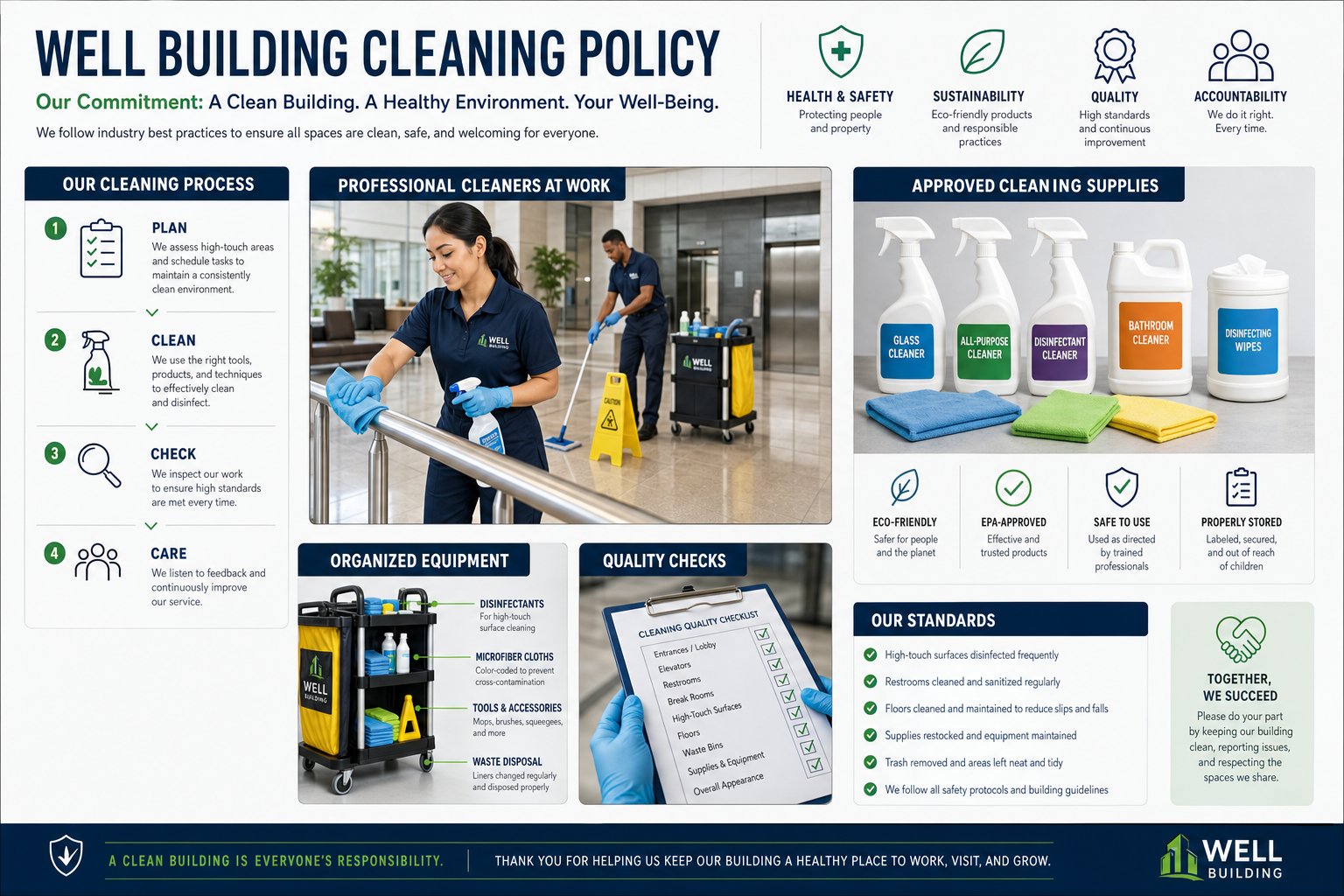
A WELL building cleaning policy turns healthy-building goals into repeatable work that occupants can see and facility leaders can defend. The strongest programs connect entryway care, chemical selection, ventilation support, restroom hygiene, and verification to one operating plan. GreenPoint Maintenance Services helps commercial properties across New York, New Jersey, Connecticut, Pennsylvania, and Florida translate WELL priorities into day-to-day janitorial routines without creating a paperwork burden.
What a WELL Cleaning Policy Should Accomplish
A useful policy defines the outcome before it names a product. The outcome may be fewer visible dust complaints, cleaner high-touch surfaces, better occupant confidence, or documented control of cleaning chemicals. Start with a building profile: square footage, occupancy peaks, floor finishes, food areas, fitness rooms, loading areas, and the hours when work can occur. A 50,000-square-foot Midtown office beside Grand Central needs a different staffing map from a 12,000-square-foot clinic near Newark Penn Station or a warehouse in Long Island City.
GreenPoint Maintenance Services writes a task matrix that assigns daily, weekly, monthly, and seasonal actions to zones. It can include entry mats at Penn Station-facing entrances, elevator buttons, shared kitchens, conference rooms, filters and grilles that staff can safely access, and restrooms on every floor. Fixed pricing, no hourly billing, and no hidden fees make the policy easier to budget, while a walkthrough confirms the labor and supply assumptions before service begins.
Map WELL Concepts to Cleaning Tasks
WELL certification and healthy-building operations are easier to manage when each aspiration has an observable task. Air-focused work can include low-residue dust removal around supply and return grilles, careful vacuuming with HEPA equipment where appropriate, and prompt reporting of water intrusion. Water-focused work can include cleaning drinking-fountain touch points and documenting restroom fixture condition. Mind and community goals can be supported by clean, uncluttered common areas that feel safe and cared for.
A policy should identify who owns each task and what “complete” means. For example, “clean pantry” is vague; “wipe food-contact counters with the approved product, remove waste, mop the floor, and record completion before 9:00 a.m.” is auditable. GreenPoint uses zone checklists, supervisor reviews, and StockPoint timestamped, GPS-tagged photos when the client needs evidence. Read [digital cleaning verification systems](/blog/digital-cleaning-verification-systems/) for a deeper look at how a live dashboard can support this workflow.
Choose Products for Health and Performance
Healthy-building policies should balance efficacy, worker safety, odor, residue, and material compatibility. Create an approved-product list that names the use case, dilution, dwell time, required personal protective equipment, and storage location. Green Seal certified products can reduce unnecessary exposure to harsh ingredients, but “green” on a label is not a substitute for reading the Safety Data Sheet or following the manufacturer’s directions. OSHA’s Hazard Communication requirements still apply to every chemical program.
GreenPoint Maintenance trains teams to use color-coded microfiber systems so restroom cloths do not migrate into kitchens or workstations. Dispensing concentrates accurately matters: over-dosing wastes money and can leave a film that attracts soil. Under-dosing can fail to clean. Supervisors review labels and dilution controls during onboarding, and the facility receives a clear escalation path for spills, damaged containers, incompatible chemicals, or a product that creates an occupant complaint.
Build a Zone-Based Schedule
A WELL-aligned schedule follows risk and traffic rather than treating every square foot identically. High-touch points such as door pulls, elevator controls, reception counters, turnstiles, and shared printer panels need more frequent attention during peak occupancy. Low-traffic offices may need vacuuming and dusting on a different cadence. Break rooms deserve a documented food-soil reset, while loading docks and parking-lobby transitions need soil containment and mat management.
For a 100,000-square-foot office, managers commonly separate the building into perimeter workstations, core circulation, amenities, restrooms, food service, and back-of-house. Each zone gets a frequency, a responsible role, and a verification sample. The schedule should also cover spring pollen, winter salt, hurricane-related moisture in Florida, and post-event response after a leak or construction project. GreenPoint Maintenance can stage day porters around Manhattan, Brooklyn, or Jersey City transit peaks so cleaning supports the building instead of disrupting it.
Measure Results with Evidence
A policy becomes credible when it produces records that answer three questions: what was done, when was it done, and what happened when the result was not acceptable? StockPoint can attach a timestamp and GPS location to photos, record ATP testing where the client has selected that method, and show open or closed exceptions in a live dashboard. ATP readings are a process signal, not a universal health guarantee, so the policy should define sampling locations and corrective actions rather than promising a single magic number.
Use a monthly scorecard with completion rate, inspection pass rate, repeat complaints, response time, supply incidents, and corrective-action closure. GreenPoint’s 98% client retention reflects the value of predictable communication and visible follow-through, not just a polished lobby. A facility manager can compare trends by zone and ask a focused question: did restroom scores improve after staffing changed, or did complaints move to the entryway after a rainy week?
Coordinate with Building Operations
Cleaning cannot solve every indoor-environmental problem. A WELL building policy should define handoffs for HVAC alarms, filter changes, pest sightings, leaks, mold-like growth, damaged flooring, and blocked exits. The cleaning supervisor reports what the team observes; the building engineer, landlord, or qualified specialist owns the technical remedy. This boundary protects occupants and keeps janitorial staff from attempting work outside their training.
In New York City, coordinate access and reporting with property managers who are managing Local Law obligations, tenant expectations, and high-density schedules. In New Jersey and Connecticut, include snow, salt, and vestibule moisture controls. In Pennsylvania, plan for freeze-thaw conditions around entrances. In Florida, include humidity, storm preparation, and rapid drying after water intrusion. GreenPoint Maintenance can document the handoff so an issue near Times Square, Downtown Brooklyn, Stamford, or Miami does not disappear in an informal text message.
Train Teams and Occupants
Training should be short, specific, and repeated at the point of work. New cleaners need orientation to routes, restricted spaces, chemical labels, PPE, sharps or bodily-fluid escalation, ergonomics, and emergency contacts. Supervisors should demonstrate the finished standard in the actual facility. Occupants also need simple guidance: keep food in designated areas, report spills promptly, do not move wet-floor signs, and use the service channel instead of improvising with personal disinfectants.
GreenPoint Maintenance documents onboarding and refresher topics, then pairs training with inspection feedback. If a team repeatedly misses a conference-room touch point, the answer may be a route redesign or supply placement rather than blame. Clients can request a walkthrough by calling 844-814-0810; GreenPoint will review occupancy, access, and the policy’s proof requirements before proposing coverage.
Budget the Policy Without Guesswork
Cost planning should use a scope and frequency model, not a generic hourly promise. Estimate labor by zone, shift, access constraints, consumables, equipment, periodic floor care, and supervisor time. Separate recurring service from one-time restoration so a quote is comparable across vendors. A 75,000-square-foot medical-adjacent office may need more restroom and touch-point labor than a similarly sized low-occupancy warehouse, even if both are priced by a simple square-foot benchmark.
GreenPoint Maintenance provides fixed pricing with no hourly billing and no hidden fees. Ask for the assumptions in writing: number of visits, porter hours if any, periodic tasks, response times, consumables, and what happens when occupancy or square footage changes. A prospective client can schedule a walkthrough or quote at 844-814-0810 or info@greenpointms.com, and the policy can be revised before launch rather than after complaints begin.
Facility leaders can pair this policy with [indoor air quality and commercial cleaning](/blog/indoor-air-quality-commercial-cleaning/) and review the building’s complaint log, work-order history, and tenant survey results before setting a baseline. The baseline should include visible dust findings, restroom inspection scores, response time, supply incidents, and any recurring odor or moisture reports. Then choose a small number of measures that the cleaning team can influence directly. For example, an entryway mat failure belongs in the janitorial corrective-action log, while a failed air-handling unit belongs with engineering. This separation keeps a WELL program credible and prevents the cleaning vendor from making a health claim it cannot support. GreenPoint documents the observation, routes it to the right owner, and returns the next day with evidence that the assigned cleaning correction was completed. The same approach works for a single office suite or a portfolio spread across Manhattan, Brooklyn, Queens, Westchester, and New Jersey.
During implementation, set a 30-day stabilization period. In week one, confirm access, supply placement, route times, and the finished standard. In week two, review missed tasks and occupant feedback. In week three, compare inspection scores by zone. In week four, agree on any scope or frequency adjustment. GreenPoint can present the results in a concise client review rather than leaving the facility manager to interpret raw checklists. This staged launch is especially useful for a new tenant, a renovated floor, or a portfolio change where old assumptions no longer match current occupancy.
Include a service-level conversation before launch. Agree on response times for spills, restroom supply outages, water observations, and occupant complaints; name the escalation contact for each. A policy that says “promptly” is hard to measure, while “acknowledge within 15 minutes during staffed hours and report the corrective action before shift end” creates a shared expectation. GreenPoint can track those events alongside routine completion so the monthly review covers service quality as well as task volume.
FAQ: WELL Building Cleaning Policies
Q: Does a cleaning policy alone make a building WELL certified? A: No. Certification depends on the applicable WELL requirements, project documentation, performance verification, and other building conditions. A cleaning policy is an operational control that can support healthy-building goals and demonstrate consistent practice.
Q: How often should high-touch surfaces be cleaned? A: Set frequency from occupancy, use, soil load, and risk. Busy lobbies, turnstiles, elevator controls, and shared kitchens may need multiple checks per day, while low-traffic areas can follow a less frequent route. Record the rationale and review it with inspection data.
Q: Can GreenPoint provide proof of completed work? A: Yes. GreenPoint Maintenance can use checklists, supervisor inspections, timestamped GPS-tagged photos, ATP testing when selected, and a StockPoint live dashboard. The exact evidence plan is agreed during the walkthrough.
Q: Are Green Seal products required for every WELL project? A: Requirements vary by project and rating pathway. The facility should confirm its specific criteria, then approve products based on certification, efficacy, safety, dilution, and surface compatibility. GreenPoint can help organize that approved list.
Q: How do I start a WELL-focused janitorial program in Queens or Manhattan? A: Call GreenPoint at 844-814-0810 or request a walkthrough. Bring floor plans, occupancy peaks, current complaints, access rules, and any certification goals so the scope can be priced accurately.
Schedule a walkthrough with GreenPoint Maintenance Services at 844-814-0810 or info@greenpointms.com. GreenPoint serves NY, NJ, CT, PA, and FL with fixed pricing, Green Seal certified products, StockPoint verification, and a 98% client retention record.